FSU computer scientists ensure that ocean modeling codes can take full advantage of the latest supercomputing architecture

Realistic ocean models require significant computing power, especially as resolution increases from scales of tens of kilometers to a single kilometer. These models are used for short-term and seasonal weather predictions, as well as in long-term climate simulations, all of which are used routinely for decision making. The better the resolution, the better potential dangers can be understood and mitigated, resulting in a better situation for all… right? 

That's the question Eric P. Chassignet and XU Xiaobiao from Florida State University's Center for Ocean-Atmospheric Prediction Studies asked in a review study published on July 31 in Advances in Atmospheric Sciences

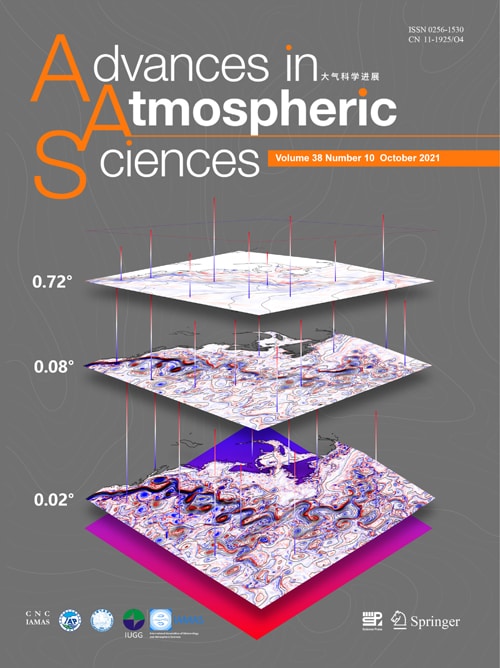
"Increasing the resolution allows you to resolve more and more small-scale ocean features, and the question that then arises is whether there is the corresponding improvement in the overall representation of the ocean circulation and at what cost," said Chassignet, who leads the center. "In other words, what are the optimal ratio of resolution and computational resources that truly leads to a better understanding of ocean physics and the Earth's climate?" Modeled surface relative vorticity in the Gulf Stream region depicting the flow rotation and shear as a function of horizontal grid spacing (~50, 6, and 2 km, respectively). (Image by Advances in Atmospheric Sciences)

Coarse-resolution models, with a horizontal resolution on the order of 100 kilometers, are mostly used for climate applications and the ocean currents in this class of models tend to be broad and steady. When the model's resolution is increased to approximately 10 kilometers, the currents become unstable, forming swirling ocean mesoscale eddies, somewhat like storms in the atmosphere. Just like storms, they have an impact on other components of the earth system. 

However, resolving the mesoscale eddies is not enough to accurately model the ocean circulation, according to Chassignet. His team determined that increasing resolution to approximately a kilometer, which makes the model able to simulate smaller, sub-mesoscale eddies, shifted their model of the Gulf Stream to a realistic rendition that more closely resembled actual observations. 

"We argue that resolving sub-mesoscale features is as significant a regime shift as resolving the mesoscale eddies," Chassignet said. 

Yet the resolution comes at a price and with a concern, since each time the model's resolution is increased by a factor of two, it requires increasing computational power by a factor of 10. According to Chassignet, more work is needed to better understand whether increasing resolution improves the overall representation of ocean water masses.

"The next step is to have routine, sub-mesoscale-resolving global ocean models so we can fully assess their ability to model the ocean and quantify their impact in climate models," Chassignet said, noting that close collaborations with computer scientists are essential to ensure computer systems that can more efficiently handle the modeling needs for Earth systems. 

The Chinese Academy of Sciences President's International Fellowship Initiative supported this work in part. 

Keck Observatory astronomers probe layer-cake structure of brown dwarf’s atmosphere

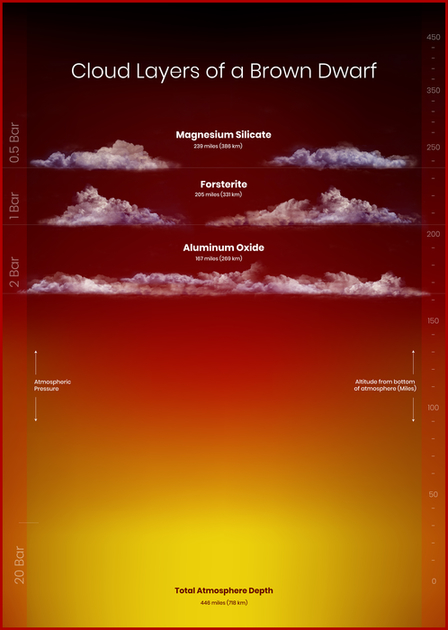
Jupiter may be the bully planet of our solar system because it’s the most massive planet, but it’s actually a runt compared to many of the giant planets found around other stars. This graphic shows successive layers of clouds in the atmosphere of a nearby, free-floating brown dwarf. Breaks in the upper cloud layers allowed astronomers to probe deeper into the atmosphere of the brown dwarf called 2MASS J22081363+2921215. Brown dwarfs are more massive than planets but too small to sustain nuclear fusion, which powers stars. This illustration is based on infrared observations of the clouds' colors and brightness variations, as well as the spectral fingerprints of various chemical elements contained in the clouds and atmospheric modeling.  CREDIT NASA, ESA, STScI, Andi James (STScI)
These alien worlds, called super-Jupiters, weigh up to 13 times Jupiter’s mass. Astronomers have analyzed the composition of some of these monsters, but it has been difficult to study their atmospheres in detail because these gas giants get lost in the glare of their parent stars.

Researchers, however, have a substitute: the atmospheres of brown dwarfs, so-called failed stars that are up to 80 times Jupiter’s mass. These hefty objects form out of a collapsing cloud of gas, as stars do, but lack the mass to become hot enough to sustain nuclear fusion in their cores, which powers stars.

Instead, brown dwarfs share a kinship with super-Jupiters. Both types of objects have similar temperatures and are extremely massive. They also have complex, varied atmospheres. The only difference, astronomers think, is their pedigree. Super-Jupiters form around stars; brown dwarfs often form in isolation.

A team of astronomers, led by Elena Manjavacas of the Space Telescope Science Institute in Baltimore, Maryland, has tested a new way to peer through the cloud layers of these nomadic objects. The researchers used an instrument at W. M. Keck Observatory on Maunakea in Hawaiʻi to study in near-infrared light the colors and brightness variations of the layer-cake cloud structure in the nearby, free-floating brown dwarf known as 2MASS J22081363+2921215.

The Keck Observatory instrument, called the Multi-Object Spectrograph for Infrared Exploration (MOSFIRE), also analyzed the spectral fingerprints of various chemical elements contained in the clouds and how they change with time. This is the first time astronomers have used MOSFIRE in this type of study.

These measurements offered Manjavacas a holistic view of the brown dwarf’s atmospheric clouds, providing more detail than previous observations of this object. Pioneered by Hubble observations, this technique is difficult for ground-based telescopes to do because of contamination from Earth’s atmosphere, which absorbs certain infrared wavelengths. This absorption rate changes due to the weather.

"The only way to do this from the ground is by using Keck’s high-resolution MOSFIRE instrument because it allows us to observe multiple stars simultaneously with our brown dwarf,” said Manjavacas, a former staff astronomer at Keck Observatory and the lead author of the study. “This allows us to correct for the contamination introduced by the Earth’s atmosphere and measure the true signal from the brown dwarf with good precision. So, these observations are a proof-of-concept that MOSFIRE can do these types of studies of brown dwarf atmospheres.”

She decided to study this particular brown dwarf because it is very young and therefore extremely bright. It has not cooled off yet. Its mass and temperature are similar to those of the nearby giant exoplanet Beta Pictoris b, discovered in 2008 near-infrared images taken by the European Southern Observatory’s Very Large Telescope in northern Chile.

“We don’t have the ability yet with current technology to analyze in detail the atmosphere of Beta Pictoris b,” Manjavacas said. “So, we’re using our study of this brown dwarf’s atmosphere as a proxy to get an idea of what the exoplanet’s clouds might look like at different heights of its atmosphere.”

Both the brown dwarf and Beta Pictoris b are young, so they radiate heat strongly in the near-infrared. They are both members of a flock of stars and sub-stellar objects called the Beta Pictoris moving group, which shares the same origin and a common motion through space. The group, which is about 33 million years old, is the closest grouping of young stars to Earth. It is located roughly 115 light-years away.

While they're cooler than bona fide stars, brown dwarfs are still extremely hot. The brown dwarf in Manjavacas’ study is a sizzling 2,780 degrees Fahrenheit (1,527 degrees Celsius). Artist’s concept of 2MASS J22081363+2921215, a nearby brown dwarf. Though only roughly 115 light-years away, the brown dwarf is too distant for any atmospheric features to be photographed. Instead, researchers used W. M. Keck Observatory’s MOSFIRE instrument to study the colors and brightness variations of the brown dwarf’s layer-cake cloud structure, as seen in near-infrared light. MOSFIRE also collected the spectral fingerprints of various chemical elements contained in the clouds and how they change over time.  CREDIT NASA, ESA, STScI, Leah Hustak (STScI), Greg T. Bacon (STScI)
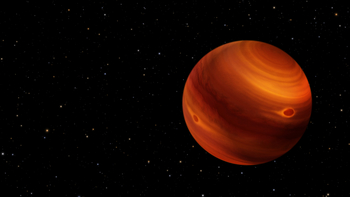
The giant object is about 12 times heavier than Jupiter. As a young body, it is spinning incredibly fast, completing a rotation every 3.5 hours, compared to Jupiter’s 10-hour rotation period. So, clouds are whipping around the planet, creating a dynamic, turbulent atmosphere.

Keck Observatory’s MOSFIRE instrument stared at the brown dwarf for 2.5 hours, watching how the light filtering up through the atmosphere from the dwarf’s hot interior brightens and dims over time. Bright spots that appeared on the rotating object indicate regions where researchers can see deeper into the atmosphere, where it is hotter. Infrared wavelengths allow astronomers to peer deeper into the atmosphere. The observations suggest the brown dwarf has a mottled atmosphere with scattered clouds. If viewed close-up, the planet might resemble a carved Halloween pumpkin, with light escaping from the hot interior.

Its spectrum reveals clouds of hot sand grains and other exotic elements. Potassium iodide traces the object’s upper atmosphere, which also includes magnesium silicate clouds. Moving down in the atmosphere is a layer of sodium iodide and magnesium silicate clouds. The final layer consists of aluminum oxide clouds. The atmosphere’s total depth is 446 miles (718 kilometers). The elements detected represent a typical part of the composition of brown dwarf atmospheres, Manjavacas said.

She and her team used supercomputer models of brown dwarf atmospheres to determine the location of the chemical compounds in each cloud layer.

The study will be published in The Astronomical Journal and is available in pre-print format on arXiv.org

Manjavacas’ plan is to use Keck Observatory’s MOSFIRE to study other atmospheres of brown dwarfs and compare them to those of gas giants. Future telescopes such as NASA’s James Webb Space Telescope, an infrared observatory scheduled to launch later this year, will provide even more information about a brown dwarf’s atmosphere.

“JWST will give us the structure of the entire atmosphere, providing more coverage than any other telescope,” Manjavacas said.

She hopes that MOSFIRE can be used in tandem with JWST to sample a wide range of brown dwarfs and gain a better understanding of brown dwarfs and giant planets.

“Exoplanets are so much more diverse than what we see locally in the solar system,” said Keck Observatory Chief Scientist John O’Meara. “It’s work like this, and future work with Keck and JWST, that will give us a fuller picture of the diversity of planets orbiting other stars.”


UK Met Office, China research climate models that predict rainfall becomes increasingly variable as the climate warms

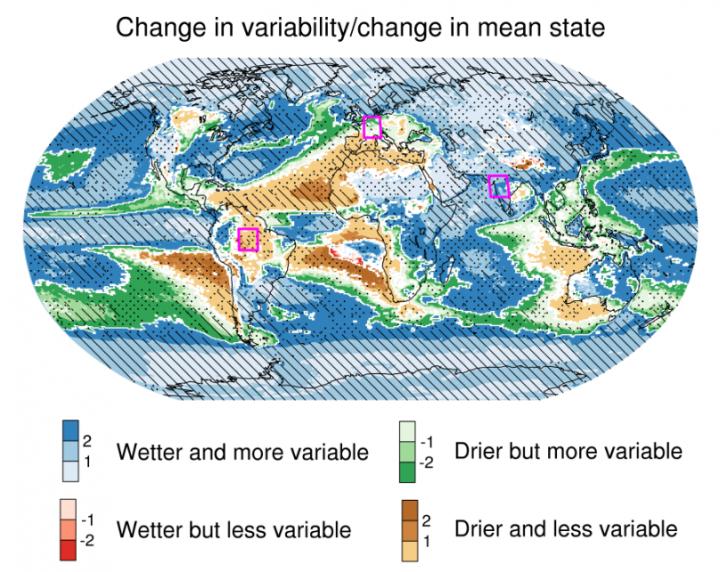
Climate models predict that rainfall variability over wet regions globally will be greatly enhanced by global warming, causing wide swings between dry and wet conditions, according to a joint study by the Institute of Atmospheric Physics (IAP) of the Chinese Academy of Sciences (CAS) and the Met Office, the UK's national meteorological service. Classification of precipitation change regimes based on changes in the precipitation mean state and variability. Shading indicates the ratio of change in precipitation variability and mean precipitation.

Rainfall plays an important part in our daily life. More leads to floods, less to drought. It has been realized decades earlier that global warming drives increased rainfall on average. How this increase is delivered in time matters enormously. A 2-3% increase of annual precipitation uniformly spreading out of the year does not mean much, but if it falls out in a week or a day, it will cause havoc.

Using large ensembles of state-of-the-art climate model simulations produced from supercomputers, this study highlights the increase in rainfall variability across a range of time scales from daily to multiyear. Scientists have found that in a future warming world, climatologically wet regions (including the tropics, monsoon regions, and mid-to high-latitudes) will not only get wetter on average but also swing widely between wet and dry conditions.

"As the climate warms, climatologically wet regions will generally get wetter and dry regions to get drier. Such a global pattern of mean rainfall change is often described as 'wet-get-wetter'. By analogy, the global pattern of rainfall variability change features a 'wet-get-more variable' paradigm. Moreover, the global mean increase in rainfall variability is more than twice as fast as the increase in mean rainfall in a percentage sense," said ZHOU Tianjun, corresponding author of the study. ZHOU is a senior scientist at IAP. He is also a professor at the University of Chinese Academy of Sciences.

The enhanced rainfall variability, to a first-order, is due to increased water vapor in the air as the climate warms; but is partly offset by the weakening circulation variability. The latter dominates regional patterns of change in rainfall variability.

By considering changes in both the mean state and variability of precipitation, the research provides a new perspective for interpreting future precipitation change regimes. "Around two-thirds of land will face a 'wetter and more variable' hydroclimate, while the remaining land regions are projected to become 'drier but more variable' or 'drier and less variable'. This classification of different precipitation change regimes is valuable for regional adaptation planning," said ZHANG Wenxia, lead author of the study.

"The globally amplified rainfall variability manifests the fact that global warming is making our climate more uneven—more extreme in both wet and dry conditions, with wider and probably more rapid transitions between them," said Kalli Furtado, Expert Scientist at the Met Office and second author of the study. "The more variable rainfall events could further translate into impacts on crop yields and river flows, challenging the existing climate resilience of infrastructures, human society, and ecosystems. This makes climate change adaptation more difficult."

This study was published in Science Advances on July 28th, 2021.