St. Jude Children's Research Hospital study highlights the power of comprehensive whole-genome, whole-exome, RNA sequencing to better treat each patient's cancer

St. Jude Children's Research Hospital investigators have demonstrated that comprehensive genomic sequencing of all pediatric cancer patients is feasible and essential to capitalize on the lifesaving potential of precision medicine. Results from the St. Jude Genomes for Kids study appear online today in the journal Cancer DiscoveryCo-corresponding authors Jinghui Zhang, Ph.D., St. Jude Department of Computational Biology chair, demonstrated that comprehensive genomic sequencing of all pediatric cancer patients is feasible and essential to capitalize on the lifesaving potential of precision medicine.

Whole-genome and whole-exome sequencing of germline DNA were offered to all 309 patients who enrolled in the study. Whole-genome, whole-exome, and RNA sequencing of tumor DNA were carried out for the 253 patients for whom adequate tumor samples were available.

Overall, 86% of patients had at least one clinically significant variation in tumor or germline DNA. Those included variants related to diagnosis, prognosis, therapy, or cancer predisposition. Researchers estimated that 1 in 5 patients had clinically relevant mutations that would have gone undetected using standard sequencing methods.

"Some of the most clinically relevant findings were only possible because the study combined whole-genome sequencing with whole-exome and RNA sequencing," said Jinghui Zhang, Ph.D., St. Jude Department of Computational Biology chair and co-corresponding author of the study.

Every tumor is unique. Every patient is unique.

Comprehensive clinical sequencing that includes whole-genome, whole-exome, and RNA sequencing is not widely available. But as the technology becomes less expensive and accessible to more patients, researchers said comprehensive sequencing will become an important addition to pediatric cancer care.

"We want to change the thinking in the field," said David Wheeler, Ph.D., St. Jude Precision Genomics team director, and a co-author of the study. "We showed the potential to use genomic data at the patient level. Even in common pediatric cancers, every tumor is unique, every patient is unique.

"This study showed the feasibility of identifying tumor vulnerabilities and learning to exploit them to improve patient care," he said.

Tumor sequencing guided the change in treatment for 12 of the 78 study patients for whom the standard of care was unsuccessful. In four of the 12 patients, the changes stabilized disease and extended patient lives. Another patient, one with acute myeloid leukemia, went into remission and was cured by blood stem cell transplantation.

"Through the comprehensive genomic testing in this study, we were able to clearly identify tumor variations that could be treated with targeted agents, opening doors for how oncologists manage their patients," said co-corresponding author Kim Nichols, M.D., St. Jude Cancer Predisposition Division director.

Additional findings and details

Genomes for Kids enrolled patients between August 2015 and March 2017.

Eighteen percent of patients carried germline variations in one of 156 known, cancer-predisposition genes.

Almost two-thirds of the germline variations identified would not have been detected based on current screening guidelines.

Next steps

Genomes for Kids helped launch the hospital's clinical genomics program, which has enrolled about 2,700 cancer patients to date.

Meanwhile, data generated through the Genomes for Kids study are available at no cost to the international research community. By sharing the data, St. Jude aims to speed advances in understanding and treatment of pediatric cancer. The data are available in St. Jude Cloud.

"Even the most treatable cancers are not curable in all patients. For example, relapse remains the leading cause of death for the most common childhood cancer, acute lymphoblastic leukemia," Nichols said. "Being able to understand and predict which patients will respond to treatment and which won't require collecting comprehensive genomic data on all patients."
New University of Houston program recruits ROTC students as future gatekeepers of cyber security

Not so long ago, a strong password felt mighty enough to keep you safe and your computer data private. But we now live amid heightened risks in malware, phishing, spearphishing, and denial-of-service attacks. Even scarier, it is possible for computer terrorists to wreak global havoc by commandeering your personal computer - yes, your own computer - without you suspecting danger until it's way too late.

Sound frightening? It can be. But in this game, the good guys have critical skills, too.

The fall 2021 CyberCops program - funded by a $250,000 grant from the U.S. Navy's Office of Naval Research and sponsored by the University of Houston with the cooperation of the University of Houston-Downtown and Texas Southern University - will introduce the critical field of cybersecurity to students recruited from the three participating universities' ROTC (Reserve Officer Training Corps) programs.

In recent headlines, accusations of cyber aggression by unfriendly foreign powers reveal how high the stakes are.

"The Department of Defense is interested in artificial intelligence and machine learning, and how those fields intersect with the needs of defense. They want students who plan on taking up careers in defense to have that kind of training and background," said Rakesh Verma, a computer science professor at the UH College of Natural Sciences and Mathematics. "Because these are ROTC students, the expectation is they will enter into a D.O.D. agency. But there are a lot of opportunities in the private sector, too, for people coming out with cybersecurity backgrounds."

In the CyberCops program, students will study how to protect data, networks, and computers as they also learn another critical lesson: Always stay a step ahead.

"The students will gain expertise in the intersection of a number of fields, including data science, machine learning, and cybersecurity. They will have a semester of classroom training then spend about 10 weeks in my lab on the University of Houston main campus. There, they will study models on statistics, machine learning, natural language processing, and data mining," Verma said.

The term natural language processing refers to programming that "teaches" computers to understand not only the digital language of computers but also written and spoken words in various languages - English, Chinese, Russian, and others.

Just how bad are the hackers, terrorists, and just plain thieves who troll the internet? Don't underestimate them, Verma warns.

As an individual, you may be at risk of:

  • Ransom demands - Your data is locked. "Your computer's been hacked, and all the data encrypted. Then you might receive a demand to pay a certain number of bitcoins to get it back," Verma said.
  • Thieves - Your identity is stolen. "These are criminals whose goal is to make a lot of money quickly," Verma said. With special software, they enter the dark web where each set of stolen credit card information sells for about $5, a Social Security number for around $10.
  • Zombies - And we're totally serious here. In cybersecurity circles, a zombie is a computer that's under the control of an attacker. If a cyber-terrorist commandeers your computer, all you can do is watch your screen helplessly while someone - on the other side of the world or maybe next door - swiftly moves through the internet with your identity, perhaps with the aim of infiltrating a commercial or government network or conducting a denial-of-service attack

Risks are greater for government agencies and businesses. In early July, Microsoft announced the discovery of the PrintNightmare hack and urged all Windows users to immediately install an update. The U.S. government and its allies later said the hackers were hired by China's government or its representatives.

Two months earlier, the Colonial Pipeline ransomware attack resulted in a five-day shutdown, fuel shortages in the Eastern U.S., and a ransom of $4.4 million. Eventually, all but $2.1 million of the ransom was recovered.

Several companies have faced spearphishing, which targets one individual inside an organization. For example, by weaving in facts easily found on a company's website, attackers can craft an "urgent" email convincing enough for a trusted employee to move money.

Knowing how to fight the threat is not always easy, especially with deceptions, fake news, and social engineering specifically designed to avoid detection. "You have to put yourself in the shoes of the attacker. Think like an attacker and find the weaknesses." Verma said.

For the six gifted students recruited for the new program, an exciting future may start with CyberCops training on the UH campus. And for your own data, security may someday depend on the critical lessons they learn there.

Australian bioinformatics team uses machine learning to realize new insights into immune responses to malaria

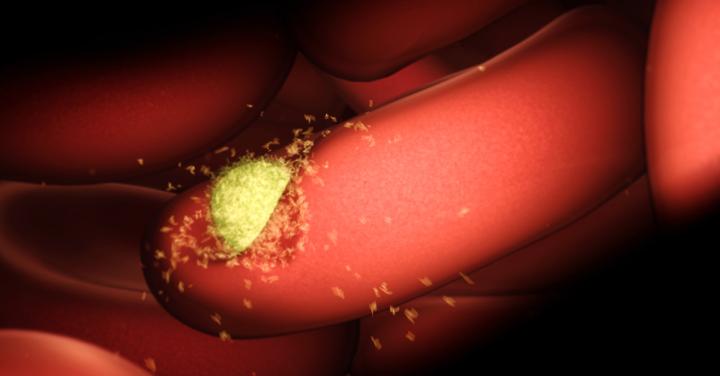
Advanced technologies have been used to solve a long-standing mystery about why some people develop serious illness when they are infected with the malaria parasite, while others carry the infection asymptomatically. Malaria invading a red blood cell, a key stage in its life cycle

An international team used mass cytometry - an in-depth way of characterizing individual cells - and machine learning to discover 'immune signatures' associated with symptomatic or asymptomatic infections in people infected with the Plasmodium vivax parasite. This uncovered an unexpected role for immune T cells in protection against malaria, a finding that could help to improve the development of much-needed malaria vaccines.

The research, which was published in the journal JCI Insight was led by WEHI's Dr. Lisa Ioannidis and Associate Professor Diana Hansen, in collaboration with Professor Ric Price from the Menzies School of Health Research, Darwin, and Dr. Rintis Noviyanti from the Eijkman Institute for Molecular Biology, Indonesia.

At a glance

  • Advanced technologies have revealed 'immune signatures' that differentiate immune responses that drive symptomatic or asymptomatic Plasmodium vivax malaria infections.
  • The international collaboration revealed a previously unrecognized role for immune CD4 T cells in preventing serious disease and controlling asymptomatic infection of low parasite burden.
  • The findings could guide the development of better vaccines against malaria, a disease that kills hundreds of thousands of people around the world each year.

Variable immune responses

Malaria is a parasitic disease impacting hundreds of millions of people each year. After infection, people develop immunity to the Plasmodium parasite that causes malaria - but this immunity only reduces the disease severity rather than preventing infection altogether. Despite the immense global impact of malaria, there are not yet vaccines in clinical use to prevent this disease.

The immune response to malaria is a double-edged sword, Associate Professor Hansen said. "While an immune response to the parasite can prevent severe disease, in some people it is an excessive immune response - driving severe inflammation - that exacerbates malaria, causing the most severe, and potentially fatal, symptoms," she said.

"Our research has investigated the longstanding question of how immune responses differ between people with symptomatic and asymptomatic malaria infections. We focussed on the Plasmodium vivax form of malaria, which is most common in Asia-Pacific and Latin America. This species is a particular challenge to control as infected people can carry it for many months in the liver without symptoms."

Using the University of Melbourne's mass cytometry facility, the research team was able to undertake in-depth, multi-dimensional assessments of the immune cells in blood samples provided by people living in a vivax malaria-endemic region of Indonesia. Dr. Ioannidis said the team compared many aspects of immunity in samples from people who were uninfected, asymptomatically infected, or symptomatically infected with P. vivax.

"In collaboration with a WEHI bioinformatics team led by Professor Gordon Smyth, we used machine learning to develop an 'immune signature' that distinguished between these three categories of samples. These signatures could be applied to new blood samples from people infected with malaria, to accurately predict the severity of their infection," Dr. Ioannidis said.

Enhancing malaria control

Dr. Ioannidis said the immune signatures revealed the key components of the immune response that drive immunity to malaria. "Antibodies produced by B cells were one important component, especially in people with high parasite loads and symptomatic disease, but we also discovered that certain types of CD4 T cells were critical to keeping infections in check, preventing symptoms," she said.

"This is the first time CD4 T cells are important for controlling asymptomatic P. vivax infections."

Associate Professor Hansen said the discovery could lead to better approaches to controlling - or even eliminating - malaria. "Malaria vaccine development has focussed almost entirely on measuring antibody responses as a marker of vaccine success. Our research has revealed the important role of CD4 T cells in controlling malaria infections - and we think these cells need much more consideration when designing malaria vaccines. Because vivax malaria can persist in asymptomatic people, vaccines must activate CD4 T cells to control these low-grade infections," Associate Professor Hansen said.