

IAA-CSIC modeling leads to discovery of a large tidal stream in the Sombrero galaxy

According to the latest cosmological models, large spiral galaxies such as the Milky Way grew by absorbing smaller galaxies, by a sort of galactic cannibalism. Evidence for this is given by very large structures, the tidal stellar streams, which are observed around them, which are the remains of these satellite galaxies. But the full histories of the majority of these cases are hard to study, because these flows of stars are very faint, and only the remains of the most recent mergers have been detected. Sombrero galaxy (M104)  CREDIT Manuel Jiménez/Giuseppe Donatiello

A study led by the Instituto de Astrofísica de Andalucía (IAA-CSIC), with the participation of the Instituto de Astrofísica de Canarias (IAC), has made detailed observations of a large tidal flow around the Sombrero galaxy, whose strange morphology has still not been definitively explained. 

The Sombrero galaxy (Messier 104) is a galaxy some thirty million light-years away, which is part of the Local Supercluster (a group of galaxies that includes the Virgo cluster and the Local Group containing the Milky Way). It has roughly one-third of the diameter of the Milky Way and shows characteristics of both of the dominant types of galaxies in the Universe, the spirals and the ellipticals. It has spiral arms, and a very large bright central bulge, which makes it look like a hybrid of the two types. 

{media id=257,layout=solo}

"Our motive for obtaining these very deep images of the Sombrero galaxy (Messier 104) was to look for the remains of its merger with a very massive galaxy. This possible collision was recently suggested based on studies of the stellar population of its strange halo obtained with the Hubble Space Telescope", says David Martínez-Delgado, a researcher at the IAA-CSIC and first author of the paper reporting the work.

The observations with the Hubble, in 2020, showed that the halo, an extensive and faint region surrounding the Sombrero galaxy, shows many stars rich in metals, elements heavier than hydrogen and helium. This is a feature typical of new generations of stars, which are normally found in the discs of galaxies and are quite unusual in galactic halos, which are populated by old stars. To explain their presence astronomers suggested what is known as "a wet merger", a scenario in which a large elliptical galaxy is rejuvenated by large quantities of gas and dust from another massive galaxy, which went into the formation of the disc which we now observe.

"In our images, we have not found any evidence to support this hypothesis, although we cannot rule out that it could have happened several thousand million years ago, and the debris is completely dissipated by now -explains David Martínez-Delgado-. In our search, we have in fact been able to trace for the first time the complete tidal stream which surrounds the disc of this galaxy, and our theoretical simulations have let us reconstruct its formation in the last three thousand million years, by cannibalism of a satellite dwarf galaxy."

"Observational techniques in present-day Astrophysics need advanced image processing. Our modeling of the bright stars around the Sombrero galaxy, and at the same time of the halo light of the galaxy itself has enabled us to unveil the nature of this tidal stream. It is remarkable that thanks to these advanced photometric techniques we have been able to do front line science with a Messier object using only an 18 cm (diameter) telescope", explains Javier Román, a postdoctoral researcher at the IAC and a co-author of the study.

The research team rejects the idea that the large stellar tidal stream, known for more than three decades, could be related to the event which produced the strange morphology of the Sombrero galaxy which, if it was caused by a wet merger, would need the interaction of two galaxies with large masses.

The work has been possible thanks to the collaboration between professional and amateur astronomers. "We have collaborated with the Spanish astrophotographer Manuel Jiménez, who took the images with a robotic telescope of 18-centimeter diameter, and the well-known Australian astrophotographer David Malin, who discovered this tidal stream on photographic plates taken in the '90s of the last century. This collaboration shows the potential of amateur telescopes to take deep images of nearby galaxies which give important clues about the process of their assembly which is continuing until the present epoch", concludes Martínez-Delgado.
FAU prof Hill first to model COVID-19 completion vs. cessation study using machine learning

To win the battle against COVID-19, studies to develop vaccines, drugs, devices, and re-purposed drugs are urgently needed. Randomized clinical trials are used to provide evidence of safety and efficacy as well as to better understand this novel and evolving virus. As of July 15, more than 6,180 COVID-19 clinical trials have been registered through ClinicalTrials.gov, the national registry and database for privately and publicly funded clinical studies conducted around the world. Knowing which ones are likely to succeed is imperative. Xingquan "Hill" Zhu, Ph.D., senior author and a professor in FAU's Department of Computer and Electrical Engineering and Computer Science.

Researchers from Florida Atlantic University's College of Engineering and Computer Science are the first to model COVID-19 completion versus cessation in clinical trials using machine learning algorithms and ensemble learning. The study, published in PLOS ONE, provides the most extensive set of features for clinical trial reports, including features to model trial administration, study information and design, eligibility, keywords, drugs, and other features.

This research shows that computational methods can deliver effective models to understand the difference between completed vs. ceased COVID-19 trials. In addition, these models also can predict COVID-19 trial status with satisfactory accuracy.

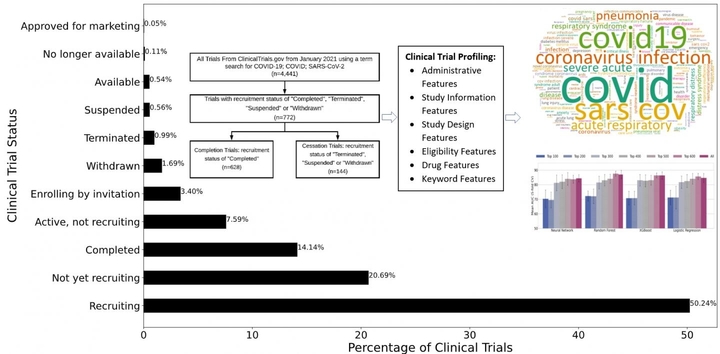
Because COVID-19 is a relatively novel disease, very few trials have been formally terminated. Therefore, for the study, researchers considered three types of trials as cessation trials: terminated, withdrawn, and suspended. These trials represent research efforts that have been stopped/halted for particular reasons and represent research efforts and resources that were not successful.

"The main purpose of our research was to predict whether a COVID-19 clinical trial will be completed or terminated, withdrawn or suspended. Clinical trials involve a great deal of resources and time including planning and recruiting human subjects," said Xingquan "Hill" Zhu, Ph.D., senior author and a professor in the Department of Computer and Electrical Engineering and Computer Science, who researched with first author Magdalyn "Maggie" Elkin, a second-year Ph.D. student in computer science who also works full-time. "If we can predict the likelihood of whether a trial might be terminated or not down the road, it will help stakeholders better plan their resources and procedures. Eventually, such computational approaches may help our society save time and sources to combat the global COVID-19 pandemic."

For the study, Zhu and Elkin collected 4,441 COVID-19 trials from ClinicalTrials.gov to build a testbed. They designed four types of features (statistics features, keyword features, drug features, and embedding features) to characterize clinical trial administration, eligibility, study information, criteria, drug types, study keywords, as well as embedding features commonly used in state-of-the-art machine learning. In total, 693-dimensional features were created to represent each clinical trial. For comparison purposes, researchers used four models: Neural Network; Random Forest; XGBoost; and Logistic Regression.

Feature selection and ranking showed that keyword features derived from the MeSH (medical subject headings) terms of the clinical trial reports, were the most informative for COVID-19 trial prediction, followed by drug features, statistics features, and embedding features. Although drug features and study keywords were the most informative features, all four types of features are essential for accurate trial prediction.

By using ensemble learning and sampling, the model used in this study achieved more than 0.87 areas under the curve (AUC) scores and more than 0.81 balanced accuracies for prediction, indicating high efficacy of using computational methods for COVID-19 clinical trial prediction. Results also showed single models with balanced accuracy as high as 70 percent and an F1-score of 50.49 percent, suggesting that modeling clinical trials is best when segregating research areas or diseases. As of July 15, more than 6,180 COVID-19 clinical trials have been registered through ClinicalTrials.gov.

"Clinical trials that have stopped for various reasons are costly and often represent a tremendous loss of resources. As future outbreaks of COVID-19 are likely even after the current pandemic has declined, it is critical to optimize efficient research efforts," said Stella Batalama, Ph.D., dean, College of Engineering and Computer Science. "Machine learning and AI-driven computational approaches have been developed for COVID-19 health care applications, and deep learning techniques have been applied to medical imaging processing to predict outbreak, track virus spread, and for COVID-19 diagnosis and treatment. The new approach developed by professors Zhu and Maggie will be helpful to design computational approaches to predict whether or not a COVID-19 clinical trial will be completed so that stakeholders can leverage the predictions to plan resources, reduce costs, and minimize the time of the clinical study."

Japanese researchers use supercomputer simulations to model the dynamics of cell differentiation in the development of the bile ducts, which may lead to an improved understanding of embryonic signaling pathways

Japanese scientists from the Department of Anatomy and Embryology at the Faculty of Medicine of the University of Tsukuba created a supercomputer model to simulate the development of complex structures based on the Delta-Notch signaling pathway. This work may lead to a more comprehensive picture of the process that results in the formation of organs and other physiological systems.

The development of a tiny embryo consisting of undifferentiated cells into a healthy fetus with spatially defined organs depends on the complex interplay between genetic instructions and signaling molecules. For example, "Notch" genes are found in almost all animals and insects and encode receptor proteins that extend through a cell's membrane. This allows external signaling molecules to coordinate the cell's development by turning specific genes on or off at just the right time and location. However, there is still much we do not understand about the details of this mechanism.

Now, to better understand the role of signaling systems in organ development and cell differentiation, a team of scientists at the University of Tsukuba created a supercomputer simulation that models the Delta-Notch signaling pathway in biliary cell differentiation. The differentiation of epithelial cells that are essential for the development of the liver's bile ducts is special in that they receive signals in the form of Delta ligands from portal vein cells to ensure they are in the proper location. "A Delta ligand released by a portal vein cell can bind to a Notch receptor to regulate gene expression in the epithelial cell," first author Masaharu Yoshihara explains.

The scientists used a set of coupled differential equations to show how the concentrations of each change overtime on a 20 × 20 two-dimensional matrix mimicking the planar cross-section of the liver. The diffusion of Delta molecules led to concentration differences based on the location, ensuring that epithelial differentiation occurred at only the correct places, which the authors called "fine-grained differentiation". However, even with a portal vein cell from the liver sending out Delta molecules, certain conditions resulted in no cell differentiation, showing that proper development is dependent on the rates of production of Delta ligands and Notch receptors. "This project demonstrates the ability of computer models to simulate the formation of spatial structure using complex feedback signaling pathways," senior author Professor Satoru Takahashi says. Future models may incorporate other signaling molecules, as well as cell migration.