Individual protected areas in the Amazon differ in how effectively they help to fight deforestation, carbon emissions

While tropical forests remain threatened and their future is uncertain, the importance of understanding how well individual protected areas avoid deforestation increases. Researchers from the University of Turku and University of Helsinki, Finland, have investigated this question in a newly published study that focuses on the State of Acre in the Brazilian Amazon.

Tropical forests are unique environments that have huge species diversity and also act as important reservoirs of organic carbon, thereby counteracting climate change. However, their area is diminishing due to deforestation, which gives reason to worry both about the survival of their biodiversity and about the increasing carbon emissions. To help to optimize conservation efforts, it is important to understand how well conservation areas succeed in safeguarding tropical forests. 

A group of researchers from the Amazon Research Team of the University of Turku and the University of Helsinki has now compared deforestation rates between protected and environmentally similar non-protected areas in the Acre state of Amazonian Brazil. 

– We found that the most protected areas have been effective against deforestation and the associated carbon emissions. In total, we estimated that each year the network of protected areas in Acre helps to avoid the same amount of carbon emissions that are produced by more than 120,000 Europeans, explains the lead author of the study, Doctoral Candidate Teemu Koskimäki

Carrying out this kind of analysis is based on massive amounts of data and requires sophisticated analytical methods. The high-performance computer software needed to do this was developed by Postdoctoral Researcher Johanna Eklund and colleagues in an earlier project. 

– To quantify the effect of protection, we had to take into account many other variables to find and match protected and non-protected areas that are similar in terms of deforestation threat. For example, the closer an area is to a big city and the easier it is to reach, the more deforestation pressure it faces whether it is protected or not, explains Eklund. 

Identifying Differences Helps to Plan Future Conservation Actions

Interestingly, the researchers discovered significant variation among the protected areas.

– Some of the protected areas were very effective, whereas others seemed to suffer from even more severe deforestation than similar non-protected forests. Recognizing these differences and their causes could make the management of protected areas more efficient and help to allocate resources to areas where they are most needed, Koskimäki says. Individual protected areas showed substantial variation in their impact, i.e. estimated amount of prevented deforestation. The average impact over all areas, and also within each protection category, was positive.
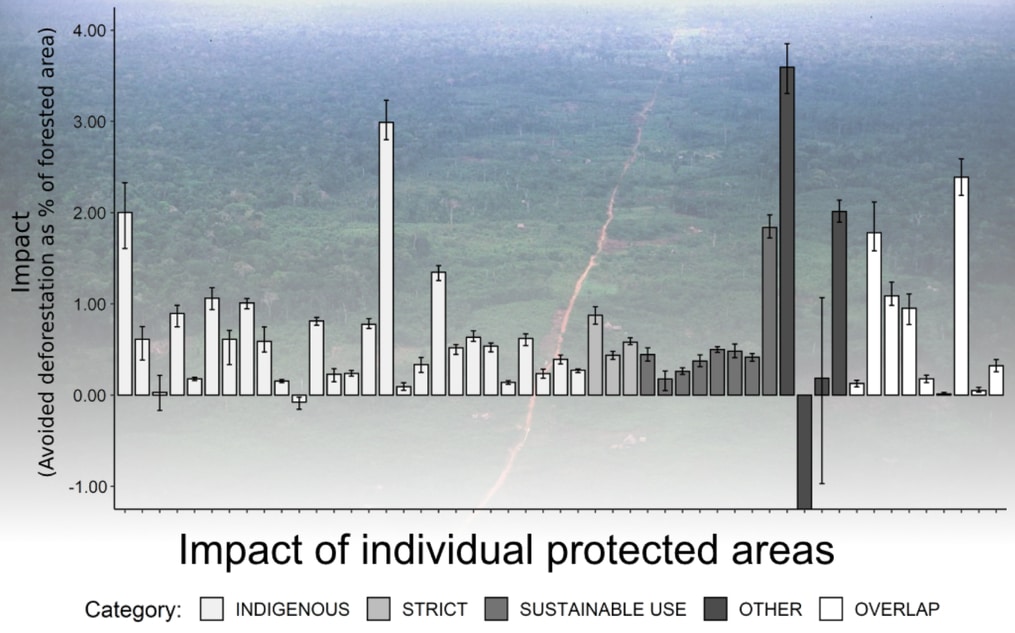
In the case of indigenous lands, the primary objective is to safeguard space for the local traditional peoples to live in rather than to protect nature. Nevertheless, these areas were found to be at least as effective in preventing deforestation as other categories of a protected area. It seems that indigenous peoples have not been called guardians of the forest without good reason.

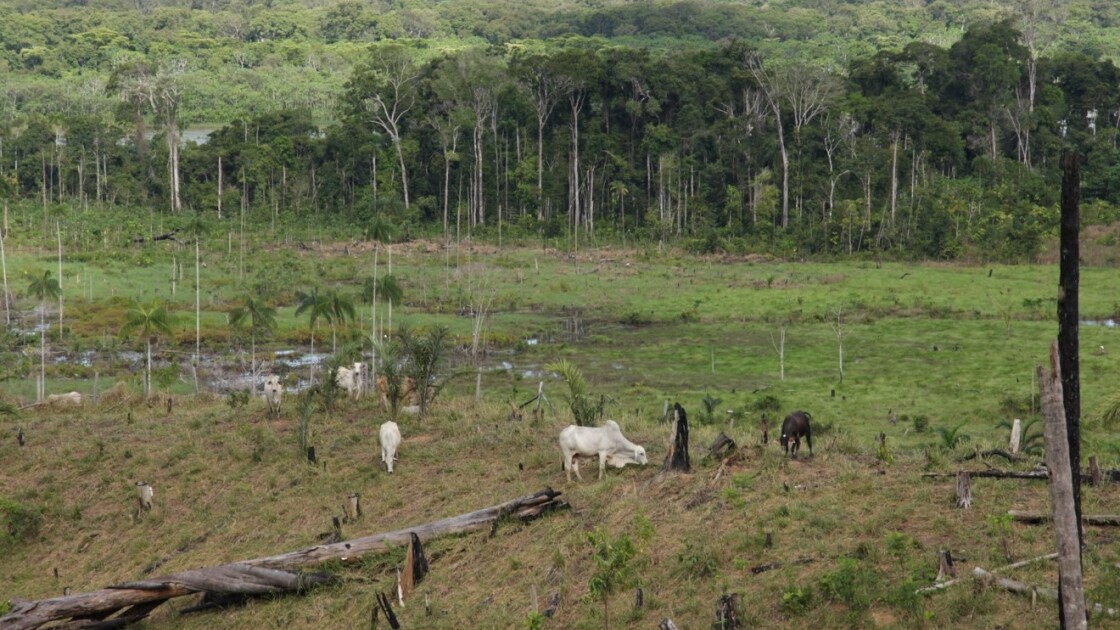
– We are now starting a new project to assess how climate change is affecting biodiversity and the livelihoods of indigenous communities in central Amazonia. This is done in collaboration with the local people. They are worried because the seasonal patterns of rains and river floods seem to be changing and becoming less predictable, says Professor Hanna TuomistoOne of the main threats to Amazonian biodiversity is beef production for export. The biomass (and therefore carbon content) of the intact forest is many times larger than the biomass of the pasture and cattle together. Therefore, forest conversion releases significant amounts of carbon dioxide into the atmosphere. (Photo by Hanna Tuomisto)

In the future, it would be interesting to clarify what the components of a successful protected area are to identify and spread the good practices. The results of this new study could be used to identify potential study subjects for future on-the-ground research at the local level. Such research could also focus on other factors that contribute to conservation success than prevention of deforestation, such as how well-protected areas prevent selective logging or unsustainable levels of hunting.

The research article has been published in the journal Environmental Conservation.

UMBC researchers identify healthcare data defects, create software for easier defect detection

Researchers at the University of Maryland, Baltimore County (UMBC) have developed a method to investigate the quality of healthcare data using a systematic approach, which is based on creating a taxonomy for data defects thorough literature review and examination of data. Using that taxonomy, the researchers developed software that automatically detects data defects effectively and efficiently.

The research is published in the Journal of the American Medical Informatics Association (JAMIA) and is led by Günes Koru, FAMIA, professor of information systems, and Yili Zhang, a former graduate student in Koru's lab who is now a postdoctoral fellow at Northwestern University. The paper stresses that the prevalence of defects in some of the existing healthcare data can be quite high. This must be addressed to better leverage the data to improve the quality of care, reduce costs, and achieve better healthcare outcomes. The team collaborated with an anonymous healthcare organization using real healthcare datasets.

Though many researchers today are involved in the analysis of healthcare data and are invested in its importance, there is very little research being done on the quality of the data being analyzed. Ultimately, this creates a far-reaching problem because important findings from the data may be less meaningful than assumed unless significant effort and money can be invested to deal with data quality problems with ad-hoc methods. For instance, much of the data that Koru's team analyzed contained errors of duplication, mismatched formatting, and incorrect syntax. {module INSIDE STORY}

Identifying these defects in healthcare data is deeply important when it comes to healthcare facilities providing essential services. Koru explains how healthcare facilities use the data collected. Healthcare organizations must "improve upon their services based on that data, and collect more data. If we can keep this cycle going, we can actually learn and improve more quickly, which is the main idea behind the concept of Learning Health Systems, and doing so is all the more important in the COVID-19 era," he says.

In the last decade, healthcare providers in the U.S. made a large leap from keeping patient records on paper to containing all patient information in computerized databases. This jump is significant because of the opportunity it provides for analysis, but researchers are still trying to learn how to effectively leverage the data as an asset.

Koru positions his team's research on data quality as being between the fields that are working to leverage data and the fields that are working to generate it. If the data itself--the bridge that connects the two fields--contains many inconsistencies and problems, then the relevant information cannot be used to provide better outcomes for patients and facilities.

In the future, Koru will continue to work with the partner facility's healthcare professionals to build a path forward. He will collaborate further to improve the quality of data and sustain an operation that bases much of its success on the data that it can gather from health services. His team will work with healthcare administration professionals when the software tools developed through this research are adopted in organizational settings to ensure the usability and usefulness of the tools.

"The taxonomy will help data stewards to identify, understand, and manage potential data quality problems in their future work," says Zhang.

Now more than ever, healthcare facilities are relying on strong data to support patients and the healthcare field as a whole. Koru and Zhang have found that collaborations between data researchers and healthcare organizations can generate effective solutions to the problem of data quality improvement.

Cibreed creates new software to support decision-making for breeding

Göttingen University researchers develop software for the simulation of complex breeding programs

A team of researchers at the University of Göttingen has developed an innovative software program for the simulation of breeding programmes. The "Modular Breeding Program Simulator" (MoBPS) enables the simulation of highly complex breeding programs in animal and plant breeding and is designed to assist breeders in their everyday decisions. Furthermore, the program is intended to be a cornerstone for further studies in breeding research in Göttingen. In addition to purely economic criteria inbreeding, the research team is striving for goals such as sustainability, conservation of genetic diversity and improved animal welfare. The software was presented in the journal G3 Genes, Genomes, Genetics.

"By simulating breeding programmes, conclusions can be drawn about genetic improvements," says Torsten Pook from the Centre for Integrated Breeding Research (Cibreed) at the University of Göttingen. "In fact, potentially problematic issues such as inbreeding or adverse effects on the health of the animals can also be identified at an early stage." Pook is the main developer of MoBPS. The software offers opportunities to realistically model common processes in breeding such as selection, reproduction, and data-collection (eg DNA information, trait observations). At the same time, it can simulate millions of matings of animals with certain features in just a few minutes. {module INSIDE STORY}

"From the simulation of simple maize-breeding programmes, to increased consideration of bone stability in horse breeding, to the simulated development of red deer populations in Baden-Württemberg over the last 200 years, everything has been done," said Pook. The next goal of the research team is to develop an additional module for MoBPS that can automatically optimise breeding programmes with a large number of variables and under given constraints.