A computer scientist focused on astroinformatics Mike Gowanlock, an assistant professor at Northern Arizona University’s School of Informatics, Computing, and Cyber Systems was recently awarded a $411,964 grant from the National Science Foundation (NSF). The award will support Gowanlock’s research in the emerging field of parallel computing architectures needed to process large volumes of data generated by major astronomical surveys, including the Legacy Survey of Space and Time (LSST).
The award will support a new undergraduate course that teaches parallel computing and ensuring that graduates of NAU’s computer science undergraduate program have the skills needed to use future generations of supercomputing systems.
Harnessing the power of parallel computing to process the large data volumes
Designed to lay the groundwork for the launch of the Vera C. Rubin Observatory on the Cerro Pachón ridge in north-central Chile, the 10-year LSST project will begin in 2024. The groundbreaking survey will transform many areas of astrophysics by delivering huge sets of images that will enable scientists to address some of the most pressing questions about the evolution of the universe and the objects in it.
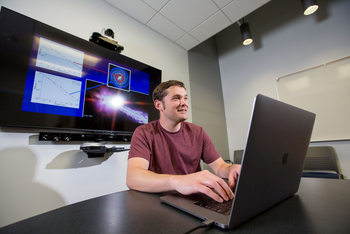 “Modern scientific instruments are generating enormous volumes of data, and these volumes remain a critical challenge for astronomers,” Gowanlock said. “The LSST will enable us to understand how astronomical objects may change over time. Because many interesting astronomical events are transient in nature, it is critical that data from the LSST are processed quickly to enable follow-up observations of transient phenomena using other telescope facilities. New scalable parallel algorithms are needed to enable astronomers to make sense of large data volumes and carry out time-sensitive research objectives. Consequently, one goal of the project is to create new parallel algorithms that exploit emerging computer architectures to enable scientific discoveries in the era of time-domain astronomy.”
NSF’s most prestigious award in support of junior faculty integrating education and research
The NSF made the award to Gowanlock through its prestigious Faculty Early Career Development (CAREER) Program “in support of early-career faculty who have the potential to serve as academic role models in research and education and to lead advances in the mission of their department or organization. Activities pursued by early-career faculty should build a firm foundation for a lifetime of leadership in integrating education and research.”
The LSST will generate 20 terabytes of data each night. Preprocessed data will be sent downstream to NAU to be analyzed by the Solar System Notification and Alert Processing System (SNAPS), a collaboration between Gowanlock and professor David Trilling in the Department of Astronomy and Planetary Science.
The SNAPS system will actively monitor the solar system to determine whether any interesting astrophysical phenomena are occurring, such as an asteroid that is outgassing or changing color. SNAPS will act as an international clearinghouse for solar system research, where astronomers from around the world will listen to the SNAPS data stream, find potential objects of interest, and follow up on those objects using other telescopes facilities.
Parallel computing is a discipline that examines splitting up large amounts of work to be processed by multiple computer processors at the same time. Recently, special purpose processors, such as graphics processing units (GPUs) have been used to solve general-purpose problems, because they have thousands of processors on a single card and are more power-efficient than standard central processing units (CPUs). The project aims to find new ways to exploit the strengths of differing computer architectures as applied to computer science problems that are integral to SNAPS, including problems in databases, unsupervised machine learning, and outlier detection.
The NSF funding will support Gowanlock’s research at the intersection of computer science and astronomy to enable several LSST science goals and will yield standalone parallel algorithms that can be used by domain scientists in other fields.
Grant to support new undergraduate course, internship program, community outreach
The project will combine research and teaching, integrating several activities to ensure both computer scientists and astronomers receive the necessary training to exploit future generation computer systems.
“GPUs are used in the world’s fastest supercomputers,” Gowanlock said. “The grant will support the development of a new upper-division undergraduate course that teaches parallel computing using GPUs. This course will ensure that graduates of NAU’s computer science undergraduate program have the skills necessary to exploit these new architectures in their future careers and enable recent graduates to apply for jobs that require knowledge of parallel computing and/or background in other systems-related topics.”
In addition, the local community will be engaged through outreach activities that promote science, technology, engineering, and mathematical fields, particularly through activities targeting K-12 students.
“Computer science is severely lacking in representation from underrepresented groups,” Gowanlock said. Another outcome of the project is the development of internship opportunities that primarily serve underrepresented groups in partnership with Lawrence Livermore National Lab (LLNL). Undergraduate students will first perform parallel and distributed computing research with Gowanlock at NAU and will then intern at LLNL for a summer.
“Internship opportunities enable students to get early job experience and have the potential to lead to full-time employment upon graduation. These opportunities can help retain underrepresented groups in computer science, consequently enabling a more diverse and inclusive workforce.”