

Japanese scientists detect strongly entangled pair of protons on a nanocrystalline silicon surface, potentially enabling new levels of high-speed supercomputing

Quantum entanglement is one of the most fundamental and intriguing phenomena in nature. Recent research on entanglement has proven to be a valuable resource for quantum communication and information processing. Now, scientists from Japan have discovered a stable quantum entangled state of two protons on a silicon surface, opening doors to an organic union of classical and quantum computing platforms and potentially strengthening the future of quantum technology.

One of the most interesting phenomena in quantum mechanics is “quantum entanglement.” This phenomenon describes how certain particles are inextricably linked, such that their states can only be described regarding each other. This particle interaction also forms the basis of quantum computing. And this is why, in recent years, physicists have looked for techniques to generate entanglement. However, these techniques confront several engineering hurdles, including limitations in creating a large number of “qubits” (quantum bits, the basic unit of quantum information), the need to maintain extremely low temperatures (<1 K), and the use of ultrapure materials. Surfaces or interfaces are crucial in the formation of quantum entanglement. Unfortunately, electrons confined to surfaces are prone to “decoherence,” a condition in which there is no defined phase relationship between the two distinct states. Thus, to obtain stable, coherent qubits, the spin states of surface atoms (or equivalently, protons) must be determined. This study shows how quantum entanglement displays a huge energy difference between its states unlike those of molecular hydrogen, promising ultra-fast processing in the order of 106 qubits and atom teleportation (H1→H4). Image courtesy: Takahiro Matsumoto from NCU, Japan
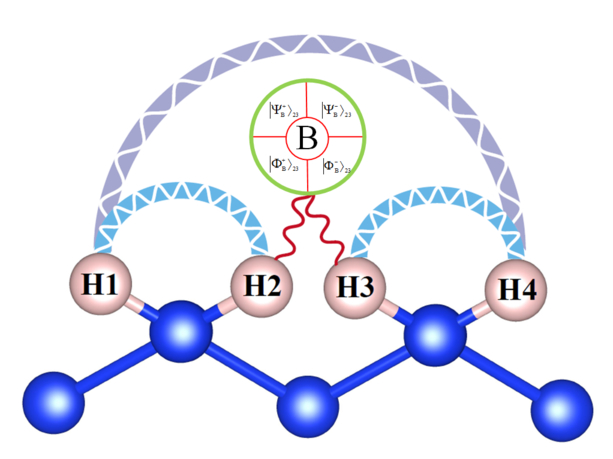
Recently, a team of scientists in Japan, including Prof. Takahiro Matsumoto from Nagoya City University, Prof. Hidehiko Sugimoto from Chuo University, Dr. Takashi Ohhara from the Japan Atomic Energy Agency, and Dr. Susumu Ikeda from High Energy Accelerator Research Organization, recognized the need for stable qubits. By looking at the surface spin states, the scientists discovered an entangled pair of protons on the surface of a silicon nanocrystal.

Prof. Matsumoto, the lead scientist, outlines the significance of their study, “Proton entanglement has been previously observed in molecular hydrogen and plays an important role in a variety of scientific disciplines. However, the entangled state was found in gas or liquid phases only. Now, we have detected quantum entanglement on a solid surface, which can lay the groundwork for future quantum technologies.” Their pioneering study was published in a recent issue of Physical Review B. 

The scientists studied the spin states using a technique known as “inelastic neutron scattering spectroscopy” to determine the nature of surface vibrations. By modeling these surface atoms as “harmonic oscillators,” they showed anti-symmetry of protons. Since the protons were identical (or indistinguishable), the oscillator model restricted their possible spin states, resulting in strong entanglement. Compared to the proton entanglement in molecular hydrogen, the entanglement harbored a massive energy difference between its states, ensuring its longevity and stability. Additionally, the scientists theoretically demonstrated a cascade transition of terahertz entangled photon pairs using the proton entanglement.

The confluence of proton qubits with contemporary silicon technology could result in an organic union of classical and quantum supercomputing platforms, enabling a much larger number of qubits (106) than currently available (102), and ultra-fast processing for new supercomputing applications. “Quantum computers can handle intricate problems, such as integer factorization and the ‘traveling salesman problem,’ which are virtually impossible to solve with traditional supercomputers. This could be a game-changer in quantum computing concerning storing, processing, and transferring data, potentially even leading to a paradigm shift in pharmaceuticals, data security, and many other areas,” concludes an optimistic Prof. Matsumoto.

We could be on the verge of witnessing a technological revolution in quantum supercomputing!

Newcastle study proposes the potential of a DNA-based green-by-design data structure that organizes data like conventional computers

The team, led by researchers from Newcastle University’s School of Computing in the UK, created new dynamic DNA data structures able to store and recall information in an ordered way from DNA molecules. They also analyzed how these structures are able to be interfaced with external nucleic acid computing circuits.

Developed as a DNA chemical reaction system, the stack system is able to record combinations of two different DNA signals (0s and 1s), release the signals into solution in reverse order, and then re-record. 

The stack, which is a linear data structure that follows a particular order in which the operations are performed, stores and retrieves information (DNA signal strands) in a last-in-first-out order by building and truncating DNA "polymers" of single ssDNA strands. Such a stack data structure may eventually be embedded in an in vivo context to store messenger RNAs and reverse the temporal order of a translational response, among other applications.

Professor Natalio Krasnogor, of Newcastle University’s School of Computing, who led the study explains: “Our civilization is data-hungry and all that information processing thirst is having a strong environmental impact. For example, digital technologies pollute more than the aviation industry, the top 7000 data centers in the world use around 2% of global electricity and we all heard about the environmental footprint of some cryptocurrencies.

“In recent years DNA has been shown to be an excellent substrate to store data and the DNA is a renewable, sustainable resource. At Newcastle, we are passionate about sustainability and thus we wanted to start taking baby steps into green-by-design molecular information processing in DNA and go beyond simply storing data. We wanted to be able to organize it. In computer science, data structures are at the core of all the algorithms that run our modern economy; this is so because you need a way to have a unified and standardized way to operate on the data that is stored. This is what data structures enable. We are the first to demonstrate a molecular realization of this crucial component of the modern information age.”

Study co-author, Dr. Annunziata Lopiccolo, Research Associate at Newcastle University’s Centre for Synthetic Biology and the Bioeconomy, added: “If we start thinking about data storage, immediately our minds picture electronic microchips, USB drives, and many other existing technologies. But over the last few years, biologists challenged the data storage media sector demonstrating that the DNA nature, as a highly stable and resilient media, can function as a quaternary data storage, rather than binary. In our work, we wanted to demonstrate that it is possible to use the quaternary code to craft readable inputs and outputs under the form of programmable signals, with a linear and organized data structure. Our work expands knowledge in the context of information processing at the nanoscale level.”

Study co-author Dr. Harold Fellermann, Lecturer at Newcastle University School of Computing added: “Our biomolecular data structure, where both data, as well as operations, are represented by short pieces of DNA, has been designed with biological implementations in mind. In principle, we can imagine such a device to be used inside a living cell, bacteria for example. This makes it possible to bring computational power to domains that are currently hard to access with traditional silicon-based, electronic computing. In the future, such data structures might be used in environmental monitoring, bioremediation, green production, and even personalized nanomedicine.”

Study co-author, Dr. Benjamin Shirt-Ediss, Research Associate, Newcastle University School of Computing, said: “It was really interesting to develop a computational model of the DNA chemistry and to see good agreement with experimental results coming out of the lab. The computational model allowed us to really get a handle on the performance of the DNA stack data structure - we could systematically explore its absolute limits and suggest future avenues for improvement.”

The experimental DNA stack system constitutes proof of principle that polymerizing DNA chemistry can be used as a dynamic data structure to store two types of DNA signal in last-in-first-out order. While more research is needed to determine the best possible way to archive and access DNA-based data, the study highlights the enormous potential of this technology, and how it could help tackle the rapidly growing data demands. 

Will COVID-19 become a mostly childhood disease?

COVID-19 risks may shift from older adults to younger children as the SARS-CoV-2 virus becomes endemic, according to new modeling results

Within the next few years, as the SARS-CoV-2 virus becomes endemic in the global population, COVID-19 may behave like other common-cold coronaviruses, affecting mostly young children who have not yet been vaccinated or exposed to the virus, according to new modeling results. Because COVID-19 severity is generally lower among children, the overall burden from this disease is expected to decline.

“Following infection by SARS-CoV-2, there has been a clear signature of increasingly severe outcomes and fatality with age,” said Ottar Bjornstad. “Yet, our modeling results suggest that the risk of infection will likely shift to younger children as the adult community becomes immune either through vaccination or exposure to the virus.”

Bjornstad explained that such shifts have been observed in other coronaviruses and influenza viruses as they have emerged and then become endemic.

“Historical records of respiratory diseases indicate that age-incidence patterns during virgin epidemics can be very different from endemic circulation,” he said. “For example, ongoing genomic work suggests that the 1889-1890 pandemic, sometimes known as the Asiatic or Russian flu — which killed one million people, primarily adults over age 70 — may have been caused by the emergence of HCoV-OC43 virus, which is now an endemic, mild, repeat-infecting cold virus affecting mostly children ages 7-12 months old.”

Bjornstad cautioned, however, that if an immunity to reinfection by SARS-CoV-2 wanes among adults, the disease burden could remain high in that group, although previous exposure to the virus would lessen the severity of the disease.

“Empirical evidence from seasonal coronaviruses indicates that prior exposure may only confer short-term immunity to reinfection, allowing recurrent outbreaks, this prior exposure may prime the immune system to provide some protection against severe disease,” said Bjornstad. “However, research on COVID-19 shows that vaccination provides stronger protection than exposure to the SARS-CoV-2 virus, so we encourage everyone to get vaccinated as soon as possible.”

The U.S.-Norwegian team developed what is known as a “realistic age-structured (RAS) mathematical model” that integrates demography, degree of social mixing, and duration of infection-blocking and disease-reducing immunity to examine potential future scenarios for age-incidence and burden of mortality for COVID-19.

Specifically, the researchers examined disease burden over immediate, medium, and long terms — 1, 10, and 20 years, respectively. They also examined disease burden for 11 different countries — including China, Japan, South Korea, Europe, Spain, United Kingdom, France, Germany, Italy, United States, Brazil, and South Africa — that differed widely in their demographics. They used data from the United Nations for each of these countries to parameterize the model.

“Regardless of immunity and mixing, the population-level burden of mortality may differ among countries because of varying demographics,” said Ruiyun Li, postdoctoral fellow, University of Oslo. “Our general model framework allows for robust predictions of age-dependent risk in the face of either short or long-term protective immunity, reduction of severity of disease given previous exposure, and consideration of the range of countries with their different demographics and social mixing patterns.”  

According to Li, social distancing is well documented to affect transmissibility, and many countries implemented interventions, such as “shelter in place,” during the build-up of the virgin COVID-19 epidemic. Therefore, the team’s model assumes that the reproduction number (R0) — or the level of transmissibility — on any given day is linked to the amount of mobility on that day. The model also incorporates a variety of scenarios for immunity, including both independence and dependence of disease severity on prior exposure, as well as short- (either three months or one year) and long-term (either 10 years or permanent) immunity.

The team’s results appear today in the journal Science Advances.

“For many infectious respiratory diseases, the prevalence in the population surges during a virgin epidemic but then recedes in a diminishing wave pattern as the spread of the infection unfolds over time toward an endemic equilibrium,” said Li. “Depending on immunity and demography, our RAS model supports this observed trajectory; it predicts a strikingly different age-structure at the start of the COVID-19 epidemic compared to the eventual endemic situation. In a scenario of long-lasting immunity, either permanent or at least 10 years, the young are predicted to have the highest rates of infection as older individuals are protected from new infections by prior infection.”

Jessica Metcalf, associate professor of ecology, evolutionary biology, and public affairs, Princeton University, noted that this prediction is likely to hold only if reinfections produce only mild disease. However, she said, the burden of mortality over time may remain unchanged if primary infections do not prevent reinfections or mitigate severe disease among the elderly.

“In this bleakest scenario, excess deaths due to continual severe reinfections that result from waning immunity will continue until more effective pharmaceutical tools are available,” she said.

Interestingly, due to variations in demographics, the model predicts different outcomes for different countries.

“Given the marked increase of the infection-fatality ratio with age, countries with older population structures would be expected to have a larger fraction of deaths than those with relatively younger population structures,” said Nils Chr. Stenseth, professor of ecology and evolution, University of Oslo. “Consistent with this, for example, South Africa — likely due, in part, to its younger population structure — has a lower number of deaths compared to older populations such as Italy. We found that such ‘death disparities’ are heavily influenced by demographics. However, regardless of demographics, we predict a consistent shift of the risk to the young.”

The researchers said that they designed their model so that health authorities will have a powerful and flexible tool to examine future age-circulation of COVID-19 for use in strengthening preparedness and deployment of interventions.

Bjornstad said, “The mathematical framework we built is flexible and can help in tailoring mitigation strategies for countries worldwide with varying demographics and social mixing patterns, thus providing a critical tool for policy decision making.”