

U.S. Navy connects the dots for quantum networks

Researchers at the U.S. Naval Research Laboratory (NRL) developed a new technique that could enable future advancements in quantum technology.

The technique squeezes quantum dots, tiny particles made of thousands of atoms, to emit single photons (individual particles of light) with precisely the same color and with positions that can be less than a millionth of a meter apart.

"This breakthrough could accelerate the development of quantum information technologies and brain-inspired computing," said Allan Bracker, a chemist at NRL and one of the researchers on the project. CAPTION Schematic of a nanoscale structure called a 'photonic crystal waveguide' that contains quantum dots that can interact with one another when they are tuned to the same wavelength.  CREDIT Chul Soo Kim, US Naval Research Laboratory{module In-article}
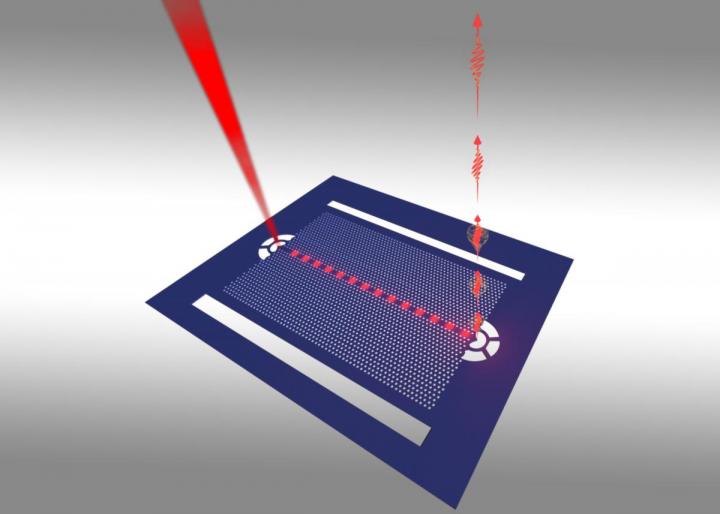
In order for quantum dots to "communicate" (interact), they have to emit light at the same wavelength. The size of a quantum dot determines this emission wavelength. However, just as no two snowflakes are alike, no two quantum dots have exactly the same size and shape -- at least when they're initially created.

This natural variability makes it impossible for researchers to create quantum dots that emit light at precisely the same wavelength [color], said NRL physicist Joel Grim, the lead researcher on the project.

"Instead of making quantum dots perfectly identical, to begin with, we change their wavelength afterward by shrink-wrapping them with laser-crystallized hafnium oxide," Grim said. "The shrink wrap squeezes the quantum dots, which shifts their wavelength in a very controllable way."

While other scientists have demonstrated "tuning" of quantum dot wavelengths in the past, this is the first time researchers have achieved it precisely in both wavelength and position.

"This means that we can do it not just for two or three, but for many quantum dots in an integrated circuit, which could be used for optical, rather than electrical computing," Bracker said.

The wide breadth of researcher expertise and science assets at NRL allowed the team to test various approaches to making this quantum dot breakthrough in a relatively short amount of time.

"NRL has in-house facilities for crystal growth, device fabrication, and quantum optical measurements," Grim said. "This means that we could immediately coordinate our efforts to focus on rapidly improving the material properties."

According to Grim and Bracker, this milestone in the manipulation of quantum dots could lay the groundwork for future strides in a number of areas.

"NRL's new method for tuning the wavelength of quantum dots could enable new technologies that use the strange properties of quantum physics for computing, communication, and sensing," Bracker said. "It may also lead to 'neuromorphic' or brain-inspired computing based on a network of tiny lasers."

Applications in which space and power-efficiency are limiting factors may also benefit from this breakthrough approach, researchers said.

Chinese scientists deploy secure metro quantum networks

Successful new field tests of a continuous-variable quantum key distribution (CV-QKD) system over commercial fiber networks could pave the way to its use in metropolitan areas.

That is the key achievement from a joint team of Chinese scientists, published today in Quantum Science and Technology, which demonstrates CV-QKD transmission over commercial deployed fiber link with a distance of 50 kilometres.

Team leader and lead author, Prof. Hong Guo, from a joint team of Peking University and Beijing University of Posts and Telecommunications (PKU-BUPT joint team), Beijing, said: "CV-QKD provides, in principle, unconditional secret keys to protect people's data - such as banking information, emails and passwords. 

{module In-article} "It has attracted much attention in the past few years, because it uses standard telecom components that operate at room temperature, instead of specific quantum devices such as single photon detectors etc, and it has potentially much higher secret key rates. However, most previous long-distance CV-QKD demonstrations were only done in laboratory fiber, without the disturbances caused by the field environment."

Lead authors Dr. Yichen Zhang and Prof. Song Yu, from the PKU-BUPT joint team, Beijing, said: "There are several challenges to bringing a practical CV-QKD system from a laboratory setup to the real world. Deployed commercial dark fibers are inevitably subject to much stronger perturbations from changing environmental conditions and physical stress. This in turn causes severe disturbances of the transmitted quantum states. 

"They also suffer from higher losses due to splices, sharp bends and inter-fiber couplings. The software and hardware of CV-QKD modules must not only be designed to cope with all the conditions affecting the transmission fiber, but must also be robustly engineered to operate in premises designed for standard telecom equipment. Furthermore, as the systems need to run continuously and without frequent attention, they need to be designed to automatically recover from any errors and shield end users from service interruptions."

The PKU-BUPT joint research team carried out two field tests of CV-QKD over commercial fiber networks in two cities of China - Xi'an and Guangzhou - achieving transmission distances of 30.02 km (12.48 dB loss) and 49.85 km (11.62 dB loss), respectively.

Prof. Hong Guo said: "The longest previous field tests of a CV-QKD system were over a 17.52 km deployed fiber (10.25 dB loss) and a 17.7 km deployed fiber (5.6 dB loss), where the secret key rates were 0.2 kbps and 0.3 kbps, respectively. 

"Comparing with these results, our results show a more than twice transmission distance, and a two orders-of-magnitude higher secret key rates, though in more lossy commercial fiber links.

"This is a significant step in bringing CV-QKD closer to everyday use. It has pushed CV-QKD towards a more practical setting, and, naturally, one may expect that a quantum-guaranteed secure metropolitan network could be built within reach of current technologies."

Voltaire Ranked on Deloitte's Technology Fast 500

Voltaire has been named to the Deloitte Technology Fast 500 EMEA 2008, a ranking of the 500 fastest growing technology companies in Europe, the Middle East and Africa.  Rankings are based on percentage revenue growth over five years, from 2003--2007.  Voltaire's 4,405 percent growth rate during this period resulted in a 19 ranking in the 2008 Deloitte Technology Fast 500 EMEA.

"This is the second year in a row that Deloitte has recognized Voltaire as a high growth company," said Ronnie Kenneth, Chairman and CEO, Voltaire.  "Our fast and steady growth represents the increasing number of customers who rely on Voltaire switches and software to improve the performance of their applications and increase the efficiency and manageability of their data centers."

"Being one of the 500 fastest growing technology companies in EMEA is an impressive accomplishment. We commend Voltaire for making the Deloitte Technology Fast 500 EMEA with a phenomenal 4,405 percent growth rate over five years," said Karel Bakkes, partner in charge of Deloitte's Technology Fast 500 EMEA program.

In addition to ranking on Deloitte's Technology Fast 500, Voltaire placed no 2 on the Israel Technology Fast 50, which is a ranking of the 50 fastest growing technology firms in Israel.

Additional information on the Deloitte Technology Fast 500 EMEA program is available at http://www.fast500europe.com/.