Michigan's Petty uses machine learning to predict breast cancer recurrences

A new tool combining traditional pathology with machine learning could predict which breast cancer patients actually need surgery. The technology, reported in the November issue of American Journal of Physiology -- Cell Physiology (vol. 319: C910-C921; https://doi.org/10.1152/ajpcell.00280.2020), could spare women from unnecessary treatments, reduce medical expenses, and lead to a new generation of drugs to stop breast cancer recurrences.

Ductal carcinoma in situ (DCIS) of the breast, an early form of the disease also known as stage 0 breast cancer, is a diagnosis that only sometimes leads to invasive breast cancer. But only some patients need surgery, chemotherapy, and/or radiotherapy, and the rest could be sent home. Predicting the outcomes of patients with early forms of cancer has been a major scientific problem for decades.

Professor Howard Petty and Ms. Alexandra Kraft, his research assistant, both of the University of Michigan, have just reported a solution to this diagnostic dilemma. The new technology was tested on DCIS patient samples donated to research over 10 years ago supplemented by their current clinical histories.

"Typically, patients with pre-invasive cancers, such as DCIS, are treated very aggressively," says Prof. Petty. "In the case of DCIS, this means partial or total mastectomies...but we know from other work that more than half of these patients will not experience invasive disease."

The method relies upon the newly reported discovery that, in both DCIS cases that are destined to recur and metastatic breast cancer, cells reorganize certain enzymes into "metabolic platforms" just beneath the outer membrane of these dangerous tumor cells. "This allows the enzymes to operate with high efficiencies, like an assembly line at a factory," Prof. Petty says. That efficiency is what makes those cancers so dangerous. Petty theorizes that the enzyme products produced by these cellular factories promote tumor cell invasiveness and simultaneously deflect many forms of chemotherapy and radiotherapy.

To predict which DCIS cases lead to such assembly lines, Petty and colleagues tag biomarkers within patient samples then photograph the biomarkers with a sophisticated camera - similar to those used in astronomy. The digital images are then uploaded into a cloud supercomputing platform for analysis. They used the custom vision application of Microsoft’s Azure cognitive services.  {module INSIDE STORY} CAPTION Micrographs from samples of women who experienced and did not experience cancer recurrences.  CREDIT Dr. Howard R. Petty
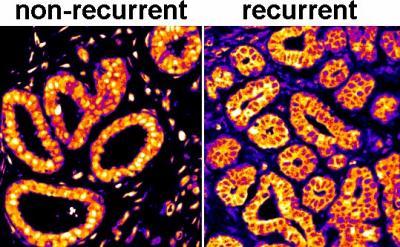
Using this approach, the researchers correctly predicted cancer recurrences and non-recurrence 91% of the time, with only 4% false negatives. Further improvements are on the way.

The authors suggest that this tool will reduce the overdiagnosis of life-threatening DCIS. The technique may allow scientists to pharmaceutically disrupt metabolic platforms, thereby blocking tumor invasiveness, enhancing chemotherapy and radiotherapy, and stopping recurrences. "This tool may also be useful in predicting the outcomes of other pre-invasive lesions and in predicting which patients will respond to specific therapeutic interventions," Prof. Petty says.

The researchers are presently performing the additional retrospective experiments needed to obtain FDA approval of this new diagnostic test.
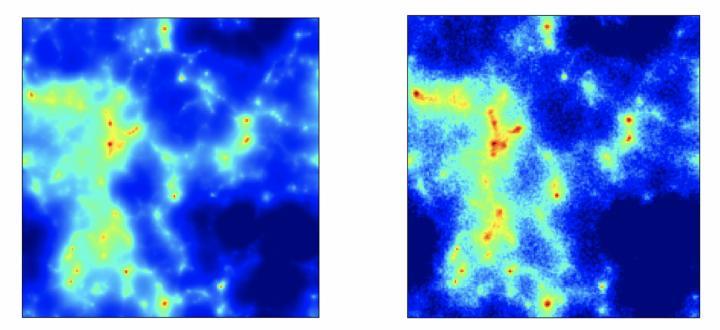
Kavli IPMU researchers validate theory that neutrinos shape the universe using cosmological Vlasov–Poisson simulations

The effect that nearly massless, subatomic particles called neutrinos have on the formation of galaxies has long been a cosmological mystery--one that physicists have sought to measure since discovering the particles in 1956.

But an international research team including the Kavli Institute for the Physics and Mathematics of the Universe (Kavli IPMU) Principal Investigator Naoki Yoshida, who is also a professor in the department of physics at the University of Tokyo, has created cosmological simulations that accurately depict the role of neutrinos in the evolution of the universe. Their study was recently published in The Astrophysical Journal.

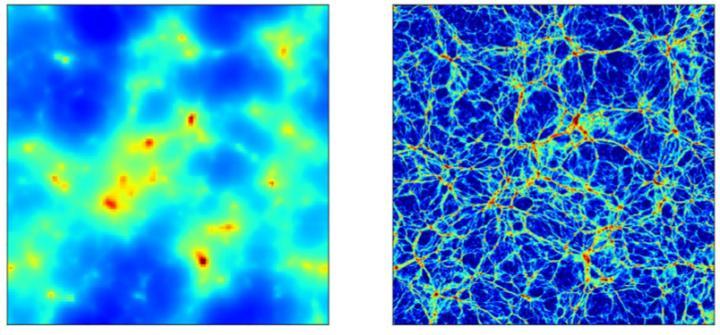
Missouri University of Science and Technology (Missouri S&T) cosmologist Dr. Shun Saito, an assistant professor of physics and a researcher on the team, says the work is a milestone in the process of simulating the formation of the structure of the universe. Saito is also a visiting associate scientist at the Kavli IPMU. Density distribution of neutrinos (left) and dark matter (right) in the cosmic large-scale structure. While the neutrinos move fast and look diffuse, dark matter distribution composes cosmic webs such as filamentary structure. {module INSIDE STORY}

The team used a system of differential equations known as the Vlasov-Poisson equations to explain how neutrinos move through the universe with different values assigned to their mass.

The technique accurately represented the velocity distribution function of the neutrinos and followed its evolution over time. The researchers then examined the effects of neutrinos on galaxy formation and evolution.

Their results showed that neutrinos suppress the clustering of dark matter--the undefined mass in the universe--and, in turn, galaxies. They found that neutrino-rich regions are strongly correlated with massive galaxy clusters and that the effective temperature of the neutrinos varies substantially depending on the mass of the neutrino.

The researchers say that the most stringent experiments used to estimate neutrino mass are cosmological observations, but those can only be relied upon if simulation predictions are accurate. The researchers' Vlasov-Poisson simulation (left) predicts a smoother and less noisy density distribution of neutrinos compared to a traditional N-body particle simulation of Newtonian gravitational interaction (right). {module INSIDE STORY}

"Overall, our findings are consistent with both theoretical predictions and the results of previous simulations," says Dr. Kohji Yoshikawa from the Center for Computational Sciences at the University of Tsukuba and lead author of the study. "It is reassuring that the results from entirely different simulation approaches agree with each other."

"Our simulations are important because they set constraints on the unknown quantity of the neutrino mass," says Saito from Missouri S&T. "Neutrinos are the lightest particles we know of. We only recently learned neutrinos have mass from the discovery featured in the 2015 Nobel Prize in physics."

That prize awarded two scientists, including Kavli IPMU Principal Investigator Takaaki Kajita, who is also the Director at the Institute for Cosmic Ray Research, University of Tokyo, for their separate discoveries that one kind of neutrino can change into another, which showed that neutrinos have mass.

"Our work might ultimately lead to a robust determination of the neutrino mass," Saito says.

UK astrophysics, AI may offer key to early dementia diagnosis

Crucial early diagnosis of dementia in general practice could improve thanks to a supercomputer model designed in a collaboration between Brighton and Sussex Medical School (BSMS) and astrophysicists at the University of Sussex.

Currently, only two-thirds of people with dementia in the UK receive a formal diagnosis, and many receive it late in the disease process, meaning that a large number are missing out on the care that could help them achieve a good quality of life.

The team, led by Dr Elizabeth Ford, Senior Lecturer in Primary Care Research at BSMS, used data from GP patient records to create a list of 70 indicators related to the onset of dementia and recorded in the five years before diagnosis. Working with data scientists from astrophysics, they then tried several types of machine-learning models to identify patterns of clinical information in patient records before a dementia diagnosis. The best model was able to identify 70% of dementia cases before the GP, but also threw up a number of false positives. {module INSIDE STORY}

Dr Ford said: "Patients appear to be exhibiting a wide range of indicators prior to being diagnosed with dementia. It can be really hard for GPs to connect all these indicators and make the link with dementia, but with a supercomputer program, we can potentially do that. Early diagnosis could make a significant difference to the care dementia patients then receive.

"These findings are exciting but they spark the need for discussion with GPs and patients about what place this kind of technology should have in the GP clinic. As technology develops, we need to have wider conversations on whether we are happy with computers working out our chance of having life-changing conditions like dementia."

Seb Oliver, Professor of Astrophysics in the School for Mathematical and Physical Sciences, said: "It has been fantastic working on this project with Dr Ford and her team. It is always amazing to see how statistical methods such as AI and machine-learning can be used to extract useful information from data, whether that be images from space telescopes or GP patient records. Of course the statistics are only one part of the understanding and it is really exciting to work in new areas to try to understand the different challenges that those present."