SUPERCOMPUTING NEWS SUPERCOMPUTING NEWS
    • MEDIA KIT
    • MOST READ
    • RSS FEED
    • ACADEMIA
    • AEROSPACE
    • APPLICATIONS
    • ASTRONOMY
    • AUTOMOTIVE
    • BIG DATA
    • BIOLOGY
    • CHEMISTRY
    • CLIENTS
    • CLOUD
    • DEFENSE
    • DEVELOPER TOOLS
    • EARTH SCIENCES
    • ECONOMICS
    • ENGINEERING
    • ENTERTAINMENT
    • GAMING
    • GOVERNMENT
    • HEALTH
    • OIL & GAS
    • INDUSTRY
    • INTERCONNECTS
    • MANUFACTURING
    • MIDDLEWARE
    • MOVIES
    • NETWORKS
    • PHYSICS
    • PROCESSORS
    • RETAIL
    • SCIENCE
    • STORAGE
    • SYSTEMS
    • VISUALIZATION
    • AcyMailing subscription form

    • ADD YOUR VIDEOS
    • MANAGE VIDEOS
    • CONVERSATION INBOX
    • SOCIAL ADVERTISER
    • SOCIAL NETWORK VIDEOS
    • SURVEYS
    • GROUPS
    • PAGES
    • MARKETPLACE LISTINGS
    • APPLICATIONS BROWSER
    • PRIVACY CONFIRM REQUEST
    • PRIVACY CREATE REQUEST
    • LEADERBOARD
    • POINTS LISTING
      • BADGES
    • TRADE SHOWS
Sign In
Tyler O'Neal, Staff Editor PROCESSORS November 23, 2021, 6:00 am

SETI deploys GPU cluster to receive data from the VLA

A system designed to provide data from the National Science Foundation’s Karl G. Jansky Very Large Array (VLA) for analysis in the Search for Extraterrestrial Intelligence (SETI) has successfully acquired data from a VLA antenna. The system, dubbed COSMIC: the Commensal Open Source Multimode Interferometer Cluster, is designed to receive data from a newly-developed parallel Ethernet interface to the VLA, using the same data stream used for other research but analyzed in parallel by COSMIC.

“As soon as the cabling was physically connected, our interface locked on to the VLA data streams and we were able to grab some preliminary data,” said Dr. Jack Hickish, of the SETI Institute and Real-Time Radio Systems Limited, who is leading the development of the COSMIC system. Credit: Aspen Doan-Isenhour, NRAO/AUI/NSF.

The National Radio Astronomy Observatory (NRAO) and the SETI Institute agreed last year to collaborate on developing and installing the COSMIC system at the VLA. COSMIC, funded by the SETI Institute, will analyze data from the VLA to identify transmissions possibly generated by extraterrestrial technologies.

“As the VLA goes about its normal observing, this system will allow an additional and valuable use for the data we’re already collecting. We’re happy to see this important milestone, and congratulate the SETI Institute and NRAO personnel who achieved it,” said NRAO Director Tony Beasley.

The initial success with a single VLA antenna clears the way for the buildup of the additional hardware required to capture data from all 27 VLA antennas. In addition, the equipment that will do the actual SETI signal analysis still is under development. Full scientific operations of COSMIC are expected to begin in January of 2023.

The complete system “will allow us to conduct a powerful, wide-area SETI survey that will be vastly more complete than any previous such search,” according to Andrew Siemion, Bernard M. Oliver Chair for SETI at the SETI Institute and Principal Investigator for the Breakthrough Listen Initiative at the University of California, Berkeley.
UCL, Oxford study shows promise of quantum supercomputing using factory-made silicon chips

Tyler O'Neal, Staff Editor PROCESSORS March 31, 2021, 12:00 pm

A single qubit on a standard silicon transistor chip has been successfully demonstrated as "quantum capable" in a new study by the UCL spinout Quantum Motion, led by researchers at UCL and Oxford University.

The qubit is the building block of quantum supercomputing, analogous to the bit in classical computers. To perform error-free calculations, quantum supercomputers of the future are likely to need at least millions of qubits. The latest study, published in the journal PRX Quantum, suggests that these computers could be made with industrial-grade silicon chips using existing manufacturing processes, instead of adopting new manufacturing processes or even newly discovered particles.

For the study, researchers were able to isolate and measure the quantum state of a single electron (the qubit) in a silicon transistor manufactured using a 'CMOS' technology similar to that used to make chips in computer processors.

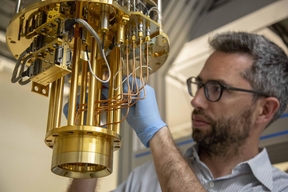
Furthermore, the spin of the electron was found to remain stable for a period of up to nine seconds. The next step is to use a similar manufacturing technology to show how an array of qubits can interact to perform quantum logic operations. Professor John Morton next to a dilution fridge  CREDIT A. Abrusci / UCL

Professor John Morton (London Centre for Nanotechnology at UCL), the co-founder of Quantum Motion, said: "We're hacking the process of creating qubits, so the same kind of technology that makes the chip in a smartphone can be used to build quantum computers.

"It has taken 70 years for transistor development to reach where we are today in computing and we can't spend another 70 years trying to invent new manufacturing processes to build quantum computers. We need millions of qubits and an ultra-scalable architecture for building them, our discovery gives us a blueprint to shortcut our way to industrial-scale quantum chip production."

The experiments were performed by Ph.D. student Virginia Ciriano Tejel (London Centre for Nanotechnology at UCL) and colleagues working in a low-temperature laboratory. During operation, the chips are kept in a refrigerated state, cooled to a fraction of a degree above absolute zero (?273 degrees Celsius).

Ms Ciriano Tejel said: "Every physics student learns in textbooks that electrons behave like tiny magnets with weird quantum properties, but nothing prepares you for the feeling of wonder in the lab, being able to watch this 'spin' of a single electron with your own eyes, sometimes pointing up, sometimes down. It's thrilling to be a scientist trying to understand the world and at the same time be part of the development of quantum computers." The dilution fridge at UCL  CREDIT A. Abrusci / UCL

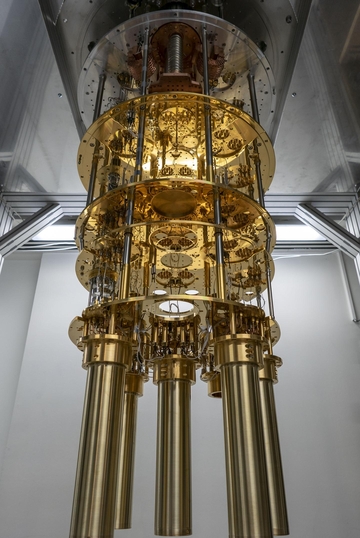
A quantum computer harnesses laws of physics that are normally seen only at the atomic and subatomic level (for instance, that particles can be in two places simultaneously). Quantum supercomputers could be more powerful than today's supercomputers and capable of performing complex calculations that are otherwise practically impossible. Dilution fridge at UCL  CREDIT A. Abrusci / UCL

While the applications of quantum computing differ from traditional computers, they will enable us to be more accurate and faster in hugely challenging areas such as drug development and tackling climate change, as well as more everyday problems that have huge numbers of variables - just as in nature - such as transport and logistics.

KTH team develops heat-free optical switch to enable optical quantum supercomputing chips

Tyler O'Neal, Staff Editor PROCESSORS March 3, 2021, 5:52 pm

In a potential boost for quantum supercomputing and communication, a European research collaboration reported a new method of controlling and manipulating single photons without generating heat. The solution makes it possible to integrate optical switches and single-photon detectors in a single chip.

Publishing in an academic journal, the team reported having developed an optical switch that is reconfigured with microscopic mechanical movement rather than heat, making the switch compatible with heat-sensitive single-photon detectors.

Optical switches in use today work by locally heating light guides inside a semiconductor chip. "This approach does not work for quantum optics," says co-author Samuel Gyger, a PhD student at KTH Royal Institute of Technology in Stockholm. Illustration of a controlled quantum circuit enabled by the reported heat-free switches. Credit: Lucas Schweickert

"Because we want to detect every single photon, we use quantum detectors that work by measuring the heat a single photon generates when absorbed by a superconducting material," Gyger says. "If we use traditional switches, our detectors will be flooded by heat, and thus not work at all."

The new method enables control of single photons without the disadvantage of heating up a semiconductor chip and thereby rendering single-photon detectors useless, says Carlos Errando Herranz, who conceived the research idea and led the work at KTH as part of the European Quantum Flagship project, S2QUIP.

Using microelectromechanical (MEMS) actuation, the solution enables optical switching and photon detection on a single semiconductor chip while maintaining the cold temperatures required by single-photon detectors.

"Our technology will help to connect all building blocks required for integrated optical circuits for quantum technologies," Errando Herranz says.

"Quantum technologies will enable secure message encryption and methods of computation that solve problems today's computers cannot," he says. "And they will provide simulation tools that enable us to understand fundamental laws of nature, which can lead to new materials and medicines."

The group will further develop the technology to make it compatible with typical electronics, which will involve reducing the voltages used in the experimental setup.

Errando Herranz says that the group aims to integrate the fabrication process in semiconductor foundries that already fabricate on-chip optics - a necessary step in order to make quantum optic circuits large enough to fulfill some of the promises of quantum technologies.

  1. Silicon 'neurons' may add a new dimension to chips
  2. HMS forms consortium for ending the pandemic

Page 2 of 15

  • 1
  • 2
  • 3
  • 4
  • 5
  • 6
  • 7
  • 8
  • 9
  • 10
POPULAR RIGHT NOW
  • Supercomputers replace ‘bathtub’ flood maps with physics-based digital twins of Britain’s coastline
    Supercomputers replace ‘bathtub’ flood maps with physics-based digital twins of Britain’s coastline
  • Supercomputers push neural quantum simulation beyond previous limits
    Supercomputers push neural quantum simulation beyond previous limits
  • Intel’s AI supercomputing revival: Q2 financial surge signals new era for CPU-powered HPC infrastructure
    Intel’s AI supercomputing revival: Q2 financial surge signals new era for CPU-powered HPC infrastructure
  • AWS supercomputing investment reaches historic scale as Amazon’s AI strategy powers record financial results
    AWS supercomputing investment reaches historic scale as Amazon’s AI strategy powers record financial results
  • AI infrastructure financing fears shake semiconductor sector
    AI infrastructure financing fears shake semiconductor sector
  • Catching the wave of the future: Supercomputers unlock the hidden dynamics of Venus
    Catching the wave of the future: Supercomputers unlock the hidden dynamics of Venus
  • NCAR supercomputers run planet scale climate experiments impossible in the real world
    NCAR supercomputers run planet scale climate experiments impossible in the real world
  • AI hunts the cosmos: Machine learning helps astronomers discover the first ‘Wandering’ supermassive black hole caught destroying a star
    AI hunts the cosmos: Machine learning helps astronomers discover the first ‘Wandering’ supermassive black hole caught destroying a star
  • Supercomputing for the masses: Meta's vision of a personal superintelligence for everyone
    Supercomputing for the masses: Meta's vision of a personal superintelligence for everyone
  • NVIDIA helps turn AI compute into a new asset class as Wall Street mobilizes $500 billion
    NVIDIA helps turn AI compute into a new asset class as Wall Street mobilizes $500 billion
THIS YEAR'S MOST READ
  • Wall Street wants to trade supercomputing power like oil
    Wall Street wants to trade supercomputing power like oil
  • Beamforming the future: BeammWave's 6G push signals the rise of orbital-terrestrial wireless networks
    Joakim Axmon
    Joakim Axmon
  • Cosmic ambition at scale: UK’s supercomputer unlocks a 2.5 petabytes universe
    Cosmic ambition at scale: UK’s supercomputer unlocks a 2.5 petabytes universe
  • Hidden order, revealed at scale: Supercomputing, electron ptychography uncover the inner workings of relaxor ferroelectrics
    Hidden order, revealed at scale: Supercomputing, electron ptychography uncover the inner workings of relaxor ferroelectrics
  • Intel's Q1 results signal supercomputing surge driving Xeon momentum
    Intel's Q1 results signal supercomputing surge driving Xeon momentum
  • When stars fall apart: Supercomputing reveals the hidden physics of black holes
    When stars fall apart: Supercomputing reveals the hidden physics of black holes
  • MIT develops computational framework to probe dark matter via gravitational waves
    MIT develops computational framework to probe dark matter via gravitational waves
  • Explainable AI moves into the watershed: FAMU-FSU engineers build predictive framework for real-time E. coli forecasting
    FAMU-FSU College of Engineering Assistant Professor Nasrin Alamdari. (Scott Holstein/FAMU-FSU College of Engineering)
    FAMU-FSU College of Engineering Assistant Professor Nasrin Alamdari. (Scott Holstein/FAMU-FSU College of Engineering)
  • Multi-layer simulations reveal the hidden supply chain of solar prominences
    Multi-layer simulations reveal the hidden supply chain of solar prominences
  • Japanese scientists decode dolphin speed with supercomputing: Turbulence, vortices, and the hidden physics of propulsion
    Japanese scientists decode dolphin speed with supercomputing: Turbulence, vortices, and the hidden physics of propulsion
  • FRONTPAGE
  • LATEST
  • POPULAR
  • REGISTER
  • SOCIAL
  • VIDEO
  • SUBSCRIPTION
  • RSS
  • GUIDELINES
  • PRIVACY
  • TOS
  • ABOUT
  • +1 (816) 799-4488
  • editorial@supercomputingonline.com
© 2001 - 2026 SuperComputingOnline.com, LLC. All rights reserved. This material may not be published, broadcast, rewritten or redistributed without permission.
Sign In
  • FRONT PAGE
  • LATEST
    • MEDIA KIT
    • MOST READ
    • RSS FEED
    • ACADEMIA
    • AEROSPACE
    • APPLICATIONS
    • ASTRONOMY
    • AUTOMOTIVE
    • BIG DATA
    • BIOLOGY
    • CHEMISTRY
    • CLIENTS
    • CLOUD
    • DEFENSE
    • DEVELOPER TOOLS
    • EARTH SCIENCES
    • ECONOMICS
    • ENGINEERING
    • ENTERTAINMENT
    • HEALTH
    • INDUSTRY
    • INTERCONNECTS
    • GAMING
    • GOVERNMENT
    • MANUFACTURING
    • MIDDLEWARE
    • MOVIES
    • NETWORKS
    • OIL & GAS
    • PHYSICS
    • PROCESSORS
    • RETAIL
    • SCIENCE
    • STORAGE
    • SYSTEMS
    • VISUALIZATION
  • VIDEOS
    • ADD YOUR VIDEOS
    • MANAGE VIDEOS
  • COMMUNITY
    • TRADE SHOWS
    • SOCIAL NETWORK VIDEOS
    • SURVEYS
    • APPLICATIONS BROWSER
    • CONVERSATION INBOX
    • SOCIAL ADVERTISER
    • GROUPS
    • MARKETPLACE LISTINGS
    • PAGES
    • LEADERBOARD
    • POINTS LISTING
      • BADGES
    • PRIVACY CONFIRM REQUEST
    • PRIVACY CREATE REQUEST

Hey there! We noticed you’re using an ad blocker.