

SUPERCOMPUTING NEWS SUPERCOMPUTING NEWS
    • MEDIA KIT
    • MOST READ
    • RSS FEED
    • ACADEMIA
    • AEROSPACE
    • APPLICATIONS
    • ASTRONOMY
    • AUTOMOTIVE
    • BIG DATA
    • BIOLOGY
    • CHEMISTRY
    • CLIENTS
    • CLOUD
    • DEFENSE
    • DEVELOPER TOOLS
    • EARTH SCIENCES
    • ECONOMICS
    • ENGINEERING
    • ENTERTAINMENT
    • GAMING
    • GOVERNMENT
    • HEALTH
    • OIL & GAS
    • INDUSTRY
    • INTERCONNECTS
    • MANUFACTURING
    • MIDDLEWARE
    • MOVIES
    • NETWORKS
    • PHYSICS
    • PROCESSORS
    • RETAIL
    • SCIENCE
    • STORAGE
    • SYSTEMS
    • VISUALIZATION
    • AcyMailing subscription form

    • ADD YOUR VIDEOS
    • MANAGE VIDEOS
    • CONVERSATION INBOX
    • SOCIAL ADVERTISER
    • SOCIAL NETWORK VIDEOS
    • SURVEYS
    • GROUPS
    • PAGES
    • MARKETPLACE LISTINGS
    • APPLICATIONS BROWSER
    • PRIVACY CONFIRM REQUEST
    • PRIVACY CREATE REQUEST
    • LEADERBOARD
    • POINTS LISTING
      • BADGES
    • TRADE SHOWS
Sign In
Tyler O'Neal, Staff Editor SCIENCE May 5, 2022, 8:29 am

Surrey team shows quantum mechanics explains why DNA can spontaneously mutate

The molecules of life, DNA, replicate with astounding precision, yet this process is not immune to mistakes and can lead to mutations. Using sophisticated supercomputer modeling, a team of physicists and chemists at the University of Surrey have shown that such errors in copying can arise due to the strange rules of the quantum world.  Getty
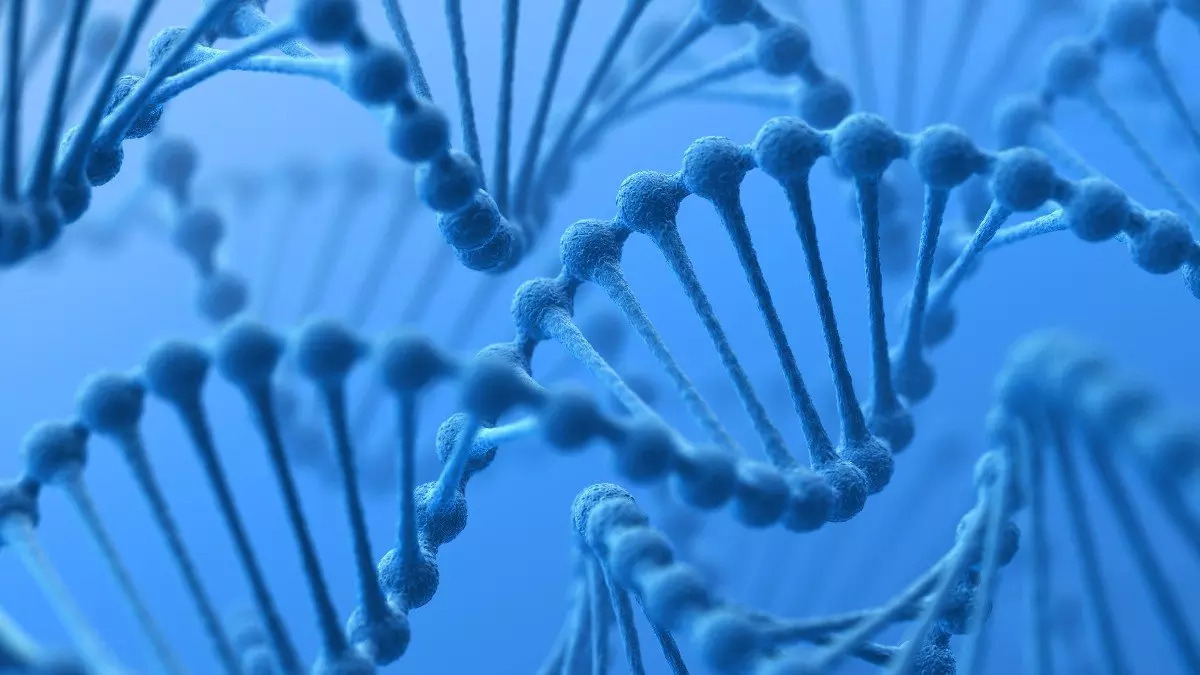
The two strands of the famous DNA double helix are linked together by subatomic particles called protons – the nuclei of atoms of hydrogen – which provide the glue that bonds molecules called bases together. These so-called hydrogen bonds are like the rungs of a twisted ladder that makes up the double helix structure discovered in 1952 by James Watson and Francis Crick based on the work of Rosalind Franklin and Maurice Wilkins.  

Normally, these DNA bases (called A, C, T, and G) follow strict rules on how they bond together: A always bonds to T and C always to G. This strict pairing is determined by the molecules' shape, fitting them together like pieces in a jigsaw, but if the nature of the hydrogen bonds changes slightly, this can cause the pairing rule to break down, leading to the wrong bases being linked and hence a mutation. Although predicted by Crick and Watson, it is only now that sophisticated computational modeling has been able to quantify the process accurately. 

The team, part of Surrey's research program in the exciting new field of quantum biology, has shown that this modification in the bonds between the DNA strands is far more prevalent than has hitherto been thought. The protons can easily jump from their usual site on one side of an energy barrier to land on the other side. If this happens just before the two strands are unzipped in the first step of the copying process, then the error can pass through the replication machinery in the cell, leading to what is called a DNA mismatch and, potentially, a mutation.  

The Surrey team based in the Leverhulme Quantum Biology Doctoral Training Centre used an approach called open quantum systems to determine the physical mechanisms that might cause the protons to jump across between the DNA strands. But, most intriguingly, it is thanks to a well-known yet almost magical quantum mechanism called tunneling – akin to a phantom passing through a solid wall – that they manage to get across.  

It had previously been thought that such quantum behavior could not occur inside a living cell's warm, wet and complex environment. However, the Austrian physicist Erwin Schrödinger had suggested in his 1944 book What is Life? that quantum mechanics can play a role in living systems since they behave rather differently from inanimate matter. This latest work seems to confirm Schrödinger's theory.   

In their study, the authors determine that the local cellular environment causes the protons, which behave like spread-out waves, to be thermally activated and encouraged through the energy barrier. The protons are found to be continuously and very rapidly tunneling back and forth between the two strands. Then, when the DNA is cleaved into its separate strands, some of the protons are caught on the wrong side, leading to an error. 

Dr. Louie Slocombe, who performed these calculations during his Ph.D., explained: “The protons in the DNA can tunnel along with the hydrogen bonds in DNA and modify the bases which encode the genetic information. The modified bases are called "tautomers" and can survive the DNA cleavage and replication processes, causing "transcription errors" or mutations.” 

Dr. Slocombe's work at the Surrey's Leverhulme Quantum Biology Doctoral Training Centre was supervised by Prof Jim Al-Khalili (Physics, Surrey) and Dr. Marco Sacchi (Chemistry, Surrey) and published in Communications Physics. 

Prof Al-Khalili commented: “Watson and Crick speculated about the existence and importance of quantum mechanical effects in DNA well over 50 years ago, however, the mechanism has been largely overlooked.”  

Dr. Sacchi continued: “Biologists would typically expect tunneling to play a significant role only at low temperatures and in relatively simple systems. Therefore, they tended to discount quantum effects in DNA. With our study, we believe we have proved that these assumptions do not hold.” 

Data Sonification: Black Hole at the Center of Galaxy M87 (Multiwavelength)

Tyler O'Neal, Staff Editor SCIENCE May 4, 2022, 8:47 pm
Studied by scientists for decades, the black hole in Messier 87, or M87, gained celebrity status in science after the first release from the Event Horizon Telescope (EHT) project in 2019.This new sonification does not feature the EHT data, but rather looks at data from other telescopes that observed M87 on much wider scales at roughly the same time.The image in visual form contains three panels...
...

Read more https://www.supercomputingonline.com/gallery/category/how-to-style/data-sonification-black-hole-at-the-center-of-galaxy-m87-multiwavelength

Data Sonification: Black Hole at the Center of the Perseus Galaxy Cluster (X-ray)

Tyler O'Neal, Staff Editor SCIENCE May 4, 2022, 8:41 pm
Since 2003, the black hole at the center of the Perseus galaxy cluster has been associated with sound.This is because astronomers discovered that pressure waves sent out by the black hole caused ripples in the cluster's hot gas that could be translated into a note — one that humans cannot hear some 57 octaves below middle C.Now a new sonification brings more notes to this black hole sound machin...
...

Read more https://www.supercomputingonline.com/gallery/category/how-to-style/data-sonification-black-hole-at-the-center-of-the-perseus-galaxy-cluster-x-ray

  1. SIAM recognizes distinguished work in applied mathematics, computational science
  2. Swiss researchers demo carbon nanomaterials for future quantum supercomputer technologies

Page 47 of 61

  • 42
  • 43
  • 44
  • 45
  • 46
  • 47
  • 48
  • 49
  • 50
  • 51
POPULAR RIGHT NOW
  • Supercomputers replace ‘bathtub’ flood maps with physics-based digital twins of Britain’s coastline
    Supercomputers replace ‘bathtub’ flood maps with physics-based digital twins of Britain’s coastline
  • Supercomputers push neural quantum simulation beyond previous limits
    Supercomputers push neural quantum simulation beyond previous limits
  • Intel’s AI supercomputing revival: Q2 financial surge signals new era for CPU-powered HPC infrastructure
    Intel’s AI supercomputing revival: Q2 financial surge signals new era for CPU-powered HPC infrastructure
  • AWS supercomputing investment reaches historic scale as Amazon’s AI strategy powers record financial results
    AWS supercomputing investment reaches historic scale as Amazon’s AI strategy powers record financial results
  • AI infrastructure financing fears shake semiconductor sector
    AI infrastructure financing fears shake semiconductor sector
  • Catching the wave of the future: Supercomputers unlock the hidden dynamics of Venus
    Catching the wave of the future: Supercomputers unlock the hidden dynamics of Venus
  • NCAR supercomputers run planet scale climate experiments impossible in the real world
    NCAR supercomputers run planet scale climate experiments impossible in the real world
  • AI hunts the cosmos: Machine learning helps astronomers discover the first ‘Wandering’ supermassive black hole caught destroying a star
    AI hunts the cosmos: Machine learning helps astronomers discover the first ‘Wandering’ supermassive black hole caught destroying a star
  • Supercomputing for the masses: Meta's vision of a personal superintelligence for everyone
    Supercomputing for the masses: Meta's vision of a personal superintelligence for everyone
  • NVIDIA helps turn AI compute into a new asset class as Wall Street mobilizes $500 billion
    NVIDIA helps turn AI compute into a new asset class as Wall Street mobilizes $500 billion
THIS YEAR'S MOST READ
  • Wall Street wants to trade supercomputing power like oil
    Wall Street wants to trade supercomputing power like oil
  • Beamforming the future: BeammWave's 6G push signals the rise of orbital-terrestrial wireless networks
    Joakim Axmon
    Joakim Axmon
  • Cosmic ambition at scale: UK’s supercomputer unlocks a 2.5 petabytes universe
    Cosmic ambition at scale: UK’s supercomputer unlocks a 2.5 petabytes universe
  • Hidden order, revealed at scale: Supercomputing, electron ptychography uncover the inner workings of relaxor ferroelectrics
    Hidden order, revealed at scale: Supercomputing, electron ptychography uncover the inner workings of relaxor ferroelectrics
  • Intel's Q1 results signal supercomputing surge driving Xeon momentum
    Intel's Q1 results signal supercomputing surge driving Xeon momentum
  • When stars fall apart: Supercomputing reveals the hidden physics of black holes
    When stars fall apart: Supercomputing reveals the hidden physics of black holes
  • MIT develops computational framework to probe dark matter via gravitational waves
    MIT develops computational framework to probe dark matter via gravitational waves
  • Explainable AI moves into the watershed: FAMU-FSU engineers build predictive framework for real-time E. coli forecasting
    FAMU-FSU College of Engineering Assistant Professor Nasrin Alamdari. (Scott Holstein/FAMU-FSU College of Engineering)
    FAMU-FSU College of Engineering Assistant Professor Nasrin Alamdari. (Scott Holstein/FAMU-FSU College of Engineering)
  • Multi-layer simulations reveal the hidden supply chain of solar prominences
    Multi-layer simulations reveal the hidden supply chain of solar prominences
  • Japanese scientists decode dolphin speed with supercomputing: Turbulence, vortices, and the hidden physics of propulsion
    Japanese scientists decode dolphin speed with supercomputing: Turbulence, vortices, and the hidden physics of propulsion
  • FRONTPAGE
  • LATEST
  • POPULAR
  • REGISTER
  • SOCIAL
  • VIDEO
  • SUBSCRIPTION
  • RSS
  • GUIDELINES
  • PRIVACY
  • TOS
  • ABOUT
  • +1 (816) 799-4488
  • editorial@supercomputingonline.com
© 2001 - 2026 SuperComputingOnline.com, LLC. All rights reserved. This material may not be published, broadcast, rewritten or redistributed without permission.
Sign In
  • FRONT PAGE
  • LATEST
    • MEDIA KIT
    • MOST READ
    • RSS FEED
    • ACADEMIA
    • AEROSPACE
    • APPLICATIONS
    • ASTRONOMY
    • AUTOMOTIVE
    • BIG DATA
    • BIOLOGY
    • CHEMISTRY
    • CLIENTS
    • CLOUD
    • DEFENSE
    • DEVELOPER TOOLS
    • EARTH SCIENCES
    • ECONOMICS
    • ENGINEERING
    • ENTERTAINMENT
    • HEALTH
    • INDUSTRY
    • INTERCONNECTS
    • GAMING
    • GOVERNMENT
    • MANUFACTURING
    • MIDDLEWARE
    • MOVIES
    • NETWORKS
    • OIL & GAS
    • PHYSICS
    • PROCESSORS
    • RETAIL
    • SCIENCE
    • STORAGE
    • SYSTEMS
    • VISUALIZATION
  • VIDEOS
    • ADD YOUR VIDEOS
    • MANAGE VIDEOS
  • COMMUNITY
    • TRADE SHOWS
    • SOCIAL NETWORK VIDEOS
    • SURVEYS
    • APPLICATIONS BROWSER
    • CONVERSATION INBOX
    • SOCIAL ADVERTISER
    • GROUPS
    • MARKETPLACE LISTINGS
    • PAGES
    • LEADERBOARD
    • POINTS LISTING
      • BADGES
    • PRIVACY CONFIRM REQUEST
    • PRIVACY CREATE REQUEST

Hey there! We noticed you’re using an ad blocker.