UNH researchers unleash the power of AI, transforming the realm of auroral exploration

In a world where the mysteries of the cosmos continually beckon humanity's insatiable curiosity, the University of New Hampshire (UNH) shines as a beacon of innovation. Researchers at UNH have recently pioneered artificial intelligence to categorize a colossal database of over 700 million stunning aurora images, providing insight into a realm where science, technology, and imagination intersect.

The aurora borealis, a breathtaking display of light in the night sky, has captivated generations with its mystical beauty. However, behind this ethereal phenomenon lies a scientific field full of challenges and untapped potential. The groundbreaking work led by Jeremiah Johnson, an associate professor of applied engineering and sciences, and a team of visionary collaborators embarks on a transformative journey into the heart of auroral exploration.

Published in the esteemed Journal of Geophysical Research, this research highlights the development of innovative artificial intelligence and machine learning tools capable of analyzing the vast repository of auroral data found in NASA's THEMIS database. By meticulously categorizing and annotating images taken by the THEMIS twin spacecraft, the researchers are paving the way for a deeper understanding of the dynamic relationship between the solar wind and Earth's magnetosphere.

"The massive dataset is a treasure trove of knowledge, offering profound insights into the intricate dance of cosmic forces that shape our planet," asserts Johnson. "Our novel algorithm not only clarifies the complexities of auroral dynamics but also opens the door to a new era of discovery, enabling researchers to utilize historical data more efficiently than ever."

Each image has been meticulously classified into six categories, ranging from arcs to clouds. This labeled database facilitates the study of auroral dynamics and is a valuable resource for future research. The project, led by a team that includes Amy Keesee and esteemed collaborators from the University of Alaska–Fairbanks and NASA's Goddard Space Flight Center, exemplifies the collaborative spirit that drives scientific progress.

As we stand on the brink of a new frontier in auroral research, the implications of this monumental achievement extend far beyond academia. The spirit of innovation fostered at the University of New Hampshire embodies a sentiment of exploration and discovery that transcends boundaries, inspiring a new generation of aspiring scientists and dreamers to reach for the stars.

In a world where artificial intelligence and human ingenuity converge, the journey into the cosmos is not merely a quest for knowledge but a testament to the boundless potential of the human spirit. As we admire the mesmerizing beauty of the aurora borealis, let us remember our capacity to unlock the secrets of the universe and illuminate the path toward a future where discovery knows no limits.

Mingyu “Max” Joo and Hai Che

Bridging uncertainty: The role of AI in predicting optimal prices

In a world characterized by turmoil and unpredictability, businesses face the challenge of setting prices that successfully balance profitability and consumer appeal. The rise of artificial intelligence (AI) has been viewed as a potential game-changer in this area, offering a promising solution to help navigate uncertain times. However, recent global disruptions, such as the COVID-19 pandemic, have revealed the limitations of traditional AI models to adapt to drastic changes.

A new development emerges from this landscape thanks to the work of UC Riverside School of Business professors Mingyu "Max" Joo and Hai Che, along with collaborators from Baruch College and Ohio State University. They have created an innovative deep-learning model that combines historical sales data with economic demand theory. This breakthrough has the potential to transform how businesses understand and predict consumer behavior, especially during challenging times.

The essence of their research highlights a significant shift in perspective. Traditionally, AI models relied solely on historical sales data, often neglecting the complexities of consumer behavior during unforeseen events. Joo and Che's model integrates fundamental principles of economic theory, creating a new paradigm for pricing predictions.

Through the application of economic theory, the researchers have successfully quantified the unpredictable nature of consumer behavior during extraordinary circumstances—a challenge that has long confounded conventional AI models. By analyzing the interactions between external influences like pandemics or economic shocks and pricing strategies, their model offers hope for businesses navigating uncertain terrains.

The past year has underscored the weaknesses of traditional AI models, and this breakthrough serves as a timely reminder of the value that diverse perspectives bring. The combination of AI and economic theory not only provides a clearer understanding of consumer behavior but also showcases the transformative potential of interdisciplinary collaboration.

Validation of their model during the COVID-19 pandemic highlights its resilience. While conventional AI models struggled under immense disruptions, Joo and Che's approach demonstrated exceptional accuracy, significantly reducing generalization errors. This development paves the way for a new era in pricing predictions.

This work offers a compelling glimpse into a future where advanced AI techniques and established economic principles converge to form a robust and adaptable framework.

In an era marked by uncertainty, these advancements highlight AI's transformative potential when combined with diverse perspectives. They pave the way for a future in which businesses can confidently navigate uncharted waters with insight and expertise.

Hai-Bo Yu
Hai-Bo Yu

Discovering the secrets of dark matter: A journey of exploration

In a realm where the invisible communicates loudly and the unknown holds the key to understanding the universe's deepest secrets, physicists embark on a journey that challenges conventional wisdom. At the forefront of this cosmic exploration is Hai-Bo Yu, a visionary researcher at the University of California, Riverside. His groundbreaking work has revealed the mysterious nature of stellar streams and the significant impact of dark matter.

The GD-1 stellar stream, a fascinating feature surrounding the Milky Way, has long intrigued astronomers with its complex structures—a delicate dance of stars that reveals stories of cosmic interactions. In the midst of this celestial phenomenon, a team led by researcher Hai-Bo Yu has made significant strides in unraveling a longstanding cosmic mystery by proposing the existence of a core-collapsing self-interacting dark matter (SIDM) subhalo as the key entity behind the unique characteristics of the GD-1 stream.

Published in The Astrophysical Journal Letters, Yu’s research sheds light on the obscure aspects of the universe, providing new insights into the properties and dynamics of dark matter. Collaborating with a dedicated group of researchers, Yu utilized the capabilities of supercomputer N-body simulations to model a collapsing SIDM subhalo, thereby enhancing our understanding of the cosmic forces at work.

In a universe heavily influenced by the unseen, Yu’s findings illuminate the complexities of stellar streams and invite deeper contemplation about the nature of dark matter. By embracing the concept of self-interacting dark matter, Yu's research opens doors to new avenues of exploration, challenging traditional theories and paving the way for innovative insights into previously uncharted areas.

As we observe the stunning array of stars in the Milky Way’s galactic halo, we are reminded of the transformative power of scientific inquiry and the limitless potential of human curiosity. Through the lens of Yu's visionary research, we recognize that the universe is a canvas of infinite possibilities, eager to be explored by curious minds determined to uncover its mysteries.

In a world where cosmic wonders and scientific breakthroughs converge, let Hai-Bo Yu's pioneering spirit inspire us, guiding us toward a future where discovery knows no limits and the secrets of the universe are unveiled one star at a time.

Yale researchers discover a new method for calculating electron structure, shedding light on material mysteries

Exploring material science has always been challenging, as complex calculations often demand significant computing power. However, a team of innovative researchers at Yale University has recently unveiled a groundbreaking approach that utilizes artificial intelligence to transform the calculation of electron structures in materials.

Understanding the electronic structure of materials is crucial for unlocking new possibilities and insights. Traditionally, density functional theory (DFT) has been widely used in this area. However, conventional methods can fall short when it comes to investigating excited-state properties—such as light interactions or electrical conductivity. This challenge inspired Professor Diana Qiu and her team to find a novel solution.

Focusing on electrons' wave function, which defines a particle's quantum state, the researchers set out to uncover the intricacies of material behavior. Using two-dimensional materials as their canvas, they employed a variational autoencoder (VAE), an AI-powered image processing tool, to create a dimensional representation of the wave function without human intervention.

"The wave function can be visualized as a probability spread over space, allowing us to condense significant amounts of data into a concise set of numbers that capture the essence of electron behavior," explained Professor Qiu, who led this transformative study. This new representation proved more accurate and significantly reduced computational time, enabling the exploration of a broader range of materials.

In a field where traditional methods could consume between 100,000 to a million CPU hours for calculations involving just three atoms, the VAE-assisted technique has reduced that timeframe to only one hour. This remarkable leap in computational efficiency accelerates research efforts and opens doors to discovering new materials with unique and desirable properties.

The strength of this approach lies in its ability to move beyond human intuition, paving the way for more precise and versatile material analysis. As Professor Qiu aptly states, "This method not only speeds up complicated calculations but also broadens our horizons in material discovery, offering a glimpse into the vast possibilities within the realm of electron structures."

Armed with this innovative methodology, Yale researchers are positioned to significantly impact material science, unraveling the complexities of electron structures and unlocking potential breakthroughs that could shape the future of technology and innovation.

Geologist Tim Little measuring curved scratches on the Alpine Fault. (Nic Barth/UCR)

UC Riverside explores earthquake forecasting techniques

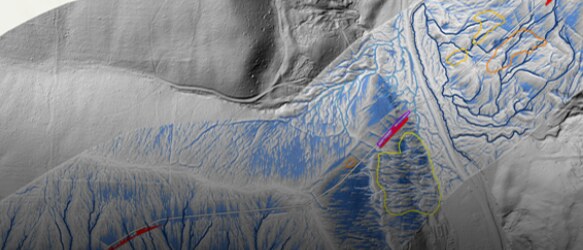
To improve earthquake forecasting and gain insights into potential seismic activities, scientists have introduced a groundbreaking method that analyzes fault dynamics and enhances the accuracy of earthquake predictions. This innovative technique, detailed in a paper published in the journal Geology, explores the intricate details of past earthquake events, providing valuable information about the origins of quakes, their propagation patterns, and the geographical areas likely to experience significant seismic impacts.

At the core of this approach are advanced supercomputer modeling techniques that allow for a thorough analysis of fault activities, which ultimately helps in creating more precise earthquake scenarios for significant fault lines. By closely examining the subtle curved scratches left on fault surfaces after an earthquake—similar to the markings on a drag race track—researchers can determine the direction in which the earthquakes originated and how they moved toward specific locations.

The lead author of this groundbreaking study, UC Riverside geologist Nic Barth, explains the importance of these previously unnoticed curved scratch marks. Supercomputer modeling identified the shape of these curves relative to the earthquake's direction; the research establishes a solid foundation for determining the locations of prehistoric earthquakes. This understanding provides a pathway for forecasting future seismic events and improving hazard assessment strategies globally.

One of this study's key findings is its ability to reveal critical information about the origins and trajectories of earthquakes. This knowledge is vital for predicting potential initiation points of future seismic events and understanding their likely paths. Such insights are significant for earthquake-prone areas like California, where accurate forecasts can significantly reduce the impact of earthquakes.

The study also highlights the need to understand earthquake propagation and its implications. For example, researchers examine a large earthquake that starts near the Salton Sea on the San Andreas fault and propagates northward toward Los Angeles, demonstrating how different earthquake origins and directions can affect energy dispersion and impact intensity.

Furthermore, this research extends its focus to international fault lines, notably New Zealand's Alpine Fault, known for its seismic activities. By analyzing historical earthquake patterns and modeling potential scenarios, the study showcases the predictive power of this new technique in forecasting seismic behavior and informing preparedness measures in earthquake-prone regions worldwide.

In a time characterized by increased seismic risks and an emphasis on disaster readiness, employing advanced supercomputer modeling techniques to analyze earthquake dynamics offers a promising path forward in earthquake science. As researchers globally adopt this innovative approach to uncover the complex history of faults and refine seismic predictions, the potential to enhance earthquake preparedness and response mechanisms grows, providing hope for communities at risk from seismic events.

Overall, this new horizon of knowledge promises to transform our understanding of earthquake science, offering a powerful tool to improve our comprehension of seismic behavior and strengthen global resilience against the unpredictable forces of nature.