A study using satellite imagery and machine learning techniques shows that many deforestation hotspots lie outside the 11 municipalities currently monitored by the Brazilian federal government under its Amazon Plan 2021/2022. 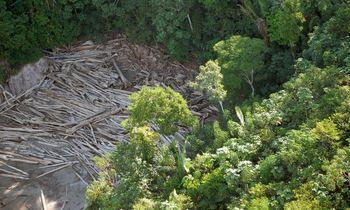
Using a method based on satellite images and artificial intelligence, Brazilian researchers have shown that the priority area for actions to combat illegal deforestation could comprise 27.8% less territory than the 11 municipalities monitored by the federal government under the current strategy, known as the Amazon Plan 2021/2022. This monitoring ignores new deforestation frontiers outside the targeted areas.
According to an article by the researchers, published in June in Conservation Letters, a journal of the Society for Conservation Biology, areas of the Amazon classified as a high priority for having the highest deforestation rates totaled 414,603 square kilometers (km2) this year, while the total area targeted by the plan for the 11 municipalities is 574,724 km2. In other words, the area to be monitored could be reduced by 160,000 km2, which is about the size of Suriname.
However, while the deforestation hotspots identified by the researchers accounted for 66% of the average annual deforestation rate, the 11 municipalities targeted by the plan represented 37% of the deforestation rate for the last three years (2019-21).
In the article, scientists affiliated with Brazil’s National Space Research Institute (INPE) and universities in the United States conclude that the proposed method would give monitoring and law enforcement a tighter focus. Furthermore, they stress, that it reveals new deforestation frontiers outside the priority area and hence not covered by the official monitoring plan.
“Using this new approach, we concluded that prioritizing areas with higher deforestation rates would be more effective than limiting the monitoring to certain municipalities, This is an important finding, given that the agencies responsible for law enforcement, in this case, mainly IBAMA and ICMBio, have had their budgets and staffing steadily whittled down. Some of these deforestation hotspots are in the 11 municipalities, but others are in the vicinity and constitute new frontiers,” Guilherme Augusto Verola Mataveli, corresponding author of the article, told Agência FAPESP. Mataveli is a researcher in INPE’s Earth Observation and Geoinformatics Division.
The study was supported by FAPESP via four projects (19/25701-8, 19/21662-8, 21/07382-2, and 16/02018-2).
The National Council for Legal Amazonia (CNAL), which oversees the Amazon Plan 2021/2022, responded as follows to Agência FAPESP's request for comment: “The aim [of the plan] was to focus on where the occurrence of illegal environmental activities had the most impact on the results of Brazil’s environmental management without neglecting the need to act in other areas of Legal Amazonia.”
Legal Amazonia is an area of more than 5 million km2 comprising the states of Acre, Amapá, Amazonas, Maranhão, Mato Grosso, Pará, Rondônia, Roraima, and Tocantins. It was created by federal laws dating back to 1953 to promote special protection and development policies for the area.
According to CNAL, “the 11 municipalities were chosen because they had the largest deforested area and the highest incidence of fires, with the possibility of including others to be mapped by the Center for Management and Operations of the Amazon Protection System [Censipam]”.
The council also stated that INPE was one of the “leading institutions in the process of choosing priorities”, and that the scientists who conducted the research “could have contributed in an institutional manner as the opportunity arose”.
“CNAL always works with official information managed, processed, and analyzed by official government bodies,” its statement said.
Advances in the data processing
The authors of the article note that deforestation in the 11 municipalities targeted by the plan has been significant in recent years and that this is grounds for monitoring but not sufficient to prioritize only these areas, which are as follows: São Félix do Xingu, Altamira, Novo Progresso, Pacajá, Portel, Itaituba and Rurópolis (Pará); Apuí and Lábrea (Amazonas); Colniza (Mato Grosso); and Porto Velho (Rondônia).
They also note that despite the concentration on these areas for monitoring and law enforcement, deforestation increased 105% between February and April 2021 compared with the average for the same period between 2017 and 2021. DETER, Brazil’s official deforestation alert program pointed to 524.89 km2 of new deforestation sites in these areas.
“The study validates the importance of INPE, which for 60 years has trained outstanding researchers, producing science and technology from satellite data for society and national development. The advances in data processing embodied in the use of artificial intelligence for the planning of actions to combat deforestation are critical to mitigate the country’s environmental problems and construct a national sustainable development plan,” said Luiz Aragão, the last author of the article. Aragão heads INPE’s Earth Observation and Geoinformatics Division,
Priority areas
The data sources for the study included INPE’s Legal Amazonia Deforestation Satellite Monitoring Service (PRODES), which produces the annual deforestation statistics used by the Brazilian government in formulating public policy for the region. PRODES focuses on cut-and-burn rates and has used the same methodology since 1988.
According to its latest report, the areas deforested in the region totaled 13,235 km2 between August 2020 and July 2021. This was a year-over-year increase of 22%, the largest since 2006 (more at: terrabrasilis.dpi.inpe.br/app/dashboard/deforestation/biomes/legal_amazon/rates).
“The idea for the article came up in February 2021 when the Amazon Plan 2021/2022 was announced,” Mataveli said. “Deforestation in the 11 municipalities was said to account for 70% of total deforestation detected in the Amazon, but the PRODES number was different. When we enhanced the model, we found it to be a useful tool to focus monitoring and law enforcement more effectively.”
To establish the priority areas, the researchers first defined what they call grid cells measuring 25 km by 25 km and regularly distributed across the Amazon. Using the Random Forest machine learning algorithm to predict deforestation hotspots in the following year based on sets of multivariate regressions, they placed each cell in a high, medium, or low priority class. According to the article, the method identified a larger proportion of areas at risk of deforestation in terms of total size and public plots where clearing trees is illegal.
The model considered five predictors: deforestation in previous years, distance to grid cells with high cumulative deforestation in previous years, distance to infrastructures such as roads and waterways, the total area protected in grid cells, and the number of active fires.
The three priority classes were based on predicted deforestation, with values below the 70th percentile classified as low, values between the 70th and 90th percentiles as a medium, and values above the 90th percentile as high. The grid cells classified as high were used to map priority areas for 2022 totaling 414,603 km2.
The authors also note that their method prioritizes actions in boundary areas of the 11 priority municipalities where deforestation activities are concentrated, captures other areas of increasing deforestation not monitored by the plan, determines priorities based on the land cleared in the previous year, and does not depend on geopolitical frontiers such as municipalities.
“Prioritizing these 11 municipalities will be insufficient for Brazil to achieve its international commitments, including the pledge to reduce illegal deforestation to zero by 2028 announced at COP-26 [the 2021 UN Climate Change Conference],” Mataveli said. “Moreover, the plan aims to reduce deforestation by 8,719 km2 per year, but a 2018 decree set a far lower target of 3,925 km2 per year after 2020.”
This was a reference to Decree 9578 (2018), which consolidated the National Climate Change Policy and set a goal of cutting deforestation in the Amazon by 80% compared with the average for 1996-2005. This is one of the actions to which Brazil is committed to containing greenhouse gas emissions.
Besides its 2028 zero-deforestation pledge, Brazil also announced at COP-26 that it would cut greenhouse gas emissions by half compared to 2005 levels by 2030 and achieve climate neutrality by 2050. Rising deforestation in the Amazon contrasts with these promises: about 11% of greenhouse gas emissions are due to forest and land use mismanagement, including deforestation and fire.
When the Amazon Plan 2021/2022 was announced, experts criticized the targets it set as insufficient because they were based on the average deforestation rate for the period 2016-20, which was already 35% higher than the average for the previous ten years.
Call for complementary actions
The article argues for several complementary actions to combat deforestation, in addition to direct methods for the setting of public policy targets. These should include environmental education and awareness raising, identifying and making accountable actors who infringe environmental protection laws and profit from illegal deforestation, incentivizing projects that invest in the green economy and maintenance of the standing forest, and regularizing public and Indigenous land holdings.
“We used open-source code to create the model and define priority areas,” Mataveli said. “We’re talking to the Terra Brasilis platform to include these areas in the information available to all those who want to access it, so that it can be used in practice by any state or municipal governments interested.”


 How to resolve AdBlock issue?

 “Our calculations have shown that the higher the intensity of the noise, the more unpredictable the consequences, the stronger the disturbances, and the more intense El Niño will manifest itself. And for the system to get out of equilibrium, sometimes you need a little push: a change in humidity or ocean currents,” says Head of the Laboratory of multiscale mathematical modeling at UrFU Dmitri Alexandrov. “The mathematical model allowed us to show how the process will develop under the influence of one or another factor. That is, we did not predict when El Niño would appear or what its consequences for the global climate would be, we calculated possible scenarios of this phenomenon and showed that under some conditions there would be one version of events and under a different set of parameters there would be another.”