What can you do with spiral graph? Help understand how galaxies evolve

The spiral structure is seen in a variety of natural objects, ranging from plants and animals to tropical cyclones and galaxies. Now researchers at the North Carolina Museum of Natural Sciences have developed a technique to accurately measure the winding arms of spiral galaxies that is so easy, virtually anyone can participate. This new and simple method is currently being applied in a citizen science project, called Spiral Graph, that takes advantage of a person's innate ability to recognize patterns, and ultimately could provide researchers with some insight into how galaxies evolve.

Spiral galaxies, like our own Milky Way, make up approximately 70 percent of the galaxies in the nearby Universe. In many of these galaxies, the difference in brightness between the winding arms and the inter-arm regions is very subtle, making it challenging for automated methods to measure. Even bright foreground stars can skew the automated analysis of a galaxy. Additionally, patterns in spiral galaxies are easily seen and followed by people but computer algorithms have a harder time determining where spirals begin and end, especially if they aren't continuous.

The Spiral Graph project takes advantage of a time-honored short cut common in art classes -- tracing. Ian Hewitt, Research Adjunct at the NC Museum of Natural Sciences, and Patrick Treuthardt, Assistant Head of the Museum's Astronomy & Astrophysics Research Lab, tested their tracing method on a set of simple model images of spiral galaxies with known windings. They then traced out the spiral structure and measured the winding of the tracings with their own specially designed software, P2DFFT. When they compared their results against other approaches that involved an artificial intelligence program, fitting observed structure with mathematical models, or even directly inputting images into their own measurement software, none produced results as precise and accurate as their tracing method. A paper detailing this comparison appeared online on March 9, 2020. Spiral Graph is available on the Zooniverse.org platform for citizen science projects. CAPTION This image shows the sum of 15 independent tracings of the spiral structure of the same galaxy displayed using a violet to red rainbow color map. The violet areas indicate no agreement and the red areas indicate greatest agreement between tracings.  CREDIT Ian Hewitt{module INSIDE STORY}
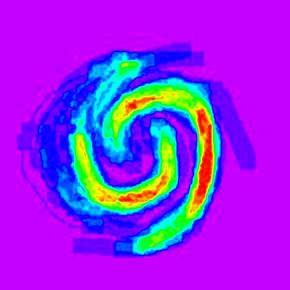
"These human-generated tracings give our software a boost so it can accurately measure how tightly wrapped the structure is," Treuthardt says. "The degree of wrapping of the spiral arms is called the pitch angle. If a spiral pattern has very tightly wrapped arms, it has a small pitch angle. If the spiral pattern is very open, it has a large pitch angle." Why is the pitch angle important? Because it relates to other parameters of the host galaxy that are more difficult and time-consuming to measure, such as the mass of the black hole found in the nucleus, or dark matter content of the galaxy. "If we know the pitch angle we can quickly and easily estimate these parameters and identify interesting galaxies for more detailed, follow-up telescope observations," Treuthardt adds.

Hewitt's work on this study, and the Spiral Graph citizen science project, is especially rewarding since he started out as a volunteer working with Treuthardt. Although a long-time amateur astronomer, Hewitt retired from a career in industry to pursue astronomy full time. He later completed a degree in astronomy and began teaching and working on programming projects in the Museum's Astronomy & Astrophysics Research Lab. "It's been really exciting to get a chance to participate in this kind of research, but even better to have a part in enabling others to contribute to the efforts to better understand our Universe," says Hewitt. And with an estimated 6,000 galaxies in their study, enlisting citizen scientists is a must.
Space super-storm likelihood estimated from longest period of magnetic field observations

A 'great' space weather super-storm large enough to cause significant disruption to our electronic and networked systems occurred on average once in every 25 years

  • The analysis led by University of Warwick shows 'severe' space super-storms occurred 42 years out of 150 and 'great' super-storms occurred in 6 years out of 150
  • Super-storms can disrupt electronics, aviation, and satellite systems and communications
  • Provides insight into the scale of the largest super-storm in recorded history

A 'great' space weather super-storm large enough to cause significant disruption to our electronic and networked systems occurred on average once every 25 years according to a new joint study by the University of Warwick and the British Antarctic Survey.

By analyzing magnetic field records at opposite ends of the Earth (the UK and Australia), scientists have been able to detect super-storms going back over the last 150 years. d2790 77 a74cb{module INSIDE STORY}

This result was made possible by a new way of analyzing historical data, pioneered by the University of Warwick, from the last 14 solar cycles, way before the space age began in 1957, instead of the last five solar cycles currently used.

The analysis shows that 'severe' magnetic storms occurred in 42 out of the last 150 years, and 'great' super-storms occurred in 6 years out of 150. Typically, a storm may only last a few days but can be hugely disruptive to modern technology. Super-storms can cause power blackouts, take out satellites, disrupt aviation and cause temporary loss of GPS signals and radio communications.

Lead author Professor Sandra Chapman, from the University of Warwick's Centre for Fusion, Space, and Astrophysics, said: "These super-storms are rare events but estimating their chance of occurrence is an important part of planning the level of mitigation needed to protect critical national infrastructure.

"This research proposes a new method to approach historical data, to provide a better picture of the chance of occurrence of super-storms and what super-storm activity we are likely to see in the future."

The Carrington storm of 1859 is widely recognized as the largest super-storm on record but predates even the data used in this study. The analysis led by Professor Chapman estimates what amplitude it would need to have been to be in the same class as the other super-storms- and hence with a chance of occurrence that can be estimated.

Professor Richard Horne, who leads Space Weather at the British Antarctic Survey, said: "Our research shows that a super-storm can happen more often than we thought. Don't be misled by the stats, it can happen any time, we simply don't know when and right now we can't predict when."

Space weather is driven by activity from the sun. Smaller-scale storms are common, but occasionally larger storms occur that can have a significant impact.

One way to monitor this space weather is by observing changes in the magnetic field at the earth's surface. High-quality observations at multiple stations have been available since the beginning of the space age (1957). The sun has an approximately 11-year cycle of activity which varies in intensity and this data, which has been extensively studied, covers only five cycles of solar activity.

If we want a better estimate of the chance of occurrence of the largest space storms over many solar cycles, we need to go back further in time. The aa geomagnetic index is derived from two stations at opposite ends of the earth (in the UK and Australia) to cancel out the earth's own background field. This goes back over 14 solar cycles or 150 years but has poor resolution.

Using annual averages of the top few percents of the aa index the researchers found that a 'severe' super-storm occurred in 42 years out of 150 (28%), while a 'great' super-storm occurred in 6 years out of 150 (4%) or once in every 25 years. As an example, the 1989 storm that caused a major power blackout of Quebec was a great storm.

In 2012 the Earth narrowly avoided trouble when a coronal mass ejection from the Sun missed the Earth and went off in another direction. According to satellite measurements if it had hit the Earth it would have caused a super-storm.

Space weather was included in the UK National Risk Register in 2012 and updated in 2017 with a recommendation for more investment in forecasting. In September 2019 the Prime Minister announced a major new investment of £20 million into space weather. The object is to forecast magnetic storms and develop better mitigation strategies.

Notredame Lab builds a 'Hubble Space Telescope' to study multiple genome sequences for protecting Earth's biodiversity

A new tool that simultaneously compares 1.4 million genetic sequences can classify how species are related to each other at far larger scales than previously possible. Described today in an academic journal by researchers from the Centre for Genomic Regulation in Barcelona, the technology can reconstruct how life has evolved over hundreds of millions of years and makes important inroads for the ambition to understand the code of life for every living species on Earth.

Protecting Earth's biodiversity is one of the most urgent global challenges of our times. To steward the planet for all life forms, humanity must understand the way animals, fungi, bacteria, and other organisms have evolved and how they interact amongst millions of other species. Sequencing the genome of life on Earth can unlock previously unknown secrets that yield fresh insights into the evolution of life while bringing new foods, drugs, and materials that pinpoint strategies for saving species at risk of extinction. Cedric Notredame{module INSIDE STORY}

The most common way scientists study these relationships is by using Multiple Sequence Alignments (MSA), a tool that can be used to describe the evolutionary relationships of living organisms by looking for similarities and differences in their biological sequences, finding matches among seemingly unrelated sequences and predicting how a change at a specific point in a gene or protein might affect its function. The technology underpins so much biological research that the original study describing it is one of the most cited papers in history.

"We currently use multiple sequence alignments to understand the family tree of species evolution," says Cédric Notredame, a researcher at the Centre for Genomic Regulation in Barcelona and lead author of the study. "The bigger your MSA, the bigger the tree and the deeper we dig into the past and find how species appeared and separated from each other.

"What we've made lets us dig ten times deeper than what we've been able to do before, helping us to see hundreds of millions of years into the past. Our technology is essentially a time machine that tells us how ancient constraints influenced genes in a way that resulted in life as we know today, much like how the Hubble Space Telescope observes things that happened millions of years ago to help us understand the Universe we live in today."

Researchers can use MSA to understand how certain species of plants have evolved to be more resistant to climate change, or how particular genetic mutations in one species makes them vulnerable to extinction. By studying a living organism's evolutionary history, scientists may come up with and test new ideas to stave off the collapse of entire ecosystems.

Technological advances have made sequencing cheaper than ever before, resulting in increasingly large datasets with more than a million sequences for scientists to analyze. Some ambitious endeavors, like the Earth BioGenome Project, may run to the tens of millions. Researchers have not been able to take full advantage of these enormous datasets because current MSAs cannot analyze more than 100,000 sequences with accuracy.

To evaluate the scale-up potential of MSA, the authors of the paper used Nextflow, a cloud supercomputing software developed in-house at the Centre for Genomic Regulation. "We spent hundreds of thousands of hours of computation to test our algorithm's effectiveness," says Evan Floden, a researcher at the CRG who also led on developing the tool. "My hope is that in combining high-throughput instrumentation readouts with high-throughput computation, science will usher in an era of vastly improved biological understanding, ultimately leading to better outcomes for consumers, patients and our planet as a whole."

"There is a vast amount of 'dark matter' in biology, code we have yet to identify in the unexplored parts of the genome that is untapped potential for new medicines and other benefits we can't fathom," concludes Cédric. "Even seemingly inconsequential organisms may play a pivotal role in furthering human health and that of our planet, such as the discovery of CRISPR in archaea. What we have built is a new way of finding the needles in the haystack of life's genomes."