

Americans reflect on Apollo 11 and the space program

On the 50th anniversary of the first Apollo landing on the moon, American adults cite the 1969 lunar landing as NASA's most important achievement in its 60-year history. 

In a national survey conducted by the University of Michigan, 35% of American adults (age 18 or older) mention the first lunar landings as one of the two most important achievements of NASA when asked in an open-ended format. 

"This level of public recall and recognition reflect the deep-seated impact of the first moon landing in American culture," said Jon Miller, director of the International Center for the Advancement of Scientific Literacy at U-M's Institute for Social Research.  {module In-article}

It is important to recognize that only 45% of today's adults were alive at the time of the first lunar landing on July 20, 1969.

Although the lunar landing was the most frequently mentioned NASA achievement over the last 60 years, many American adults pointed to other achievements, including the exploration of our solar system and the improvement of our understanding of the planetary system. Other adults noted the important technologies that have been produced by the space program and transferred to civilian uses, especially in communication and supercomputer technologies.

Miller's 2018 survey repeated an earlier question used in a national survey in 1988 about the value of spin-off technologies from the space program. When asked to agree or disagree with the statement "The space program has paid for itself through the creation of new technologies and scientific discoveries," 56% of adults agreed in 1988 and 69% agreed 30 years later in 2018.

"This pattern reflects a long-standing public belief in the indirect benefit of the space program apart from spectacular events like the lunar landing," Miller said.

American adults continue to see current space activities as a part of the human instinct for exploration. When asked to agree or disagree with the statement "The United States should seek to explore space in the same spirit that led Europeans to explore this planet in earlier centuries," 69% of adults agreed in 1988 and 72% agreed in 2018. 

An examination of the patterns of public agreement with this statement found that older adults were more supportive of this view in 2018 than 30 years ago. Men were more supportive of this view than women, but the difference narrowed over the last 30 years.

The results indicate that a majority of American adults continue to recognize the first lunar landing as a landmark achievement for NASA and for the U.S., Miller said.

American adults continue to recognize the value of new technologies and new scientific discoveries that flow from the space program, he said. More than 70% of American adults think the U.S. should continue to explore space in the same spirit as the early European explorations of Earth.
UK astronomers explore deep space with Deep-CEE

Galaxy clusters are some of the most massive structures in the cosmos, but despite being millions of lightyears across, they can still be hard to spot. Researchers at Lancaster University have turned to artificial intelligence for assistance, developing "Deep-CEE" (Deep Learning for Galaxy Cluster Extraction and Evaluation), a novel deep learning technique to speed up the process of finding them. Matthew Chan, a Ph.D. student at Lancaster University, is presenting this work at the Royal Astronomical Society's National Astronomy meeting on 4 July at 3:45 pm in the Machine Learning in Astrophysics session. 

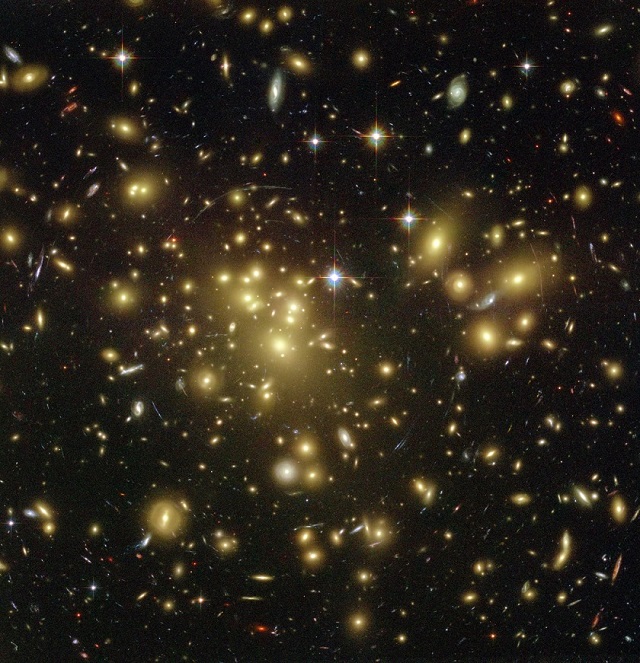
Most galaxies in the universe live in low-density environments known as "the field", or in small groups, like the one that contains our Milky Way and Andromeda. Galaxy clusters are rarer, but they represent the most extreme environments that galaxies can live in and studying them can help us better understand dark matter and dark energy. {module In-article} Image showing the galaxy cluster Abell1689. The novel deep learning tool Deep-CEE has been developed to speed up the process of finding galaxy clusters such as this one, and takes inspiration in its approach from the pioneer of galaxy cluster finding, George Abell, who manually searched thousands of photographic plates in the 1950s.

During the 1950s the pioneer of galaxy cluster-finding, astronomer George Abell, spent many years searching for galaxy clusters by eye, using a magnifying lens and photographic plates to locate them. Abell manually analyzed around 2,000 photographic plates, looking for visual signatures the of galaxy clusters, and detailing the astronomical coordinates of the dense regions of galaxies. His work resulted in the 'Abell catalog' of galaxy clusters found in the northern hemisphere.

Deep-CEE builds on Abell's approach for identifying galaxy clusters but replaces the astronomer with an AI model that has been trained to "look" at color images and identify galaxy clusters. It is a state-of-the-art model based on neural networks, which are designed to mimic the way a human brain learns to recognize objects by activating specific neurons when visualizing distinctive patterns and colors.

Chan trained the AI by repeatedly showing it examples of known, labeled, objects in images until the algorithm is able to learn to associate objects on its own. Then ran a pilot study to test the algorithm's ability to identify and classify galaxy clusters in images that contain many other astronomical objects.

"We have successfully applied Deep-CEE to the Sloan Digital Sky Survey," says Chan, "ultimately, we will run our model on revolutionary surveys such as the Large Synoptic Survey Telescope (LSST) that will probe wider and deeper into regions of the Universe never before explored. 

New state-of-the-art telescopes have enabled astronomers to observe wider and deeper than ever before, such as studying the large-scale structure of the universe and mapping its vast undiscovered content. 

By automating the discovery process, scientists can quickly scan sets of images, and return precise predictions with minimal human interaction. This will be essential for analyzing data in the future. The upcoming LSST sky survey (due to come online in 2021) will image the skies of the entire southern hemisphere, generating an estimated 15 TB of data every night. 

"Data mining techniques such as deep learning will help us to analyze the enormous outputs of modern telescopes," says Dr. John Stott (Chan's Ph.D. supervisor). "We expect our method to find thousands of clusters never seen before by science".

Chan will present the findings of his paper "Fishing for galaxy clusters with "Deep-CEE" neural nets" on 4 July at 3:45 pm in the 'Machine Learning in Astrophysics' session. (Chan and Stott 2019) which has been submitted to MNRAS and can be found on Arxiv here: https://arxiv.org/abs/1906.08784.

German researchers show how acids behave in ultracold interstellar space

Solvated acids tend to release a proton; however, they display more complex behavior under space conditions

Bochum-based researchers from the Cluster of Excellence Ruhr Explores Solvation (Resolv), together with cooperation partners from Nijmegen, have investigated how acids interact with water molecules at extremely low temperatures. Using spectroscopic analyses and supercomputer simulations, they investigated the question of whether hydrochloric acid (HCl) does or does not release its proton in conditions like those found in interstellar space. The answer was neither yes nor no, but instead depended on the order in which the team brought the water and hydrochloric acid molecules together.

The group led by Professor Martina Havenith, Chair of Physical Chemistry II, and Professor Dominik Marx, Chair of Theoretical Chemistry, from Ruhr-Universität Bochum, Germany, together with the team led by Dr. Britta Redlich from Radboud University, Nijmegen, the Netherlands, describes the results in the journal Science Advances, published online in advance on 7 June 2019. {module In-article}

Understanding how complex molecules were formed

If hydrochloric acid comes into contact with water molecules under normal conditions, such as at room temperature, the acid immediately dissociates: it releases its proton (H+), one chloride ion (Cl-) remains. The research team wanted to find out whether the same process also takes place at extremely low temperatures below ten Kelvin, i.e. below minus 263.15 degrees Celsius. "We would like to know whether the same acid-alkali chemistry as we know on Earth also exists in the extreme conditions in interstellar space," explains Martina Havenith, Speaker for the Cluster of Excellence Resolv. "The results are crucial for understanding how more complex chemical molecules formed in space - long before the first precursors of life came into existence."

In order to replicate the extremely low temperatures in the laboratory, the researchers had the chemical reactions take place in a droplet of superfluid helium. They monitored the processes using a special type of infrared spectroscopy, which can detect molecular vibrations with low frequencies. A laser with especially high brightness, as is available in Nijmegen, was needed for this. Supercomputer simulations enabled the scientists to interpret the experimental results.

It comes down to the order

First of all, the researchers added four water molecules, one after the other, to the hydrochloric acid molecule. The hydrochloric acid dissociated during this process: it donated its proton to a water molecule, and a hydronium ion was created. The remaining chloride ion, the hydronium ion and the three other water molecules formed a cluster.

However, if the researchers first created an ice-like cluster from the four water molecules and then added the hydrochloric acid, they yielded a different result: the hydrochloric acid molecule did not dissociate; the proton remained bonded to the chloride ion.

"Under the conditions that can be found in interstellar space, the acids are thus able to dissociate, but this does not necessarily have to happen - both processes are two sides of the same coin, so to speak," summarises Martina Havenith.

Chemistry in space is not simple

The researchers assume that the result can also be applied to other acids, i.e. it represents the basic principle of chemistry under ultracold conditions. "Chemistry in space is by no means simple; it might even be more complex than chemistry under planetary conditions," says Dominik Marx. After all, it depends not only on the mixing ratios of the reacting substances but also on the order in which they are added to each other. "This phenomenon needs to be taken into consideration in future experiments and simulations under ultracold conditions," says the researcher.