SUPERCOMPUTING NEWS SUPERCOMPUTING NEWS
    • MEDIA KIT
    • MOST READ
    • RSS FEED
    • ACADEMIA
    • AEROSPACE
    • APPLICATIONS
    • ASTRONOMY
    • AUTOMOTIVE
    • BIG DATA
    • BIOLOGY
    • CHEMISTRY
    • CLIENTS
    • CLOUD
    • DEFENSE
    • DEVELOPER TOOLS
    • EARTH SCIENCES
    • ECONOMICS
    • ENGINEERING
    • ENTERTAINMENT
    • GAMING
    • GOVERNMENT
    • HEALTH
    • OIL & GAS
    • INDUSTRY
    • INTERCONNECTS
    • MANUFACTURING
    • MIDDLEWARE
    • MOVIES
    • NETWORKS
    • PHYSICS
    • PROCESSORS
    • RETAIL
    • SCIENCE
    • STORAGE
    • SYSTEMS
    • VISUALIZATION
    • AcyMailing subscription form

    • ADD YOUR VIDEOS
    • MANAGE VIDEOS
    • CONVERSATION INBOX
    • SOCIAL ADVERTISER
    • SOCIAL NETWORK VIDEOS
    • SURVEYS
    • GROUPS
    • PAGES
    • MARKETPLACE LISTINGS
    • APPLICATIONS BROWSER
    • PRIVACY CONFIRM REQUEST
    • PRIVACY CREATE REQUEST
    • LEADERBOARD
    • POINTS LISTING
      • BADGES
    • TRADE SHOWS
Sign In
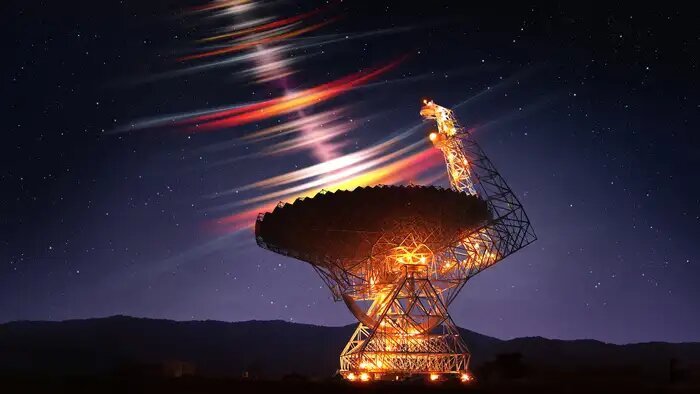
Artist's impression of the discovery of microsecond bursts. The foreground shows the Green Bank Telescope (United States) with which the research was done. Incoming radio waves are shown as white, red, and orange streaks that follow each other in rapid succession. The long red streaks are the previously known millisecond flashes. (c) Daniëlle Futselaar/www.artsource.nl
Tyler O'Neal, Staff Editor APPLICATIONS October 20, 2023, 10:00 am

Dutch astronomers search through telescope archives; recently discovering a burst event that lasted for just a few microseconds

An international team of researchers led by Dutch Ph.D. candidate Mark Snelders has discovered radio pulses from the distant universe that last only millionths of a second. The ultrafast bursts are a new kind of fast radio bursts, which are unpredictable flashes of radio waves far beyond our Milky Way, possibly caused by magnetic neutron stars. The discovery of these ultrafast bursts could help researchers create a map of the space between stars and galaxies to better understand how galaxies are being fed by the surrounding gas.

Researchers at the University of Amsterdam and ASTRON discovered microsecond radio bursts after meticulously examining archival data from a known millisecond source. The origin of these ultra-fast bursts remains unclear, but they may be caused by magnetic neutron stars, also known as magnetars. The first bursts were discovered in 2007 and most of them last longer than a thousandth of a second, emitting as much energy as our sun generates in a day.

In 2022, Mark Snelders, a Ph.D. candidate at ASTRON and the University of Amsterdam, led a team that hypothesized the existence of bursts that would last only millionths of a second. The researchers used a public archive from the Breakthrough Listen project, which searches for extraterrestrial life, to analyze five hours of data from the known repeating fast radio burst FRB 20121102A, located three billion light years away toward the constellation of Auriga.

The researchers used software filters and machine learning to analyze half a million individual images per second, discovering eight ultra-fast bursts that lasted only ten-millionths of a second or less. While researchers expect to find more such sources, some data files may not be detailed enough to analyze in such detail.

Ultimately, the researchers hope to use the bursts to create a map of the space between stars and galaxies to better understand how galaxies are fed by the surrounding gas.

AI hardware processing is going 3D, from square to cube, to boost processing power

AI hardware processing is going 3D, from square to cube, to boost processing power

Tyler O'Neal, Staff Editor APPLICATIONS October 20, 2023, 7:00 am

A team of researchers from the University of Oxford, in collaboration with other universities, has developed an innovative hardware system that combines photonic and electronic technologies to process 3D data. The system significantly enhances processing power for AI tasks. To test the hardware, the team analyzed 100 electrocardiogram signals simultaneously and achieved a 93.5% accuracy rate in identifying the risk of sudden death. The researchers believe that this approach could lead to a 100-fold increase in energy efficiency and compute density compared to current electronic processors if scaled up.

The efficiency of conventional computer chip processing doubles every 18 months. However, modern AI tasks require processing power that is currently doubling every 3.5 months. This means that new supercomputing paradigms are urgently needed to cope with this rising demand.

One possible solution is to use light instead of electronics to carry out multiple calculations in parallel using different wavelengths to represent different sets of data. In 2021, the same authors published groundbreaking work demonstrating a form of integrated photonic processing chip that could carry out matrix-vector multiplication at a much faster speed than the fastest electronic approaches. This breakthrough led to the creation of Salience Labs, a photonic AI company that emerged from the University of Oxford.

The team has now taken this concept further by adding an extra parallel dimension to the processing capability of their photonic matrix-vector multiplier chips. This higher-dimensional processing is made possible by using multiple different radio frequencies to encode the data, thereby achieving a level of parallelism that was previously impossible.

The team tested the hardware by applying it to the task of assessing the risk of sudden death from electrocardiograms of heart disease patients. They were able to successfully analyze 100 electrocardiogram signals simultaneously, accurately identifying the risk of sudden death with 93.5% accuracy.

The researchers estimated that even with a moderate scaling of 6 inputs x 6 outputs, this approach could outperform state-of-the-art electronic processors, potentially providing a 100-times enhancement in energy efficiency and compute density. The team anticipates further enhancement in supercomputing parallelism in the future by exploiting more degrees of freedom of light, such as polarization and mode multiplexing.

Dr. Bowei Dong, the first author of the publication, expressed his gratitude for the vibrant and collaborative platform provided by Oxford, which gave him the opportunity and courage to push the frontiers of advanced AI supercomputing hardware. Professor Harish Bhaskaran, the co-founder of Salience Labs and leader of this work, said that this is an exciting time to be doing research in AI hardware at the fundamental scale, and this work is one example of how what we assumed was a limit can be further surpassed.

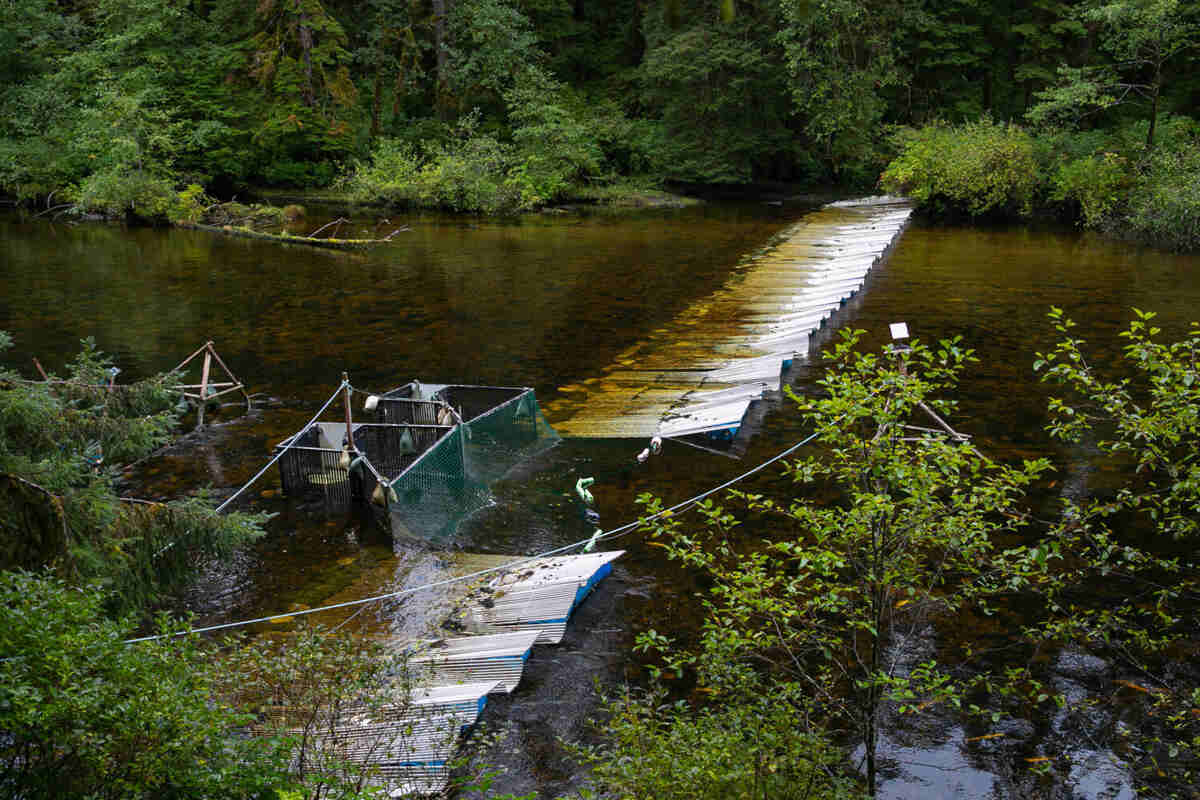
A weir on the Koeye River is one location where Wild Salmon Center is partnering with First Nations to pilot the Salmon Vision technology. (PC: Olivia Leigh Nowak/Le Colibri Studio.)

WSC, First Nations develop Salmon Vision, a real-time machine learning model to track salmon returns

Tyler O'Neal, Staff Editor APPLICATIONS October 19, 2023, 3:00 pm

The Wild Salmon Center has partnered with several First Nations to use a combination of cutting-edge artificial intelligence tools and traditional Indigenous fishing methods to gain a better understanding of salmon runs in real time. The Salmon Vision deep learning model, which uses advanced artificial intelligence tools to identify and count fish species, is currently being utilized in various rivers around the North and Central Coasts of British Columbia. By 2024, Salmon Vision aims to provide reliable real-time fish count data to First Nations fisheries managers, thereby increasing their involvement in fisheries management decisions.

Fisheries managers on British Columbia’s Central Coast have to make decisions without knowing how many salmon are returning until after fishing seasons are over. They have to make forecasts and set harvest targets for commercial and recreational fisheries based on modeled data from the past. Emergency closures also have to be decided on when salmon populations start to decline. However, with the unpredictable and accelerating effects of climate change, it is increasingly difficult to rely on past data to predict future salmon returns. 

Dr. Will Atlas, Wild Salmon Center Senior Watershed Scientist, suggests a solution called “Salmon Vision.” A first-of-its-kind technology that combines artificial intelligence with ancient fishing weir technology, the Salmon Vision computer deep learning model can identify and count fish species. Developed by WSC in data partnership with the Gitanyow Fisheries Authority and Skeena Fisheries Commission, Salmon Vision aims to enable real-time salmon population monitoring for First Nations fisheries managers and beyond.

Automating fish counting is crucial for informed decisions while salmon are still running, according to many of our First Nations partners. Dr. Atlas suggests that underwater video technology can help us see those salmon returning to rivers. 

The Salmon Vision pilot study has annotated over 500,000 video frames captured at Indigenous-run fish counting weirs on the Kitwanga and Bear Rivers of B.C.'s Central Coast. Early assessments indicate that the technology is adept at tracking 12 different fish species passing through custom fish-counting boxes at the two weirs, with scores surpassing 90 and 80 percent accuracy for coho and sockeye salmon: two of the principal fish species targeted by First Nations, commercial, and recreational fishers. 

The Heiltsuk Nation is running Salmon Vision on a weir on the Koeye River. For First Nations like the Heiltsuk, weirs represent more than a revitalization of an age-old fishing technology. The rebuilding of weirs on rivers like the Koeye is a statement of First Nations sovereignty and their seat at the table in fisheries management decisions, as they were banned in the late 1800s by Canada's Department of Fisheries and Oceans as a way to consolidate control of fishery resources. 

"Modern-day expression of Heiltsuk title and rights and an avenue for us to be a part of the latest science," says William Housty, Associate Director of the Heiltsuk Integrated Resource Management Department. "And to make decisions not just for the betterment of this creek, but for the whole ecosystem." 

The Salmon Vision team is implementing automated counting on a trial basis in several rivers around the B.C. North and Central Coasts with partner First Nations. The goal is to provide reliable real-time fish count data to these partners by 2024. Ultimately, Dr. Atlas says, this groundbreaking A.I. technology could be in place in rivers across the North Pacific. 

"How many salmon are returning everywhere that we're fishing for salmon is the information we need," Dr. Atlas says. "You can't tell me with a straight face that you're having a sustainable fishery if you don't know how many fish you have coming back. And that's a problem right around the Pacific Rim." 

It's a problem with a promising solution, one that's just now coming into focus.

  1. Scientists are using the mechanics of giant waves on a nanometric scale
  2. German scientists use supercomputing tech to gain a better understanding of the 3D structure of kilonovae

Page 11 of 66

  • 6
  • 7
  • 8
  • 9
  • 10
  • 11
  • 12
  • 13
  • 14
  • 15
POPULAR RIGHT NOW
  • Supercomputers replace ‘bathtub’ flood maps with physics-based digital twins of Britain’s coastline
    Supercomputers replace ‘bathtub’ flood maps with physics-based digital twins of Britain’s coastline
  • Supercomputers push neural quantum simulation beyond previous limits
    Supercomputers push neural quantum simulation beyond previous limits
  • Intel’s AI supercomputing revival: Q2 financial surge signals new era for CPU-powered HPC infrastructure
    Intel’s AI supercomputing revival: Q2 financial surge signals new era for CPU-powered HPC infrastructure
  • AWS supercomputing investment reaches historic scale as Amazon’s AI strategy powers record financial results
    AWS supercomputing investment reaches historic scale as Amazon’s AI strategy powers record financial results
  • AI infrastructure financing fears shake semiconductor sector
    AI infrastructure financing fears shake semiconductor sector
  • Catching the wave of the future: Supercomputers unlock the hidden dynamics of Venus
    Catching the wave of the future: Supercomputers unlock the hidden dynamics of Venus
  • NCAR supercomputers run planet scale climate experiments impossible in the real world
    NCAR supercomputers run planet scale climate experiments impossible in the real world
  • AI hunts the cosmos: Machine learning helps astronomers discover the first ‘Wandering’ supermassive black hole caught destroying a star
    AI hunts the cosmos: Machine learning helps astronomers discover the first ‘Wandering’ supermassive black hole caught destroying a star
  • Supercomputing for the masses: Meta's vision of a personal superintelligence for everyone
    Supercomputing for the masses: Meta's vision of a personal superintelligence for everyone
  • NVIDIA helps turn AI compute into a new asset class as Wall Street mobilizes $500 billion
    NVIDIA helps turn AI compute into a new asset class as Wall Street mobilizes $500 billion
THIS YEAR'S MOST READ
  • Wall Street wants to trade supercomputing power like oil
    Wall Street wants to trade supercomputing power like oil
  • Beamforming the future: BeammWave's 6G push signals the rise of orbital-terrestrial wireless networks
    Joakim Axmon
    Joakim Axmon
  • Cosmic ambition at scale: UK’s supercomputer unlocks a 2.5 petabytes universe
    Cosmic ambition at scale: UK’s supercomputer unlocks a 2.5 petabytes universe
  • Hidden order, revealed at scale: Supercomputing, electron ptychography uncover the inner workings of relaxor ferroelectrics
    Hidden order, revealed at scale: Supercomputing, electron ptychography uncover the inner workings of relaxor ferroelectrics
  • Intel's Q1 results signal supercomputing surge driving Xeon momentum
    Intel's Q1 results signal supercomputing surge driving Xeon momentum
  • When stars fall apart: Supercomputing reveals the hidden physics of black holes
    When stars fall apart: Supercomputing reveals the hidden physics of black holes
  • MIT develops computational framework to probe dark matter via gravitational waves
    MIT develops computational framework to probe dark matter via gravitational waves
  • Explainable AI moves into the watershed: FAMU-FSU engineers build predictive framework for real-time E. coli forecasting
    FAMU-FSU College of Engineering Assistant Professor Nasrin Alamdari. (Scott Holstein/FAMU-FSU College of Engineering)
    FAMU-FSU College of Engineering Assistant Professor Nasrin Alamdari. (Scott Holstein/FAMU-FSU College of Engineering)
  • Multi-layer simulations reveal the hidden supply chain of solar prominences
    Multi-layer simulations reveal the hidden supply chain of solar prominences
  • Japanese scientists decode dolphin speed with supercomputing: Turbulence, vortices, and the hidden physics of propulsion
    Japanese scientists decode dolphin speed with supercomputing: Turbulence, vortices, and the hidden physics of propulsion
  • FRONTPAGE
  • LATEST
  • POPULAR
  • REGISTER
  • SOCIAL
  • VIDEO
  • SUBSCRIPTION
  • RSS
  • GUIDELINES
  • PRIVACY
  • TOS
  • ABOUT
  • +1 (816) 799-4488
  • editorial@supercomputingonline.com
© 2001 - 2026 SuperComputingOnline.com, LLC. All rights reserved. This material may not be published, broadcast, rewritten or redistributed without permission.
Sign In
  • FRONT PAGE
  • LATEST
    • MEDIA KIT
    • MOST READ
    • RSS FEED
    • ACADEMIA
    • AEROSPACE
    • APPLICATIONS
    • ASTRONOMY
    • AUTOMOTIVE
    • BIG DATA
    • BIOLOGY
    • CHEMISTRY
    • CLIENTS
    • CLOUD
    • DEFENSE
    • DEVELOPER TOOLS
    • EARTH SCIENCES
    • ECONOMICS
    • ENGINEERING
    • ENTERTAINMENT
    • HEALTH
    • INDUSTRY
    • INTERCONNECTS
    • GAMING
    • GOVERNMENT
    • MANUFACTURING
    • MIDDLEWARE
    • MOVIES
    • NETWORKS
    • OIL & GAS
    • PHYSICS
    • PROCESSORS
    • RETAIL
    • SCIENCE
    • STORAGE
    • SYSTEMS
    • VISUALIZATION
  • VIDEOS
    • ADD YOUR VIDEOS
    • MANAGE VIDEOS
  • COMMUNITY
    • TRADE SHOWS
    • SOCIAL NETWORK VIDEOS
    • SURVEYS
    • APPLICATIONS BROWSER
    • CONVERSATION INBOX
    • SOCIAL ADVERTISER
    • GROUPS
    • MARKETPLACE LISTINGS
    • PAGES
    • LEADERBOARD
    • POINTS LISTING
      • BADGES
    • PRIVACY CONFIRM REQUEST
    • PRIVACY CREATE REQUEST

Hey there! We noticed you’re using an ad blocker.