German scientist has commercialized green supercomputer technology 'Made in Hessen'

Patenting and commercialization crown ten years' development work based on the 'Green IT' approach of Professor Volker Lindenstruth of Goethe University and the GSI Helmholtz Centre for Heavy Ion Research

By 2030, data centers could be responsible for 13 percent of worldwide power consumption. In Frankfurt, the global network node with the highest data volume, data centers today already consume 20 percent of all local electricity - and this figure is rising. A large part of it is used for cooling power. Already today, the waste heat from single large-scale data centers could be used to heat up to 10,000 households.

An answer to this global challenge comes from Hessen. To be specific, it comes from Goethe University and the GSI Helmholtz Centre for Heavy Ion Research, which was recently granted a European patent for their concept for an energy-efficient cooling structure for data centers. This patent now paves the way for the commercialization of the pioneering technology developed by Professor Volker Lindenstruth, Professor Horst Stöcker and Alexander Hauser of e3c. Together with parallel patents outside Europe, the invention can now be put to economic use throughout the world. The team has already received inquiries from various countries for the construction of such data centers.

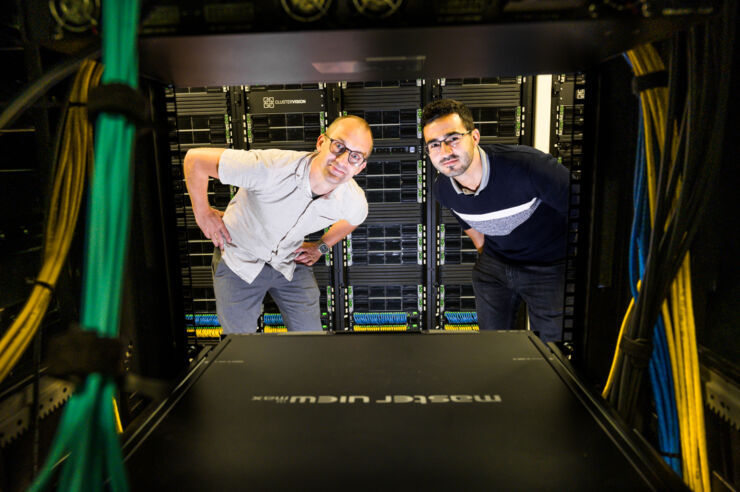
The data center is thus becoming an important export commodity "Made in Hessen." This success is also thanks to Innovectis, Goethe University's own transfer agency, and its managing director Dr. Martin Raditsch, the driving force behind the invention's commercialization, as well as Dr. Tobias Engert, head of the GSI's Technology Transfer Department. The successful commercialization of the patents is a perfect example of collaboration between a university and a major research facility in Hessen. CAPTION Volker Lindenstruth: {module INSIDE STORY}

NDC Data Centers GmbH, a Munich-based company, has obtained the rights to market the green technology in data center construction projects around the globe and is thus also making a major contribution to the careful handling of our energy resources against the backdrop of global digitalization.

The basis for these activities is the visionary concept of a significantly optimized cooling system for data centers with the highest possible level of energy efficiency, which was developed by Volker Lindenstruth, Professor for High-Performance Computing Architecture at Goethe University and former head of the Scientific IT Department at GSI. On the basis of his concept, data centers, and commercial IT systems can today be operated with up to 50 percent less primary energy consumption in comparison to conventional data centers.

The technology has been in use for years and is being continuously improved: The first data center of this type was Goethe University's own, which was set at in the Infraserv industrial park. Another very data center, the Green IT Cube, was built by the GSI Helmholtz Centre in Darmstadt and financed from funds provided by the German federal government and the Federal State of Hessen via Helmholtz expansion investments. The concept enables the realization and particularly efficient operation of data centers for large-scale research facilities such as FAIR (Facility for Antiproton and Ion Research), which is currently being set up at the GSI. Later, the Green IT Cube will be the central data center for FAIR, one of the largest projects worldwide in support of research. Moreover, the waste heat from the servers in the Green IT Cube is already being used today to heat a modern office and canteen building on the GSI campus.

Apart from the high energy savings associated with the use of this new technology, the construction of such data centers is also extraordinarily cost-efficient, thus minimizing procurement and operating costs: An expedient coupling of ecology and economy.

Lindenstruth's supercomputers have received several awards for their energy-efficient concept in recent years. At the end of 2014, one of his computers ranked first place in the global listing of the most energy-efficient supercomputers, thanks to its greatly optimized computer architecture.

Goethe University's success in the area of green IT is also spurring on its current application, together with Mainz, Kaiserslautern, and Saarbrücken, to host one of the new National High-Performance Computing Centres. Thanks to the optimized computer architecture based on the Hessian green IT approach, considerably more computing power could be made available to users at the same cost. Goethe University would, therefore, be an ideal location for one of the new centers.

Views on the green supercomputer technology:

Angela Dorn, Hessen's Minister of Science, says: "My sincere congratulations to Professor Lindenstruth and his team. I'm especially pleased that this success has been accomplished in a field close to my heart: The energy turnaround to which green IT can make a very important contribution. I'm also very happy that we as the Federal State of Hessen have contributed to this success. The first supercomputer in which Professor Lindenstruth used his energy-saving technology was the LOEWE-CSC at Goethe University's data center in the Infraserv industrial park. Hessen's Ministry of Science supported this investment with a total of almost € 2 million in the shape of both direct fundings as well as from the LOEWE program. We're therefore today harvesting together with the fruits of this funding and the LOEWE program launched in 2008."

Professor Birgitta Wolff, President of Goethe University, says: "Just as in Goethe's days it made no sense to harness more and more horses in front of a stagecoach in order to increase the speed, so today we are facing a fundamental paradigm shift in IT. Back then, the railroad was the answer to the problem of speed. Today, the smart IT sector has a huge sustainability and energy problem. To satisfy its enormous hunger for data, our IT-based society requires new energy concepts for supercomputers that drastically reduce power consumption. Volker Lindenstruth from Goethe University has developed such a solution. It's successful patenting with the support of our subsidiary Innovectis is a major step in the right direction: The dissemination and commercialization of this truly smart technology."

Professor Volker Lindenstruth, Professor for High-Performance Computing Architecture at Goethe University, says: "Our successful patent registration is a milestone for the further global commercialization of our "Green IT" approach. We've already received inquiries for it from various regions worldwide. This gives our work a further boost, the more so since with NDC we now have a strong business partner at our side to help with the practical steps."

Professor Karlheinz Langanke, Research Director of the GSI Helmholtz Centre for Heavy Ion Research and FAIR - Facility for Antiproton and Ion Research in Europe, says: "The Green IT Cube high-performance computing center at the GSI Helmholtz Centre is an outstanding example of how practical and usable know-how and developments evolve out of basic research. The Green IT Cube was developed for enormous volumes of measurement data from scientific research: It provides the highest computing capacities required and is at the same time extraordinarily energy-efficient and space-saving."

Markus Bodenmeier, NDC co-founder and partner: "With the help of the innovations created by Professor Volker Lindenstruth from Goethe University and by the GSI, NDC Data Centers GmbH builds the most energy-efficient and resource-friendly data centers. In so doing, we can guarantee over the long term the benefits offered by the exponential growth of digitalization. We're in keeping here with the current trend - all major cloud operators are at present keeping a very close eye on the impact of their activities on the environment."

Other statements by experts involved:

Dr. Martin Raditsch, Managing Director of Innovectis GmbH, a subsidiary of Goethe University explains: "The application in practice of this technology is a very nice example of how results from basic research at the university and their transfer lead to technological solutions for societal challenges. Through our technology, the advancing digitalization of industry and society can be accomplished in a far more energy-saving way."

Dr. Tobias Engert, Director of the Technology Transfer Department at the GSI, is very pleased about the invention's success: "The cooling concept of the Green IT Cube at the GSI is based on an innovative idea for the reduction of energy costs, and together with Innovectis we've now been able to successfully market it to NDC. Equipped with an innovative cooling system, the Green IT Cube meets the high requirements of optimum energy efficiency coupled with the highest possible computing power, and it will later become the central data center for the new accelerator FAIR - Facility for Antiproton and Ion Research. The commercialization of the patents is certainly one of the most important examples of technology transfer from the GSI into the industry." His colleague Michael Geier, Director of the Patents Department, adds: "The sale of the patents to NDC corroborates how important it is to protect new technical solutions developed at research facilities such as the GSI through patents. Such patents are a deciding factor for technology transfer into the industry, through which income is generated that then flows back into research."

British researchers use sound, light to generate ultra-fast data transfer

Researchers have made a breakthrough in the control of terahertz quantum cascade lasers, which could lead to the transmission of data at the rate of 100 gigabits per second - around one thousand times quicker than a fast Ethernet operating at 100 megabits a second.

What distinguishes terahertz quantum cascade lasers from other lasers is the fact that they emit light in the terahertz range of the electromagnetic spectrum. They have applications in the field of spectroscopy where they are used in chemical analysis.

The lasers could also eventually provide ultra-fast, short-hop wireless links where large datasets have to be transferred across hospital campuses or between research facilities on universities - or in satellite communications.

To be able to send data at these increased speeds, the lasers need to be modulated very rapidly: switching on and off or pulsing around 100 billion times every second.

Engineers and scientists have so far failed to develop a way of achieving this.

A research team from the University of Leeds and University of Nottingham believe they have found a way of delivering ultra-fast modulation, by combining the power of acoustic and light waves.  Dr Aniela Dunn holds the laser and its mounting in the palm of her hand.

John Cunningham, Professor of Nanoelectronics at Leeds, said: "This is exciting research. At the moment, the system for modulating a quantum cascade laser is electrically driven - but that system has limitations. 

"Ironically, the same electronics that deliver the modulation usually puts a brake on the speed of the modulation. The mechanism we are developing relies instead on acoustic waves."

A quantum cascade laser is very efficient. As an electron passes through the optical component of the laser, it goes through a series of 'quantum wells' where the energy level of the electron drops and a photon or pulse of light energy is emitted.

One electron is capable of emitting multiple photons. It is this process that is controlled during the modulation.

Instead of using external electronics, the teams of researchers at Leeds and Nottingham Universities used acoustic waves to vibrate the quantum wells inside the quantum cascade laser.

The acoustic waves were generated by the impact of a pulse from another laser onto an aluminum film. This caused the film to expand and contract, sending a mechanical wave through the quantum cascade laser.

Tony Kent, Professor of Physics at Nottingham said "Essentially, what we did was use the acoustic wave to shake the intricate electronic states inside the quantum cascade laser. We could then see that its terahertz light output was being altered by the acoustic wave." {module INSIDE STORY}

Professor Cunningham added: "We did not reach a situation where we could stop and start the flow completely, but we were able to control the light output by a few percents, which is a great start.

"We believe that with further refinement, we will be able to develop a new mechanism for complete control of the photon emissions from the laser, and perhaps even integrate structures generating sound with the terahertz laser so that no external sound source is needed."

Professor Kent said: "This result opens a new area for physics and engineering to come together in the exploration of the interaction of terahertz sound and light waves, which could have real technological applications."

Astronomers create Orbitize! code to unlock the evolution of distant giant planets formation

A team of astronomers led by Brendan Bowler of The University of Texas at Austin has probed the formation process of giant exoplanets and brown dwarfs, a class of objects that are more massive than giant planets, but not massive enough to ignite nuclear fusion in their cores to shine like true stars.

Using direct imaging with ground-based telescopes in Hawaii - W. M. Keck Observatory and Subaru Telescope on Maunakea - the team studied the orbits of these faint companions orbiting stars in 27 systems. These data, combined with modeling of the orbits, allowed them to determine that the brown dwarfs in these systems formed like stars, but the gas giants formed like planets.

The research is published in the current issue of The Astronomical Journal.

In the last two decades, technological leaps have allowed telescopes to separate the light from a parent star and a much-dimmer orbiting object. In 1995, this new capability produced the first direct images of a brown dwarf orbiting a star. The first direct image of planets orbiting another star followed in 2008.

"Over the past 20 years, we've been leaping down and down in mass," Bowler said of the direct imaging capability, noting that the current limit is about 1 Jupiter mass. As technology has improved, "One of the big questions that have emerged is 'What's the nature of the companions we're finding?'" CAPTION This image of the low-mass brown dwarf GJ 504 B was taken by Bowler and his team using adaptive optics with the NIRC2 camera at Keck Observatory in Hawaii. The image has been processed to remove light from the host star (whose position is marked with an {module INSIDE STORY}

Brown dwarfs, as defined by astronomers, have masses between 13 and 75 Jupiter masses. They have characteristics in common with both planets and with stars, and Bowler and his team wanted to settle the question: Are gas giant planets on the outer fringes of planetary systems the tip of the planetary iceberg, or the low-mass end of brown dwarfs? Past research has shown that brown dwarfs orbiting stars likely formed like low-mass stars, but it's been less clear what is the lowest mass companion this formation mechanism can produce.

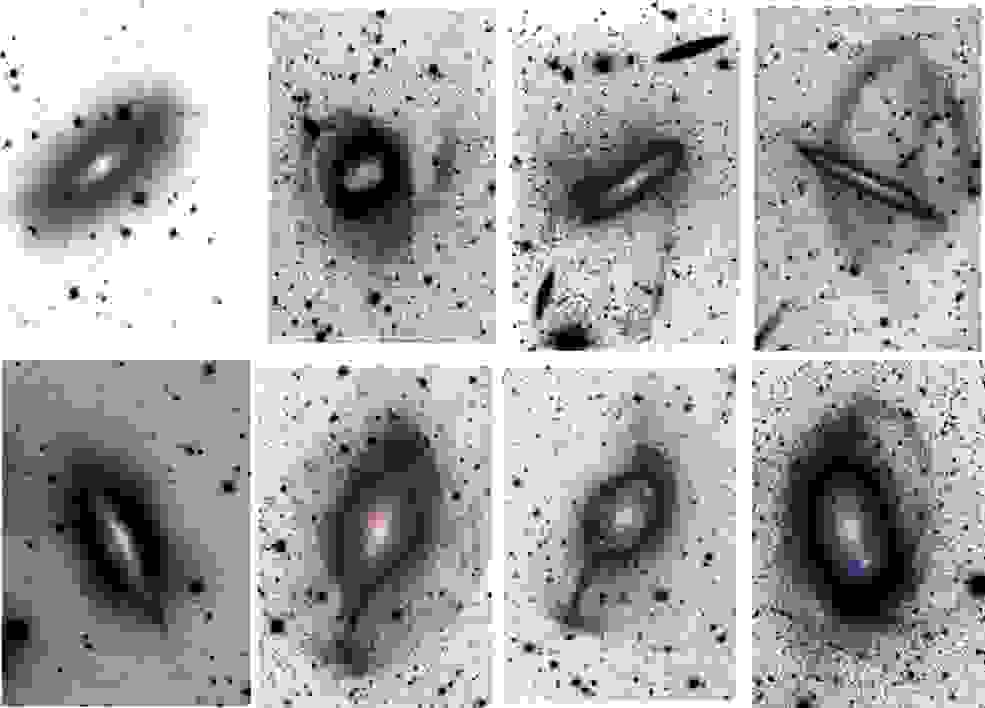
"One way to get at this is to study the dynamics of the system -- to look at the orbits," Bowler said. Their orbits today hold the key to unlocking their evolution.CAPTION By patiently watching giant planets and brown dwarfs orbit their host stars, Bowler and his team were able to constrain the orbit shapes even though only a small portion of the orbit has been monitored. The longer the time baseline, the smaller the range of possible orbits. These plots show nine of the 27 systems from their study.  CREDIT Brendan Bowler (UT-Austin){module INSIDE STORY}

Using Keck Observatory's adaptive optics (AO) system with the Near-Infrared Camera, second-generation (NIRC2) instrument on the Keck II telescope, as well as the Subaru Telescope, Bowler's team took images of giant planets and brown dwarfs as they orbit their parent stars.

It's a long process. The gas giants and brown dwarfs they studied are so distant from their parent stars that one orbit may take hundreds of years. To determine even a small percentage of the orbit, "You take an image, you wait a year," for the faint companion to travel a bit, Bowler said. Then "you take another image, you wait another year."

This research relied on AO technology, which allows astronomers to correct for distortions caused by the Earth's atmosphere. As AO instruments have continually improved over the past three decades, more brown dwarfs and giant planets have been directly imaged. But since most of these discoveries have been made over the past decade or two, the team only has images corresponding to a few percents of each object's total orbit. They combined their new observations of 27 systems with all of the previous observations published by other astronomers or available in telescope archives. 

At this point, supercomputer modeling comes in. Coauthors on this paper have helped create an orbit-fitting code called "Orbitize!" which uses Kepler's laws of planetary motion to identify which types of orbits are consistent with the measured positions, and which are not. 

The code generates a set of possible orbits for each companion. The slight motion of each giant planet or brown dwarf forms a "cloud" of possible orbits. The smaller the cloud, the more astronomers are closing in on the companion's true orbit. And more data points -- that is, more direct images of each object as it orbits -- will refine the shape of the orbit.

"Rather than wait decades or centuries for a planet to complete one orbit, we can make up for the shorter time baseline of our data with very accurate position measurements," said team member Eric Nielsen of Stanford University. "A part of Orbitize! that we developed specifically to fit partial orbits, OFTI [Orbits For The Impatient], allowed us to find orbits even for the longest period companions."

Finding the shape of the orbit is key: Objects that have more circular orbits probably formed like planets. That is when a cloud of gas and dust collapsed to form a star, the distant companion (and any other planets) formed out of a flattened disk of gas and dust rotating around that star. CAPTION These two curves show the final distribution of orbit shapes for giant planets and brown dwarfs. The orbital eccentricity determines how elongated the ellipse is, with a value of 0.0 corresponding to a circular orbit and a high value near 1.0 being a flattened ellipse. Gas giant planets located at wide separations from their host stars have low eccentricities, but the brown dwarfs have a wide range of eccentricities similar to binary star systems. For reference, the giant planets in our solar system have eccentricities less than 0.1.  CREDIT Credit: Brendan Bowler (UT-Austin){module INSIDE STORY}

On the other hand, the ones that have more elongated orbits probably formed like stars. In this scenario, a clump of gas and dust was collapsing to form a star, but it fractured into two clumps. Each clump then collapsed, one forming a star, and the other a brown dwarf orbiting around that star. This is essentially a binary star system, albeit containing one real star and one "failed star."

"Even though these companions are millions of years old, the memory of how they formed is still encoded in their present-day eccentricity," Nielsen added. Eccentricity is a measure of how circular or elongated an object's orbit is.

The results of the team's study of 27 distant companions were unambiguous. 

"The punchline is, we found that when you divide these objects at this canonical boundary of more than about 15 Jupiter masses, the things that we've been calling planets do indeed have more circular orbits, as a population, compared to the rest," Bowler said. "And the rest look like binary stars."

The future of this work involves both continuing to monitor these 27 objects, as well as identifying new ones to widen the study. "The sample size is still modest, at the moment," Bowler said. His team is using the Gaia satellite to look for additional candidates to follow up using direct imaging with even greater sensitivity at the forthcoming Giant Magellan Telescope (GMT) and other facilities. UT-Austin is a founding member of the GMT collaboration.

Bowler's team's results reinforce similar conclusions recently reached by the GPIES direct imaging survey with the Gemini Planet Imager, which found evidence for a different formation channel for brown dwarfs and giant planets based on their statistical properties.

This work was supported by a NASA Keck PI Data Award, administered by the NASA Exoplanet Science Institute. The Keck Observatory is managed by Caltech and the University of California.