

SUPERCOMPUTING NEWS SUPERCOMPUTING NEWS
    • MEDIA KIT
    • MOST READ
    • RSS FEED
    • ACADEMIA
    • AEROSPACE
    • APPLICATIONS
    • ASTRONOMY
    • AUTOMOTIVE
    • BIG DATA
    • BIOLOGY
    • CHEMISTRY
    • CLIENTS
    • CLOUD
    • DEFENSE
    • DEVELOPER TOOLS
    • EARTH SCIENCES
    • ECONOMICS
    • ENGINEERING
    • ENTERTAINMENT
    • GAMING
    • GOVERNMENT
    • HEALTH
    • OIL & GAS
    • INDUSTRY
    • INTERCONNECTS
    • MANUFACTURING
    • MIDDLEWARE
    • MOVIES
    • NETWORKS
    • PHYSICS
    • PROCESSORS
    • RETAIL
    • SCIENCE
    • STORAGE
    • SYSTEMS
    • VISUALIZATION
    • AcyMailing subscription form

    • ADD YOUR VIDEOS
    • MANAGE VIDEOS
    • CONVERSATION INBOX
    • SOCIAL ADVERTISER
    • SOCIAL NETWORK VIDEOS
    • SURVEYS
    • GROUPS
    • PAGES
    • MARKETPLACE LISTINGS
    • APPLICATIONS BROWSER
    • PRIVACY CONFIRM REQUEST
    • PRIVACY CREATE REQUEST
    • LEADERBOARD
    • POINTS LISTING
      • BADGES
    • TRADE SHOWS
Sign In
Tyler O'Neal, Staff Editor APPLICATIONS October 10, 2023, 11:00 am

Energy consumption of AI could be equivalent to that of a small country

AI has the potential to have a large energy footprint in the future, potentially exceeding the power demands of some countries. Improvements in AI efficiency can lead to increased demand and the Jevons Paradox. Google processes up to 9 billion searches a day and if every search used AI it would need about 29.2 TWh of power a year, the same as Ireland's annual electricity consumption.

Artificial intelligence (AI) is believed to help coders code faster, make daily tasks less time-consuming, and improve driving safety. However, a recent commentary published in the Joule journal by the founder of Digiconomist suggests that the tool's massive adoption could result in a large energy footprint. In the future, this energy demand could exceed that of some countries.

The author of the commentary, Alex de Vries, a Ph.D. candidate at Vrije Universiteit Amsterdam, states "Looking at the growing demand for AI services, it’s very likely that energy consumption related to AI will significantly increase in the coming years."

Generative AI, which produces text, images, or other data, has undergone rapid growth since 2022, including OpenAI’s ChatGPT. To train these AI tools, large amounts of data are required, which is an energy-intensive process. Hugging Face, an AI-developing company based in New York reported that its multilingual text-generating AI tool consumed about 433 megawatt-hours (MWH) during training, which is enough to power 40 average American homes for a year.

Furthermore, AI's energy demand does not end with training. De Vries's analysis shows that when the tool generates data based on prompts, every text or image it produces uses a significant amount of computing power and energy. For example, ChatGPT may consume 564 MWh of electricity every day.

As companies worldwide are striving to improve the efficiency of AI hardware and software to make the tool less energy-intensive, an increase in the machines’ efficiency often leads to an increase in demand. According to de Vries, technological advancements will lead to a net increase in resource use, a phenomenon known as Jevons’ Paradox.

Making these tools more efficient and accessible can result in allowing more applications it and more people to use them, de Vries says. For instance, Google has been incorporating generative AI in its email service and testing out powering its search engine with AI. Currently, the company processes up to 9 billion searches a day. Based on the data, de Vries estimates that if every Google search uses AI, it would require approximately 29.2 TWh of power per year, equivalent to the annual electricity consumption of Ireland.

However, de Vries notes that this extreme scenario is unlikely to occur in the short term due to the high costs associated with additional AI servers and bottlenecks in the AI server supply chain. Nevertheless, AI server production is projected to grow rapidly soon. By 2027, worldwide AI-related electricity consumption could increase by 85 to 134 TWh annually based on the projection of AI server production, according to de Vries.

This amount is comparable to the annual electricity consumption of countries such as the Netherlands, Argentina, and Sweden. Furthermore, improvements in AI efficiency could also enable developers to repurpose some computer processing chips for AI use, which could further increase AI-related electricity consumption.

“The potential growth highlights that we need to be very mindful about what we use AI for. It’s energy-intensive, so we don't want to put it in all kinds of things where we don’t actually need it,” de Vries says.
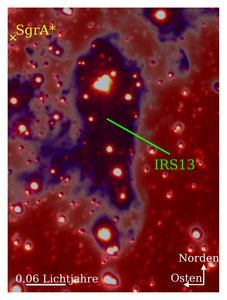
Ein Multi-Wellenlängenblick auf die Umgebung des supermassiven Schwarzen Lochs SgrA* (gelbes X). Rot sind die Sterne, blau der Staub. Viele der jungen Sterne in dem Sternenhaufen IRS13 werden vom Staub verdeckt oder von den hellen Sternen überblendet. Credits: Florian Peißker / Universität zu Köln

German astrophysicist discovers a turbulent fountain of youth in the center of our galaxy with a remarkable formation history

Tyler O'Neal, Staff Editor APPLICATIONS October 10, 2023, 5:08 am

A team of researchers led by Dr Florian Peißker at the University of Cologne’s Institute of Astrophysics has discovered an unexpectedly large number of young stars in the vicinity of a supermassive black hole. The study, titled ‘The Evaporating Massive Embedded Stellar Cluster IRS 13 Close to Sgr A*. Detection of a Rich Population of Dusty Objects in the IRS13 Cluster’ and published in The Astrophysical Journal, suggests that the star cluster IRS13, discovered over twenty years ago, migrated towards the supermassive black hole through a variety of processes, with its formation history being turbulent.

The researchers used a wide variety of data gathered over several decades from various telescopes to determine the cluster members in detail. The stars are a few hundred thousand years old, which is considered young for such conditions. Given the high-energy radiation and tidal forces of the galaxy, it is unexpected to have such a large number of young stars in the direct vicinity of the supermassive black hole.

In addition to the discovery of young stars, the researchers found water ice at the center of our galaxy for the first time. The James Webb Space Telescope (JWST) was used for the study, and the prism on board the telescope used to record a spectrum free of atmospheric interference from the Galactic Center was developed at the Institute of Astrophysics in the working group led by Professor Dr. Andreas Eckart, a co-author of the publication. The presence of water ice around very young stellar objects is another independent indicator of the young age of some stars near the black hole.

The researchers also found that IRS13 has a turbulent history of formation behind it and that it migrated towards the supermassive black hole through friction with the interstellar medium, collisions with other star clusters, or internal processes. From a certain distance, the cluster was then captured by the gravitation of the black hole. In this process, a bow shock may have formed at the top of the cluster from the dust surrounding the cluster, similar to the tip of a ship in the water. The increase in dust density stimulated further star formation, which explains why these young stars are mostly at the top or front of the cluster.

According to Dr Peißker, the analysis of IRS13 and the accompanying interpretation of the cluster is the first attempt to unravel a decade-old mystery about the unexpectedly young stars in the Galactic Center. Dr. Michal Zajaček, the second author of the study and scientist at Masaryk University in Brno (Czech Republic), added that the star cluster IRS13 may be the key to unraveling the origin of the dense star population at the center of our galaxy. The researchers have gathered extensive evidence that very young stars within the range of the supermassive black hole may have formed in star clusters such as IRS13, and have identified star populations of different ages in the cluster so close to the center of the Milky Way.

Further Information:
https://iopscience.iop.org/article/10.3847/1538-4357/acf6b5

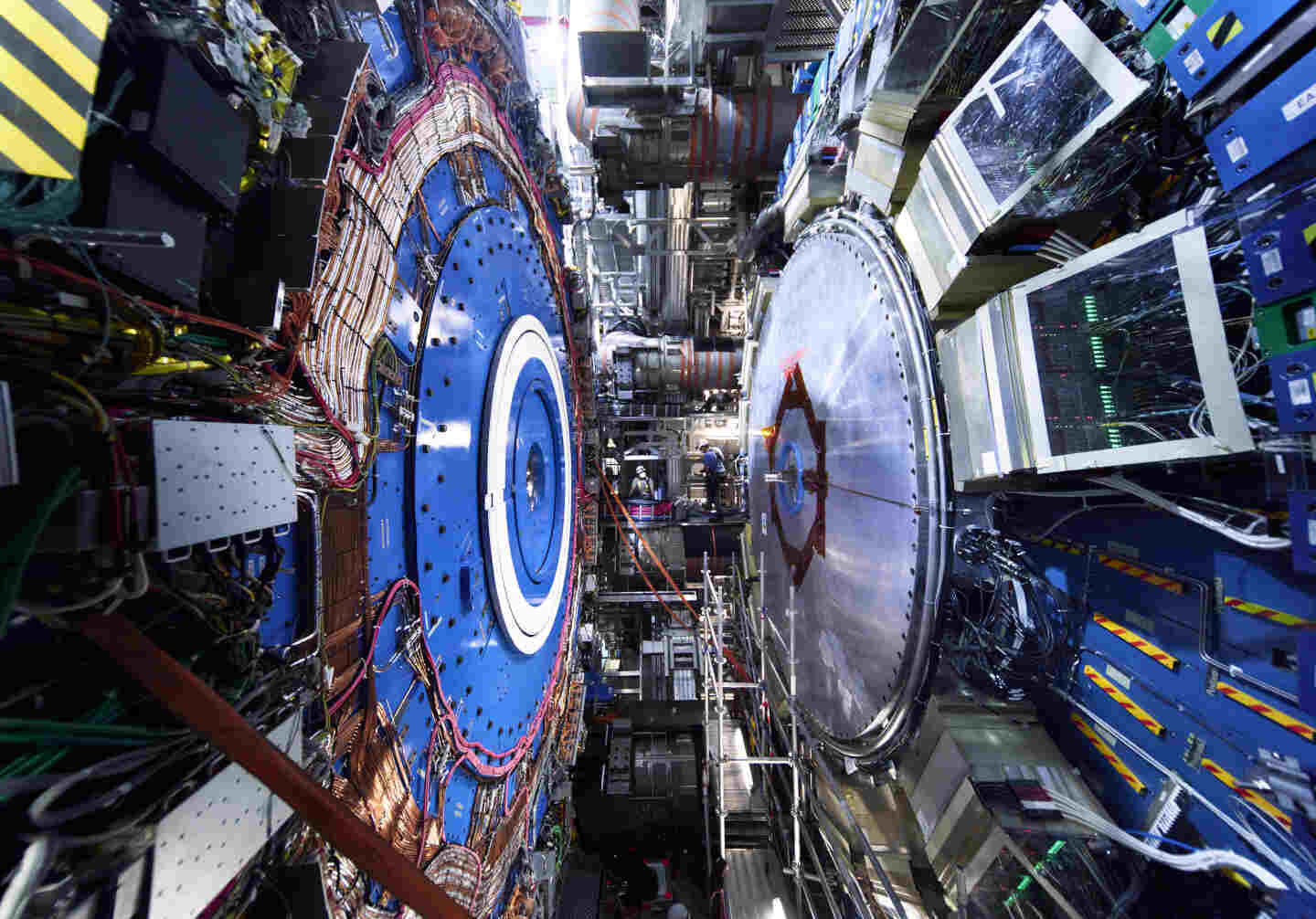
The ATLAS detector (Image: CERN)

ATLAS establishes strict boundaries on the potential existence of dark matter particles that are supersymmetric

Tyler O'Neal, Staff Editor APPLICATIONS October 10, 2023, 4:59 am

The ATLAS collaboration has conducted an extensive search for weakly interacting supersymmetric particles, which could potentially explain the mystery of dark matter. The searches have been very sensitive, exploring a broad range of supersymmetric particle masses, resulting in the exclusion of some previously favored regions.

Despite the progress made, many models remain elusive, and further developments in search strategies will be required to improve the sensitivity of ATLAS searches.

If new particles do exist, the Large Hadron Collider (LHC) is the perfect place to search for them. According to the theory of supersymmetry, a whole new family of partner particles exists for each of the known fundamental particles. While this might seem extravagant, these partner particles could address various shortcomings in current scientific knowledge, such as the source of the mysterious dark matter in the Universe, the “unnaturally” small mass of the Higgs boson, the anomalous way that the muon spins and even the relationship between the various forces of nature. But if these supersymmetric particles exist, where might they be hiding?

This is what physicists at the LHC have been trying to find out, and in a recent study of proton-proton collision data from Run 2 of the LHC (2015-2018), the ATLAS collaboration provides the most comprehensive overview yet of their searches for some of the most elusive types of supersymmetric particles - those that would only rarely be produced through the “weak” nuclear force or the electromagnetic force. The lightest of these weakly interacting supersymmetric particles could be the source of dark matter.

Thanks to the increased collision energy and the higher collision rate provided by Run 2, as well as new search algorithms and machine-learning techniques, ATLAS has been able to explore deeper into this difficult-to-reach territory of supersymmetry.

The ATLAS physicists have combined results from eight searches, each seeking evidence for supersymmetric particles in a different way. The combined power and sensitivity of the different search strategies have allowed ATLAS researchers to study tens of thousands of supersymmetry models, each with different predictions about the masses of supersymmetric particles.

These ATLAS searches have unprecedented sensitivity and explore a wide range of supersymmetric particle masses. The ATLAS physicists looked for evidence of “lab-made” dark matter – that is, dark matter created in LHC collisions. Their searches have proved complementary to other experiments seeking natural, “relic” dark matter left over from the Big Bang. Unlike collider searches, which don’t need to see the dark matter to infer its presence, the latter experiments rely on the sufficiently large probability of dark matter particles hitting normal materials and therefore being detected.

One of the most significant findings of this combination of searches is that some regions for supersymmetric-particle masses that were previously viewed favorably, where the dark matter particle has about half the mass of the Z boson or the Higgs boson, have now been almost entirely ruled out.

Another benefit of such a comprehensive study is an understanding of which supersymmetry models have not yet been probed. ATLAS has presented examples of such surviving models, which can be used to optimize future searches. Though possible hiding places for supersymmetric particles are being systematically reduced, many models remain stubbornly elusive. Improving the sensitivity of ATLAS searches to these models will require more collision data and further clever developments in search strategies.

  1. According to British researchers, AI language models aid in the diagnosis of schizophrenia
  2. Pulsars: Shedding light on the enigma of dark matter

Page 16 of 66

  • 11
  • 12
  • 13
  • 14
  • 15
  • 16
  • 17
  • 18
  • 19
  • 20
POPULAR RIGHT NOW
  • Supercomputers replace ‘bathtub’ flood maps with physics-based digital twins of Britain’s coastline
    Supercomputers replace ‘bathtub’ flood maps with physics-based digital twins of Britain’s coastline
  • Supercomputers push neural quantum simulation beyond previous limits
    Supercomputers push neural quantum simulation beyond previous limits
  • Intel’s AI supercomputing revival: Q2 financial surge signals new era for CPU-powered HPC infrastructure
    Intel’s AI supercomputing revival: Q2 financial surge signals new era for CPU-powered HPC infrastructure
  • AWS supercomputing investment reaches historic scale as Amazon’s AI strategy powers record financial results
    AWS supercomputing investment reaches historic scale as Amazon’s AI strategy powers record financial results
  • AI infrastructure financing fears shake semiconductor sector
    AI infrastructure financing fears shake semiconductor sector
  • Catching the wave of the future: Supercomputers unlock the hidden dynamics of Venus
    Catching the wave of the future: Supercomputers unlock the hidden dynamics of Venus
  • NCAR supercomputers run planet scale climate experiments impossible in the real world
    NCAR supercomputers run planet scale climate experiments impossible in the real world
  • AI hunts the cosmos: Machine learning helps astronomers discover the first ‘Wandering’ supermassive black hole caught destroying a star
    AI hunts the cosmos: Machine learning helps astronomers discover the first ‘Wandering’ supermassive black hole caught destroying a star
  • Supercomputing for the masses: Meta's vision of a personal superintelligence for everyone
    Supercomputing for the masses: Meta's vision of a personal superintelligence for everyone
  • NVIDIA helps turn AI compute into a new asset class as Wall Street mobilizes $500 billion
    NVIDIA helps turn AI compute into a new asset class as Wall Street mobilizes $500 billion
THIS YEAR'S MOST READ
  • Wall Street wants to trade supercomputing power like oil
    Wall Street wants to trade supercomputing power like oil
  • Beamforming the future: BeammWave's 6G push signals the rise of orbital-terrestrial wireless networks
    Joakim Axmon
    Joakim Axmon
  • Cosmic ambition at scale: UK’s supercomputer unlocks a 2.5 petabytes universe
    Cosmic ambition at scale: UK’s supercomputer unlocks a 2.5 petabytes universe
  • Hidden order, revealed at scale: Supercomputing, electron ptychography uncover the inner workings of relaxor ferroelectrics
    Hidden order, revealed at scale: Supercomputing, electron ptychography uncover the inner workings of relaxor ferroelectrics
  • Intel's Q1 results signal supercomputing surge driving Xeon momentum
    Intel's Q1 results signal supercomputing surge driving Xeon momentum
  • When stars fall apart: Supercomputing reveals the hidden physics of black holes
    When stars fall apart: Supercomputing reveals the hidden physics of black holes
  • MIT develops computational framework to probe dark matter via gravitational waves
    MIT develops computational framework to probe dark matter via gravitational waves
  • Explainable AI moves into the watershed: FAMU-FSU engineers build predictive framework for real-time E. coli forecasting
    FAMU-FSU College of Engineering Assistant Professor Nasrin Alamdari. (Scott Holstein/FAMU-FSU College of Engineering)
    FAMU-FSU College of Engineering Assistant Professor Nasrin Alamdari. (Scott Holstein/FAMU-FSU College of Engineering)
  • Multi-layer simulations reveal the hidden supply chain of solar prominences
    Multi-layer simulations reveal the hidden supply chain of solar prominences
  • Japanese scientists decode dolphin speed with supercomputing: Turbulence, vortices, and the hidden physics of propulsion
    Japanese scientists decode dolphin speed with supercomputing: Turbulence, vortices, and the hidden physics of propulsion
  • FRONTPAGE
  • LATEST
  • POPULAR
  • REGISTER
  • SOCIAL
  • VIDEO
  • SUBSCRIPTION
  • RSS
  • GUIDELINES
  • PRIVACY
  • TOS
  • ABOUT
  • +1 (816) 799-4488
  • editorial@supercomputingonline.com
© 2001 - 2026 SuperComputingOnline.com, LLC. All rights reserved. This material may not be published, broadcast, rewritten or redistributed without permission.
Sign In
  • FRONT PAGE
  • LATEST
    • MEDIA KIT
    • MOST READ
    • RSS FEED
    • ACADEMIA
    • AEROSPACE
    • APPLICATIONS
    • ASTRONOMY
    • AUTOMOTIVE
    • BIG DATA
    • BIOLOGY
    • CHEMISTRY
    • CLIENTS
    • CLOUD
    • DEFENSE
    • DEVELOPER TOOLS
    • EARTH SCIENCES
    • ECONOMICS
    • ENGINEERING
    • ENTERTAINMENT
    • HEALTH
    • INDUSTRY
    • INTERCONNECTS
    • GAMING
    • GOVERNMENT
    • MANUFACTURING
    • MIDDLEWARE
    • MOVIES
    • NETWORKS
    • OIL & GAS
    • PHYSICS
    • PROCESSORS
    • RETAIL
    • SCIENCE
    • STORAGE
    • SYSTEMS
    • VISUALIZATION
  • VIDEOS
    • ADD YOUR VIDEOS
    • MANAGE VIDEOS
  • COMMUNITY
    • TRADE SHOWS
    • SOCIAL NETWORK VIDEOS
    • SURVEYS
    • APPLICATIONS BROWSER
    • CONVERSATION INBOX
    • SOCIAL ADVERTISER
    • GROUPS
    • MARKETPLACE LISTINGS
    • PAGES
    • LEADERBOARD
    • POINTS LISTING
      • BADGES
    • PRIVACY CONFIRM REQUEST
    • PRIVACY CREATE REQUEST

Hey there! We noticed you’re using an ad blocker.