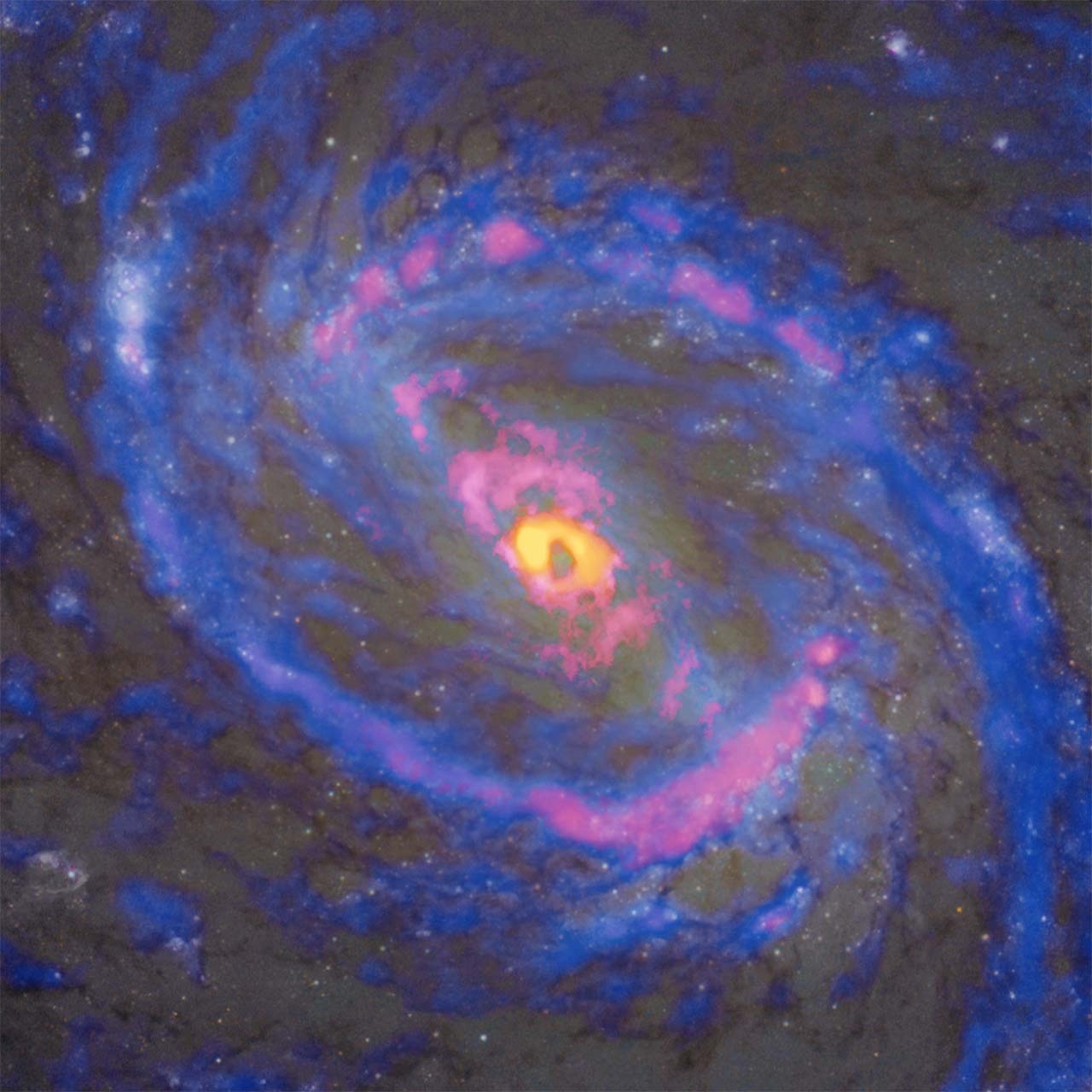
Credit: Melissa Weiss/Center for Astrophysics | Harvard & Smithsonian

Harvard early career researcher discovers a never-before-seen molecule in the atmosphere of a planet using the latest data from JWST

The telescope's array of highly sensitive instruments was trained on the atmosphere of a "hot Saturn" a planet about as massive as Saturn orbiting a star some 700 light-years away known as WASP-39 b. While JWST and other space telescopes, including Hubble and Spitzer, previously have revealed isolated ingredients of this broiling planet's atmosphere, the new readings provide a full menu of atoms, molecules, and even signs of active chemistry and clouds.

"The clarity of the signals from a number of different molecules in the data is remarkable," says Mercedes López-Morales, an astronomer at the Center for Astrophysics | Harvard & Smithsonian and one of the scientists who contributed to the new results.

"We had predicted that we were going to see many of those signals, but still, when I first saw the data, I was in awe," López-Morales adds.

The latest data also give a hint of how these clouds in exoplanets might look up close: broken up rather than a single, uniform blanket over the planet.

This led to another first: scientists applying supercomputer models of photochemistry to data that requires much higher level physics to be fully explained.

The findings bode well for the capability of JWST to conduct the broad range of investigations on exoplanets — planets around other stars — scientists hoped for. That includes probing the atmospheres of smaller, rocky planets like those in the TRAPPIST-1 system.

"We observed the exoplanet with multiple instruments that, together, provide a broad swath of the infrared spectrum and a panoply of chemical fingerprints inaccessible until JWST," said Natalie Batalha, an astronomer at the University of California, Santa Cruz, who contributed to and helped coordinate the new research. "Data like these are a game changer."

The suite of discoveries is detailed in a set of five newly submitted academic papers, available on the preprint server arXiv. Among the unprecedented revelations is the first detection in an exoplanet atmosphere of sulfur dioxide, a molecule produced from chemical reactions triggered by high-energy light from the planet's parent star. On Earth, the protective ozone layer in the upper atmosphere is created in a similar way.

"The surprising detection of sulfur dioxide finally confirms that photochemistry shapes the climate of hot Saturns,'" says Diana Powell, a NASA Hubble fellow, astronomer at the Center for Astrophysics, and core member of the team that made the sulfur dioxide discovery. "Earth's climate is also shaped by photochemistry, so our planet has more in common with 'hot Saturns' than we previously knew!"

Jea Adams a graduate student at Harvard and researcher at the Center for Astrophysics analyzed the data that confirmed the sulfur dioxide signal.

"As an early career researcher in the field of exoplanet atmospheres, it's so exciting to be a part of a detection like this," Adams says. "The process of analyzing this data felt magical. We saw hints of this feature in early data, but this higher precision instrument revealed the signature of SO2 clearly and helped us solve the puzzle."

At an estimated temperature of 1,600 degrees Fahrenheit and an atmosphere made mostly of hydrogen, WASP-39 b is not believed to be habitable. The exoplanet has been compared to both Saturn and Jupiter, with a mass similar to Saturn, but an overall size as big as Jupiter. But the new work points the way to finding evidence of potential life on a habitable planet.

The planet's proximity to its host star – eight times closer than Mercury is to our Sun – also makes it a laboratory for studying the effects of radiation from host stars on exoplanets. Better knowledge of the star-planet connection should bring a deeper understanding of how these processes create the diversity of planets observed in the galaxy.

Other atmospheric constituents detected by JWST include sodium, potassium, and water vapor, confirming previous space and ground-based telescope observations as well as finding additional water features, at longer wavelengths, that haven’t been seen before.

JWST also saw carbon dioxide at higher resolution, providing twice as much data as reported from its previous observations. Meanwhile, carbon monoxide was detected, but obvious signatures of both methane and hydrogen sulfide were absent from the data. If present, these molecules occur at very low levels, a significant finding for scientists making inventories of exoplanet chemistry in order to better understand the formation and development of these distant worlds.

Capturing such a broad spectrum of WASP-39 b's atmosphere was a scientific tour de force, as an international team numbering in the hundreds independently analyzed data from four of JWST's finely calibrated instrument modes. They then made detailed inter-comparisons of their findings, yielding yet more scientifically nuanced results.

JWST views the universe in infrared light, on the red end of the light spectrum beyond what human eyes can see; that allows the telescope to pick up chemical fingerprints that can't be detected in visible light.

Each of the three instruments even has some version of the "IR" of infrared in its name: NIRSpec, NIRCam, and NIRISS.

To see light from WASP-39 b, JWST tracked the planet as it passed in front of its star, allowing some of the star's light to filter through the planet's atmosphere. Different types of chemicals in the atmosphere absorb different colors of the starlight spectrum, so the colors that are missing tell astronomers which molecules are present.

By so precisely parsing an exoplanet atmosphere, the JWST instruments performed well beyond scientists' expectations — and promise a new phase of exploration among the broad variety of exoplanets in the galaxy.

López-Morales says, "I am looking forward to seeing what we find in the atmospheres of small, terrestrial planets."

UK research models show sea level rise to dramatically speed up the erosion of rock coastlines by 2100

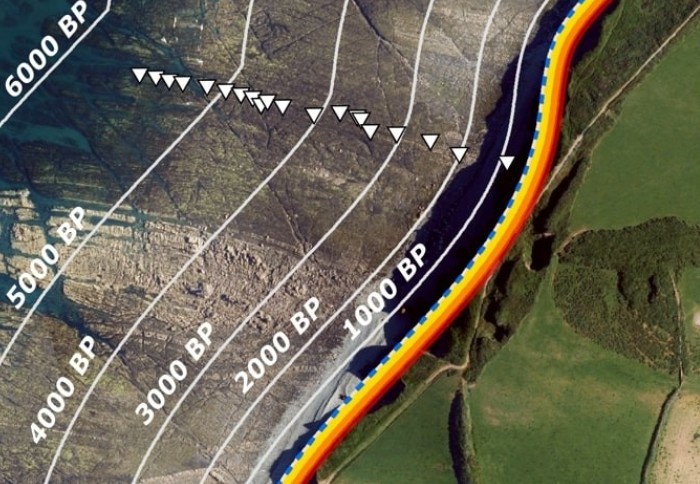
Forecast future cliff positions by 2100 at Bideford. Red line represents cliff position at current greenhouse gas emission rates.Rock coasts, which make up over half the world’s coastlines, could retreat more rapidly in the future due to accelerating sea level rise. 

This is according to new Imperial College London research that modeled likely future cliff retreat rates of two rock coasts in the UK. The forecasts are based on predictions of sea level rise for various greenhouse gas emissions and climate change scenarios.  

The study found that rock coasts, traditionally thought of as stable compared to sandy coasts and soft cliffs, are likely to retreat at a rate not seen for 3,000-5,000 years.  

At the UK study sites in Yorkshire and Devon, this will cause rock coast cliffs to retreat by at least 10-22 meters inland. The rate of erosion is likely between three and seven times today’s rate and potentially up to tenfold. 

Senior author Dr. Dylan Rood, of Imperial’s Department of Earth Science, said: “Coastal erosion is one of the greatest financial risks to society of any natural hazard. Some rock cliffs are already crumbling, and within the next century, rock coast erosion rates could increase tenfold. Even rock coasts that have been stable in the last hundred years will likely respond to sea level rise by 2030.” 

Globally, coasts are home to hundreds of millions of people and hundreds of billions of dollars of infrastructure like homes, businesses, nuclear power stations, transport links, and agriculture.  

The researchers are calling on policymakers, planners, and insurers to take action to classify rock coasts as high-risk areas in future planning for climate change response, as well as to limit climate change by achieving Net Zero as an immediate priority.  

Dr. Rood added: “Rock coast erosion is irreversible: now is the time to limit future sea level rise before it’s too late. Humanity can directly control the fate of our coastlines by reducing greenhouse gas emissions — the future of our coasts is in our hands.” 

A rocky road 

The new study is the first to validate models of the expected erosion of hard rock coasts from sea level rise using observational data over prehistoric timescales. Previous studies have mostly focused on theoretical models of soft, sandy coasts. The new results suggest that as sea levels continue to rise, the rate of rock coastal erosion will also accelerate. 

To study the future rate of erosion, the researchers looked at past and present cliff retreat rates on the coastlines near Scalby in Yorkshire and Bideford in Devon, finding that by 2100 they will likely retreat by 13-22m and 10-14m, respectively.  

They collected rock samples and analyzed them for rare isotopes called cosmogenic radionuclides (CRNs) that build up in rocks exposed to cosmic rays. Concentrations of CRNs in rock reveal how quickly, and for how long, the rock has been exposed, reflecting the rate of erosion and retreat. 

They combined these data with observed coastal topography to calibrate a model that tracks the evolution of these rock coasts over time, before comparing them with rates of past sea level change dating back 8000 years. They found that the rate of coastal erosion on these two sites closely matched the rate of sea level rise.  

The researchers say this is clear evidence of a causal relationship between cliff retreat and sea level from which future forecasts can be made, and that rock coasts are more sensitive to sea level rise than previously thought. The findings, they say, could be applied to rock coasts worldwide because the rock type is common globally, and similar hard rock coasts are likely to respond similarly to sea level rise. 

Lead author Dr. Jennifer Shadrick, who conducted the work in Imperial’s Department of Earth Science and Engineering as a member of the NERC Science & Solutions for a Changing Planet Doctoral Training Partnership, and now works in the marine and coastal risk management team at JBA Consulting, said: “Sea level rise is accelerating, and our results confirm that rock coast retreat will accelerate in line with this. It isn’t a matter of if, but when. 

“The more positive news is that, now that we have a better idea of magnitudes and timescales, we can adapt accordingly. The more data we have on the effects of climate change on sea level rise and coastal erosion, the more we can prepare by championing urgent policies that protect coasts and their communities.” 

Sea level rise 

As the climate warms, sea levels are forecast to rise one meter by 2100 unless greenhouse gas emissions are reduced. 

This study is the first to confirm with observational data that the rate of past coastal erosion followed the rate of sea level rise over prehistoric timescales. The researchers say this erosion was driven by waves, which will likely get larger and more forceful as future sea level rises, and more land is given over to the sea. 

While this study looked at the effects of sea level rise, it did not account for the effects of stronger storms, which some studies forecast will happen more frequently due to climate change. Next, the researchers will adapt their model to also forecast the rate of cliff retreat for softer rock coasts, such as chalk. 

Dr. Rood said: “Our study did not account for the effect of increased storms, which may become stronger and more frequent in the future as the climate changes, on wave-driven cliff erosion. However, increased storms would only speed up the cliff retreat even more than our forecasts. This is another angle to the climate crisis we will account for in future studies to give a more complete picture of likely rates of rock coast erosion. We are also looking to improve our models for softer rock coasts where erosion other than by waves is more important.” 

Dr. Shadrick said: “The findings are a stark warning that we must better adapt to coastal retreat or face the loss of the people, homes, and infrastructure that call coastal areas home.” 

Study co-author Dr. Martin Hurst at the University of Glasgow said: “The implication is that rock coasts are more sensitive to sea level rise than previously thought. We need to pay more attention to how our rock coasts continue to erode as sea levels rise. 

“Heightened erosion risks at our coasts will continue throughout this century. Even if we achieve Net Zero tomorrow, a substantive amount of sea level rise is already baked in as our climate, glaciers, and oceans continue to respond to the emissions that have already taken place.”

This study was funded by the Natural Environmental Research Council (NERC), the British Geological Survey (BGS), and the Australian Nuclear Science and Technology Organisation (ANSTO). 

Global sea level changes in recent decades. Coastal cities with rising sea levels will be more vulnerable to ongoing global climate change.  CREDIT Hongyin Chen
Global sea level changes in recent decades. Coastal cities with rising sea levels will be more vulnerable to ongoing global climate change. CREDIT Hongyin Chen

China evaluates the performance of CMIP6 models in simulating sea level

According to the Sixth Assessment Report of the Intergovernmental Panel on Climate Change, the global mean sea level has risen faster since 1900 than over any preceding century in the last 3000 years. This makes hundreds of coastal cities and millions of people vulnerable to the threat of higher water levels. State-of-the-art climate models provide a crucial means to study how much and how soon sea levels will rise. However, to what extent these models can represent sea level variations remains an open issue. Thus, they should be evaluated before they can be adapted to forecast future sea-level changes.

In a paper recently published in Atmospheric and Oceanic Science Letters, Dr. Zhuoqi He from the South China Sea Institute of Oceanology led a team to assess the performance of climate models in simulating the sea level over the low-to-mid latitudes of the globe. The results indicated that the models simulated the long-term mean sea level relatively well. However, strong biases were apparent when the models tried to reproduce the sea level variance. For example, almost all of them underestimated the interannual signals over the subtropics where western solid boundary currents prevail.

“This bias is at least partially due to the misrepresentation of ocean processes because of the relatively low resolution of their historical simulations. We can see that the nearshore bias is reduced as the model resolution increases,” explains Dr. He.Low Res Chen Hongying.jpg 7a0e7

“Understanding the causes of model misrepresentation is important towards improving the simulation skills of models, and our study helps in this respect by identifying a direction for future model development to reduce model biases.”