

Almeida builds a new model of a fundamental process of Earth’s global dynamics

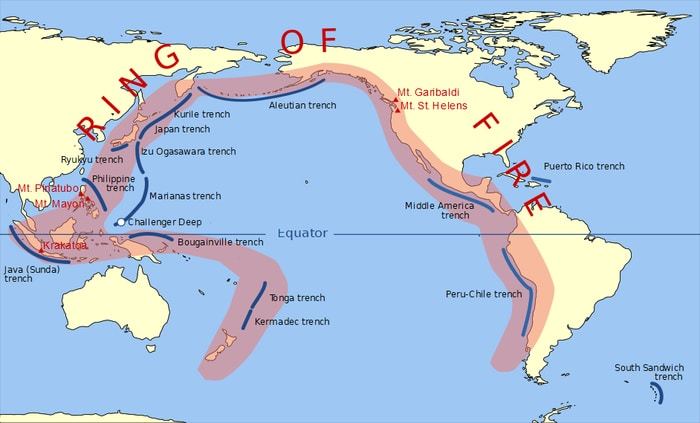
The tectonic plates that form the Earth's surface are like puzzle pieces that are in constant, very slow motion – on average, they move only up to around 10 centimeters a year. But these puzzle pieces don't quite fit together: there are zones on one plate that end up plunging under another – the so-called subduction zones, central to the dynamics of the planet. This movement is slow, but it can lead to moments of great energy release and, over thousands of years, large mountain ranges or marine trenches are formed in these regions. Pacific Ring of Fire  CREDIT Gringer (talk) 23:52, 10 February 2009 (UTC), Public domain, via Wikimedia Commons
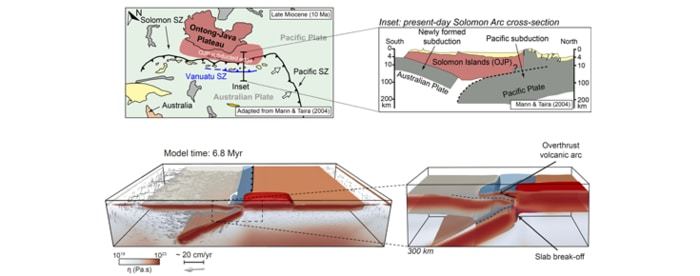
How do these subduction zones originate, and how do they evolve? Geologists already knew that in these zones, on a time scale of thousands of years, this process can stagnate and reverse itself, giving rise to new subduction zones. But it was still necessary to know how this happens and to include in the models the various (and enormous) forces involved in this process. For the first time, it was possible to simulate in three dimensions one of the most common processes of formation of new subduction zones, ensuring that all forces are dynamically and realistically modeled, including Earth's own gravity.

“Subduction zones are one of the main features of our planet and the main driver of plate tectonics and the global dynamics of the planet. Subduction zones are also the places where earthquakes of great magnitude occur, as is the case of the Pacific Ring of Fire, the largest system of subduction zones in the world. For this reason, it is extremely important to understand how new subduction zones start and how this process takes place,” explains Jaime Almeida, first author of this study, researcher at Instituto Dom Luiz, at Faculty of Sciences of the University of Lisbon (Ciências ULisboa). Formation of the Vanuatu subduction zone.  CREDIT Almeida, J., Riel, N., Rosas, F.M. et al. Self-replicating subduction zone initiation by polarity reversal. Commun Earth Environ 3, 55 (2022). https://doi.org/10.1038/s43247-022-00380-2
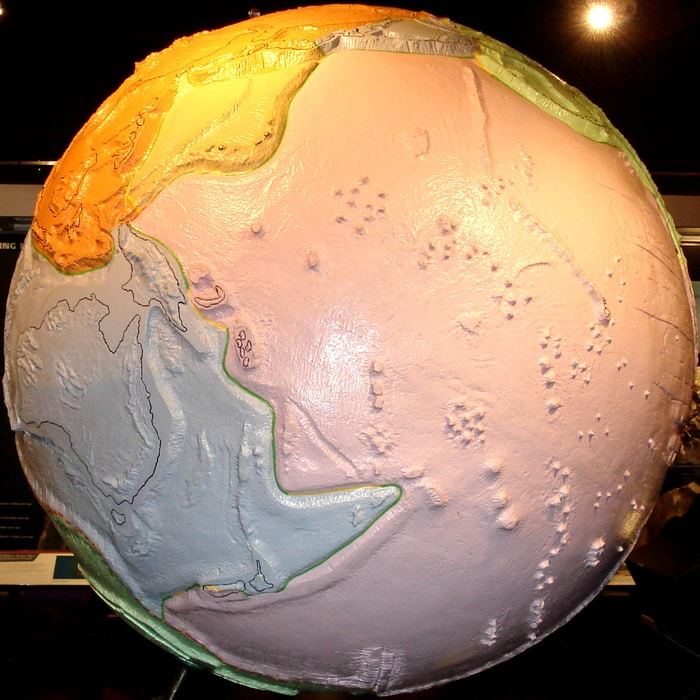
Each of the simulations that led to these results took up to a week to process on a supercomputer at the Johannes Gutenberg University (Germany). But it could have taken weeks, or even months, to run on this supercomputer – had it not been for the computational code recently developed at this University, significantly more efficient than other available codes. Model of the earth showing tectonic plates, American Museum of Natural History.  CREDIT Tom Magliery (https://www.flickr.com/photos/mag3737/178758761/in/photostream/)
“It had already been theoretically proposed that new subduction zones were more likely to form from pre-existing ones, but models of this kind had never been carried out. In a way, it seems to be easier and more likely than anticipated”, explains João Duarte, a researcher at Instituto Dom Luiz and co-author of this study, now published in the Communications Earth and Environment journal, from the Nature group.

This model opens up a new range of perspectives and represents the starting point for studying specific regions of our planet: “We are now applying these models to specific cases, such as the subduction zones that are starting in the Atlantic Ocean, in the Caribbean, the Scotia Arc, next to Antarctica, and on the Southwest Portuguese margin, and which could lead to the closing of the Atlantic Ocean. The 1755 Lisbon earthquake may have been the harbinger of the beginning of subduction on our margin, and there are marine geology data that support it”, concludes João Duarte.
Molecular dynamics simulations of Earth's core show a mixture of solid Fe, liquid-like light elements

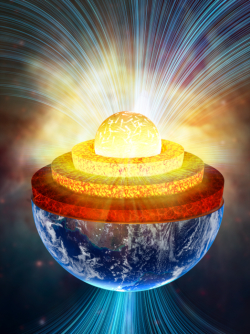
Earth's core, the deepest part of our planet, is characterized by extremely high pressure and temperature. It is composed of a liquid outer core and a solid inner core. Earth’s interior structure and superionic inner core

The inner core is formed and grows due to the solidification of liquid iron at the inner core boundary. The inner core is less dense than pure iron, and some light elements are believed to be present in the inner core.

A joint research team led by Prof. HE Yu from the Institute of Geochemistry of the Chinese Academy of Sciences (IGCAS) has found that the inner core of the Earth is not a normal solid but is composed of a solid iron sublattice and liquid-like light elements, which is also known as a superionic state. The liquid-like light elements are highly diffusive in iron sublattices under inner core conditions.

A superionic state, which is an intermediate state between solid and liquid, widely exists in the interior of planets. Using high-pressure and high-temperature computational simulations based on quantum mechanics theory, researchers from IGCAS and the Center for High Pressure Science & Technology Advanced Research (HPSTAR) found that some Fe-H, Fe-C and Fe-O alloys transformed into a superionic state under inner core conditions.

In superionic iron alloys, light elements become disordered and diffuse like a liquid in the lattice, while iron atoms remain ordered and vibrate about their lattice grid, forming the solid iron framework. The diffusion coefficients of C, H and O in superionic iron alloys are the same as those in liquid Fe.

"It is quite abnormal. The solidification of iron at the inner core boundary does not change the mobility of these light elements, and the convection of light elements is continuous in the inner core," said Prof. HE Yu, the first and corresponding author of the study.

One longstanding mystery about the inner core is that it is quite soft, with quite low shear wave velocity. The researchers calculated the seismic velocities in these superionic iron alloys and found a significant decrease in shear wave velocity. "Our results fit well with seismological observations. It is the liquid-like elements that make the inner core soften," said co-first author SUN Shichuan from IGCAS.

Highly diffusive light elements can affect seismic velocities, providing critical clues for understanding other mysteries in the inner core. The anisotropic structure, seismic wave attenuations, and structural changes of the inner core during past decades can be rationalized in the superionic model by considering the distribution and convection of these liquid-like elements in the inner core.

UK supercomputing reveals more hostile conditions on Earth as life evolved

During long portions of the past 2.4 billion years, the Earth may have been more  inhospitable to life than scientists previously thought, according to new supercomputer simulations.  Graphic showing how UV radiation on Earth has changed over the last 2.4 billion years. Credit Gregory Cooke.

Using a state-of-the-art climate model, researchers now believe the level of ultraviolet (UV) radiation reaching the Earth’s surface could have been underestimated, with UV levels being up to ten times higher.   

UV radiation is emitted by the sun and can damage and destroy biologically important molecules such as proteins.  

The last 2.4 billion years represent an important chapter in the development of the biosphere. Oxygen levels rose from almost zero to significant amounts in the atmosphere, with concentrations fluctuating but eventually reaching modern-day concentrations approximately 400 million years ago.   

During this time, more complex multicellular organisms and animals began to colonize the land.   

Gregory Cooke, a Ph.D. researcher at the University of Leeds who led the study, said the findings raise new questions about the evolutionary impact of UV radiation as many forms of life are known to be negatively affected by intense doses of UV radiation.  

He said: “We know that UV radiation can have disastrous effects if life is exposed to too much. For example, it can cause skin cancer in humans. Some organisms have effective defense mechanisms, and many can repair some of the damage UV radiation causes.  

“Whilst elevated amounts of UV radiation would not prevent life’s emergence or evolution, it could have acted as a selection pressure, with organisms better able to cope with greater amounts of UV radiation receiving an advantage.”    

The amount of UV radiation reaching the Earth is limited by the ozone in the atmosphere, described by the researchers as “...one of the most important molecules for life” because of its role in absorbing UV radiation as it passes into the Earth’s atmosphere. 

Ozone forms as a result of sunlight and chemical reactions – and its concentration is dependent on the level of oxygen in the atmosphere.  

For the last 40 years, scientists have believed that the ozone layer was able to shield life from harmful UV radiation when the level of oxygen in the atmosphere reached about one percent relative to the present atmospheric level.  

The new modeling challenges that assumption. It suggests the level of oxygen needed may have been much higher, perhaps 5% to 10% of present atmospheric levels.  A rough outline of oxygen (O2) concentrations in Earth's atmosphere through time are illustrated in this figure. Brown blocks show the estimated range for O2 in terms of its present atmospheric level (which is 21% by volume). Grey-blue lines indicated various important events for the evolution of life, including the emergence of eukaryotes and animals. Black arrows refer to important events where atmospheric oxygen concentration changed. The Archean, Proterozoic, and Phanerozoic are geological eons. GOE = Great Oxidation Event; NOE = Neoproterozoic Oxidation Event; CE = Cambrian Explosion; LE = Lomagundi Excursion. credit Gregory Cooke

As a result, there were periods when UV radiation levels at the Earth’s surface were much greater, and this could have been the case for most of the Earth’s history. 

Mr. Cooke said: “If our modeling is indicative of atmospheric scenarios during Earth’s oxygenated history, then for over a billion years the Earth could have been bathed in UV radiation that was much more intense than previously believed. 

“This may have had fascinating consequences for life’s evolution. It is not precisely known when animals emerged, or what conditions they encountered in the oceans or on land. However, depending on oxygen concentrations, animals and plants could have faced much harsher conditions than today’s world. We hope that the full evolutionary impact of our results can be explored in the future.”   

The results will also lead to new predictions for exoplanet atmospheres. Exoplanets are planets that orbit other stars. The presence of certain gases, including oxygen and ozone, may indicate the possibility of extra-terrestrial life, and the results of this study will aid in the scientific understanding of surface conditions in other worlds.