

SUPERCOMPUTING NEWS SUPERCOMPUTING NEWS
    • MEDIA KIT
    • MOST READ
    • RSS FEED
    • ACADEMIA
    • AEROSPACE
    • APPLICATIONS
    • ASTRONOMY
    • AUTOMOTIVE
    • BIG DATA
    • BIOLOGY
    • CHEMISTRY
    • CLIENTS
    • CLOUD
    • DEFENSE
    • DEVELOPER TOOLS
    • EARTH SCIENCES
    • ECONOMICS
    • ENGINEERING
    • ENTERTAINMENT
    • GAMING
    • GOVERNMENT
    • HEALTH
    • OIL & GAS
    • INDUSTRY
    • INTERCONNECTS
    • MANUFACTURING
    • MIDDLEWARE
    • MOVIES
    • NETWORKS
    • PHYSICS
    • PROCESSORS
    • RETAIL
    • SCIENCE
    • STORAGE
    • SYSTEMS
    • VISUALIZATION
    • AcyMailing subscription form

    • ADD YOUR VIDEOS
    • MANAGE VIDEOS
    • CONVERSATION INBOX
    • SOCIAL ADVERTISER
    • SOCIAL NETWORK VIDEOS
    • SURVEYS
    • GROUPS
    • PAGES
    • MARKETPLACE LISTINGS
    • APPLICATIONS BROWSER
    • PRIVACY CONFIRM REQUEST
    • PRIVACY CREATE REQUEST
    • LEADERBOARD
    • POINTS LISTING
      • BADGES
    • TRADE SHOWS
Sign In
Tyler O'Neal, Staff Editor ENGINEERING February 11, 2022, 5:00 am

NGI advances graphene spintronics as 1D contacts improve mobility in nano-scale devices

Researchers at The University of Manchester may have cleared a significant hurdle on the path to quantum supercomputing, demonstrating step-change improvements in the spin transport characteristics of nanoscale graphene-based electronic devices. 1920 toc graphic highres1200px 3543f
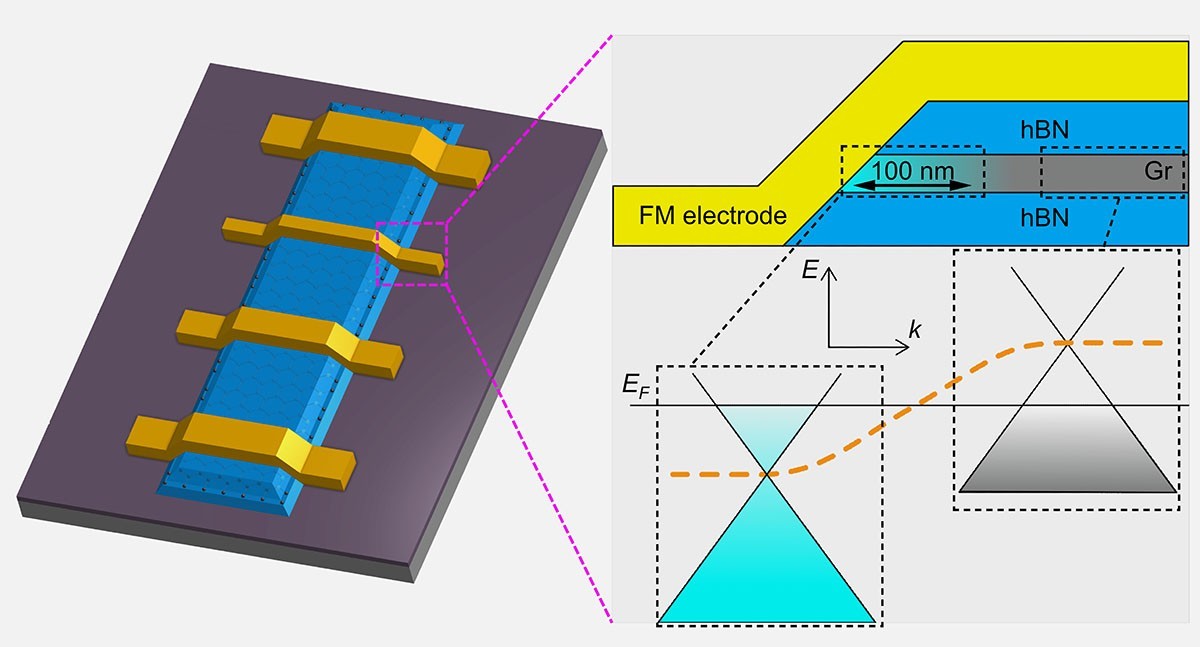
The team - comprising researchers from the National Graphene Institute (NGI) led by Dr. Ivan Vera Marun, alongside collaborators from Japan and including students internationally funded by Ecuador and Mexico - used monolayer graphene encapsulated by another 2D material (hexagonal boron nitride) in a so-called van der Waals heterostructure with one-dimensional contacts (main picture, above). This architecture was observed to deliver an extremely high-quality graphene channel, reducing the interference or electronic ‘doping’ by traditional 2D tunnel contacts.

‘Spintronic’ devices, as they are known, may offer higher energy efficiency and lower dissipation compared to conventional electronics, which rely on charge currents. In principle, phones and tablets operating with spin-based transistors and memories could be greatly improved in speed and storage capacity, exceeding Moore’s Law. 

As published in Nano Letters, the Manchester team measured electron mobility up to 130,000cm2/Vs at low temperatures (20K or -253oC). For purposes of comparison, the only previously published efforts to fabricate a device with 1D contacts achieved mobility below 30,000cm2/Vs, and the 130k figure measured at the NGI is higher than recorded for any other previous graphene channel where spin transport was demonstrated.

The researchers also recorded spin diffusion lengths approaching 20μm. Where longer is better, most typical conducting materials (metals and semiconductors) have spin diffusion lengths <1μm. The value of spin diffusion length observed here is comparable to the best graphene spintronic devices demonstrated to date.

Lead author of the study Victor Guarochico said: “Our work is a contribution to the field of graphene spintronics. We have achieved the largest carrier mobility yet regarding spintronic devices based on graphene. Moreover, the spin information is conserved over distances comparable with the best reported in the literature. These aspects open up the possibility to explore logic architectures using lateral spintronic elements where long-distance spin transport is needed.”

Co-author Chris Anderson added: “This research work has provided exciting evidence for a significant and novel approach to controlling spin transport in graphene channels, thereby paving the way towards devices possessing comparable features to advanced contemporary charge-based devices. Building on this work, bilayer graphene devices boasting 1D contacts are now being characterized, where the presence of an electrostatically tunable bandgap enables an additional dimension to spin transport control.”

Discover more about our capabilities in graphene and 2D material research at the National Graphene Institute website.
Chinese researchers accelerate photonic matrix multiplication for AI

Tyler O'Neal, Staff Editor ENGINEERING February 10, 2022, 12:00 pm

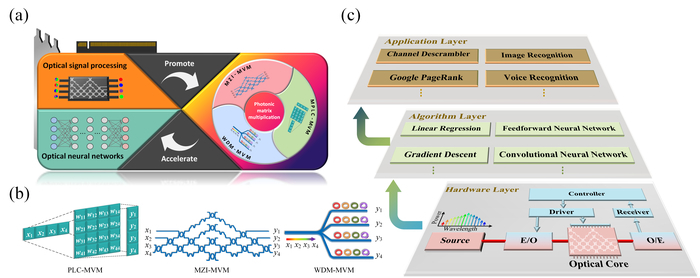
There has been an ever-growing demand for artificial intelligence and fifth-generation communications globally, resulting in very large computing power and memory requirements. The slowing down or even failure of Moore's law makes it increasingly difficult to improve their performance and energy efficiency by relying on advanced semiconductor technology. Optical devices can have a super-large bandwidth and low power consumption. And light has an ultrahigh-frequency of up to 100 THz and multiple degrees of freedom in their quantum state, making optical computing one of the most competitive candidates for high-capacity and low-latency matrix information processing in the “More than Moore” era. In recent years, photonic matrix multiplication has been developed rapidly and widely used in photonic acceleration fields such as optical signal processing, artificial intelligence, and photonic neural network.  These applications based on matrix multiplication show the great potential and opportunities in the photonic accelerator. a, concept of photonic accelerator with photonic matrix multiplication. b, methods for photonic matrix multiplication. c, schematic diagram of the optoelectronic-hybrid AI computing chip framework.  CREDIT by Hailong Zhou, Jianji Dong Junwei Cheng, Wenchan Dong, Chaoran Huang, Yichen Shen, Qiming Zhang, Min Gu, Chao Qian, Hongsheng Chen, Zhichao Ruan, and Xinliang Zhang

In a new review published in Light Science & Application, a team of scientists, led by Professor Jianji Dong from Wuhan National Laboratory for Optoelectronics, Huazhong University of Science and Technology in China and co-workers have introduced the methods of photonic matrix multiplication and summarized the developmental milestones of photonic matrix multiplication and the related applications. Then, their detailed advances in applications to optical signal processing and artificial neural networks in recent years were reviewed. Comments on the challenges and perspectives of photonic matrix multiplication and photonic acceleration were also discussed

The paper reviewed and discussed the progress of photonic accelerators from a unique viewpoint of photonic matrix multiplication. These scientists summarize the main content of this review:

“The methods for photonic matrix-vector multiplications (MVMs) mainly fall into three categories: the plane light conversion (PLC) method, Mach–Zehnder interferometer (MZI) method, and wavelength division multiplexing (WDM) method.”

“The photonic matrix multiplication network itself can be used as a general linear photonic loop for photonic signal processing. In recent years, MVM has been developed as a powerful tool for a variety of photonic signal processing methods.”

“AI technology has been widely used in various electronics industries, such as for deep-learning-based speech recognition and image processing. MVM, as the basic building block of ANNs, occupies most of the computing tasks, such as over 80% for GoogleNet and OverFeat models. Improving the MVM performance is one of the most effective means for ANN acceleration. Compared with electrical computing, optical computing is poor at data storage and flow control, and the low efficiency of optical nonlinearities limits the applications in nonlinear computation, such as activation functions. While it has significant advantages on massively parallel supercomputing through multiplexing strategies of wavelength, mode, and polarization, extremely high data modulation speeds up to 100 GHz. Hence, photonic networks are quite good at MVM. The combination of optical computing and AI is expected to realize intelligent photonic processors and photonic accelerators. In recent years, AI technology has also seen rapid developments in the field of optics.”

“In general, photonic computing has obvious advantages in terms of signal rate, latency, power consumption, and computing density, and its accuracy is generally lower than that of electrical computing.”

“Before the all-optical ANNs are mature, especially in optical nonlinear effect and optical cascade, optoelectronic-hybrid AI is a more practical and more competitive candidate for deep ANNs. Therefore, the development of a highly efficient and dedicated optoelectronic-hybrid AI hardware chip system is one of the core research routes of photonic AI.”

Leicester computational modelers pioneer pest-busting model

Tyler O'Neal, Staff Editor ENGINEERING February 10, 2022, 7:00 am

Mathematicians at the University of Leicester have developed a new mathematical model which could greatly increase the efficiency of pest control and hence significantly reduce the impact of pests on crops whilst minimizing the damage to the environment. slug distribution 770 38932

A new study builds upon individual-based model (IBM) techniques to explain and predict the formation of high slug density patches in arable fields.

While existing models built around the Turing theory of pattern formation (named for AI pioneer Alan Turing) and its generalizations are shown to work well for patterns in plant distribution, these are rarely able to accurately predict the distribution of animals due to the complexity of behavioral responses.

Drawing on field data collected in a three-year project, computational modeling experts in the University of Leicester’s School of Computing and Mathematical Sciences, alongside colleagues from The University of Birmingham and Harper Adams University, applied mathematical concepts to building a new model which shows trends of distribution, accounting for the movements of individual creatures.

Their model could be used in creating more efficient methods of pest control – by targeting the use of pesticides and other techniques to protect crops – and could be adapted to better understand the collective behavior in other species, such as fish schools, bird flocks, and insect swarms.

Sergei Petrovskii is a Professor in Applied Mathematics at the University of Leicester and the lead author for the study. Professor Petrovskii said: “This study is an example of how a fundamental ecological concept, when applied to a real-world problem, can lead to breakthrough findings and ultimately helps to make agriculture more sustainable”

Keith Walters, Professor in Agriculture and Pest Control at Harper Adams University, said: “Understanding factors determining slug distribution in agricultural fields have been a long-standing problem. Using unique field techniques specifically developed to support modeling and simulations allowed progress that would hardly be possible with empirical tools alone.”

Dr. Natalia Petrovskaya, Senior Lecturer in Applied Mathematics at the University of Birmingham and corresponding author for the study, added: “Computer simulations helped us to reveal a hidden link between biological processes going on very different spatial scales, which was crucial for the success of this project.”

  1. Judea Pearl wins Spain's Frontiers of Knowledge Award for AI
  2. UK scientists build a global repository for cell engineering

Page 56 of 78

  • 51
  • 52
  • 53
  • 54
  • 55
  • 56
  • 57
  • 58
  • 59
  • 60
POPULAR RIGHT NOW
  • 10,000 AI agents, 130 billion tokens and 88 hours: How OpenAI turned Navier–Stokes into a supercomputing workload
    10,000 AI agents, 130 billion tokens and 88 hours: How OpenAI turned Navier–Stokes into a supercomputing workload
  • Qualcomm enters the supercomputing arena as AWS partnership challenges Nvidia’s AI infrastructure dominance
    Qualcomm enters the supercomputing arena as AWS partnership challenges Nvidia’s AI infrastructure dominance
  • Fugaku goes inside the molecular machine: Supercomputer simulations reveal how kinesin knows which way to step
    Fugaku goes inside the molecular machine: Supercomputer simulations reveal how kinesin knows which way to step
  • From the Tibetan Plateau to California: Supercomputing reveals a hidden source of flood predictability
    From the Tibetan Plateau to California: Supercomputing reveals a hidden source of flood predictability
  • Supercomputing reconstructs the moon Venus may have lost
    Supercomputing reconstructs the moon Venus may have lost
  • Japanese supercomputer recreates the birth of the Universe’s monster black holes
    Visualization of the simulation by ATERUI III showing a rapidly growing black hole surrounded by gas. Red indicates areas of higher temperature. (Credit: Sunmyon Chon, Takaaki Takeda, 4D2U Project, NAOJ)
    Visualization of the simulation by ATERUI III showing a rapidly growing black hole surrounded by gas. Red indicates areas of higher temperature. (Credit: Sunmyon Chon, Takaaki Takeda, 4D2U Project, NAOJ)
  • China’s supercomputing push meets a harder problem: Teaching computers to keep asteroids honest
    China’s supercomputing push meets a harder problem: Teaching computers to keep asteroids honest
  • Alibaba’s superintelligence ambition puts supercomputing at the center of the AI race
    Alibaba’s superintelligence ambition puts supercomputing at the center of the AI race
  • AI’s trillion dollar compute race hits a hard limit: There isn’t enough power
    AI’s trillion dollar compute race hits a hard limit: There isn’t enough power
  • AI agents search 1.9 billion protein clusters, discover a new biological system
    AI agents search 1.9 billion protein clusters, discover a new biological system
THIS YEAR'S MOST READ
  • Wall Street wants to trade supercomputing power like oil
    Wall Street wants to trade supercomputing power like oil
  • Beamforming the future: BeammWave's 6G push signals the rise of orbital-terrestrial wireless networks
    Joakim Axmon
    Joakim Axmon
  • AI breaks conservation barriers: Australia’s Wildlife Observatory leverages supercomputing to protect biodiversity
    AI breaks conservation barriers: Australia’s Wildlife Observatory leverages supercomputing to protect biodiversity
  • Silicon spintronics brings the P-computer closer to reality
    Microscope image of a semiconductor-integrated spintronic test chip developed by researchers at Tohoku University and NIST. The device demonstrates the first silicon-integrated probabilistic bit (p-bit), a key building block for future large-scale probabilistic computers designed for AI and optimization workloads.
    Microscope image of a semiconductor-integrated spintronic test chip developed by researchers at Tohoku University and NIST. The device demonstrates the first silicon-integrated probabilistic bit (p-bit), a key building block for future large-scale probabilistic computers designed for AI and optimization workloads.
  • Hidden order, revealed at scale: Supercomputing, electron ptychography uncover the inner workings of relaxor ferroelectrics
    Hidden order, revealed at scale: Supercomputing, electron ptychography uncover the inner workings of relaxor ferroelectrics
  • Physics-trained ‘Digital Super Brain’ learns from supercomputers to accelerate discovery
    Physics-trained ‘Digital Super Brain’ learns from supercomputers to accelerate discovery
  • Cosmic ambition at scale: UK’s supercomputer unlocks a 2.5 petabytes universe
    Cosmic ambition at scale: UK’s supercomputer unlocks a 2.5 petabytes universe
  • Memory has become the new compute: Why Micron, SK Hynix crossing $1 trillion matters to supercomputing
    Memory has become the new compute: Why Micron, SK Hynix crossing $1 trillion matters to supercomputing
  • Huawei’s Tau Scaling ambition tests the limits of post-Moore semiconductor reality
    He Tingbo from HUAWEI delivered a keynote speech titled &quot;New Semiconductor Path in Practice&quot;
    He Tingbo from HUAWEI delivered a keynote speech titled "New Semiconductor Path in Practice"
  • Intel's Q1 results signal supercomputing surge driving Xeon momentum
    Intel's Q1 results signal supercomputing surge driving Xeon momentum
  • FRONTPAGE
  • LATEST
  • POPULAR
  • REGISTER
  • SOCIAL
  • VIDEO
  • SUBSCRIPTION
  • RSS
  • GUIDELINES
  • PRIVACY
  • TOS
  • ABOUT
  • +1 (816) 799-4488
  • editorial@supercomputingonline.com
© 2001 - 2026 SuperComputingOnline.com, LLC. All rights reserved. This material may not be published, broadcast, rewritten or redistributed without permission.
Sign In
  • FRONT PAGE
  • LATEST
    • MEDIA KIT
    • MOST READ
    • RSS FEED
    • ACADEMIA
    • AEROSPACE
    • APPLICATIONS
    • ASTRONOMY
    • AUTOMOTIVE
    • BIG DATA
    • BIOLOGY
    • CHEMISTRY
    • CLIENTS
    • CLOUD
    • DEFENSE
    • DEVELOPER TOOLS
    • EARTH SCIENCES
    • ECONOMICS
    • ENGINEERING
    • ENTERTAINMENT
    • HEALTH
    • INDUSTRY
    • INTERCONNECTS
    • GAMING
    • GOVERNMENT
    • MANUFACTURING
    • MIDDLEWARE
    • MOVIES
    • NETWORKS
    • OIL & GAS
    • PHYSICS
    • PROCESSORS
    • RETAIL
    • SCIENCE
    • STORAGE
    • SYSTEMS
    • VISUALIZATION
  • VIDEOS
    • ADD YOUR VIDEOS
    • MANAGE VIDEOS
  • COMMUNITY
    • TRADE SHOWS
    • SOCIAL NETWORK VIDEOS
    • SURVEYS
    • APPLICATIONS BROWSER
    • CONVERSATION INBOX
    • SOCIAL ADVERTISER
    • GROUPS
    • MARKETPLACE LISTINGS
    • PAGES
    • LEADERBOARD
    • POINTS LISTING
      • BADGES
    • PRIVACY CONFIRM REQUEST
    • PRIVACY CREATE REQUEST

Hey there! We noticed you’re using an ad blocker.