How modeling the development of C4 photosynthesis offers a window into evolution

Laboratory research is the possibly best-known driving force for advancement in science. However, when it comes to investigating evolutionary processes, lab work often faces its limitations. This is where the power of big data and computational modeling comes into play. A recent joint effort from the Bielefeld University and the Leibniz Institute of Plant Genetics and Crop Plant Research (IPK) in Gatersleben to understand the evolution of C4 photosynthesis, demonstrates the potential of in silico modeling in science. Using constraint-based modeling, the researchers were able to step back in time and predict the evolutionary pathway of this particular form of photosynthesis.

All plants, algae and select bacteria perform photosynthesis, converting water and carbon dioxide (CO2) into glucose with the help of energy from sunlight. As they all produce their own food, they are classed as autotroph organisms. However, the process of photosynthesis is not the same in all autotrophs. The most common type of photosynthesis in plants is the C3 photosynthesis. It relies on the enzyme Rubisco for the fixation of CO2. Despite its prevalence in the plant-world, the C3 process has its downsides, as the function of Rubisco is slow and also unspecific. Instead of fixing CO2, plants can accidentally fix oxygen, thus producing toxic by-products that need to be recycled. To avoid these detrimental aspects, plants evolved alternative photosynthesis types. One alternative, C4 photosynthesis, independently evolved at least 62 times in 19 different families of flowering plants. Plants with the C4 trait intensify their carbon fixation by using a biochemical pump to increase the concentration of CO2 at the site of Rubisco. As a result, C4 plants, such as maize, are known to have high growth rates. In a recent project, two researchers from the Bielefeld University and the IPK in Gatersleben applied constraint-based modeling (CBM) in order to find out which selective pressures lead to the evolution of the C4 pathway. CAPTION Evolution of C4 photosynthesis from its C3 ancestor  CREDIT Blätke / IPK Leibniz Institute{module INSIDE STORY}
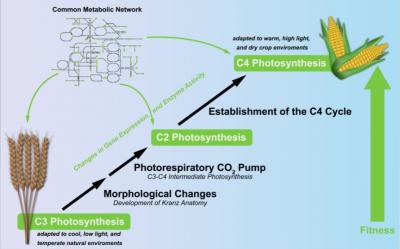
CBM enables researchers to apply different physical, enzymatic, and topological constraints when modeling metabolic networks. Therefore, different computational predictions can be made for a row of differing experimental scenarios, letting scientists glimpse the various possible routes evolution took or could have taken, depending on the settings of the constraints. After developing their C4-CBM-model the two scientists, Prof. Andrea Bräutigam, professor for computational biology at Bielefeld's Center for Biotechnology (CeBiTec) at Bielefeld University, and Dr. Mary-Ann Blätke, a member of the Network Analysis and Modelling IPK research group, focused on finding the constraints which led to the prediction of C4 photosynthesis as the optimal solution. Prof. Bräutigam: "Once the models are set up, observation of in silico evolution becomes possible. In our case, the simulations reproduced the evolutionary trajectory from C3 to C4 photosynthesis, which depended on the carbon dioxide level." Dr. Blätke complemented: "The model also predicts intermediacy as an optimal solution under particular conditions and explains why different variations of C4 photosynthesis may exist. It also put forth nitrogen and light as new eco-physiological parameters that play a role for the evolution of C4 photosynthesis."

The study showcases CBM as a powerful tool for querying and understanding the evolution of other complex traits in plants. Simultaneously, the successful analysis of the C4 evolution paves the way for the more detailed investigation of the C4 evolution and metabolism but also highlights new targets for future breeding and engineering efforts in C4-crop plants. Dr. Blätke: "A metabolic network correctly predicting the trajectory of C4 evolution, such as the one provided here, is a prerequisite to approach more detailed questions on C4 metabolism and its evolution. It can, therefore, be used as a working horse for follow-up studies and act as an integrative framework for multi-omic data and derived regulatory networks."
German deep learning identifies patterns of cancer to improve drug discovery, survival outlook

A new deep-learning algorithm can quickly and accurately analyze several types of genomic data from colorectal tumors for more accurate classification, which could help improve diagnosis and related treatment options, according to new research published in the journal Life Science Alliance.

Colorectal tumors are extremely varied in how they develop, require different drugs and have very different survival rates. Often, they are classified into subtypes based on the analysis of gene expression levels.

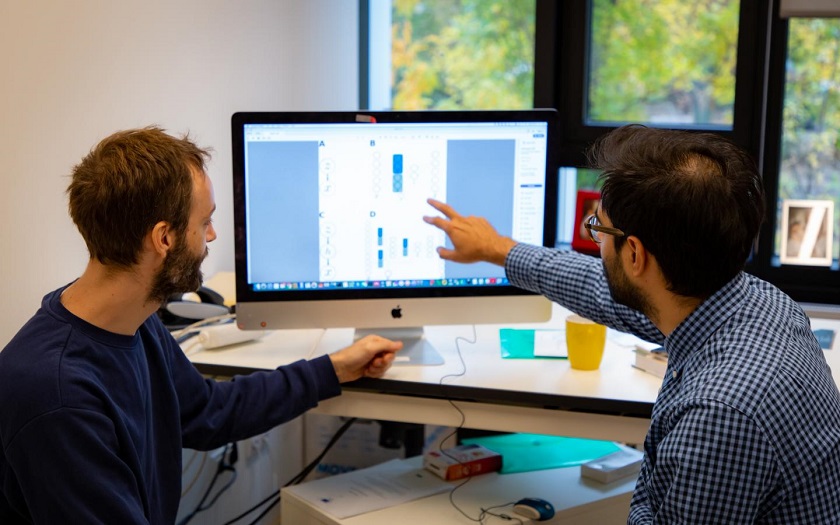
"Disease is much more complex than just one gene," said Altuna Akalin, bioinformatics scientist who leads the Bioinformatics Platform research group at MDC's Berlin Institute of Medical Systems Biology (BIMSB). "To appreciate the complexity, we have to use some kind of machine learning to really make use of all the data." CAPTION Ronen and Akalin discuss the research results.  CREDIT Felix Petermann, MDC{module INSIDE STORY}

To look at numerous features contained in genetic material, including gene expression, single point mutations, and DNA copy-numbers, Akalin and Ph.D. student Jonathan Ronen designed the Multi-omics Autoencoder Integration platform - "maui" for short.

How it works

Supervised machine learning typically requires human experts to label data and then train an algorithm to predict those labels. For example, to predict eye color from pictures of eyes, the researchers first feed the algorithm with pictures where eye color is labeled. The algorithm learns to identify different eye colors and can independently analyze new data.

In contrast, unsupervised machine learning does not involve training. A deep-learning algorithm is fed data without labels and sifts through it to find common patterns or representative features, which are called latent factors. For example, this kind of algorithm can process pictures of faces that are not labeled in any way, then identify key features, like eye colors, eyebrow shapes, nose shapes, smiles.

As a deep-learning platform, maui is able to analyze multiple "omics" datasets and identify the most relevant patterns or features, in this case, gene sets or pathways to colorectal cancer.

Reclassifying subtypes?

maui identified patterns associated with the four established subtypes of colorectal cancer, assigning tumors to subtypes with high accuracy. It also made an interesting discovery. The platform found a pattern that suggests one subtype (CMS2) might need to be split into two separate groups. The tumors have different mechanisms and survival rates. The team suggests further investigation to verify if the subtype is unique or perhaps representative of the tumor spreading. Still, it demonstrates the power of the platform to take all the data, rather than only the known genes associated with a disease, and produce deeper insights.

"Data science can handle complex data that is hard to handle other ways and makes sense of it," Akalin said. "You can feed it everything you have on the tumors and it finds meaningful patterns."

Faster, better

The program was not just more accurate, it also works much faster than other machine learning algorithms - three minutes to pick out 100 patterns, compared to the other programs that took 20 minutes and 11 hours.

"It is able to learn orders of magnitude more latent factors, at a fraction of the computation time," said Jonathan Ronen, first author of the research.

The team was actually surprised at how fast the system performs, especially because they did not have to use graphics cards that usually help speed up calculations. This shows how extremely well optimized, or efficient, the algorithm is, though they are continuing to find ways to further finetune the system.

Improving drug discovery

The team, which also included Bayer AG computational biologist Sikander Hayat, adapted their program to analyze cell lines taken from tumors and grown in labs for researching the effects of potential drug treatments. However, cell lines differ from real tumors in many ways on the molecular level. The team used maui to compare cell lines currently used for testing colorectal cancer drugs to see how closely they were related to real tumors. Nearly half of the lines were found to be more related to other cell lines than actual tumors. A handful was found to be the best line most closely representing the different classes of CRC tumors.

While drug discovery research is moving away from cell lines, this insight could help maximize the potential impact of the cell line research and could be adapted for other types of genetic-based drug testing tools.

Google for tumors

Now that the deep-learning platform for colorectal cancer has been established, it could be used to analyze data for new patients.

"Think of this as a search engine," Akalin said.

A clinician could input the new patient's genetic data into maui to find the closest match to quickly and accurately classify the tumor. The platform could advise what drugs have been used on the closest matching tumors and how well they worked, thus helping to predict drug responses and survival outlook.

For now, this could take place in a research setting only after doctors have tried the established protocols. It is a long road for a test or system to be approved for clinical use, Akalin said. The team is exploring the potential for commercialization with the help of the Berlin Institute of Health's Digital Health Accelerator Program. They are also in the process of adapting maui for other types of cancers.

U of U researchers present CFD on fossils that reveal swimming patterns of extinct cephalopod at the American Physical Society meeting

An upcoming presentation features research on the swimming patterns of cephalopods that lived more than 65 million years ago

Computational fluid dynamics can be used to study how extinct animals used to swim. Scientists studied 65 million-year-old cephalopod fossils to gain a deeper understanding of modern-day cephalopod ecosystems.

Three scientists affiliated with the University of Utah's department of geology and geophysics will present research on the width, coil diameter and the overall structure of the prehistoric cephalopods shells and how these factors affected their swimming patterns at the American Physical Society's Division of Fluid Dynamics 72nd Annual Meeting on Nov. 25. 

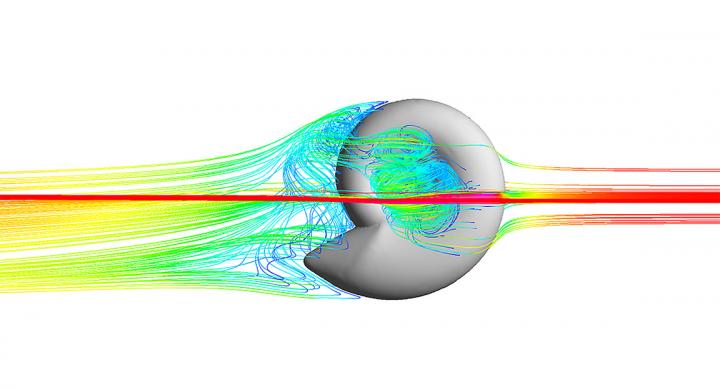
Nicholas Hebdon, Kathleen Ritterbush, and Yunji Choi use a computational fluid dynamics model to study the locomotion of ammonoids, a group of cephalopods that swam the oceans for almost 300 million years. They went extinct at the same time dinosaurs. Example image of how water flow shapes itself around one of our ammonoid models.{module INSIDE STORY}

"One of the interesting and hard things about ammonoids is they don't have any direct descendants today despite their dominance in the past," said Hebdon. "We're interested in what this might be able to tell us about the stability of marine ecosystems and how they recover diversity and ecological complexity after drastic extinctions. Since we can't compare directly to modern descendants, we have to be creative about how we investigate their potential behavior and interactions."

The scientists examined the change in size and shape of ammonoid shells by researching fossils. Shell shape and size reflected how efficiently cephalopods swam across various geological periods.

"The shapes and sizes of fossil shells we find from any given interval of geologic time - say, the early Triassic or the early Jurassic - are shells produced by whichever branch of the evolutionary tree was flourishing at that time and the shells those species could build in their particular environments," said Hebdon.

Researching these long-extinct swimmers and their adaptation into different ecosystems across millions of years is expected to shed light on the behavior of the modern cephalopod ecosystem.

"With squid and octopus' populations and harvesting efforts on the rise worldwide today, our understanding of their vulnerabilities and strength will be valuable to food source management and conservation efforts," said Hebdon.