

Brian Greene: Quantum Gravity, The Big Bang, Aliens, Death, and Meaning | Lex Fridman Podcast #232

Brian Greene is a theoretical physicist.Please support this podcast by checking out our sponsors:- The Prisoner Wine Company:https://theprisonerwine.com/lex to get 20% off & free shipping - Blinkist:https://blinkist.com/lex and use code LEX to get 25% off premium - LMNT:https://drinkLMNT.com/lex to get free sample pack - BetterHelp:https://betterhelp.com/lex to get 10% off - NI:https://www....
...

Read more

UCF's Thomas creates artificial intelligence to help scientists make spray-on solar cells

Artificial Intelligence may be just the thing to accelerate spray-on solar cell technology, which could revolutionize how consumers use energy.

A research team at the University of Central Florida used Machine Learning, aka Artificial Intelligence to optimize the materials used to make perovskite solar cells (PSC). The Organic-Inorganic halide perovskites material used in PSC converts photovoltaic power into consumable energy.

These perovskites can be processed in solid or liquid state, offering a lot of flexibility. Imagine being able to spray or paint bridges, houses and skyscrapers with the material, which would then capture light, turn it into energy and feed it into the electrical grid. Until now, the solar cell industry has relied on silicon because of its efficiency. But that's old technology with limits. Using perovskites, however, has one big barrier. They are difficult to make in a usable and stable material. Scientists spend a lot of time trying to find just the right recipe to make them with all the benefits - flexibility, stability, efficiency and low cost. That's where artificial intelligence comes in. CAPTION UCF's Jayan Thomas led the team in reviewing more than 2,000 peer-reviewed publications about perovskites and collecting more than 300 data points that were fed into the AI system the team created. The system was able to analyze the information and predict which perovskites recipe would work best.  CREDIT UCF, Karen Norum{module INSIDE STORY}
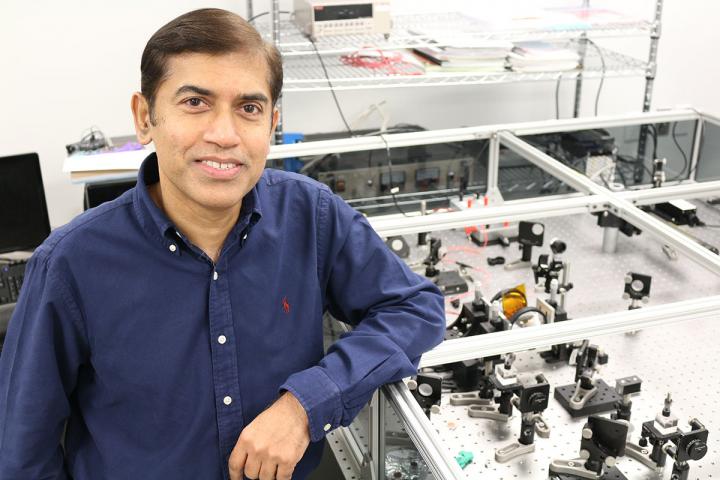
The team's work is so promising that its findings are the cover story Dec. 13 in the Advanced Energy Materials journal.

The team reviewed more than 2,000 peer-reviewed publications about perovskites and collected more than 300 data points then fed into the AI system they created. The system was able to analyze the information and predict which perovskites recipe would work best.

"Our results demonstrate that machine learning tools can be used for crafting perovskite materials and investigating the physics behind developing highly efficient PSCs," says Jayan Thomas, the study's lead author and an associate professor at the NanoScience Technology Center with multiple affiliations. "This can be a guide to design new materials as evidenced by our experimental demonstration."

If this model bears out, it means researchers could identify the best formula to create a world standard. Then spray-on solar cells may happen in our lifetime, the researchers say.

"This is a promising finding because we use data from real experiments to predict and obtain a similar trend from the theoretical calculation, which is new for PSCs. We also predicted the best recipe to make PSC with different bandgap perovskites," says Thomas and his graduate student, Jinxin Li, who is the first author of this paper. "Perovskites have been a hot research topic for the past 10 years, but we think we really have something here that can move us forward."
IAS Stone wins Schmidt Futures grant to accelerate supercomputing the cosmos

James M. Stone, professor of computational astrophysics at the Institute for Advanced Study, heads IAS project on the Dynamics of Neutron Star Mergers, Star & Planet Formation, and the Interstellar Medium

Schmidt Futures has awarded $1 million to the Institute for Advanced Study (IAS) to leverage advances in high-performance supercomputing to understand challenging astrophysical problems. The project, led by James M. Stone, Professor in the School of Natural Sciences, seeks to deepen our understanding of various cosmic phenomena, including neutron star mergers, star and planet formation, and the dynamics of the interstellar medium in galaxies such as our own Milky Way.

"Computational astrophysics continues to revolutionize the way scientists glimpse and interpret our universe, and Jim Stone is driving some of the most cutting-edge research in this field" stated Robbert Dijkgraaf, Director and Leon Levy Professor. "The Institute is proud to recognize this important investment by Schmidt Futures in a project that promises to bring humanity closer than ever to stars in their finest detail."

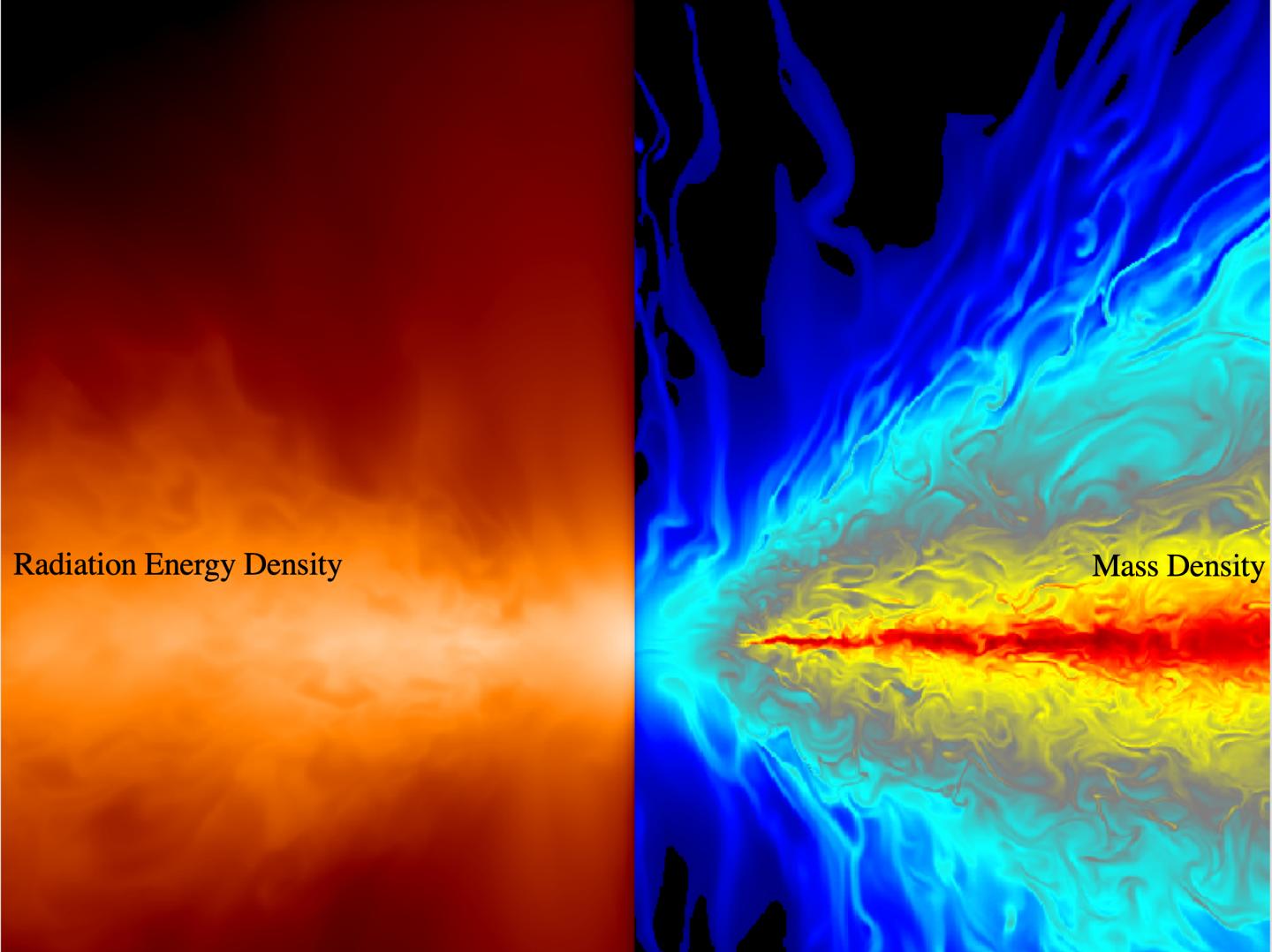
Stone's work harnesses advances in numerical algorithms and high-performance supercomputers to model and interpret the dynamics of astronomical systems. There is a wealth of data available that guides the work: from gravitational wave astronomy to newly discovered exoplanetary systems, unlocking valuable new insights into the fundamental nature of the cosmos. CAPTION Slice through a radiation-dominated accretion disk around a black hole.  CREDIT S. Davis (UVa), Y. Jiang (CCA), and J. Stone (IAS){module INSIDE STORY}

"Most of the exoplanetary systems discovered to date are very different from our own solar system, challenging our current theory of planet formation," stated Stone. "Understanding how giant planets grow inside the gas and dust disks surrounding young stars requires numerical models that evolve a dusty, weakly ionized plasma including self-gravity and radiation transfer. I have been working on various aspects of this problem for the past 10 years, and at the IAS I hope to greatly accelerate progress."

This IAS project is also poised to expand on a currently limited understanding of the properties and internal structure of neutron stars through an analysis of simultaneously detected gravitational waves and electromagnetic radiation associated with gamma-ray bursts produced by the merger of two neutron stars. Stone's work to understand the underlying physics of these events relies on the improved accuracy and more realistic physics enabled by special-purpose numerical methods. The development, implementation, and testing of these methods represents a core goal of this project.

"We are delighted to support exciting new directions using high-end and sophisticated supercomputing to address very important astrophysical problems," said Stuart Feldman, Chief Scientist, Schmidt Futures. "Now is the time to understand aspects of planet and galaxy evolution at a deep level with new tools, and Jim Stone is poised to do just that."

The last aspect of this research seeks to understand the dynamics of the interstellar medium (ISM) and star formation in galaxies such as the Milky Way. The study of the ISM is challenging because of the enormous range of length scales inherent in the problem, from small clouds of dense gas in which stars form, to the disk of the galaxy itself, which is 10,000 times larger. Resolving all these scales simultaneously requires the use of the largest high-performance computer architectures available, capable of approximately 100 million billion calculations per second. "Our existing codes run at 90% efficiency on up to one million CPU cores, and thus are well positioned to take full advantage of emerging exascale architectures," Stone explained.

Stone is an authority in numerical astrophysics. He joined the permanent Faculty of the Institute for Advanced Study in 2019. His research is focused on fluid dynamics, particularly magnetohydrodynamics and radiation transfer, for which he has developed some of the most powerful and widely used astrophysical codes. He has contributed groundbreaking methods to address some of the field's most challenging problems, resulting in important insights into the nature of giant molecular clouds, the evolution of accretion disks, the process of planetary formation, and the dynamics of radiation-dominated flows in accretion disks and stars.

The three-year grant from Schmidt Futures commenced on October 4, 2019, for the purpose of championing the world's preeminent computational astrophysicists to develop tools and study the structure and evolution of various astrophysical systems. This funding will support the hiring of a software engineer and a long-term postdoctoral fellow, both with proven expertise in the field.