

UK researchers produce a human protein co-regulation map that reveals new insights into protein functions

Proteins are key molecules in living cells. They are responsible for nearly every task of cellular life and are essential for the maintenance of the structure, function, and regulation of tissues and organs in the human body. The cells in the human body can form thousands of different types of proteins (the so-called proteome), which perform a plethora of diverse functions, all crucial for cell viability and human health. Assigning functions to the vast array of proteins present in our cells remains a challenging task in cell biology.

Scientists have now produced a co-regulation map of the human proteome, which was able to capture relationships between proteins that do not physically interact or co-localize. This will enable the prediction and assignment of functions to uncharacterized human proteins. The co-regulation map can be explored at http://www.proteomeHD.netCAPTION Co-regulation map shows associations between human proteins.  CREDIT Michael Schrader - University of Exeter{module In article}

Many of the functions of human proteins are still unknown, but researchers at the Wellcome Centre for Cell Biology, the University of Edinburgh and the Institute of Biotechnology, Technische Universität Berlin have applied large scale quantitative proteomics and machine-learning to produce a protein covariation dataset of the human proteome. The dataset forms the basis of a co-regulation map which can be used to predict the potential function of uncharacterized human proteins.

"In this study, we took thousands of mass spectrometry experiments that other laboratories had published over the past few years and re-purposed them in a way that was completely unrelated to what the original authors had intended. We used a machine-learning algorithm to mine this huge collection of data and managed to assign a biological function to hundreds of proteins (genes) that were previously uncharacterized", said Professor Juri Rappsilber and Dr. Georg Kustatscher, of the University of Edinburgh and TU Berlin.

Exploring the map revealed unexpected co-regulation partners, namely the peroxisomal membrane protein PEX11β with mitochondrial respiration factors. In cooperation with Professor Michael Schrader and his team at the University of Exeter, this led to the identification of a novel interaction between two crucial cellular organelles - mitochondria and peroxisomes.

"Peroxisomes and mitochondria in mammals are intimately linked and cooperate in the breakdown of fatty acids and cellular energy balance. Using live-cell imaging we revealed that PEX11β mediates the formation of membrane protrusions, which emanate from peroxisomes and interact with mitochondria. They likely function in the metabolic cooperation and crosstalk between both organelles, and may facilitate the transfer of metabolites during mitochondrial energy (ATP) production", said Professor Michael Schrader, of the University of Exeter.

The scientists at the University of Edinburgh created the website http://www.proteomeHD.net to allow users to search for a protein of interest, showing its position in the co-regulation map together with any co-regulation partners.

The online map is interactive and zoomable, making it easy to explore the neighborhood of a query protein. It is designed to support researchers in exploring co-regulation data at multiple scales, to validate existing hypotheses or to create new ones.

"With an ever-increasing amount of protein expression data being made available, protein co-expression analysis has huge potential for gene function annotation. In a time when "big data" becomes more and more relevant for life science, a key lessons we learned from this project is: never throw away your data - they can be re-purposed, recycled, and with the right tools there is plenty more information and knowledge that can be extracted from them", said Dr. Georg Kustatscher, of the University of Edinburgh.

HIV spreads through direct cell-to-cell contact

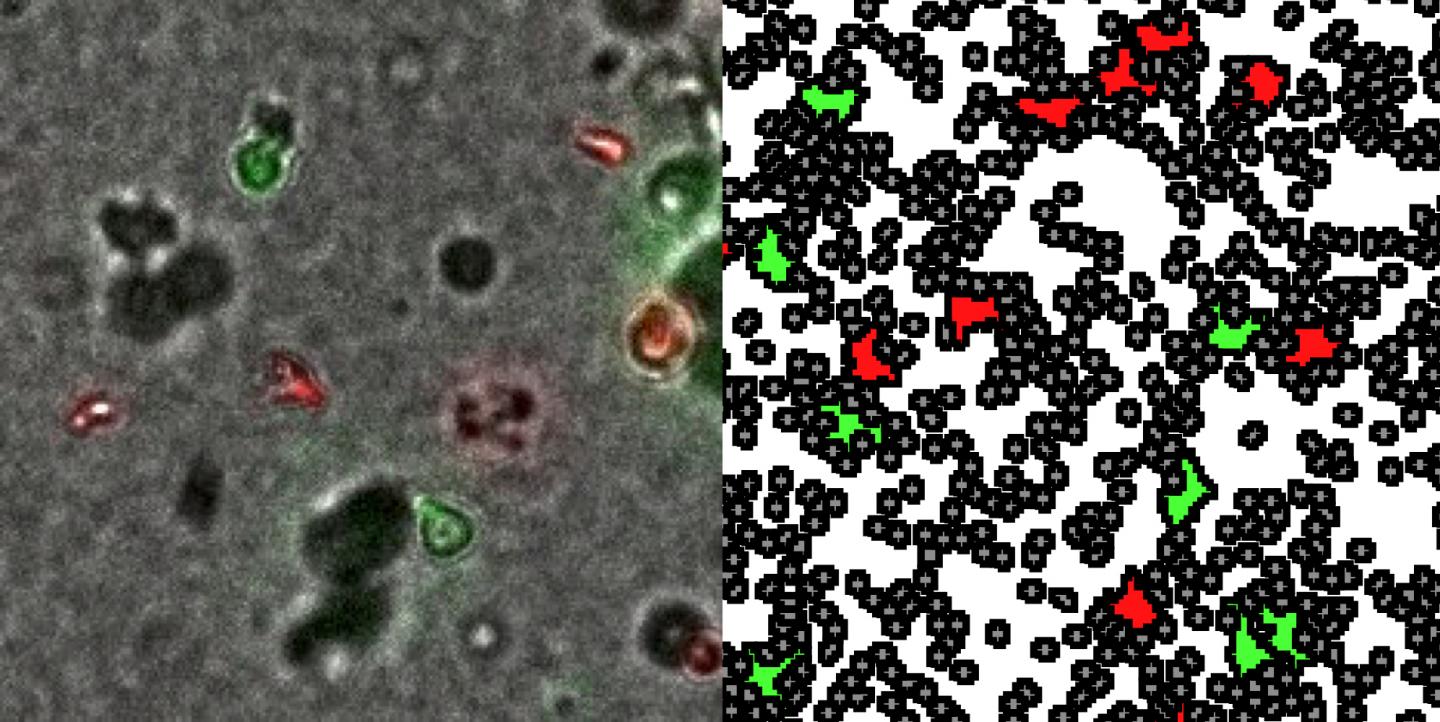
CAPTION Microscopic recording and supercomputer model of the interaction between infected cells (green) and non-infected cells (red) in collagen structures (grey). CREDIT Oliver Fackler / Frederik Graw

German researchers investigate infection dynamics in tissue-like three-dimensional cell cultures

The spread of pathogens like the human immunodeficiency virus (HIV) is often studied in a test tube, i.e. in two-dimensional cell cultures, even though it hardly reflects the much more complex conditions in the human body. Using innovative cell culture systems, quantitative image analysis, and supercomputer simulations, an interdisciplinary team of scientists from Heidelberg University has now explored how HIV spreads in three-dimensional tissue-like environments. The researchers' results show that the tissue structure forces the virus to spread through direct cell-to-cell contact. 

Despite over 30 years of research, many key aspects of how HIV, the causative agent of the acquired immune deficiency syndrome (AIDS) spreads are still not understood. One of these unresolved questions concerns the interactions between the virus with the environment in the human body. Traditionally it has been assumed that infected cells release viral particles which then diffuse and eventually infect other cells. But it is also possible that viral particles are directly transferred from one infected cell to the next through close contact. Until now it was unknown which of these modes of transmission prevailed in tissue. "Studies on HIV replication in the lab are mostly conducted in simple cell culture experiments in plastic dishes that do not reflect the complex architecture and heterogeneity of tissue", explains study director Prof. Dr Oliver Fackler of the Center for Integrative Infectious Disease Research (CIID) at Heidelberg University Hospital. {module In-article}

In their approach, the Heidelberg researchers took into account that the so-called CD4 T helper cells, the preferred cell type infected by HIV, are highly motile in their physiological environment. They used a novel cell culture system, in which a three-dimensional scaffold was generated with the help of collagen. This allowed for maintaining the cells' mobility and monitoring primary CD4 T cells infected with HIV-1 in a tissue-like environment over the course of several weeks. Using this innovative approach, the researchers measured a number of factors that characterise cell motility, virus replication, and the gradual loss of CD4 T helper cells. "This yielded a very complex set of data that was impossible to interpret without the help from scientists of other disciplines", explains Dr Andrea Imle, who worked on the project during her PhD at the CIID.

In analysing the data, the scientists who conducted the experiments collaborated with colleagues from the fields of image processing, theoretical biophysics and mathematical modelling. Together they were able to characterise the complex behaviour of cells and viruses and simulate it on the computer. This made it possible to make important predictions on the key processes that determine HIV-1 spread in these 3D cultures, which were confirmed by subsequent experimentation. "Our interdisciplinary study is a good example of how iterative cycles of experimentation and simulation can help to quantitatively analyse a complex biological process", states Prof. Dr Ulrich Schwarz of the Institute for Theoretical Physics at Heidelberg University.

The data analysis revealed that the 3D environment of the cell culture system suppresses infection with a cell-free virus while simultaneously promoting direct virus transmission from cell to cell. "Our models allowed us to integrate short single-cell microscopy films with long-term cell population measurements and thereby to estimate the minimal time span required for cell-to-cell contacts to transmit infection", explains Dr Frederik Graw of the BioQuant Centre of Heidelberg University. The researchers hope that these findings will eventually lead to new therapeutic approaches in the treatment of HIV.

Stanford researchers develop technologies that run on light

The future of faster, more efficient information processing may come down to light rather than electricity. Mark Lawrence, a postdoctoral scholar in materials science and engineering at Stanford, has moved a step closer to this future with a scheme to make a photon diode - a device that allows light to only flow in one direction - which, unlike other light-based diodes, is small enough for consumer electronics.

All he had to do was design smaller-than-microscopic structures and break a fundamental symmetry of physics.

"Diodes are ubiquitous in modern electronics, from LEDs (light emitting diodes) to solar cells (essentially LEDs run in reverse) to integrated circuits for computing and communications," said Jennifer Dionne, associate professor of materials science and engineering and senior author on the paper describing this work, published July 24 in Nature Communications. "Achieving compact, efficient photonic diodes is paramount to enabling next-generation computing, communication and even energy conversion technologies." diode getty 555x416 ad7f9 {module In-article}

At this point, Dionne and Lawrence have designed the new photon diode and checked their design with supercomputer simulations and calculations. They've also created the necessary nanostructures - the custom smaller-than-microscopic components - and are installing the light source that they hope will bring their theorized system to life.

"One grand vision is to have an all-optical computer where electricity is replaced completely by light and photons drive all information processing," Lawrence said. "The increased speed and bandwidth of light would enable faster solutions to some of the hardest scientific, mathematical and economic problems."

Spinning light, breaking laws

The main challenges of a light-based diode are two-fold. First, following the laws of thermodynamics, light should move forward through an object with no moving parts in the exact same way it would move backward. Making it flow in one direction requires new materials that overturn this law, breaking what's known as time-reversal symmetry. Second, light is much more difficult to manipulate than electricity because it doesn't have charge.

Other researchers have previously tackled these challenges by running light through a polarizer - which makes the light waves oscillate in a uniform direction - and then through a crystalline material within a magnetic field, which rotates the polarization of light. Finally, another polarizer matched to that polarization ushers the light out with near-perfect transmission. If light is run through the device in the opposite direction, no light gets out.

Lawrence described the one-way action of this three-part setup, known as a Faraday isolator, as similar to taking a moving sidewalk between two doors, where the sidewalk plays the role of the magnetic field. Even if you tried to go backward through the last door, the sidewalk would usually prevent you from reaching the first door.

In order to produce a strong enough rotation of the light polarization, these kinds of diodes must be relatively large - much too large to fit into consumer computers or smartphones. As an alternative, Dionne and Lawrence came up with a way of creating rotation in crystal using another light beam instead of a magnetic field. This beam is polarized so that its electrical field takes on a spiral motion which, in turn, generates rotating acoustic vibrations in the crystal that give it magnetic-like spinning abilities and enable more light to get out. To make the structure both small and efficient, the Dionne lab relied on its expertise in manipulating and amplifying light with tiny nano-antennas and nanostructured materials called metasurfaces.

The researchers designed arrays of ultra-thin silicon disks that work in pairs to trap the light and enhance its spiraling motion until it finds its way out. This results in high transmission in the forward direction. When illuminated in the backwards direction, the acoustic vibrations spin in the opposite direction and help cancel out any light trying to exit. Theoretically, there is no limit to how small this system could be. For their simulations, they imagined structures as thin as 250 nanometers. (For reference, a sheet of paper is about 100,000 nanometers thick.)

What's possible

Big picture, the researchers are particularly interested in how their ideas might influence the development of brain-like computers, called neuromorphic computers. This goal will also require additional advances in other light-based components, such as nanoscale light sources and switches.

"Our nanophotonic devices may allow us to mimic how neurons compute - giving computing the same high interconnectivity and energy efficiency of the brain, but with much faster computing speeds," Dionne said.

"We can take these ideas in so many directions," Lawrence said. "We haven't found the limits of classical or quantum optical computing and optical information processing. Someday we could have an all-optical chip that does everything electronics do and more."