

Syracuse Dean wins top award honoring information research

Distinguished Professor of Information Science, has been named the 2019 recipient of the Research in Information Science Award, presented by the Association for Information Science and Technology (ASIS&T).

Nominees were judged by the intellectual quality of their research contributions; the impact of those contributions to research theory, practice and society; the way their research work has contributed to methodology, including the development and evaluation of software, corpora, and other research tools; and the degree to which their research work has helped shape or reshape the information field and connect with related research areas.

ASIS&T is the preeminent professional association in the information science and technology field. The Association has been leading the search for new and better theories, techniques, and technologies to improve access to information for the past 80 years. Thousands of researchers, developers, practitioners, students, and professors in the field of information science and technology, hailing from 50 countries, are members. They are bound by their interest in improving the ways society stores, retrieves, analyzes, manages, archives, and disseminates information.

Crowston's research examines new ways of organizing made possible by the use of information technology. He approaches the issue through empirical studies of coordination-intensive processes in human organizations (especially virtual organization); theoretical characterizations of coordination problems and alternative methods for managing them; and design and empirical evaluation of systems to support people working together. Specific domains of interest include free/libre open source software development projects, citizen science projects, and research data management. Kevin Crowston{module In-article}

Upon learning of his selection for the honor, Crowston remarked, "It is a great honor to be chosen to receive the ASIS&T Research in Information Science Award, knowing the many fine researchers in our field. I strive to connect information science research to other research areas and to show how it enriches interdisciplinary projects. It is gratifying for these contributions to be recognized."

He was nominated by iSchool faculty associates Caroline Haythornthwaite and Carsten Oesterlund, who wrote how Crowston's "outstanding record comprises over 20 years of research on the new forms of work, organization, and coordination emerging with the use of information and communication technology. His empirical studies of real estate agents, virtual work arrangements, Free/Libre Open Source Software (FLOSS) development, citizen science, and the impact of artificial intelligence have been a guiding voice for many subsequent studies; and his theoretical work on document genre and stigmergic coordination have likewise shaped academic debates. He not only studies the future of work; he is also actively engaged in system building and experimentation that facilitates and shapes these areas."

Crowston is a co-principal investigator on the National Science Foundation project, "INSPIRE: Teaming Citizen Science with Machine Learning to Deepen LIGO's View of the Cosmos," which has produced the Gravity Spy system. He formerly served as co-principal investigator on the NSF grant, "Collaborative Research: Focusing Attention to Improve the Performance of Citizen Science Systems: Beautiful Images and Perceptive Observers." With colleagues, he has built several citizen science projects and the FLOSSmole.org repository. He also has three patents associated with his work on coordination. In addition, he has served as a National Science Foundation program officer for Cyber-Human Systems and Human-Centered Computing, and as a member of the Steering Committee of the National Research Program on Digital Transformation for the Swiss National Science Foundation.
LHC experiments present new Higgs results at 2019 EPS-HEP conference

The ATLAS and CMS collaborations at the LHC have studied the Higgs boson with the largest sample of proton–proton collision data recorded so far and have made precision measurements of this particle to search for signs of new physics

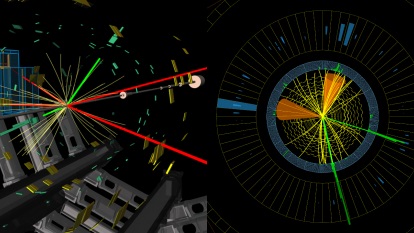
At the 2019 European Physical Society’s High-Energy Physics conference (EPS-HEP) taking place in Ghent, Belgium, the ATLAS and CMS collaborations presented a suite of new results. These include several analyses using the full dataset from the second run of CERN’s Large Hadron Collider (LHC), recorded at a collision energy of 13 TeV between 2015 and 2018. Among the highlights are the latest precision measurements involving the Higgs boson. In only seven years since its discovery, scientists have carefully studied several of the properties of this unique particle, which is increasingly becoming a powerful tool in the search for new physics. Candidates for a Higgs produced with a Z. ATLAS (l): both decay ultimately to leptons, leaving two electrons (green) and four muons (red). CMS (r): the Higgs decays to two charm quarks forming jets (cones); the Z decays to electrons (green) (Image: ATLAS/CMS/CERN)

{module In-article} The results include new searches for transformations (or “decays”) of the Higgs boson into pairs of muons and into pairs of charm quarks. Both ATLAS and CMS also measured previously unexplored properties of decays of the Higgs boson that involve electroweak bosons (the W, the Z and the photon) and compared these with the predictions of the Standard Model (SM) of particle physics. ATLAS and CMS will continue these studies over the course of the LHC’s Run 3 (2021 to 2023) and in the era of the High-Luminosity LHC (from 2026 onwards).

The Higgs boson is the quantum manifestation of the all-pervading Higgs field, which gives mass to elementary particles it interacts with, via the Brout-Englert-Higgs mechanism. Scientists look for such interactions between the Higgs boson and elementary particles, either by studying specific decays of the Higgs boson or by searching for instances where the Higgs boson is produced along with other particles. The Higgs boson decays almost instantly after being produced in the LHC and it is by looking through its decay products that scientists can probe its behaviour.

In the LHC’s Run 1 (2010 to 2012), decays of the Higgs boson involving pairs of electroweak bosons were observed. Now, the complete Run 2 dataset – around 140 inverse femtobarns each, the equivalent of over 10 000 trillion collisions – provides a much larger sample of Higgs bosons to study, allowing measurements of the particle’s properties to be made with unprecedented precision. ATLAS and CMS have measured the so-called “differential cross-sections” of the bosonic decay processes, which look at not just the production rate of Higgs bosons but also the distribution and orientation of the decay products relative to the colliding proton beams. These measurements provide insight into the underlying mechanism that produces the Higgs bosons. Both collaborations determined that the observed rates and distributions are compatible with those predicted by the Standard Model, at the current rate of statistical uncertainty.

Since the strength of the Higgs boson’s interaction is proportional to the mass of elementary particles, it interacts most strongly with the heaviest generation of fermions, the third. Previously, ATLAS and CMS had each observed these interactions. However, interactions with the lighter second-generation fermions – muons, charm quarks and strange quarks – are considerably rarer. At EPS-HEP, both collaborations reported on their searches for the elusive second-generation interactions.

ATLAS presented their first result from searches for Higgs bosons decaying to pairs of muons (H→μμ) with the full Run 2 dataset. This search is complicated by the large background of more typical SM processes that produce pairs of muons. “This result shows that we are now close to the sensitivity required to test the Standard Model’s predictions for this very rare decay of the Higgs boson,” says Karl Jakobs, the ATLASspokesperson. “However, a definitive statement on the second generation will require the larger datasets that will be provided by the LHC in Run 3 and by the High-Luminosity LHC.”

CMS presented their first result on searches for decays of Higgs bosons to pairs of charm quarks (H→cc). When a Higgs boson decays into quarks, these elementary particles immediately produce jets of particles. “Identifying jets formed by charm quarks and isolating them from other types of jets is a huge challenge,” says Roberto Carlin, spokesperson for CMS. “We’re very happy to have shown that we can tackle this difficult decay channel. We have developed novel machine-learning techniques to help with this task.”

The Higgs boson also acts as a mediator of physics processes in which electroweak bosons scatter or bounce off each other. Studies of these processes with very high statistics serve as powerful tests of the Standard Model. ATLAS presented the first-ever measurement of the scattering of two Z bosons. Observing this scattering completes the picture for the W and Z bosons as ATLAS has previously observed the WZ scattering process and both collaborations the WW process. CMS presented the first observation of electroweak-boson scattering that results in the production of a Z boson and a photon.

“The experiments are making big strides in the monumental task of understanding the Higgs boson,” says Eckhard Elsen, CERN’s Director of Research and Supercomputing. “After observation of its coupling to the third-generation fermions, the experiments have now shown that they have the tools at hand to address the even more challenging second generation. The LHC’s precision physics programme is in full swing.”

UCI researchers' deep learning algorithm solves Rubik's Cube faster than any human

Work is step toward advanced AI systems that can think, reason, plan and make decisions

Since its invention by a Hungarian architect in 1974, the Rubik's Cube has furrowed the brows of many who have tried to solve it, but the 3D logic puzzle is no match for an artificial intelligence system created by researchers at the University of California, Irvine.

DeepCubeA, a deep reinforcement learning algorithm programmed by UCI computer scientists and mathematicians, can find the solution in a fraction of a second, without any specific domain knowledge or in-game coaching from humans. This is no simple task considering that the cube has completion paths numbering in the billions but only one goal state - each of six sides displaying a solid color - which apparently can't be found through random moves. {module In-article}

For a study published today in Nature Machine Intelligence, the researchers demonstrated that DeepCubeA solved 100 percent of all test configurations, finding the shortest path to the goal state about 60 percent of the time. The algorithm also works on other combinatorial games such as the sliding tile puzzle, Lights Out and Sokoban.

"Artificial intelligence can defeat the world's best human chess and Go players, but some of the more difficult puzzles, such as the Rubik's Cube, had not been solved by computers, so we thought they were open for AI approaches," said senior author Pierre Baldi, UCI Distinguished Professor of computer science. "The solution to the Rubik's Cube involves more symbolic, mathematical and abstract thinking, so a deep learning machine that can crack such a puzzle is getting closer to becoming a system that can think, reason, plan and make decisions."

The researchers were interested in understanding how and why the AI made its moves and how long it took to perfect its method. They started with a computer simulation of a completed puzzle and then scrambled the cube. Once the code was in place and running, DeepCubeA trained in isolation for two days, solving an increasingly difficult series of combinations.

"It learned on its own," Baldi noted.

There are some people, particularly teenagers, who can solve the Rubik's Cube in a hurry, but even they take about 50 moves.

"Our AI takes about 20 moves, most of the time solving it in the minimum number of steps," Baldi said. "Right there, you can see the strategy is different, so my best guess is that the AI's form of reasoning is completely different from a human's."

The veteran computer scientist said the ultimate goal of projects such as this one is to build the next generation of AI systems. Whether they know it or not, people are touched by artificial intelligence every day through apps such as Siri and Alexa and recommendation engines working behind the scenes of their favorite online services.

"But these systems are not really intelligent; they're brittle, and you can easily break or fool them," Baldi said. "How do we create advanced AI that is smarter, more robust and capable of reasoning, understanding and planning? This work is a step toward this hefty goal."