

Keck Cosmic Web Imager data results in new cold-flow inspiral model of spiraling filaments feeding young galaxies

Galaxies grow by accumulating gas from their surroundings and converting it to stars, but the details of this process have remained murky. New observations, made using the Keck Cosmic Web Imager (KCWI) at the W. M. Keck Observatory in Hawaii, now provide the clearest, most direct evidence yet that filaments of the cool gas spiral into young galaxies, supplying the fuel for stars.

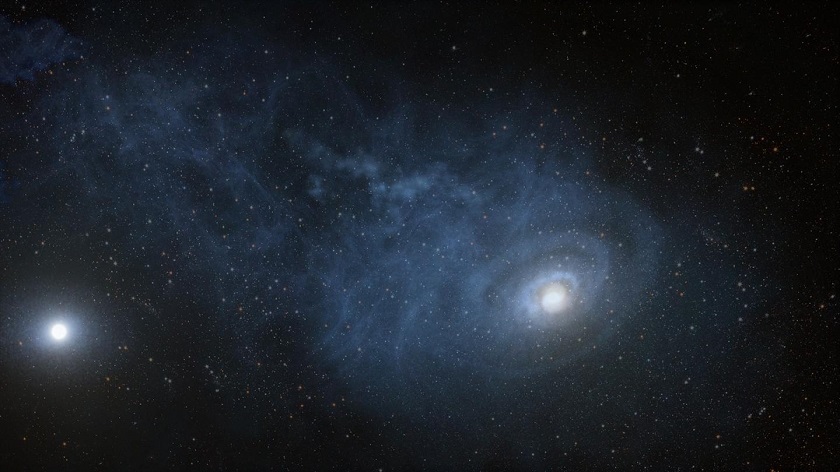
"For the first time, we are seeing filaments of gas directly spiral into a galaxy. It's like a pipeline going straight in," says Christopher Martin, a professor of physics at Caltech and lead author of a new paper appearing in the July 1 issue of the journal Nature Astronomy. "This pipeline of gas sustains star formation, explaining how galaxies can make stars on very fast timescales." CAPTION Artist's impression of a growing galaxy shows gas spiraling in toward the center. New observations from the Keck Cosmic Web Imager provide the best evidence yet that cold gas spirals directly into growing galaxies via filamentous structures. Much of the gas ends up being converted into stars.  CREDIT Adam Makarenko/W. M. Keck Observatory{module In-article}
For years, astronomers have debated exactly how the gas makes its way to the center of galaxies. Does it heat up dramatically as it collides with the surrounding hot gas? Or does it stream in along thin dense filaments, remaining relatively cold? "Modern theory suggests that the answer is probably a mix of both, but proving the existence of these cold streams of gas had remained a major challenge until now," says co-author Donal O'Sullivan (MS '15), a Ph.D. student in Martin's group who built part of KCWI.

KCWI, designed and built at Caltech, is a state-of-the-art spectral imaging camera. Called an integral-field unit spectrograph, it allows astronomers to take images such that every pixel in the image contains a dispersed spectrum of light. Installed at Keck in early 2017, KCWI is the successor to the Cosmic Web Imager (CWI), an instrument that has operated at Palomar Observatory near San Diego since 2010. KCWI has eight times the spatial resolution and 10 times the sensitivity of CWI.

"The main driver for building KCWI was understanding and characterizing the cosmic web, but the instrument is very flexible, and scientists have used it, among other things, to study the nature of dark matter, to investigate black holes, and to refine our understanding of star formation," says co-author Mateusz (Matt) Matuszewski (MS '02, PhD '12), a senior instrument scientist at Caltech.

The question of how galaxies and stars form out of a network of wispy filaments in space--what is known as the cosmic web--has fascinated Martin since he was a graduate student. To find answers, he led the teams that built both CWI and KCWI. In 2017, Martin and his team used KCWI to acquire data on two active galaxies known as quasars, named UM 287 and CSO 38, but it was not the quasars themselves they wanted to study. Nearby each of these two quasars is a giant nebula, larger than the Milky Way and visible thanks to the strong illumination of the quasars. By looking at light emitted by hydrogen in the nebulas--specifically, an atomic emission line called hydrogen Lyman-alpha--they were able to map the velocity of the gas. From previous observations at Palomar, the team already knew there were signs of rotation in the nebulas, but the Keck data revealed much more.

"When we used Palomar's CWI previously, we were able to see what looked like a rotating disk of gas, but we couldn't make out any filaments," says O'Sullivan. "Now, with the increase in sensitivity and resolution with KCWI, we have more sophisticated models and can see that these objects are being fed by gas flowing in from attached filaments, which is strong evidence that the cosmic web is connected to and fueling this disk."

Martin and colleagues developed a mathematical model to explain the velocities they were seeing in the gas and tested it on UM287 and CSO38 as well as on a supercomputer simulated galaxy. 

"It took us more than a year to come up with the mathematical model to explain the radial flow of the gas," says Martin. "Once we did, we were shocked by how well the model works."

The findings provide the best evidence to date for the cold-flow model of galaxy formation, which basically states that cool gas can flow directly into forming galaxies, where it is converted into stars. Before this model came into popularity, researchers had proposed that galaxies pull in gas and heat it up to extremely high temperatures. From there, the gas was thought to gradually cool, providing a steady but slow supply of fuel for stars. In 1996, research from Caltech's Charles (Chuck) Steidel, the Lee A. DuBridge Professor of Astronomy and a co-author of the new study threw this model into question. He and his colleagues showed that distant galaxies produce stars at a very high rate--too fast to be accounted for by the slow settling and cooling of hot gas that was a favored model for young galaxy fueling.

"Through the years, we've acquired more and more evidence for the cold-flow model," says Martin. "We have nicknamed our new version of the model the 'cold-flow inspiral,' since we see the spiraling pattern in the gas."

"These type of measurements are exactly the kind of science we want to do with KCWI," says John O'Meara, the Keck Observatory chief scientist. "We combine the power of Keck's telescope size, powerful instrumentation, and an amazing astronomical site to push the boundaries of what's possible to observe. It's very exciting to see this result in particular, since directly observing inflows has been something of a missing link in our ability to test models of galaxy formation and evolution. I can't wait to see what's coming next."
Japanese researchers teleport information within a diamond

Researchers from the Yokohama National University have teleported quantum information securely within the confines of a diamond. The study has big implications for quantum information technology - the future of how sensitive information is shared and stored.

The researchers published their results on June 28, 2019 in Communications Physics.

"Quantum teleportation permits the transfer of quantum information into an otherwise inaccessible space," said Hideo Kosaka, a professor of engineering at Yokohama National University and an author on the study. "It also permits the transfer of information into a quantum memory without revealing or destroying the stored quantum information."

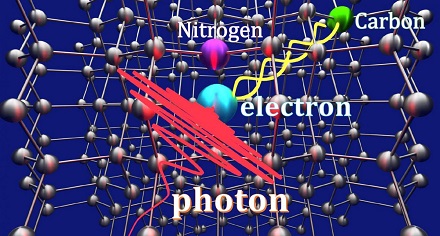
The inaccessible space, in this case, consisted of carbon atoms in diamond. Made of linked, yet individually contained, carbon atoms, a diamond holds the perfect ingredients for quantum teleportation. Caption The lattice structure of diamond contains a nitrogen-vacancy center with surrounding carbons. A carbon isotope (green) is first entangled with an electron (blue) in the vacancy, which then wait for a photon (red) to absorb, resulting in quantum teleportation?based state transfer of the photon into the carbon memory.{module In-article}

A carbon atom holds six protons and six neutrons in its nucleus, surrounded by six spinning electrons. As the atoms bond into a diamond, they form a notoriously strong lattice. Diamonds can have complex defects, though, when a nitrogen atom exists in one of two adjacent vacancies where carbon atoms should be. This defect is called a nitrogen-vacancy center.

Surrounded by carbon atoms, the nucleus structure of the nitrogen atom creates what Kosaka calls a nanomagnet.

To manipulate an electron and a carbon isotope in the vacancy, Kosaka and the team attached a wire about a quarter the width of a human hair to the surface of a diamond. They applied a microwave and a radio wave to the wire to build an oscillating magnetic field around the diamond. They shaped the microwave to create the optimal, controlled conditions for the transfer of quantum information within the diamond.

Kosaka then used the nitrogen nanomagnet to anchor an electron. Using the microwave and radio waves, Kosaka forced the electron spin to entangle with a carbon nuclear spin - the angular momentum of the electron and the nucleus of a carbon atom. The electron spin breaks down under a magnetic field created by the nanomagnet, allowing it to become susceptible to entanglement. Once the two pieces are entangled, meaning their physical characteristics are so intertwined they cannot be described individually, a photon which holds quantum information is applied and the electron absorbs the photon. The absorption allows the polarization state of the photon to be transferred into the carbon, which is mediated by the entangled electron, demonstrating a teleportation of information at the quantum level.

"The success of the photon storage in the other node establishes the entanglement between two adjacent nodes," Kosaka said. Called quantum repeaters, the process can take individual chunks of information from node to node, across the quantum field.

"Our ultimate goal is to realize scalable quantum repeaters for long-haul quantum communications and distributed quantum supercomputers for large-scale quantum computation and metrology," Kosaka said.

National Taiwan University Becomes World's First Asia-Pacific CUDA Center of Excellence

National Taiwan University Recognized as Leading School for Parallel Computing Education and Research Using GPUs -- NVIDIA Corporation and National Taiwan University (NTU), one of the world's leading research universities, today announced that NTU has been named as Asia's first CUDA Center of Excellence.  NTU earned this title by formally adopting NVIDIA GPU Computing solutions across its research facilities and integrating a class to teach parallel computing based on the CUDA architecture into its educational curriculum. NTU joins previously recognized CUDA Centers of Excellence, University of Illinois at Urbana-Champaign and University of Utah with more announcements expected in the coming weeks.

"This appointment and our adoption of GPUs will empower our academic researchers to do world-changing research," said Prof. Ji-Wang Chern, Dean for Research and Development of NTU. "This partnership with NVIDIA will help NTU improve the state of parallel computing education in Taiwan and equip the next generation of computational researchers with the tools they need to make great discoveries."

"Taiwan is the global epicenter of technology innovation and NTU is one of the key universities cultivating engineers and developers that will go on to become true pioneers in the world of IT. We are delighted to recognize their contribution by naming NTU a CUDA Center of Excellence," said David Kirk, chief scientist at NVIDIA.

Following their appointment as a CUDA Center of Excellence, NTU is uniquely positioned to educate Taiwan's next generation of computer scientists on the latest parallel programming techniques and given the increasing demand for high-tech expertise in the region, there has never been a better time to do so.

NTU is rolling out a combination of NVIDIA Tesla GPU Computing solutions, including Tesla S1070 1U systems, and Tesla Personal Supercomputers, desktop workstations containing multiple Tesla C1060 GPU Computing processors, across several of their research facilities, including:

 --  NTU Dept. of Physics
 --  NTU Dept. of Computer Science and Information Engineering
 --  NTU Dept. of Electrical Engineering
 --  NTU Dept. of Mathematics
 --  NTU Center for Quantum Science and Engineering
 --  NTU School of Pharmacy

Across these facilities, students and researchers will investigate astronomy, quantum science, medical device research, financial option modeling, information security, molecular dynamics, and much more.

For more information on NVIDIA CUDA, visit CUDA Zone at www.nvidia.com/cuda