

Israeli researchers develop algorithm to predict infectious diseases

An algorithm that predicts the immune response to a pathogen could lead to early diagnosis for such diseases as tuberculosis

First impressions are important - they can set the stage for the entire course of a relationship. The same is true for the impressions the cells of our immune system form when they first meet a new bacterium. Using this insight, Weizmann Institute of Science researchers have developed an algorithm that may predict the onset of such diseases as tuberculosis. The findings of this research were recently published in Nature Communications.

Dr. Roi Avraham, whose group in the Institute's Biological Regulation Department conducted the research, explains: "When immune cell and bacterium meet, there can be several outcomes. The immune system can kill the bacteria; the bacteria can overcome the immune defenses; or, in the case of diseases like tuberculosis, the bacterium can lie dormant for years, sometimes causing disease at a later stage and sometimes remaining in hibernation for good. We think that the junction in which one of those paths is chosen takes place early on - some 24-48 hours after infection." The repertoire of immune cells taken from blood samples after exposure to a bacterium (inside the circle, cell types; outside, subtypes) and their activation levels. Based on an algorithm, the information can be obtained from a normal blood test with no need for expensive genetic single-cell sequencing{module In-article}
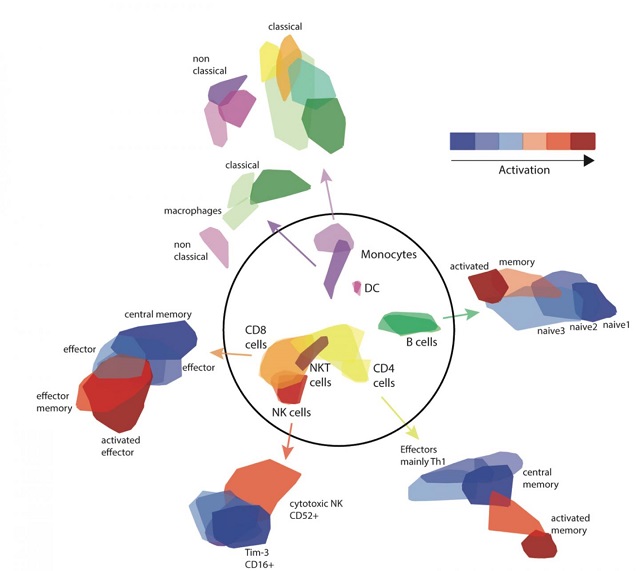
The scientists first tested real meetings between immune cells and bacteria - this time between blood samples (which contain immune cells) and the Salmonella bacterium. Led by Drs. Noa Bossel Ben Moshe and Shelly Hen-Avivi in Avraham's group, the research team used a method that has been developed in recent years, at the Weizmann Institute among other places, to sequence the gene activity in thousands of individual cells. In other words, they could see what each cell looked like as it responded to the Salmonella bacteria and they could map out the activation profiles of each. This, indeed revealed patterns not seen in standard lab tests, and it seemed to confirm their hypothesis - there were indeed, differences that enabled them to trace responses from the initial meetings to the later outcomes.

Such single-cell sequencing is still limited to specialized labs, however. The group asked whether there was a way to connect their results to real-time blood tests in real patients. For this, they turned to their single cell databases on Salmonella infection and immune responses and developed an algorithm - based on a method known as deconvolution - that would then enable them to extract similar information from standard data sets. This algorithm uses information available from the standard blood tests and extrapolates to the properties of the individual blood cells in the experiments. "The algorithm we developed," says Bossel Ben Moshe, "can not only define the ensemble of immune cells that take part in the response, it can reveal their activity levels and thus the potential strength of the immune response."

The first test of the algorithm was in blood samples taken from healthy people in the Netherlands. These samples were infected, in a lab dish, with Salmonella bacteria, and the immune response recorded. Comparisons with existing genomic analysis methods showed that the standard methods did not uncover differences between groups, while the algorithm the group had developed revealed significant ones that were tied to later variations in bacteria-killing abilities.

The group then asked whether the same algorithm could be used to diagnose the onset of tuberculosis, which is caused by a bacterium that often chooses the third way - dormancy -- and thus can hide out in the body for years. Up to a third of the world's population carries the tuberculosis bacterium, though only a small percentage of these actually become ill. Still, some two million die of the disease each year, mostly in underdeveloped areas of China, Russia and Africa. The researchers turned to another database - a British one that followed patients and carriers for a period of two years -- so the group could apply the algorithm to blood test results from both groups, as well as from the subset who went from carrier to disease onset during that period.

The researchers found that the activity levels of immune cells called monocytes could be used to predict the onset or course of the disease. "The algorithm is based on the 'first impressions' of immune cells and Salmonella, which cause a very different type of illness than mycobacterium tuberculosis," says Hen-Avivi. "Still, we were able to predict, early on, which of the carriers would develop the active form of the disease."

Once tuberculosis symptoms appear, patients have to take three different antibiotics over the course of nine months, and antibiotic resistance has become rampant in these bacteria. "If those who are at risk of active disease could be identified when the bacterial load is smaller, their chances of recovery will be better," says Avraham. "And the state medical systems in countries where tuberculosis is endemic might have a better way to keep the suffering and incidence of sickness down while reducing the cost of treatment."

The researchers intend to continue in this line of research - to expand their own database on tuberculosis and other pathogens so to as to refine the algorithm and work on developing the tools that may, in the future, be used to predict who will develop full-blown disease. With the refined algorithm further avenues of research may lead to methods of predicting the course of a number of infectious diseases.
Chest X-rays contain information that can be harvested with AI

Study finds chest X-rays contain 'hidden' information that can be harvested with artificial intelligence to predict long-term mortality

The most frequently performed imaging exam in medicine "the chest X-ray" holds 'hidden' prognostic information that can be harvested with artificial intelligence (AI), according to a study by scientists at Massachusetts General Hospital (MGH) in Boston. The findings of this study published in the July 19, 2019 issue of JAMA Network Open, could help to identify patients most likely to benefit from screening and preventive medicine for heart disease, lung cancer and other conditions.  {module In-article}

AI is responsible for major advances in medicine; for example, several groups have applied AI to automate diagnosis of chest X-rays for detection of pneumonia and tuberculosis. 

If this technology can make diagnoses, asked radiologist Michael Lu, MD, MPH, could it also identify people at high risk for future heart attack, lung cancer, or death? Lu, who is director of research for the MGH Division of Cardiovascular Imaging and assistant professor of Radiology at Harvard Medical School, and his colleagues developed a convolutional neural network, a state-of-the-art AI tool for analyzing visual information, called CXR-risk. CXR-risk was trained by having the network analyze more than 85,000 chest X-rays from 42,000 subjects who took part in an earlier clinical trial. Each image was paired with a key piece of data: Did the person die over a 12-year period? The goal was for CXR-risk to learn the features or combinations of features on a chest X-ray image that best predict health and mortality. 

Next, Lu and colleagues tested CXR-risk using chest X-rays for 16,000 patients from two earlier clinical trials. They found that 53% of people the neural network identified as "very high risk" died over 12 years, compared to fewer than 4% of those that CXR-risk labeled as "very low risk." The study found that CXR-risk provided information that predicts long-term mortality, independent of radiologists' readings of the x-rays and other factors, such as age and smoking status.

Lu believes this new tool will be even more accurate when combined with other risk factors, such as genetics and smoking status. Early identification of at-risk patients could get more into preventive and treatment programs. "This is a new way to extract prognostic information from everyday diagnostic tests," says Lu. "It's information that's already there that we're not using, that could improve people's health."

Japanese researchers build atomically precise models to improve understanding of fuel cells

Supercomputer simulations using models based on real-world atomic structures from microscope observations shed new light on the reaction pathways in fuel cells

Simulations from researchers in Japan provide new insights into the reactions occurring in solid-oxide fuel cells by using realistic atomic-scale models of the active site at the electrode based on microscope observations as the starting point. This better understanding could give clues on ways to improve performance and durability in future devices.

Extremely promising for the clean and efficient electricity generation, solid-oxide fuels cells produce electricity through the electrochemical reaction of a fuel with air, and they have already begun to find their way into homes and office buildings throughout Japan.

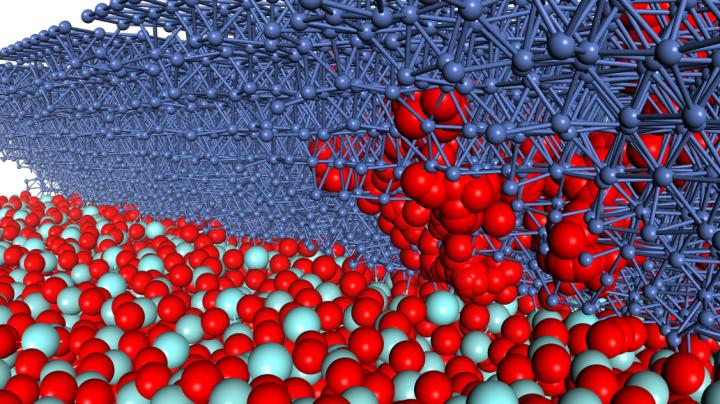
In a typical fuel cell, oxygen molecules on one side of the fuel cell first receive electrons and break up into oxide ions. The oxide ions then travel through an electrolyte to the other side of the device, where they react with the fuel and release their extra electrons. These electrons flow through outside wires back to the starting side, thereby completing the circuit and powering whatever is connected to the wires. CAPTION The initial positions of the atoms in this supercomputer model of a solid-oxide fuel cell were based on observations of the actual atomic configuration using electron microscopy. Simulations using this model revealed a previously unreported reaction (red path) in which an oxygen molecule from the yttria-stabilized zirconia layer (layer of red and light blue balls) moves through the bulk nickel layer (dark blue balls) before forming OH on the nickel surface.  CREDIT Michihisa Koyama, Kyushu University{module In-article}

Although this overall reaction is well known and relatively simple, the reaction step limiting the overall rate of the process remains controversial because the complicated structures of the electrodes--which are generally porous materials as opposed to simple, flat surfaces--hinder investigation of the phenomena at the atomic level.

Since detailed knowledge about the reactions occurring in the devices is vital for further improving the performance and durability of fuel cells, the challenge has been to understand how the microscopic structures--down to the alignment of the atoms at the different interfaces--affect the reactions.

"Computer simulations have played a powerful role in predicting and understanding reactions that we cannot easily observe on the atomic or molecular scale," explains Michihisa Koyama, the head of the group that led the research at Kyushu University's INAMORI Frontier Research Center.

"However, most studies have assumed simplified structures to reduce the computational cost, and these systems cannot reproduce the complex structures and behavior occurring in the real world."

Koyama's group aimed to overcome these shortcomings by applying simulations with refined parameters to realistic models of the key interfaces based on microscopic observations of the actual positions of the atoms at the active site of the electrode.

Leveraging the strength of Kyushu University's Ultramicroscopy Research Center, the researchers carefully observed the atomic structure of thin slices of the fuel cells using atomic-resolution electron microscopy. Based on these observations, the researchers then reconstructed supercomputer models with the same atomic structures for two representative arrangements that they observed.

Reactions between hydrogen and oxygen in these virtual fuel cells were then simulated with a method called Reactive Force Field Molecular Dynamics, which uses a set of parameters to approximate how atoms will interact--and even chemically react--with each other, without going into the full complexity of rigorous quantum chemical calculations. In this case, the researchers employed an improved set of parameters developed in collaboration with Yoshitaka Umeno's group at the University of Tokyo.

Looking at the outcome of multiple runs of the simulations on the different model systems, the researchers found that the desired reactions were more likely to occur in the layers with a smaller pore size.

Furthermore, they identified a new reaction pathway in which oxygen migrates through the bulk layers in a way that could potentially degrade performance and durability. Thus, strategies to avoid this potential reaction route should be consider as researchers work to design improved fuel cells.

"These are the kinds of insights that we could only get by looking at real-world systems," comments Koyama. "In the future, I expect to see more people using real-world atomic structures recreated from microscope observations for the basis of simulations to understand phenomena that we cannot easily measure and observe in the laboratory."