Image 1: Scanning tunnelling microscopy topography of the honeycomb lattice of germanene

Dutch scientists create material that paves the way for more energy-efficient electronics

Researchers from the University of Twente, a public technical university located in Enschede, Netherlands, have proved that germanene, a two-dimensional material made of germanium atoms, behaves as a topological insulator. It is the first 2D topological insulator that consists of a single element. It also has the unique ability to switch between ‘on’ and ‘off’ states, comparable to transistors. This could lead to more energy-efficient electronics.

Topological insulators are materials with the unique property of insulating electricity in their interior while conducting electricity along their edges. The conductive edges allow electrical current to flow without energy loss. “At the moment, electronic devices lose a lot of energy in the form of heat, because defects in the material increase the resistance. As a result, your mobile phone can get uncomfortably hot”, explains UT researcher Pantelis Bampoulis. While scattering at defects is allowed in normal materials, at the edges of 2D topological insulators, the scattering of electrons at defects is forbidden due to the unique topological protection mechanism. Therefore, electrical current in 2D topological insulators flows without dissipating energy. This makes them more energy-efficient than current electronic materials.

CREATING GERMANENE

Germanene is such a 2D topological insulator. “Current topological insulators consist of complex structures from different types of elements. Germanene is unique in that it’s made from just a single element”, explains Bampoulis. To create this exciting material, the researchers melted germanium together with platinum. When the mixture cooled down, a tiny layer of germanium atoms was arranged into a honeycomb lattice on top of the germanium-platinum alloy. This 2D layer of atoms is called germanene.

Image 2: Artistic illustration of the dissipationless edge channels in Germanene. Credits: Ella Marushchenko

TOPOLOGICAL TRANSISTORS

The researchers also discovered that the conducting properties of the material can be switched ‘off’ by applying an electric field. This property is unique for a topological insulator. “The possibility to switch between ‘on’ and ‘off’ states adds an exciting application case for germanene”, says Bampoulis. It paves the way for designing topological field-effect transistors. These transistors could replace traditional transistors in electronic devices. Resulting in electronics that no longer heat up.

First-authors Gavin Rice (left) and Thorsten Wagner (right).

Germany creates AI software for dependable imaging of proteins in cells

Max Planck researchers from Dortmund programmed a tool that accurately recognizes and picks proteins in electron cryo-tomography, substituting troublesome hand selection

Electron cryo-tomography (cryo-ET) is emerging as a powerful technique to provide detailed 3D images of cellular environments and enclosed biomolecules. However, one of the challenges of the methodology is the identification of protein molecules in the images for further processing. A research team around Stefan Raunser, Director at the MPI of Molecular Physiology in Dortmund, led by Thorsten Wagner, developed software to pick proteins in crowded cellular volumes. The new open-source tool, called TomoTwin, is based on deep metric learning and allows scientists to locate several proteins with high accuracy and throughput without manually creating or retraining the network each time. TomoTwin processing map for a tomogram flattened to 2D. Particles of different macromolecules are arranged in the map according to their structure allowing users to identify and locate different macromolecules inside cells.

The more, the better

“TomoTwin paves the way for automated identification and localization of proteins directly in their cellular environment, expanding the potential of cryo-ET,” says Gavin Rice, co-first author of the publication. Cryo-ET has the potential to decipher how biomolecules work within a cell and, by that, to unveil the basis of life and the origin of diseases.

In a cryo-ET experiment, scientists use a transmission electron microscope to obtain 3D images, called tomograms, of the cellular volume containing complex biomolecules. To gain a more detailed image of each different protein, they average as many copies of them as possible – similar to photographers capturing the same photo at varying exposures to later combine them in a perfectly exposed image. Crucially, one has to correctly identify and locate the different proteins in the picture before averaging them. “Scientists can attain hundreds of tomograms per day, but we lacked tools to fully identify the molecules within them,” says Rice.

Hand-picking

So far, researchers used algorithms based on templates of already known molecular structures to search for matches in the tomograms, but these tend to be error-prone. Identifying molecules by hand is another option that ensures high-quality picking but takes days to weeks per dataset.

Another possibility would be to use a form of supervised machine learning. These tools can be very accurate but currently lack usability, as they require manually labeling thousands of examples to train the software for each new protein, an almost impossible task for small biological molecules in a crowded cellular environment.

TomoTwin

The newly developed software TomoTwin overcomes many of these obstacles: It learns to pick the molecules that are similar in shape within a tomogram and maps them to a geometric space – the system is rewarded for placing similar proteins near each other and penalized otherwise. In the new map (image 1), researchers can isolate and accurately identify the different proteins and use this to locate them inside the cell. “One advantage of TomoTwin is that we provide a pre-trained picking model,” says Rice. By removing the training step, the software can even run on local computers – where processing a tomogram usually requires 60-90 minutes, and runtime on the MPI supercomputer Raven is reduced to 15 minutes per tomogram.

TomoTwin allows researchers to pick dozens of tomograms in the time it takes to manually pick a single one, therefore increasing the throughput of data and the averaging rate to obtain a better image. The software can currently locate globular proteins or protein complexes larger than 150 kilodaltons in cells; in the future, the Raunser group aims to include membrane proteins, filamentous proteins, and proteins of smaller sizes.

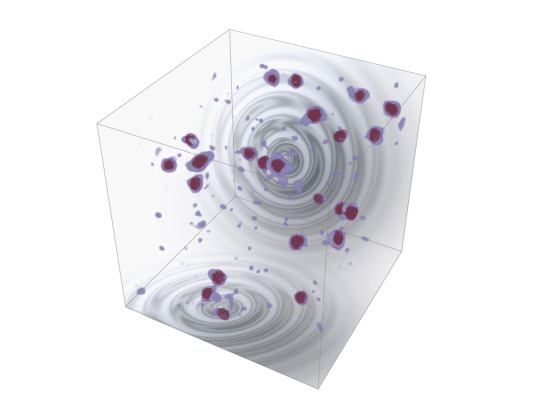
Schematic of the inflaton field fragmented into oscillons, with superimposed gravitational waves. (Credit: Kavli IPMU, Volodymyr Takhistov)

Japanese researchers discover, explore the earliest Universe dynamics with gravitational waves

Researchers have discovered a new generic production mechanism of gravitational waves generated by a phenomenon known as oscillons, which can originate in many cosmological theories from the fragmentation into solitonic “lumps” of the inflaton field that drove the early Universe’s rapid expansion. The results have set the stage for revealing exciting novel insights about the Universe's earliest moments.

The inflationary period, which occurred just after the Big Bang, is believed to have caused the Universe to expand exponentially. In many cosmological theories, the rapid expansion period is followed by the formation of oscillons. Oscillons are a type of localized non-linear massive structure that can form from fields, such as the inflaton field, which are oscillating at high frequencies. These structures can persist for long periods, and as the researchers found, their eventual decay can generate a significant amount of gravitational waves, which are ripples in space-time.

In their study, Kavli Institute for the Physics and Mathematics of the Universe (Kavli IPMU) Project Researcher Kaloian D. Lozanov, and Kavli IPMU Visiting Associate Scientist, International Center for Quantum-field Measurement Systems for Studies of the Universe and Particles (QUP) Senior Scientist, and High Energy Accelerator Research Organization (KEK) Theory Center Assistant Professor Volodymyr Takhistov, have simulated the evolution of the inflaton field during the early Universe and found that oscillons were indeed present. They then found that oscillon decay was able to generate gravitational waves that would be detectable by upcoming gravitational wave observatories.

The findings provide a novel test of the early Universe dynamics independent of the conventionally studied cosmic microwave background radiation. The discovery of these gravitational waves would establish a new window into the Universe's earliest moments and could help shed light on some of the pressing fundamental questions in cosmology.

With the ongoing development of gravitational wave detectors and supercomputing resources, we can expect to gain even more insights into the Universe's early moments in the coming years. Overall, the new study demonstrates the power of combining theoretical models with advanced computational techniques and observations to uncover new insights into the Universe's evolution.