The spin orbit torque magnetoresistive random access memory (SOT-MRAM) has the potential to store data more quickly and efficiently than current methods, which store data using electric charge and require a continuous power input to maintain that data. (Image credit: Shutterstock/raigvi)

Stanford creates new material that enables more efficient magnet-based memory

Stanford engineers have found a metallic compound that could bring more efficient forms of computer memory closer to commercialization, reducing computing’s carbon footprint, enabling faster processing, and allowing AI training to happen on individual devices instead of remote servers.

Over the last decade, with the introduction of increasingly complex artificial intelligence (AI) technologies, the demand for computing power has risen exponentially. New, energy-efficient hardware designs could help meet this demand while reducing computing’s energy use, supporting faster processing, and allowing AI training to take place within the device itself.

“In my opinion, we have already transitioned from the internet era to the AI era,” says Shan Wang, the Leland T. Edwards Professor in the School of Engineering at Stanford University. “We want to enable AI on edge – training locally on your home computer, phone, or smartwatch – for things like heart attack detection or speech recognition. To do that, you need a very fast, non-volatile memory.”

Wang and his colleagues recently found a material that could bring a new type of memory closer to commercialization. In a new paper, the researchers demonstrated that a thin layer of a metallic compound called manganese palladium three had the necessary properties to facilitate a form of working memory that stores data in electron spin directions. This method of memory storage, known as spin-orbit torque magnetoresistive random access memory or SOT-MRAM, has the potential to store data more quickly and efficiently than current methods, which store data using electric charge and require a continuous power input to maintain that data.

“We’ve provided a basic building block for future energy-efficient storage elements,” Wang says. “It’s very foundational, but it’s a breakthrough.”

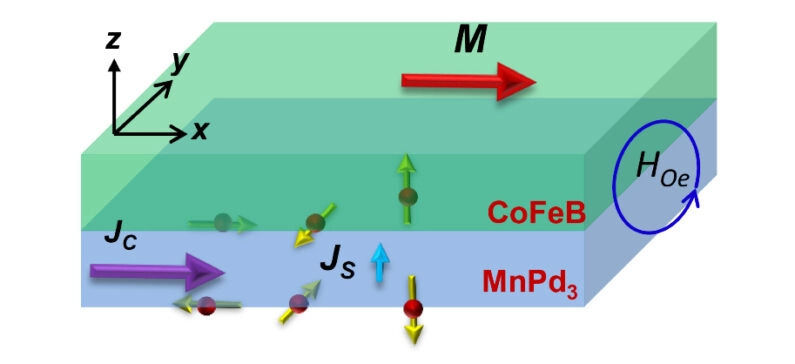
Harnessing electron spin Unconventional z-spin polarization in MnPd3 material. (Image credit: The Wang Group)
SOT-MRAM relies on an intrinsic property of electrons called spin. To understand spin, picture an electron as a rotating basketball balanced on the end of a professional athlete’s finger. Because electrons are charged particles, the rotation turns the electron into a tiny magnet, polarized along its axis (in this case, a line that extends from the finger balancing the ball). If the electron switches spin in directions, the north-south poles of the magnet switch. Researchers can use the up or down direction of that magnetism – known as the magnetic dipole moment – to represent the ones and zeroes that makeup bits and bytes of computer data.

In SOT-MRAM, a current flowing through one material (the SOT layer) generates specific spin directions. The movement of those electrons, coupled with their spin directions, creates a torque that can switch the spin directions and associated magnetic dipole moments of electrons in an adjacent magnetic material. With the right materials, storing magnetic data is as simple as switching the direction of an electrical current in the SOT layer.

But finding the right SOT materials isn’t easy. Because of the way the hardware is designed, data can be stored more densely when electron spin directions are oriented up or down in the z-direction. (If you imagine a sandwich on a plate, the x- and y-directions follow the edges of the bread and the z-direction is the toothpick shoved through the middle.) Unfortunately, most materials polarize electron spins in the y-direction if the current flows in the x-direction.

“Conventional materials only generate spin in the y-direction – that means we would need an external magnetic field to make switching happen in the z-direction, which takes more energy and space,” says Fen Xue, a postdoctoral researcher in Wang’s lab. “For the purpose of lowering the energy and having a higher density of memory, we want to be able to realize this switching without an external magnetic field.”

The researchers found that manganese palladium three has the properties they need. The material is able to generate spins in any orientation because its internal structure lacks the kind of crystal symmetry that would force all of the electrons into a particular orientation. Using manganese palladium three, the researchers were able to demonstrate magnetization switching in both the y- and z-directions without needing an external magnetic field. Although not demonstrated in the manuscript, x-direction magnetization can also be switched in the absence of an external magnetic field.

“We have the same input current as other conventional materials, but we have three different directions of spins now,” says Mahendra DC, who conducted the work as a postdoctoral researcher at Stanford and is the first author of the paper. “Depending on the application, we can control the magnetization in whatever direction we want.”

DC and Wang credit the multidisciplinary and multi-institutional collaboration that enabled these advances. “Evgeny Tsymbal’s lab at the University of Nebraska led the calculations to predict the unexpected spin directions and movement and Julie Borchers’s lab at the National Institute of Standards and Technology led the measurements and modeling efforts to reveal the intricate microstructures within manganese palladium three,” says Wang. “It truly takes a village.”

Manufacturing possibilities

In addition to its symmetry-breaking structure, manganese palladium three has several other properties that make it an excellent candidate for SOT-MRAM applications. It can, for example, survive and maintain its properties through the post-annealing process that electronics need to go through.

“Post-annealing requires electronics to be at 400 degrees Celsius for 30 minutes,” DC says. “That’s one of the challenges for new materials in these devices, and manganese palladium three can handle that.”

Also, the layer of manganese palladium three is created using a process called magnetron sputtering, which is a technique that is already used in other aspects of memory-storage hardware.

“There’s no new tools or new techniques needed for this kind of material,” Xue says. “We don’t need a textured substrate or special conditions to deposit it.”

The result is a material that not only has novel properties that could help meet our growing computing requirements but can fit smoothly into current manufacturing techniques. The researchers are already working on prototypes of SOT-MRAM using manganese palladium three that will integrate into real devices.

“We are hitting a wall with the current technology,” DC says. “So we have to figure out what other options we have.”

French team uses supercomputer modeling to study how far plastic drifts far from its starting point as it sinks into the sea

Discarded or drifting in the ocean, plastic debris can accumulate on the water’s surface, forming floating garbage islands. Although it’s harder to spot, researchers suspect a significant amount also sinks. In a new study in ACS’ Environmental Science & Technology, one team used supercomputer modeling to study how far bits of lightweight plastic travel when falling into the Mediterranean Sea. Their results suggest these particles can drift farther underwater than previously thought. 

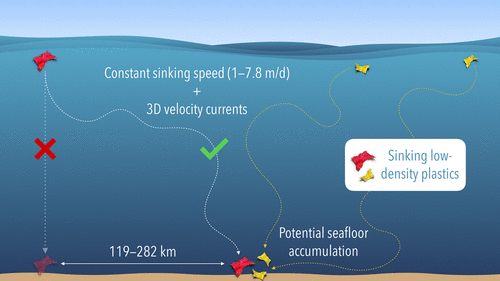
Plastic pollution is besieging the oceans from old shopping bags to water bottles. Not only is this debris unsightly, but animals can also become trapped or mistakenly eat it. And if it remains in the water, plastic waste can release organic pollutants. The problem is most visible on the surface, where currents can aggregate this debris into massive garbage patches. However, plastic waste also collects much deeper. Even material that weighs less than water can sink as algae and other organisms glom onto it, and through other processes. Bits of this light plastic, typically measuring 5 millimeters or less, have turned up at least half a mile below the surface. Researchers don’t know much about what happens when plastic sinks, but they generally assume it falls straight down from the surface. However, Alberto Baudena and his colleagues suspected this light plastic might not follow such a direct route.

To test this assumption, they used an advanced supercomputer model developed to track plastic at sea and incorporated extensive data already collected on floating plastic pollution in the Mediterranean Sea. They then simulated nearly 7.7 million bits of plastic distributed across the sea and tracked their virtual paths to depths as great as about half a mile. Their results suggested that the slower the pieces sank, the farther currents carried them from their points of origin, with the slowest traveling an average of roughly 175 miles laterally. While observations of the distribution of plastic underwater is limited, the team found their simulations agree with those available in the Mediterranean. Their simulations also suggested that currents may push plastic toward coastal areas and that only about 20% of pollution near coasts originates from the nearest country. According to the researchers, these particles’ long journeys mean this plastic has greater potential to interact with, and harm, marine life.

The authors acknowledge funding from the International Union for Conservation of Nature, the Tara Expeditions Foundation, and the Albert II Monaco Foundation.

(Adobe Stock)

UConn physicist Volkov shows how to manipulate quasiparticles in thin layers of ordinary superconductors to create topological superconductors by slightly twisting the stacked layers

"The twist is essentially determining the properties, and funnily enough, it gives you some very unexpected properties"

Transporting energy is costly. When a current runs through conductive materials, some of the energy is lost due to resistance as particles within the material interact. This energy loss presents a hurdle to the advancement of many technologies and scientists are searching for ways to make superconductors that eliminate resistance. 

Superconductors can also provide a platform for fault-tolerant quantum supercomputing if endowed with topological properties. An example of the latter is the quantum Hall effect where the topology of electrons leads to universal, “quantized,” resistance with accuracy up to one part in a billion, which finds use in meteorology. Unfortunately, the quantum Hall effect requires extremely strong magnetic fields, typically detrimental to superconductivity. This makes the search for topological superconductors a challenging task.

In two new papers in Physical Review Letters and Physical Review B UConn Physicist Pavel Volkov and his colleagues propose how to experimentally manipulate the quantum particles, called quasiparticles, in very thin layers of ordinary superconductors to create topological superconductors by slightly twisting the stacked layers.

Volkov explains there is a lot of research being done on ways to engineer materials by stacking layers of two-dimensional materials together:

“Most famously, this has been done with graphene. Stacking two graphene layers in a particular way results in a lot of interesting new phenomena. Some parallel those in high-temperature superconductors, which was unexpected because, by itself, graphene is not superconducting.”

Superconductivity happens when a material conducts current without any resistance or energy loss. Since resistance is a challenge for many technologies, superconducting materials have the potential to revolutionize how we do things, from energy transmission to quantum supercomputing to more efficient MRI machines. 

However, endowing superconductors with topological properties is challenging, says Volkov, and as of now, there are no materials that can reliably perform as topological superconductors.

The researchers theorize that there is an intricate relation between what happens inside the twisted superconductor layers and a current applied between them. Volkov says the application of a current makes the quasiparticles in the superconductor behave as if they were in a topological superconductor.

“The twist is essentially determining the properties, and funnily enough, it gives you some very unexpected properties. We thought about applying twisting to materials that have a peculiar form of superconductivity called nodal superconductivity,” says Volkov. “Fortunately for us, such superconductors exist and, for example, the cuprate high-temperature superconductors are nodal superconductors. What we claim is that if you apply a current between two twisted layers of such superconductors, it becomes a topological superconductor.”

The proposal for current-induced topological superconductivity is, in principle, applicable at any twist angle, Volkov explains, and there is a wide range of angles that optimize the characteristics, which is unlike other materials studied so far.

“This is important because, for example, in twisted bilayer graphene, observation of interesting new phenomena requires aligning the two layers to 1.1 degrees, and deviations by .1 degrees are strongly detrimental. That means that one is required to make a lot of samples before finding one that works. For our proposal, this problem won’t be as bad.  If you miss the angle even by a degree, it’s not going to destroy the effect we predict.”

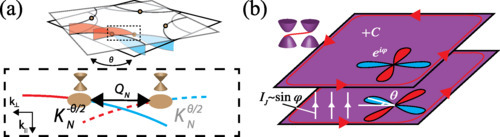
Volkov expects that this topological superconductor has the potential to be better than anything else currently on the market. Though one caveat is they do not know exactly what the parameters of the resulting material will be, they have estimates that may be useful for proof of principle experiments. (a) Momentum-space schematic of a twisted nodal superconductor exemplified by a d-wave superconductor with a sign-changing gap (from blue to red). Near the nodes (  K N   and   ˜ K N  ) he BdG quasiparticles of the two layers have a Dirac dispersion shifted by a vector   Q N ( = θ K N )   with respect to one another. (b) Interlayer current leads to opening of a bulk   Z   topological gap with gapless chiral edge modes.

The researchers also found unexpected behaviors for the special value of twist angle.

“We find a particular value of the angle, the so-called ‘magic angle,’ where a new state should appear – a form of magnetism. Typically, magnetism and superconductivity are antagonistic phenomena but here, superconductivity begets magnetism, and this happens precisely because of the twisted structure of the layers.” says Volkov.

Demonstrating these predictions experimentally will bring more challenges to overcome, including making the atoms-thick layers better themselves and determining the difficult-to-measure parameters, but Volkov says there is a lot of motivation behind developing these highly complex materials.

“Basically, the main problem so far is that the candidate materials are tricky to work with. There are several groups around the world trying to do this. Monolayers of nodal superconductors, necessary for our proposal have been realized, and experiments on twisted flakes are ongoing. Yet, the twisted bilayer of these materials has not been demonstrated. That’s work for the future.”

These materials hold promise for improving materials we use in everyday life, says Volkov. Things already in use that take advantage of the topological states include devices used to set resistance standards with high accuracy. Topological superconductors are also potentially useful in quantum supercomputing, as they serve as a necessary ingredient for proposals of fault-tolerant qubits, the units of information in quantum computing. Volkov also emphasizes the promise topological materials hold for precision physics,

“Topological states are useful because they allow us to do precision measurements with materials. A topological superconductor may allow us to perform such measurements with unprecedented precision for spin (magnetic moment of an electron) or thermal properties.”