
MIT prof Buehler builds a deep learning system that explores the properties of materials from the outside

A new method could provide detailed information about internal structures, voids, and cracks, based solely on data about exterior conditions.

Maybe you can’t tell a book from its cover, but according to researchers at MIT, you may now be able to do the equivalent for materials of all sorts, from an airplane part to a medical implant. Their new approach allows engineers to figure out what’s happening inside simply by observing the properties of the material’s surface.

The team used a type of machine learning known as deep learning to compare a large set of simulated data about materials’ external force fields and the corresponding internal structure and used that to generate a system that could make reliable predictions of the interior from the surface data.

The results are being published in the journal Advanced Materials, in a paper by doctoral student Zhenze Yang and professor of civil and environmental engineering Markus Buehler.

“It’s a very common problem in engineering,” Buehler explains. “If you have a piece of material — maybe it’s a door on a car or a piece of an airplane — and you want to know what’s inside that material, you might measure the strains on the surface by taking images and computing how much deformation you have. But you can’t really look inside the material. The only way you can do that is by cutting it and then looking inside and seeing if there’s any kind of damage in there.”

It's also possible to use X-rays and other techniques, but these tend to be expensive and require bulky equipment, he says. “So, what we have done is basically ask the question: Can we develop an AI algorithm that could look at what’s going on at the surface, which we can easily see either using a microscope or taking a photo, or maybe just measuring things on the surface of the material, and then trying to figure out what’s actually going on inside?” That inside information might include any damages, cracks, or stresses in the material or details of its internal microstructure.

The same kind of questions can apply to biological tissues as well, he adds. “Is there disease in there, or some kind of growth or changes in the tissue?” The aim was to develop a system that could answer these kinds of questions in a completely non-invasive way.

Achieving that goal involved addressing complexities including the fact that “many such problems have multiple solutions,” Buehler says. For example, many different internal configurations might exhibit the same surface properties. To deal with that ambiguity, “we have created methods that can give us all the possibilities, all the options, basically, that might result in this particular [surface] scenario.”

The technique they developed involved training an AI model using vast amounts of data about surface measurements and the interior properties associated with them. This included not only uniform materials but also ones with different materials in combination. “Some new airplanes are made out of composites, so they have deliberate designs of having different phases,” Buehler says. “And of course, in biology as well, any kind of biological material will be made out of multiple components and they have very different properties, like in bone, where you have very soft protein, and then you have very rigid mineral substances.”

The technique works even for materials whose complexity is not fully understood, he says. “With complex biological tissue, we don’t understand exactly how it behaves, but we can measure the behavior. We don’t have a theory for it, but if we have enough data collected, we can train the model.”

Yang says that the method they developed is broadly applicable. “It is not just limited to solid mechanics problems, but it can also be applied to different engineering disciplines, like fluid dynamics and other types,” Buehler adds that it can be applied to determining a variety of properties, not just stress and strain, but fluid fields or magnetic fields, for example, the magnetic fields inside a fusion reactor. It is “very universal, not just for different materials, but also for different disciplines.”

Yang says that he initially started thinking about this approach when he was studying data on a material where part of the imagery he was using was blurred, and he wondered how it might be possible to “fill in the blank” of the missing data in the blurred area. “How can we recover this missing information?” he wondered. Reading further, he found that this was an example of a widespread issue, known as the inverse problem, of trying to recover missing information.

Developing the method involved an iterative process, having the model make preliminary predictions, comparing that with actual data on the material in question, then fine-tuning the model further to match that information. The resulting model was tested against cases where materials are well enough understood to be able to calculate the true internal properties, and the new method’s predictions matched up well against those calculated properties.

The training data included imagery of the surfaces, but also various other kinds of measurements of surface properties, including stresses, and electric and magnetic fields. In many cases, the researchers used simulated data based on an understanding of the underlying structure of a given material. And even when a new material has many unknown characteristics, the method can still generate an approximation that’s good enough to provide guidance to engineers with a general direction as to how to pursue further measurements.

As an example of how this methodology could be applied, Buehler points out that today, airplanes are often inspected by testing a few representative areas with expensive methods such as X-rays because it would be impractical to test the entire plane. “This is a different approach, where you have a much less expensive way of collecting data and making predictions,” Buehler says. “From that you can then make decisions about where do you want to look, and maybe use more expensive equipment to test it.”

To begin with, he expects this method, which is being made freely available for anyone to use through the website GitHub, to be mostly applied in laboratory settings, for example in testing materials used for soft robotics applications.

For such materials, he says, “We can measure things on the surface, but we have no idea what’s going on a lot of times inside the material, because it’s made out of a hydrogel or proteins or biomaterials for actuators, and there’s no theory for that. So, that’s an area where researchers could use our technique to make predictions about what’s going on inside, and perhaps design better grippers or better composites,” he adds.

The research was supported by the U.S. Army Research Office, the Air Force Office of Scientific Research, the GoogleCloud platform, and the MIT Quest for Intelligence.
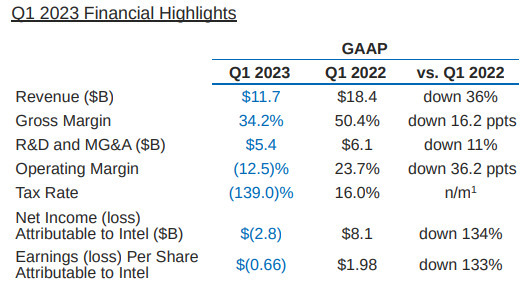
Intel reports the largest quarterly loss in its history

Intel has reported first-quarter 2023 financial results that showed a staggering 133% annual reduction in earnings per share. The company's revenue has dropped nearly 36% to $11.7 billion from $18.4 billion a year ago.

In the first quarter, Intel turned to a net loss of $2.8 billion, or 66 cents per share, from a net profit of $8.1 billion, or $1.98 per share, last year.

It’s the fifth consecutive quarter of declining sales and the second consecutive quarter of losses. It’s also Intel’s largest quarterly loss of all time, beating out the fourth quarter of 2017, when it lost $687 million.Screenshot_2023-04-27_18.45.49_8ce3d_a4cf8.jpg

“We delivered solid first-quarter results, representing steady progress with our transformation,” said Pat Gelsinger, Intel CEO. “We hit key execution milestones in our data center roadmap and demonstrated the health of the process technology underpinning it. While we remain cautious on the macroeconomic outlook, we are focused on what we can control as we deliver on IDM 2.0: driving consistent execution across process and product roadmaps and advancing our foundry business to best position us to capitalize on the $1 trillion market opportunity ahead.”

David Zinsner, Intel CFO, said, “We exceeded our first-quarter expectations on the top and bottom line, and continued to be disciplined on expense management as part of our commitment to drive efficiencies and cost savings. At the same time, we are prioritizing the investments needed to advance our strategy and establish an internal foundry model, one of the most consequential steps we are taking to deliver on IDM 2.0.”

Intel previously announced the organizational change to integrate its Accelerated Computing Systems and Graphics Group into its Client Computing Group and Data Center and AI Group. This change is intended to drive a more effective go-to-market capability and to accelerate the scale of these businesses, while also reducing costs. As a result, the company modified its segment reporting in the first quarter of 2023 to align with this and certain other business reorganizations. All prior-period segment data has been retrospectively adjusted to reflect the way the company internally receives information and manages and monitors operating segment performance starting in the fiscal year 2023.

The image shows an artistic impression of the rocky scaffold structure of the nuclear pore complex filled with intrinsically disordered nucleoporins in the central channel depicted as seaweeds. In this work, the viewer dives into the dark hole of the nuclear pore complex to shine light on the disordered nucleoporins. (ill./©: Sara Mingu)

German-built MD simulations show how proteins block dangerous invaders

Tiny pores in the cell nucleus play an essential role in healthy aging by protecting and preserving the genetic material. A team from the Department of Theoretical Biophysics at the Max Planck Institute of Biophysics in Frankfurt am Main and the Synthetic Biophysics of Protein Disorder group at Johannes Gutenberg University Mainz (JGU) has filled a hole in the understanding of the structure and function of these nuclear pores. The scientists found out how intrinsically disordered proteins in the center of the pore can form a spaghetti-like mobile barrier that is permeable to important cellular factors but blocks viruses or other pathogens. 

Human cells shield their genetic material inside the cell nucleus, protected by the nuclear membrane. As the control center of the cell, the nucleus must be able to exchange important messenger molecules, metabolites, or proteins with the rest of the cell. About 2,000 pores are therefore built into the nuclear membrane, each consisting of about 1,000 proteins.

For decades, researchers have been fascinated by the three-dimensional structure and function of these nuclear pores, which act as guardians of the genome: substances that are required for controlling the cell are allowed to pass, while pathogens or other DNA-damaging substances are blocked from entry. The nuclear pores can therefore be thought of as molecular bouncers, each checking many thousands of visitors per second. Only those who have an entrance ticket are allowed to pass.

How do the nuclear pores manage this enormous task? About 300 proteins attached to the pore scaffold protrude deep into the central opening like tentacles. Until now, researchers did not know how these tentacles are arranged and how they repel intruders. This is because these proteins are intrinsically disordered and lack a defined three-dimensional structure. They are flexible and continuously moving – like spaghetti in boiling water.

Combination of microscopy and supercomputer simulations

As these intrinsically disordered proteins (IDPs) are constantly changing their structure, it is difficult for scientists to decipher their three-dimensional architecture and their function. Most experimental techniques that researchers use to image proteins only work with a defined 3D structure. So far, the central region of the nuclear pore has been represented as a hole because it was not possible to determine the organization of the IDPs in the opening.

The team led by Gerhard Hummer, Director at the Max Planck Institute of Biophysics, and Edward Lemke, Professor of Synthetic Biophysics at Johannes Gutenberg University Mainz and Adjunct Director at the Institute of Molecular Biology Mainz (IMB) has now used a novel combination of synthetic biology, multidimensional fluorescence microscopy and supercomputer-based simulations to study nuclear pore IDPs in living cells.

"We used modern precision tools to mark several points of the spaghetti-like proteins with fluorescent dyes that we excite by light and visualize in the microscope," explained Lemke. "Based on the glow patterns and duration, we were able to deduce how the proteins must be arranged." And Hummer added: "We then used molecular dynamics simulations to calculate how the IDPs are spatially organized in the pore, how they interact with each other, and how they move. For the first time, we could visualize the gate to the control center of human cells."

Dynamic protein network as a transport barrier

 The tentacles in the transport pore take on a completely different behavior compared to what we knew before because they interact with each other and with the cargo. They move permanently like the aforementioned spaghetti in boiling water. So, in the center of the pore, there is no hole, but a shield of wiggly, spaghetti-like molecules. Viruses or bacteria are too big to get through this sieve. However, other large cellular molecules needed in the nucleus can pass as they carry very specific signals. Such molecules have an entry ticket, whereas pathogens usually do not. "By disentangling the pore filling, we enter a new phase in nuclear transport research," added Dr. Martin Beck, collaborator, and colleague at the Max Planck Institute of Biophysics.

"Understanding how the pores transport or block cargo will help us identify errors. After all, some viruses manage to enter the cell nucleus despite the barrier," Hummer summed up. "With our combination of methods, we can now study IDPs in more detail to find why they are indispensable for certain cellular functions, despite being error-prone. IDPs are found in almost all species, although they carry the risk of forming aggregates during the aging process which can lead to neurodegenerative diseases such as Alzheimer's," said Lemke. By learning how IDPs function, researchers aim to develop new drugs or vaccines that prevent viral infections and help healthy aging.