

University of Massachusetts Amherst's hydrologic models reveal Arctic rivers are discharging more water than previously thought

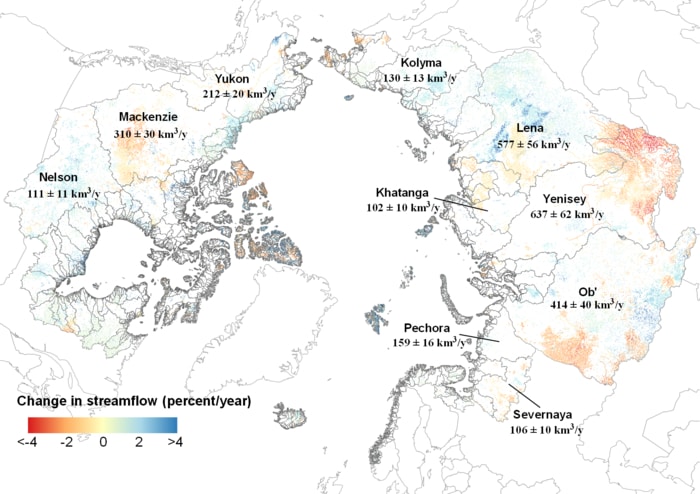
A civil and environmental engineering researcher at the University of Massachusetts Amherst has, for the first time, assimilated satellite information into on-site river measurements and hydrologic models to calculate the past 35 years of river discharge in the entire pan-Arctic region. The research reveals, with unprecedented accuracy, that the acceleration of water pouring into the Arctic Ocean could be three times higher than previously thought. Temporal trends in river discharge during 1984-2018 show significant regional differences in river discharge patterns. Areas in blue indicate increases in discharge of up to 4%, while those in red show decreases of up to 4%. The chart illustrates that significant portions of Eurasia show decreases in streamflow over the past 35 years. Only rivers with statistically significant trends are mapped.  CREDIT Dongmei Feng, et al.
The publicly available study is the result of three years of intensive work by research assistant professor Dongmei Feng, the first and corresponding author on the paper. The unprecedented research assimilates 9.18 million river discharge estimates made from 155,710 orbital satellite images into hydrologic model simulations of 486,493 Arctic river reaches from 1984-2018. The project is called RADR (remotely-sensed Arctic Discharge Reanalysis) and was funded by NASA and National Science Foundation programs for early career researchers.

“We recreated the river discharge information all over the pan-Arctic region. Previous studies didn’t do this,” Feng says. “They only used some gauge data and only for certain rivers, not all of them, to calculate how much water is pouring into the Arctic Ocean.”

“This is a new, publicly available daily record of flow across the global North,” adds Colin Gleason, a civil and environmental engineering professor and principal investigator on the study. “No one has ever tried to do it at this scale: teaching the models what the satellites saw daily in half a million rivers from millions of satellite observations. It’s a very sophisticated data assimilation, which is the process of merging models and data.”

River discharge integrates all hydrologic processes of upstream watersheds and defines a river’s carrying capacity. It is considered the single most important measurement needed to understand a river, yet the availability of this information is limited due to a lack of reliable, comprehensive, publicly available data, Feng says.

Physically gauging rivers – the “gold standard” for gaining discharge information – is expensive and labor-intensive to install and maintain because gauges need to be physically recalibrated several times a year. Also, rough terrain around some rivers can make gauge installation very difficult. This makes it more practical for studies in this region to focus on larger rivers that empty into the Arctic Ocean, so many small rivers are not gauged at all. Also, some countries don’t make their gauge information publicly available. That leaves hydrologists and environmental scientists in the dark about a tremendous number of rivers, Feng says.

“This is one major contribution of our work because we can provide river discharge information everywhere, especially for the Eurasia region,” says Feng. “Satellites are like a gauge in space. If we don’t have a gauge in place on the rivers, we can use the satellite to improve the data we have now.”

Traditional studies have had to rely on limited gauge information or simulations based on a representative sample of rivers. Feng’s work focuses on all Arctic rivers that eventually drain into the Arctic Ocean, Bering Strait, and the Hudson, James, and Ungava bays. It excludes the Greenland Ice Sheet.

One of RADR’s major findings is that the acceleration in pan-Arctic river discharge over the past 35 years is 1.2 to 3.3 times larger than previously estimated.

“This is a new reality that we’ve experienced, rather than a projection of what might happen. RADR looks into the past and shows that up to 17% more water than previously thought has already gone into the Arctic Ocean,” Gleason says of RADR’s findings.

The increase in water discharge was not homogenous, however.

"We found very significant regional differences,” Feng says. “Some places showed an increase, but others showed a decrease. We also found that North America and Eurasia show different patterns.”

“For example, Mongolia is getting drier, as are parts of the interior Mackenzie River,” Gleason says.

As more satellites launch, the data provided by RADR will only become more accurate. “We can improve even more significantly because we have built up this method and with this framework, we can very easily assimilate more satellite data, and with more data we can for sure improve more,” Feng says. “This is an exciting and also promising direction.”

Feng is making the system open access in the hopes that those studying other aspects of the Arctic, such as climate change, will use it to obtain new calculations of factors like river sediment, rainfall, and carbon emissions.

“I’m really excited that not only did we do this, but that we’re making it public and just putting it out there and anyone can download it and use it,” Gleason says. “I’m hoping this becomes a standard global data set for anyone who studies the Arctic across any of the natural sciences.”

“This is a really huge amount of information we can use for a lot of applications, like water resource management, hydropower, or other infrastructure impacted by rivers,” Feng says. “We can also improve the global river discharge simulation’s accuracy significantly.”

But the work has implications far beyond the Arctic, she adds.

“Because we show satellites can help us improve the accuracy of [measurements of] river discharge, we can use it to improve the data for river discharge all over the world,” she says.

The RADR framework "is a vector-based product, so it looks like a river network, and it’s going to be publicly available flow in literally half a million rivers, as narrow as three meters,” Gleason says.

Now that RADR has shown that previous predictions of river discharge are inaccurate, models using the new findings will have to be created.

“Now that we know this about the past, how does that change our future predictions? That’s where we’re going next,” Gleason says. “Climate change, ecology, pollution, and sediment -- those are the big things that will dramatically change.”

Cornell developers create a new tool that predicts where coronavirus binds to human proteins

A computational tool allows researchers to precisely predict locations on the surfaces of human and COVID-19 viral proteins that bind with each other, a breakthrough that will greatly benefit our understanding of the virus and the development of drugs that block binding sites.

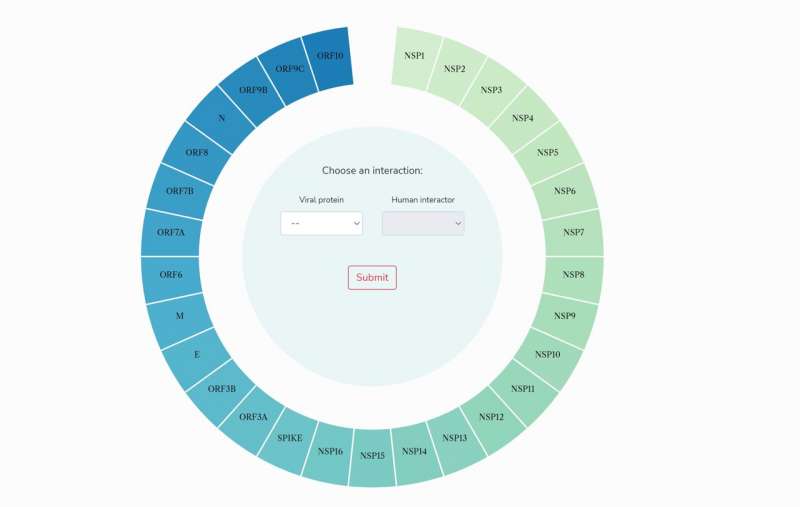
The tool’s developers have provided a user-friendly interactive web server that displays all of the protein structures, such that virologists and clinicians without computational skills can make use of the protein models to see if existing drugs, or those in development, fit into the proper binding sites.

The study describes the tool and uses it to predict how the SARS-COV-2 diverged structurally from SARS-COV-1 (which caused a SARS outbreak in 2002-04); how genetic variation of proteins in human populations may contribute to virus-human binding and higher risk of infection; and which existing drugs show promise for binding to targets on surfaces of human proteins. new tool predicts where c9da3

“Our computational tool allows you to see with an unprecedented resolution where the viral proteins are binding on the human protein, and therefore, we can really understand what part of these proteins are key for these interactions,” said Haiyuan Yu, the study’s senior author, and a professor in the Department of Biological Statistics and Computational Biology and the Weill Institute for Cell and Molecular Biology. Shayne Wierbowski, a graduate student in Yu’s lab, is the paper’s first author.

A previous study by other scientists described interactions between COVID-19 and human proteins, to repurpose human drugs to block the virus from binding. But binding interfaces are small compared to the overall protein’s surface, and previous research has lacked the detailed resolution to understand exactly where drugs might block a binding site.

“The tool we developed to predict protein-to-protein interfaces is the most accurate,” Yu said, “and we can use it to make the most informed predictions for any interactions.” 

The pandemic spurred a surge of research worldwide to understand the structure of SARS-COV-2, with scientists using advanced imaging technologies to reveal proteins that make the virus infectious. As a result, Yu and colleagues were able to validate their computationally predicted structures against those described by others using imaging technologies.

The tool also allows researchers to predict how genetic variations in human proteins affect viral-protein interactions, as two people of similar health and age can have diverging responses to catching COVID-19, with some being asymptomatic and others showing dramatic negative reactions.

“Because of our structural models, we can predict how mutations to proteins in individuals potentially affect viral interactions,” Yu said. The results could one day shed light on whether some individuals may be at higher risk due to their genetics, which could prioritize them for monitoring, vaccines, and treatments.

Additionally, the tool will not only help clinicians develop drugs that precisely target human protein binding sites, but it can also help reduce toxic or negative effects that could result when drugs bind to the wrong sites.

Co-authors include Gary Whittaker, professor of virology, and Dr. Steven Lipkin, a clinical geneticist at Weill Cornell Medicine.

Stanford researchers propose a simpler design for quantum supercomputers

A relatively simple quantum supercomputer design that uses a single atom to manipulate photons could be constructed with currently available components.

Today’s quantum supercomputers are complicated to build, difficult to scale up, and require temperatures colder than interstellar space to operate. These challenges have led researchers to explore the possibility of building quantum computers that work using photons — particles of light. Photons can easily carry information from one place to another, and photonic quantum supercomputers can operate at room temperature, so this approach is promising. However, although people have successfully created individual quantum “logic gates” for photons, it’s challenging to construct large numbers of gates and reliably connect them to perform complex calculations.  Stanford graduate student Ben Bartlett and Shanhui Fan, professor of electrical engineering, have proposed a simpler design for photonic quantum computers using readily available components. (Image credit: Courtesy Ben Bartlett / Rod Searcey)

Now, Stanford University researchers have proposed a simpler design for photonic quantum supercomputers using readily available components. Their proposed design uses a laser to manipulate a single atom that, in turn, can modify the state of the photons via a phenomenon called “quantum teleportation.” The atom can be reset and reused for many quantum gates, eliminating the need to build multiple distinct physical gates, vastly reducing the complexity of building a quantum supercomputer.

“Normally, if you wanted to build this type of quantum computer, you’d have to take potentially thousands of quantum emitters, make them all perfectly indistinguishable, and then integrate them into a giant photonic circuit,” said Ben Bartlett, a Ph.D. candidate in applied physics and lead scientist of the study. “Whereas with this design, we only need a handful of relatively simple components, and the size of the machine doesn’t increase with the size of the quantum program you want to run.”

This remarkably simple design requires only a few pieces of equipment: a fiber optic cable, a beam splitter, a pair of optical switches, and an optical cavity.

Fortunately, these components already exist and are even commercially available. They’re also continually being refined since they’re currently used in applications other than quantum computing. For example, telecommunications companies have been working to improve fiber optic cables and optical switches for years.

“What we are proposing here is building upon the effort and the investment that people have put in for improving these components,” said Shanhui Fan, the Joseph and Hon Mai Goodman Professor of the School of Engineering and senior scientist on the study. “They are not new components specifically for quantum computation.” 

A novel design 

{media id=265,layout=solo}

The scientists’ design consists of two main sections: a storage ring and a scattering unit. The storage ring, which functions similarly to memory in a regular computer, is a fiber-optic loop holding multiple photons that travel around the ring. Analogous to bits that store information in a classical computer, in this system, each photon represents a quantum bit, or “qubit.” The photon’s direction of travel around the storage ring determines the value of the qubit, which as a bit, can be 0 or 1. Additionally, because photons can simultaneously exist in two states at once, an individual photon can flow in both directions at once, which represents a value that is a combination of 0 and 1 at the same time.

The researchers can manipulate a photon by directing it from the storage ring into the scattering unit, where it travels to a cavity containing a single atom. The photon then interacts with the atom, causing the two to become “entangled,” a quantum phenomenon whereby two particles can influence one another even across great distances. Then, the photon returns to the storage ring, and a laser alters the state of the atom. Because the atom and the photon are entangled, manipulating the atom also influences the state of its paired photon.

“By measuring the state of the atom, you can teleport operations onto the photons,” Bartlett said. “So we only need the one controllable atomic qubit and we can use it as a proxy to indirectly manipulate all of the other photonic qubits.”

Because any quantum logic gate can be compiled into a sequence of operations performed on the atom, you can, in principle, run any quantum program of any size using only one controllable atomic qubit. To run a program, the code is translated into a sequence of operations that direct the photons into the scattering unit and manipulate the atomic qubit. Because you can control the way the atom and photons interact, the same device can run many different quantum programs.

“For many photonic quantum computers, the gates are physical structures that photons pass through, so if you want to change the program that’s running, it often involves physically reconfiguring the hardware,” Bartlett said. “Whereas in this case, you don’t need to change the hardware – you just need to give the machine a different set of instructions.”