

The discovery of the new exoplanets was made possible by a planet detection algorithm that UCLA postdoc Zink has developed

UCLA astronomers have identified 366 new exoplanets, thanks to an algorithm developed by a UCLA postdoctoral scholar. Among their most noteworthy findings is a planetary system that comprises a star and at least two gas giant planets, each roughly the size of Saturn and located unusually close to one another. Tiago Campante/Peter Devine via NASA UCLA researchers identified 366 new exoplanets using data from the Kepler Space Telescope, including 18 planetary systems similar to the one illustrated here, Kepler-444, which was previously identified using the telescope.
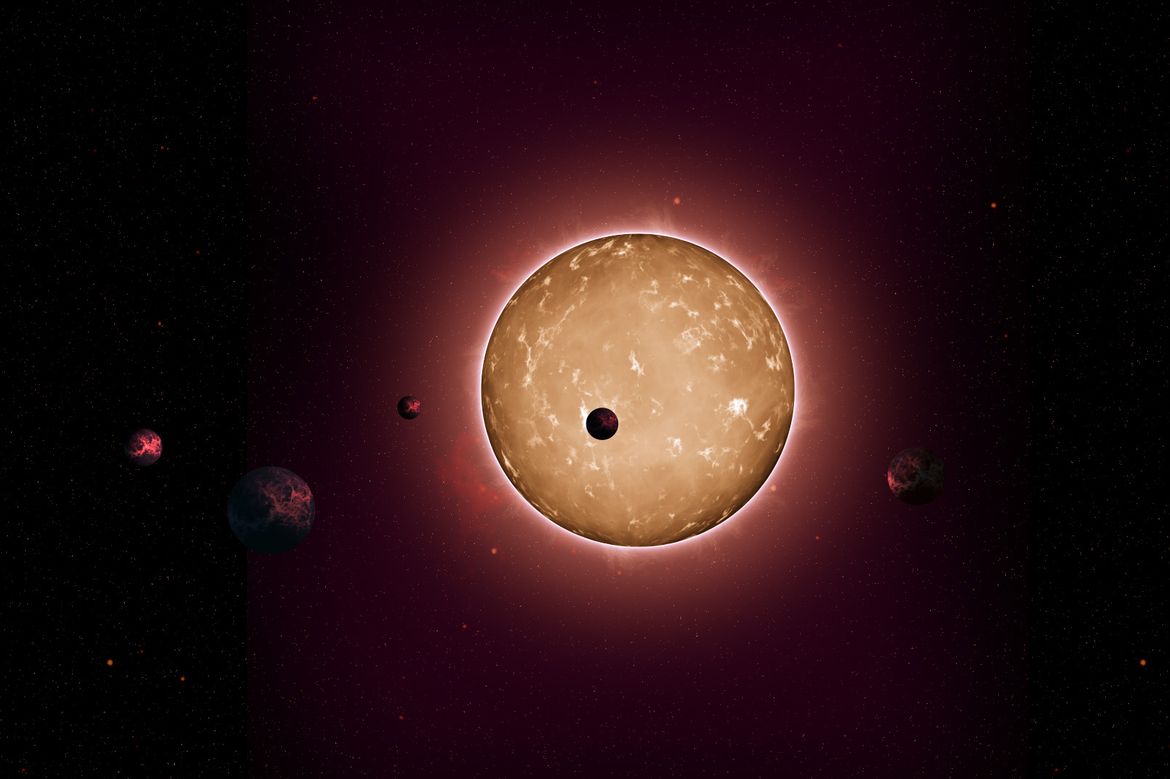
The term “exoplanets” is being used to describe planets outside of our solar system. The number of exoplanets that have been identified by astronomers numbers fewer than 5,000 in all, so the identification of hundreds of new ones is a significant advance. Studying such a large new group of bodies could help scientists better understand how planets form and orbits evolve, and it could provide new insights into how unusual our solar system is.

“Discovering hundreds of new exoplanets is a significant accomplishment by itself, but what sets this work apart is how it will illuminate features of the exoplanet population as a whole,” said Erik Petigura, a UCLA astronomy professor and co-author of the research.

The paper’s lead author is Jon Zink, who earned his doctorate from UCLA in June and is currently a UCLA postdoctoral scholar. He and Petigura, as well as an international team of astronomers called the Scaling K2 project, identified the exoplanets using data from the NASA Kepler Space Telescope’s K2 mission.

The discovery was made possible by a new planet detection algorithm that Zink developed. One challenge in identifying new planets is that reductions in staller brightness may originate from the instrument or from an alternative astrophysical source that mimics a planetary signature. Teasing out which ones require extra investigation, which traditionally has been extremely time-consuming and can only be accomplished through visual inspection. Zink’s algorithm can separate which signals indicate planets and which are merely noise.

“The catalog and planet detection algorithm that Jon and the Scaling K2 team came devised is a major breakthrough in understanding the population of planets,” Petigura said. “I have no doubt they will sharpen our understanding of the physical processes by which planets form and evolve.”

Kepler’s original mission came to an unexpected end in 2013 when a mechanical failure left the spacecraft unable to precisely point at the patch of sky it had been observing for years.

But astronomers repurposed the telescope for a new mission known as K2, whose objective is to identify exoplanets near distant stars. Data from K2 is helping scientists understand how stars’ location in the galaxy influences what kind of planets can form around them. Unfortunately, the software used by the original Kepler mission to identify possible planets was unable to handle the complexities of the K2 mission, including the ability to determine the planets’ size and their location relative to their star.

Previous work by Zink and collaborators introduced the first fully automated pipeline for K2, with software to identify likely planets in the processed data.

For the new study, the researchers used the new software to analyze the entire dataset from K2 about 500 terabytes of data encompassing more than 800 million images of stars to create a “catalog” that will soon be incorporated into NASA’s master exoplanet archive. The researchers used UCLA’s Hoffman2 Supercomputer Cluster to process the data.

In addition to the 366 new planets the researchers identified, the catalog lists 381 other planets that had been previously identified.

Zink said the findings could be a significant step toward helping astronomers understand which types of stars are most likely to have planets orbiting them and what that indicates about the building blocks needed for successful planet formation.

“We need to look at a wide range of stars, not just ones like our sun, to understand that,” he said.

The discovery of the planetary system with two gas giant planets was also significant because it’s rare to find gas giants — like Saturn in our solar system — as close to their host star as they were in this case. The researchers cannot yet explain why it occurred there, but Zink said that makes the finding especially useful because it could help scientists form a more accurate understanding of the parameters for how planets and planetary systems develop.

“The discovery of each new world provides a unique glimpse into the physics that play a role in planet formation,” he said.

China's bias-corrected CMIP6 global dataset improves performance dynamical downscaling projection of future climate

Projections of the Earth's future climate at a finer scale are important in climate-related studies. However, the typical spatial resolution of CMIP6 models is approximately 100 km, which is not sufficient for resolving fine-scale orography, land cover and dynamics of the atmosphere, hindering their ability to simulate extreme weather and climate events.

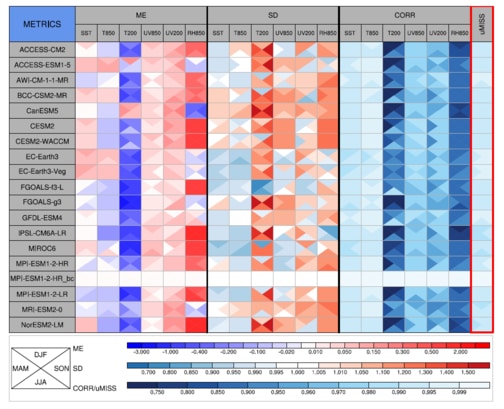
A dynamical downscaling method with a regional climate model is an important approach to obtaining fine-scale weather and climate information; whereas the traditional dynamical downscaling simulations are often degraded by biases in the global climate model (GCM). Performance of the CMIP6 models and bias-corrected data (MPI-ESM1-2-HR_bc) in simulating the climatological mean (1979-2014) of multiple variables against the ERA5 data. Lighter colors represent a better model performance. (Image by XU Zhongfeng)

Recently, a new study published in Scientific Data reported a novel GCM bias correction method, which takes advantage of the non-linear long-term trend of ensemble mean of 18 CMIP6 models to reduce the uncertainty of future projection generated by a single GCM. Moreover, both the GCM mean and variance biases were corrected based on the ERA5 reanalysis data.

Using this GCM bias correction method, the researchers developed a set of bias-corrected large-scale forcing data with a grid spacing of 1.25 longitude by 1.25 latitude based on the ERA5 reanalysis and CMIP6 data. The bias-corrected dataset included three surface variables and eight upper air variables for three sets of bias-corrected CMIP6 data, the historical data from 1979 to 2014, and SSP245 and SSP585 from 2015 to 2100.

"The bias-corrected GCM data shows much better quality than individual CMIP6 models and can provide high-quality large-scale forcing for dynamical downscaling projections of the Earth's future climate, atmospheric environment, hydrology, agriculture, wind power, etc.," said Dr. XU Zhongfeng from the Institute of Atmospheric Physics (IAP) of the Chinese Academy of Sciences, the first author of the study.

The dataset is accessible at http://www.doi.org/10.11922/sciencedb.00487.

USC prof finds vaping, not prior smoking, is associated with changes in gene regulation linked to disease

The latest vaping study from Keck School of Medicine of USC shows that, like smoking, the use of e-cigarettes is linked to dysregulation of mitochondrial genes and immune response genes.

Since they hit the market, e-cigarettes have been touted as a safe alternative to tobacco cigarettes for adult smokers. When research began to suggest otherwise, many questioned whether smoking was still to blame for adverse effects, since most vapers are either “dual users” who also smoke cigarettes or have a prior history of smoking.

Now, a team of researchers at the Keck School of Medicine of USC has demonstrated that – independent of the effects of prior smoking – using e-cigarettes is linked to adverse biological changes that can cause disease. The study, published in Scientific Reports, revealed that vapers experience a similar pattern of changes to gene regulation as smokers do, although the changes are more extensive in people who smoke.

“Our study, for the first time, investigates the biological effects of vaping in adult e-cigarette users, while simultaneously accounting for their past smoking exposure,” said Ahmad Besaratinia, Ph.D., corresponding author, and professor of research population and public health sciences at the Keck School of Medicine.  “Our data indicate that vaping, much like smoking, is associated with dysregulation of mitochondrial genes and disruption of molecular pathways involved in immunity and the inflammatory response, which govern health versus disease state.”

Isolating the effects of vaping from smoking

The researchers recruited a diverse group of 82 healthy adults and separated them into three categories: current vapers, with and without a prior history of smoking; people who exclusively smoke cigarettes; and a control group of never-smokers and never-vapers. They conducted comprehensive in-person interviews to get a detailed vaping and smoking history from each participant. The team verified the histories by performing biochemical analyses on the participants’ blood to measure the concentration of cotinine, a breakdown product of nicotine.

Using next-generation sequencing and bioinformatic data analysis, researchers then conducted a genome-wide search for changes in gene regulation in the blood cells of each of the participants. When the normal regulation of genes is disrupted and genes become dysregulated, that dysregulation can interfere with gene function, leading to disease.

For current vapers, they further performed super computational modeling to determine whether the detected gene dysregulation was associated with the intensity and duration of their current vaping or the intensity and duration of their past smoking.

“We found that more than 80% of gene dysregulation in vapers correlated with the intensity and duration of current vaping,” said Besaratinia. “Whereas none of the detected gene dysregulation in vapers correlated to their prior smoking intensity or duration.”

Effects of vaping mirror those of smoking

In previous research, Besaratinia and his team have shown that e-cigarette users develop some of the same cancer-related molecular changes in oral tissue as cigarette smokers. They also discovered vapers had the same kind of cancer-linked chemical changes to their genome as smokers.

In this study, they found that, in both vapers and smokers, mitochondrial genes are preferential targets of gene dysregulation. They also found that vapers and smokers had significant dysregulation of immune response genes. vape pixabay

Besaratinia says the findings are not only novel and significant, but they are also interrelated since growing evidence shows that mitochondria play a critical role in immunity and inflammation.

“When mitochondria become dysfunctional, they release key molecules,” said Besaratinia. “The released molecules can function as signals for the immune system, triggering an immune response that leads to inflammation, which is not only important for maintaining health but also plays a critical role in the development of various diseases, such as cardiovascular and respiratory diseases, metabolic diseases, and cancer.”

Adults aren’t the only ones vaping. The Centers for Disease Control estimates that more than 2 million middle and high school students in the U.S. report using e-cigarettes. Besaratinia says that this is one of the main reasons why the team’s research is so critical to informing policy around vaping.

“Given the popularity of e-cigarettes among young never-smokers, our findings will be of importance to the regulatory agencies,” said Besaratinia. “To protect public health, these agencies are in urgent need of scientific evidence to inform the regulation of the manufacture, distribution, and marketing of e-cigarettes.”

Next, the team plans to identify and investigate chemicals common to both e-cigarette vapor and cigarette smoke to find out which ones might be causing similar adverse effects in vapers and smokers.