Swiss physicists build quantum network nodes with warm atoms

Communication networks need nodes at which information is processed or rerouted. Physicists at the University of Basel have now developed a network node for quantum communication networks that can store single photons in a vapor cell and pass them on later.

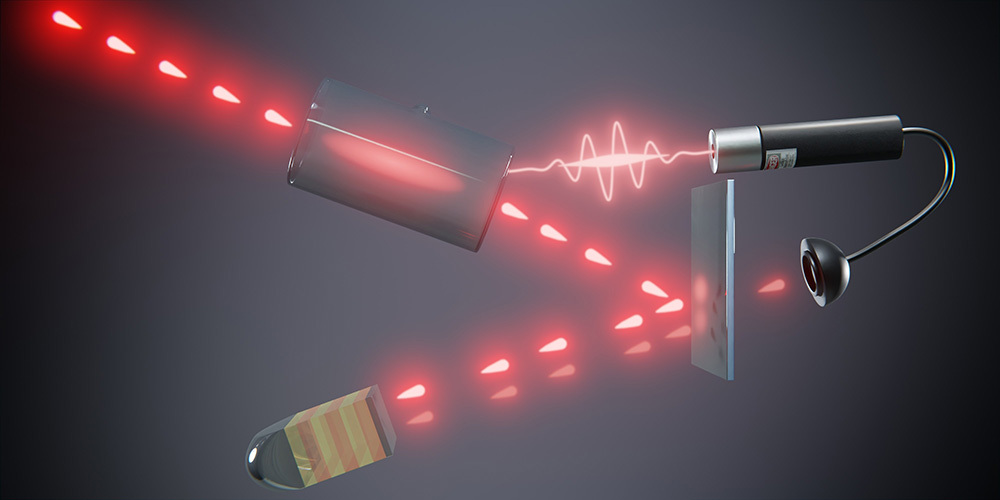
In quantum communication networks, information is transmitted by single particles of light (photons). At the nodes of such a network buffer elements are needed which can temporarily store, and later re-emit, the quantum information contained in the photons. A particle of light from the single photon source (below) is stored in the vapor cell (above). A simultaneously emitted second photon is revealed by a detector (right), which triggers the control laser pulse and thereby initiates the storage process. (Image: Department of Physics/University of Basel)

Researchers at the University of Basel in the group of Prof. Philipp Treutlein have now developed a quantum memory that is based on an atomic gas inside a glass cell. The atoms do not have to be specially cooled, which makes the memory easy to produce and versatile, even for satellite applications. Moreover, the researchers have realized a single photon source which allowed them to test the quality and storage time of the quantum memory. Their results were recently published in the scientific journal PRX Quantum.  

Warm atoms in vapor cells

“The suitability of warm atoms in vapor cells for quantum memories has been investigated for the past twenty years”, says Gianni Buser, who worked on the experiment as a Ph.D. student. “Usually, however, attenuated laser beams - and hence classical light - were used”. In classical light, the number of photons hitting the vapor cell in a certain period follows a statistical distribution; on average it is one photon, but sometimes it can be two, three, or none.

To test the quantum memory with “quantum light” – that is, always precisely one photon – Treutlein and his co-workers developed a dedicated single-photon source that emits exactly one photon at a time. The instant when that happens is heralded by a second photon, which is always sent out simultaneously with the first one. This allows the quantum memory to be activated at the right moment.

The single photon is then directed into the quantum memory where, with the help of a control laser beam, the photon causes more than a billion rubidium atoms to take on a so-called superposition state of two possible energy levels of the atoms.  The photon itself vanishes in the process, but the information contained in it is transformed into the superposition state of the atoms. A brief pulse of the control laser can then read out that information after a certain storage time and transform it back into a photon.

Reducing read-out noise

“Up to now, a critical point has been noise – additional light that is produced during the read-out and that can compromise the quality of the photon”, explains Roberto Mottola, another Ph.D. student in Treutlein’s lab. Using a few tricks, the physicists were able to reduce that noise sufficiently so that after storage times of several hundred nanoseconds the single-photon quality was still high.

“Those storage times are not very long, and we didn’t actually optimize them for this study”, Treutlein says, “but already now they are more than a hundred times longer than the duration of the stored single-photon pulse”. This means that the quantum memory developed by the Basel researchers can already be employed for interesting applications. For instance, it can synchronize randomly produced single photons, which can then be used in various quantum information applications.

South Korea demos a neuromodulation-inspired stashing system for the energy-efficient learning of a spiking neural network using a self-rectifying memristor array

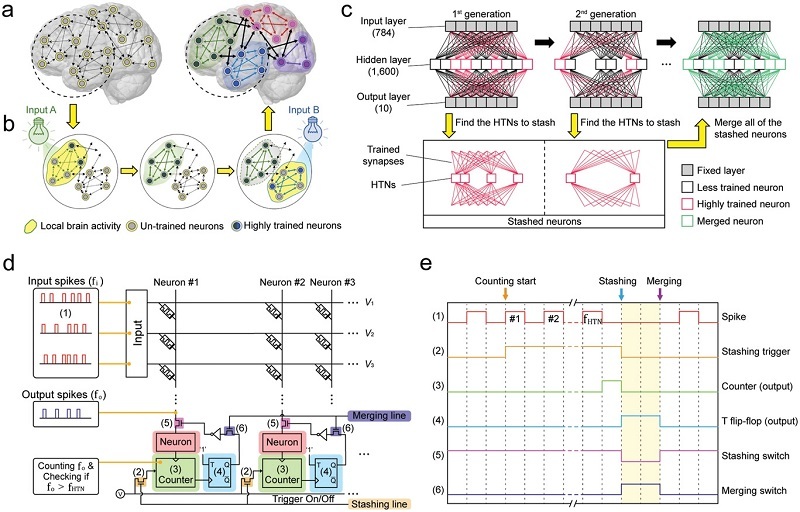
Korea Advanced Institute of Science and Technology researchers have proposed a novel system inspired by the neuromodulation of the brain, referred to as a ‘stashing system,’ that requires less energy consumption. The research group led by Professor Kyung Min Kim from the Department of Materials Science and Engineering has developed a technology that can efficiently handle mathematical operations for artificial intelligence by imitating the continuous changes in the topology of the neural network according to the situation. The human brain changes its neural topology in real-time, learning to store or recall memories as needed. The research group presented a new artificial intelligence learning method that directly implements these neural coordination circuit configurations. A schematic illustrating the localized brain activity (a-c) and the configuration of the hardware and software hybrid neural network (d-e) using a self-rectifying memristor array (f-g).

Research on artificial intelligence is becoming very active, and the development of artificial intelligence-based electronic devices and product releases is accelerating, especially in the Fourth Industrial Revolution age. To implement artificial intelligence in electronic devices, customized hardware development should also be supported. However, most electronic devices for artificial intelligence require high power consumption and highly integrated memory arrays for large-scale tasks. It has been challenging to solve these power consumption and integration limitations, and efforts have been made to find out how the human brain solves problems.

To prove the efficiency of the developed technology, the research group created artificial neural network hardware equipped with a self-rectifying synaptic array and algorithm called a ‘stashing system’ that was developed to conduct artificial intelligence learning. As a result, it was able to reduce energy by 37% within the stashing system without any accuracy degradation. This result proves that emulating the neuromodulation in humans is possible.

Professor Kim said, "In this study, we implemented the learning method of the human brain with only a simple circuit composition and through this, we were able to reduce the energy needed by nearly 40 percent.”

This neuromodulation-inspired stashing system that mimics the brain’s neural activity is compatible with existing electronic devices and commercialized semiconductor hardware. It is expected to be used in the design of next-generation semiconductor chips for artificial intelligence.

MaxLinear showcases 400G transceivers for interconnects

MaxLinear is demonstrating Molex LLC’s 400G-DR4 optical modules based on MaxLinear’s Telluride (MxL9354x) pulse-amplitude-modulation (PAM4) digital signal processors (DSPs) at the China International Optoelectronic Exposition (CIOE).  (Photonteck Booth 6A01, September 16-18)
 
The demonstrated 400G-DR4 optical modules join Molex’s complete line of data center connectivity products, providing solutions for optical interconnects across all tiers of the data center.
 
MaxLinear’s MxL9354x Telluride family of SoCs are key components in the deployment of hyper-scale data centers based on 100Gbps single lambda optical interconnects. They enabled Molex to build their high-performance 400Gbps optical modules in a compact QSFP-DD form factor for intra-datacenter applications and meet the strict performance and interoperability requirements of next-generation hyper-scale data centers. MaxLinear CIOE MxL93543 91461
 
"With the exponential growth of data traffic within hyperscale cloud networks driving demand for ever-increasing volumes of high-speed interconnects, 400Gbps Telluride-based transceiver modules are key enablers for current and next-generation hyper-scale data centers,” said Drew Guckenberger, Vice President of MaxLinear’s Optical Interconnect Group. "Through our partnership with Molex, the demonstrated Telluride-based optical modules meet all of the stringent link performance metrics demanded by our key hyperscale customers, enabling high-volume deployments and meeting their growing network expansion needs.”
 
Technical Details
The Telluride family of high-performance PAM4 DSP SoCs enable 400Gbps optical modules using a 4x100Gbps optics interface. These SoCs are suitable for use within QSFP-DD and OSFP module form factors. The MxL9354x 400G PAM4 DSP integrates an optional EA-EML driver with a 1.8V PP SE swing.
 
Asynchronous breakout mode clocking is an essential feature for hyperscale data center customers initiating 400G DR4 deployments. MaxLinear’s 400G Telluride DSPs (MxL9354x) successfully integrate this clocking requirement.
 
The devices feature a comprehensive digital pre-distortion (DPD) engine in the transmit direction to compensate for laser non-linearity and to cancel packaging limitations that cause reflections and bandwidth degradation at these extremely high signal frequencies. On the receive path, the DSP includes an auto-adaptive signal enhancement engine, which integrates a continuous-time linear equalizer (CTLE), automatic gain control (AGC), a feed-forward equalizer (FFE), and a decision feedback equalizer (DFE).
 
For additional information visit www.maxlinear.com/MxL93543.
 
MaxLinear’s Telluride family of PAM4 DSPs and Molex’s 400G-DR4 optical interconnect modules will be on display at Photonteck’s booth (6A01) at the CIOE Conference at Shenzhen World Exhibition & Convention Center on September 16-18, 2021. For an appointment, please contact MaxLinear sales at sales@maxlinear.com.