University of Delaware prof wins three awards for contributions to physics, computational chemistry

With a passion for polymer research and teaching, Arthi Jayaraman of the University of Delaware often finds herself wearing a lot of hats, figuratively, at least.

“My research has me putting on different hats,” said Jayaraman, Centennial Term Professor for Excellence in Research and Education in the College of Engineering. “Sometimes I have to put on the physicist hat, sometimes the chemist hat, and always the engineering hat.”

In the past year, professional societies in all three disciplines have recognized her work and its value to their field.

  • The American Physical Society, which includes many of the world’s most prominent physicists, in March named Jayaraman as a fellow, an honor bestowed on those who have made exceptional contributions to physics. Such fellowships are awarded to fewer than 0.5% of APS’ more than 55,000 members in any given year.
  • The American Chemical Society selected Jayaraman to serve as deputy editor of its new, fully open-access journal ACS Polymer Au (Gold).
  • The American Institute of Chemical Engineers this summer announced that Jayaraman would receive the 2021 Impact Award, administered by its Computational Molecular Science and Engineering Forum (COMSEF), at the AIChE annual meeting in November.

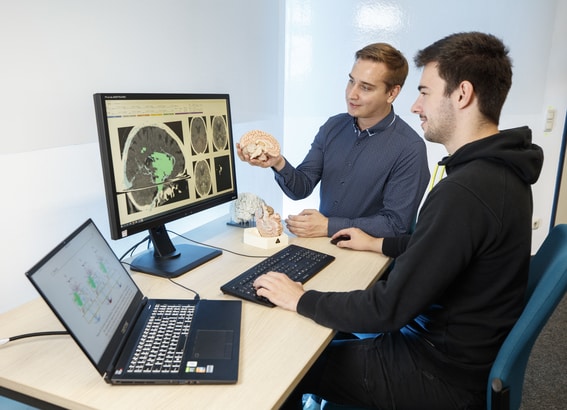
Jayaraman leads a computational materials research lab as a professor of chemical and biomolecular engineering and materials science at UD. In the past year, Arthi Jayaraman, Centennial Term Professor for Excellence in Research and Education in the College of Engineering, has been named a fellow of the American Physical Society, won an Impact Award from the American Institute of Chemical Engineers and was appointed deputy editor of a journal published by the American Chemical Society.  CREDIT Photo by Evan Krape

She also loves to teach, loves to be in front of a crowd of eager learners, and is devoted to sharing science with the broadest possible audience, making quality science communication a priority.

“I’m passionate about science, education, and training our next best scientists,” she said. “I also believe that the science we create should be shared. I share that in my classroom and with my research community through our papers. I also strongly support that dissemination with a broader community around the world. This motivated me to take on this new editorial role in the new open-access journal ACS Polymer Au.”

What drives her in all these roles is her love for polymers, substances made up of long chains of uniform molecules. They are everywhere and make amazing building blocks, whether they are produced naturally (silk, hair, DNA for example) or synthetically (plastics, for example).

“They can be in tires, in rocket ships, on a plane and they can be designed to carry a drug into the human body,” she said. “We’re all made of biopolymers, chain molecules that have a unique chemistry programmed in.”

Working at different scales requires the kind of expertise her team has.

“Polymers have non-trivial structures at different scales — Angstrom scale, nanoscale, and micron-scale,” she said. “To study these materials computationally, one has to select or develop the right model that captures that structure at the scale of interest. One model doesn’t fit all, and that adaptability is something my group works on.”

Her computational expertise pulls many aspects of scientific inquiry together, but she especially cherishes her collaborations with two kinds of researchers, she said — those who synthesize polymers and those who characterize the materials in a wet lab.

One close-to-home example is Jayaraman’s collaboration with UD’s Kristi Kiick, Blue and Gold Distinguished Professor of Materials Science and Engineering. She worked with Kiick to characterize protein-like polymers, predict their stability and thermodynamic behavior in specific conditions and ensure they will behave the way Kiick and her team want them to behave in their biomedical research.

That points the way to new materials and better materials.

Computational skills are essential to advances in research and Jayaraman’s excellence in that work is reflected in the honors received from these three independent scientific societies.

Recognizing Jayaraman’s research accomplishments, APS cited her “insightful development and use of molecular modeling, simulation and theoretical studies of structure and thermodynamics in polymer nanocomposites, conjugated polymer blends, nucleic acids and thermoresponsive peptide-polymer conjugates.”

The Impact Award from AIChE COMSEF recognizes outstanding research in computational molecular science and engineering, including methods and applications.

The editing position with ACS Polymers Au reflects her leadership in polymers research and her communication skill. She and Associate Editor Prof. Harm-Anton Klok of the Federal Institute of Technology (EPFL) in Lausanne, Switzerland, just released the first issue of the journal.

“Arthi is the complete package,” said Jan Genzer, S. Frank and Doris Culberson Distinguished Professor of Chemical and Biomolecular Engineering at North Carolina State, who nominated her for the APS fellowship and was a co-adviser for Jayaraman when she was a doctoral student at N.C. State. “She mentors her students and collaborates with a large group of people. Many of her collaborators are experimentalists and that’s very atypical for people who do simulation and modeling. She is highly sought after by my colleagues who do experiments.”

The daughter of an engineer and an educator, Jayaraman said she loved computer programming when she was growing up in Madras, India, and that lifelong skill along with her interest in chemical sciences has served her well.

“My parents were always supportive and were a driving force for me and my sister, who is an accomplished researcher in biophysics,” Jayaraman said. “I was fortunate to have that push and encouragement from my parents. We came from a lower-middle class family. My parents prioritized our education over luxury and that paid off.”

Jayaraman earned her bachelor of engineering degree in chemical engineering from the Birla Institute of Technology and Science in Pilani, India, and her doctorate in chemical and biomolecular engineering at N.C. State. She did postdoctoral research at the University of Illinois-Urbana. Before joining UD in 2014, she was an assistant professor and Patten faculty fellow at the University of Colorado at Boulder.

Her other awards include the Department of Energy (DOE) Early Career Research Award and young investigator awards from the American Institute of Chemical Engineers (AIChE) and the American Chemical Society (ACS).

Flatiron Institute’s Center for Computational Astrophysics modeling of nearby star-forming regions yields clues to the formation of our solar system

The Ophiuchus star-forming complex offers an analog for the formation of the solar system, including the sources of elements found in primitive meteorites

A region of active star formation in the constellation Ophiuchus gives astronomers new insights into the conditions in which our solar system was born. In particular, a new study of the Ophiuchus star-forming complex shows how our solar system may have become enriched with short-lived radioactive elements.

Evidence of this enrichment process has been around since the 1970s when scientists studying certain mineral inclusions in meteorites concluded that they were pristine remnants of the infant solar system and contained the decay products of short-lived radionuclides. These radioactive elements could have been blown onto the nascent solar system by a nearby exploding star (a supernova) or by the strong stellar winds from a type of massive star known as a Wolf-Rayet star. Multi-wavelength observations of the Ophiuchus star-forming region reveal interactions between clouds of star-forming gas and radionuclides produced in a nearby cluster of young stars. The top image (a) shows the distribution of aluminum-26 in red, traced by gamma-ray emissions. The central box represents the area covered in the bottom left image (b), which shows the distribution of protostars in the Ophiuchus clouds as red dots. The area in the box is shown in the bottom right image (c), a deep near-infrared color composite image of the L1688 cloud, containing many well known prestellar dense-gas cores with disks and protostars.

The new study used multi-wavelength observations of the Ophiuchus star-forming region, including spectacular new infrared data, to reveal interactions between the clouds of star-forming gas and radionuclides produced in a nearby cluster of young stars. Their findings indicate that supernovas in the star cluster are the most likely source of short-lived radionuclides in the star-forming clouds.

“Our solar system was most likely formed in a giant molecular cloud together with a young stellar cluster, and one or more supernova events from some massive stars in this cluster contaminated the gas which turned into the sun and its planetary system,” said co-author Douglas N. C. Lin, professor emeritus of astronomy and astrophysics at UC Santa Cruz. “Although this scenario has been suggested in the past, the strength of this paper is to use multi-wavelength observations and a sophisticated statistical analysis to deduce a quantitative measurement of the model’s likelihood.”

First author John Forbes at the Flatiron Institute’s Center for Computational Astrophysics said data from space-based gamma-ray telescopes enable the detection of gamma rays emitted by the short-lived radionuclide aluminum-26. “These are challenging observations. We can only convincingly detect it in two star-forming regions, and the best data are from the Ophiuchus complex,” he said.

The Ophiuchus cloud complex contains many dense protostellar cores in various stages of star formation and protoplanetary disk development, representing the earliest stages in the formation of a planetary system. By combining imaging data in wavelengths ranging from millimeters to gamma rays, the researchers were able to visualize a flow of aluminum-26 from the nearby star cluster toward the Ophiuchus star-forming region. Deep near-infrared color composite image of the L1688 cloud in the Ophiuchus star-forming complex from the VISIONS European Southern Observatory public survey, where blue, green and red are mapped to the NIR bands J (1.2 μm), H (1.6 μm) and KS (2.2 μm), respectively.  CREDIT João Alves/ESO VISIONS

“The enrichment process we’re seeing in Ophiuchus is consistent with what happened during the formation of the solar system 5 billion years ago,” Forbes said. “Once we saw this nice example of how the process might happen, we set about trying to model the nearby star cluster that produced the radionuclides we see today in gamma rays.”

Forbes developed a model that accounts for every massive star that could have existed in this region, including its mass, age, and probability of exploding as a supernova, and incorporates the potential yields of aluminum-26 from stellar winds and supernovas. The model enabled him to determine the probabilities of different scenarios for the production of the aluminum-26 observed today.

“We now have enough information to say that there is a 59 percent chance it is due to supernovas and a 68 percent chance that it’s from multiple sources and not just one supernova,” Forbes said.

Lin noted that this type of statistical analysis assigns probabilities to scenarios that astronomers have been debating for the past 50 years. “This is the new direction for astronomy, to quantify the likelihood,” he said.

The new findings also show that the number of short-lived radionuclides incorporated into newly forming star systems can vary widely. “Many new star systems will be born with aluminum-26 abundances in line with our solar system, but the variation is huge—several orders of magnitude,” Forbes said. “This matters for the early evolution of planetary systems since aluminum-26 is the main early heating source. More aluminum-26 probably means drier planets.”

The infrared data, which enabled the team to peer through dusty clouds into the heart of the star-forming complex, was obtained by coauthor João Alves at the University of Vienna as part of the European Southern Observatory’s VISION survey of nearby stellar nurseries using the VISTA telescope in Chile.

“There is nothing special about Ophiuchus as a star formation region,” Alves said. “It is just a typical configuration of gas and young massive stars, so our results should be representative of the enrichment of short-lived radioactive elements in star and planet formation across the Milky Way.”

The team also used data from the European Space Agency’s (ESA) Herschel Space Observatory, the ESA’s Planck satellite, and NASA’s Compton Gamma Ray Observatory.

Georgia Tech sheds new light on the physics of blood clotting

Research shows platelets do their job better when not in total sync with one another

Heart attacks and strokes -- the leading causes of death in human beings -- are fundamentally blood clots of the heart and brain. Better understanding how the blood-clotting process works and how to accelerate or slow down clotting, depending on the medical need, could save lives.

New research by the Georgia Institute of Technology and Emory University published in the journal Biomaterials sheds new light on the mechanics and physics of blood clotting through modeling the dynamics at play during a still poorly understood phase of blood clotting called clot contraction.

"Blood clotting is actually a physics-based phenomenon that must occur to stem bleeding after an injury," said Wilbur A. Lam, W. Paul Bowers Research Chair in the Department of Pediatrics and the Wallace H. Coulter Department of Biomedical Engineering at Georgia Tech and Emory. "The biology is known. Biochemistry is known. But how this ultimately translates into physics is an untapped area." First author Yueyi Sun inside Georgia Tech's Complex Fluids Modeling and Simulation lab, where she compares the experimental and simulated platelet-driven fibrin clot contraction process.  CREDIT Alexander Alexeev, Georgia Tech

And that's a problem, argues Lam and his research colleagues, since blood clotting is ultimately about "how good of a seal can the body make on this damaged blood vessel to stop bleeding, or when this goes wrong, how does the body accidentally make clots in our heart vessels or in our brain?"

How Blood Clotting Works

The workhorses to stem bleeding are platelets -- tiny 2-micrometer cells in the blood in charge of making the initial plug. The clot that forms is called fibrin, which acts as a glue scaffold that the platelets attach to and pull against. Blood clot contraction arises when these platelets interact with the fibrin scaffold. To demonstrate the contraction, researchers embedded a 3-millimeter Jell-O mold of a LEGO figure with millions of platelets and fibrin to recreate a simplified version of a blood clot.

"What we don't know is, 'How does that work?' 'What's the timing of it so all these cells work together -- do they all pull at the same time?' Those are the fundamental questions that we worked together to answer," Lam said.

Lam's lab collaborated with Georgia Tech's Complex Fluids Modeling and Simulation group headed by Alexander Alexeev, professor and Anderer Faculty Fellow in the George W. Woodruff School of Mechanical Engineering, to create a computational model of a contracting clot. The model incorporates fibrin fibers forming a three-dimensional network and distributed platelets that can extend filopodia, or the tentacle-like structures that extend from cells so they can attach to specific surfaces, to pull the nearby fibers.

Model Shows Platelets Dramatically Reducing Clot Volume

When the researchers simulated a clot where a large group of platelets was activated at the same time, the tiny cells could only reach nearby fibrins because the platelets can extend filopodia that are rather short, less than 6 micrometers. "But in a trauma, some platelets contract first. They shrink the clot so the other platelets will see more fibrins nearby, and it effectively increases the clot force," Alexeev explained. Due to the asynchronous platelet activity, the force enhancement can be as high as 70%, leading to a 90% decrease of the clot volume.

"The simulations showed that the platelets work best when they're not in total sync with each other," Lam said. "These platelets are actually pulling at different times and by doing that they're increasing the efficiency (of the clot)."

This phenomenon, dubbed by the team asynchronous mechanical amplification, is most pronounced "when we have the right concentration of the platelets corresponding to that of healthy patients," Alexeev said.

Research Could Lead to Better Ways to Treat Clotting, Bleeding Issues

The findings could open medical options for people with clotting issues, said Lam, who treats young patients with blood disorders as a pediatric hematologist in the Aflac Cancer and Blood Disorders Center at Children's Healthcare of Atlanta.

"If we know why this happens, then we have a whole new potential avenue of treatments for diseases of blood clotting," he said, emphasizing that heart attacks and strokes occur when this biophysical process goes wrong.

Lam explained that fine-tuning the contraction process to make it faster or more robust could help patients who are bleeding from a car accident or, in the case of a heart attack, make the clotting less intense and slow it down.

"Understanding the physics of this clot contraction could potentially lead to new ways to treat bleeding problems and clotting problems."

Alexeev added that their research also could lead to new biomaterials such as a new type of Band-Aid that could help augment the clotting process.

First author and Georgia Tech Ph.D. candidate Yueyi Sun noted the simplicity of the model and the fact that the simulations allowed the team to understand how the platelets work together to contract the fibrin clot as they would in the body.

"When we started to include the heterogeneous activation, suddenly it gave us the correct volume contraction," she said. "Allowing the platelets to have some time delay so one can use what the previous ones did as a better starting point was really neat to see. I think our model can potentially be used to provide guidelines for designing novel active biological and synthetic materials."

Sun agreed with her research colleagues that this phenomenon might occur in other aspects of nature. For example, multiple asynchronous actuators can fold a large net more effectively to enhance packaging efficiency without the need of incorporating additional actuators.

"It theoretically could be an engineered principle," Lam said. "For a wound to shrink more, maybe we don't have the chemical reactions occur at the same time -- maybe we have different chemical reactions occur at different times. You gain better efficiency and contraction when one allows half or all of the platelets to do the work together."

Building on the research, Sun hopes to examine more closely how a single platelet force converts or is transmitted to the clot force, and how much force is needed to hold two sides of a graph together from a thickness and width standpoint. Sun also intends to include red blood cells in their model since they account for 40% of all blood and play a role in defining the clot size.

"If your red blood cells are too easily trapped in your clot, then you are more likely to have a large clot, which causes a thrombosis issue," she explained.