Planners must take into account that the combined effects of densely-packed housing and climate change can make living in cities unendurable. Photo: Shutterstock

Norway simulates air currents for more habitable cities

Densely-packed housing makes urban areas vulnerable to overheating, pollution, and dangerous wind gusts. The effects of climate change can aggravate these problems, but we can also work to prevent them. This can be done by simulating microclimates.

Cities and urban areas are characterized by high population densities and widespread man-made environments. In city centers, this means surfaces covered with concrete and asphalt, less vegetation, more air pollution, and large, densely-packed buildings that reduce both air circulation and access to daylight. 

At the same time, and especially in coastal areas, extremely high wind velocities can develop between tall buildings due to airflow channeling effects. This can make pedestrian walkways and cycle paths dangerous and unsafe, especially for vulnerable groups.

Climate change can make cities unbearable to live in

The impact of climate change may be reinforcing the negative effects of densely-packed housing, and many places in the world are at risk of becoming uninhabitable. Europe is probably not the most severely affected, but even here the effects of climate change, such as heat waves, droughts, and flooding, represent a threat to both infrastructure and human life. The European heatwave of 2003 claimed more than 70,000 lives. The summer of 2022 was the hottest ever experienced in Europe, with more than 20,000 people dying as a direct result of the heat. 

For this reason, it is increasingly important to reduce the impact of extreme heat in urban areas, especially in southern Europe, but also in Norway. In Oslo, in particular, and in the southern parts of Østlandet County, we can expect to experience heat waves in the future. This is why we must do what we can to create habitable conditions in our cities, and in urban buildings, when temperatures increase to levels that we are not used to. We must begin during the planning phase of the construction process.

Advanced simulations deliver more accurate airflow calculations

So, how can urban planners take a warmer climate into account? Advanced simulation tools such as Computational Fluid Dynamics (CFD) can calculate air movements in a variety of environments. This can be done as early as during the planning phase of larger building projects and as part of the overall urban planning process.

In brief, CFD offers a method of calculating the movement of fluids, including liquids and gases such as air. In recent decades, there has been a boom in the use of such methods, in step with the increase in the power of modern computers. In the last 15 to 20 years, the method has also been applied in studies of microclimates. Microclimates represent climatic conditions that develop at scales of less than two kilometers, and for which in the past we based our investigations on measurements and observations.

Trondheim study demonstrates the effect of different measures

Studies of the microclimate at Gløshaugen in Trondheim have demonstrated the effectiveness of the use of various building materials, as well as the impact that the volume of vegetation and natural environments had on local climatic conditions, and how these factors impact the energy consumption of buildings and the thermal comfort of people outdoors.

The simulations also showed that the cumulative evaporation from lawns and trees can reduce the air temperature by several degrees (up to 2.4 °C at Gløshaugen), and thus reduce the need for cooling the buildings in summer. 

These results can be used to look into different scenarios for urban design or to calculate future urban climates. Having said this, it is difficult to give general recommendations because the systems are highly location-specific, and measures must take into account all the relevant factors that influence the microclimate in a given situation.

Multiple applications

CFD can also be used to make high-resolution calculations of wind conditions, such as turbulence and wind speed. In this way, it will be possible to identify sites where urban wind turbines for local renewable energy generation can be profitably located. Moreover, the dispersion of harmful emissions and pollution can be simulated in areas such as heavily trafficked roads, and industrial plants, and also in the aftermath of accidents and fires. 

In other words, CFD can deliver useful information to inform construction projects, urban planning, and architecture, which in the past has been inaccessible in terms of the level of resolution, precision, and speed that we are seeing today.


UK invests £54 million to develop secure, trustworthy AI research

The UK Secretary of State for Science, Innovation, and Technology Chloe Smith has announced a series of investments to develop trustworthy artificial intelligence (AI) research.

  • £54 million investment to support the UK’s AI and data science workforce and develop trustworthy and secure AI
  • new Geospatial Strategy to drive growth through technologies including AI, satellite imaging, and real-time data
  • a new pilot program backed by up to £50 million in government funding to accelerate new research ventures with industry, philanthropic organizations, and the third sector

Universities across the UK are set to benefit from a substantial £54 million investment in their work to develop cutting-edge artificial intelligence (AI) technology, Technology Secretary Chloe Smith announced today.

Delivered through UK Research and Innovation (UKRI), £31 million of the funding will be used to back ground-breaking research at the University of Southampton to establish responsible and trustworthy AI, bringing together the expertise of academia, business, and the wider public to explore how responsible AI can be developed and utilized while considering its broader impact on wider society.

The Technology Secretary unveiled the package in a keynote speech at London Tech Week, advancing efforts to secure the UK’s position as a science and tech superpower, fuel economic growth, and create better-paid jobs. The Tech Secretary also announced the launch of the UK Geospatial Strategy 2030, which will unlock billions of pounds in economic benefits through harnessing technologies including AI, satellite imaging, and real-time data.

Technology Secretary Chloe Smith said: "Despite our size as a small island nation, the UK is a technology powerhouse. Last year, the UK became just the third country in the world to have a tech sector valued at $1 trillion. It is the biggest in Europe by some distance and behind only the US and China globally.

"The technology landscape, though, is constantly evolving, and we need a tech ecosystem that can respond to those shifting sands, harness its opportunities, and address emerging challenges. The measures unveiled today will do exactly that.

"We’re investing in our AI talent pipeline with a £54 million package to develop trustworthy and secure artificial intelligence, and putting our best foot forward as a global leader in tech both now, and in the years to come."

AI developments present enormous opportunities in almost every aspect of modern life, particularly in addressing climate change challenges and pursuing net-zero targets. As part of this investment, the remaining £13 million will be used to fund 13 projects based at universities across the UK to develop pioneering AI innovations in sustainable land management, efficient CO2 capture, and improved resilience against natural hazards.

The commitments follow the announcement in March of £117 million in funding for Centres for Doctoral Training in AI, with a further £46 million to support Turing AI Fellowships to develop the next generation of top AI talent.

In pursuit of the UK’s science and technology superpower ambitions, Chloe Smith has also announced the Department for Science, Innovation, and Technology will shortly launch an open call for proposals to pilot new, collaborative approaches to scientific research in the UK, backed by £50 million in government funding. The money will drive investment and partnership with industry and further afield to fund the ideas and innovations which aren’t currently addressed in the UK research sector and open in the coming weeks. This will benefit the UK’s research community by allowing organizations to explore the viability of new models for performing research in specific areas, bypassing the large start-up costs normally needed to set up an entirely new institution.

The UK Science and Technology framework sets out how the UK will respond to emerging and critical technologies. Geospatial technology is one such example, and the new UK Geospatial Strategy, which will launch tomorrow (Thursday 15 June), will drive the use of location data right across the economy including property, transportation, and beyond, fuelling growth through innovation.

Professor Dame Ottoline Leyser, Chief Executive of UK Research and Innovation (UKRI) said: "UKRI is investing in the people and technologies that will improve lives for people in the UK and around the world. By supporting research to develop AI that is useful, trustworthy, and trusted, we are laying solid foundations on which we can build new industries, products, and services across a wide range of fields.

"Working through cross-disciplinary partnerships we will ensure that responsible innovation is integrated across all aspects of the work as it progresses."

The measures announced today will fuel the government’s mission to make the UK the most innovative economy in the world and build a technology ecosystem that cements the UK’s place at the frontier of global tech development.

Russian physicists develop the fastest algorithm for the simulation motion of microparticles in a plasma flow

The OpenDust code operates ten times faster than any existing analog

Understanding the mechanisms of interaction between plasma and microparticles is of critical importance in various fields, including astrophysics, microelectronics, and plasma medicine. A common experimental approach for studying interactions between plasma and microparticles is to place microparticles in a flowing plasma of a gas discharge. In order to achieve a more accurate understanding of the processes occurring in such systems, scientists need fast and efficient tools for calculating forces acting on microparticles in a plasma flow.

Typically, plasma physicists have to independently develop software tailored to a specific task, which is a significant investment of time and resources. Existing open-source programs frequently encounter challenges related to installation, documentation, and sluggish performance. A group of scientists from the Russian National Research University Higher School of Economics, JIHT, the HSE, and, MIPT has developed a novel solution: a fast, open-source code that is easy to install and extensively documented. 

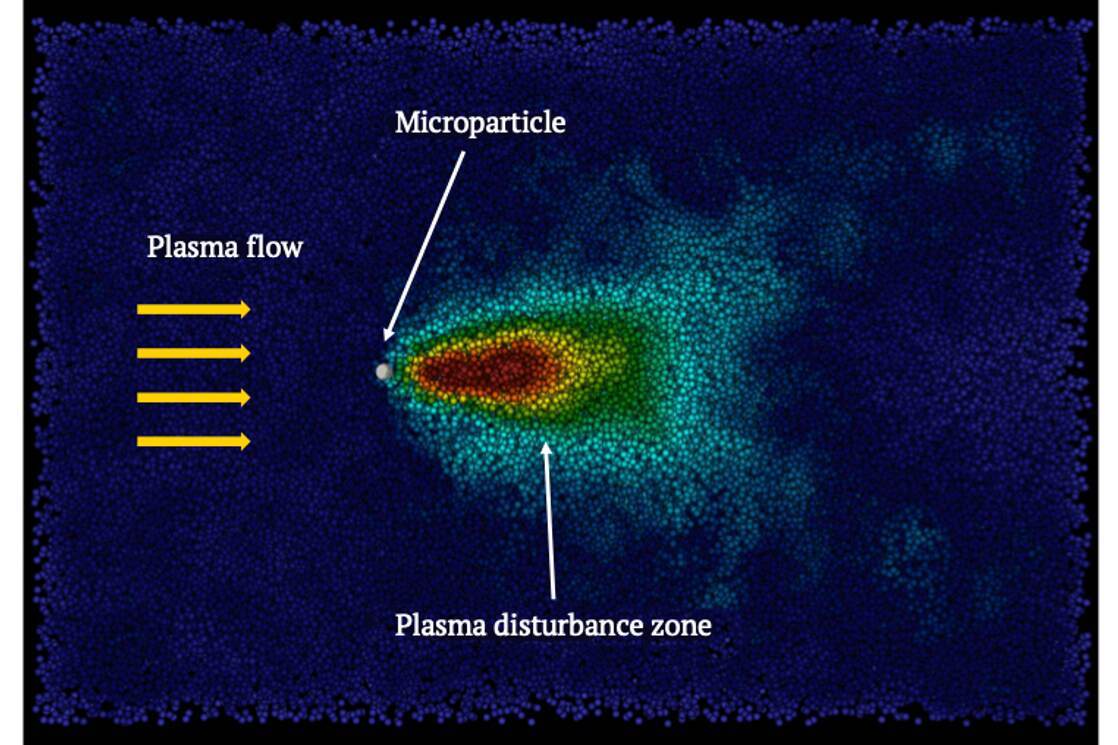
The outcome, OpenDust, performs ten times faster than existing analogs. In order to accelerate calculations, the algorithm uses multiple GPUs simultaneously. Plasma disturbance zone after microparticle in a plasma flow

"OpenDust has a flexible, user-friendly interface written in Python. Users can define the parameters of a simulated system and configure computational resources. For instance, users have the ability to specify the plasma flow rate and the number of GPU accelerators needed for a calculation. The backend, which is the server component of the product responsible for the internal logic, is optimized for high-performance computations and harnesses the power of multiple GPUs. This capability enables substantially increase calculations and processes a larger amount of data", explains Daniil Kolotinskii, study co-author and OpenDust developer, Junior Researcher at the Joint Institute for High Temperatures RAS.

The code, OpenDust, simulates the dynamics of plasma media surrounding a system of microparticles. Scientists can use it to explore intricate physical phenomena within a complex plasma, including self-organization effects and instabilities. Additionally, the code can be applied in various fields of science and industry, such as simulation of plasma purification processes within industrial extreme ultraviolet lithography machines or studying active particle systems.

"Our code is the first-ever open-source program for the multiscale self-consistent simulation of microparticle motion in a plasma flow.  OpenDust can serve as a versatile tool for simulating and studying diverse physical phenomena associated with microparticle motion in a plasma flow. The code has both academic and industrial applications. For example, it can facilitate the development of novel methods for efficiently removing dust from plasma in industrial lithography machines", says Alexey Timofeev, Leading Research Fellow, at HSE International Laboratory for Supercomputer Atomistic Modelling and Multi-scale Analysis.