Euclid, the European Space Agency’s space telescope, will be launched on the first of July if everything goes to plan. During the coming six years, it will be mapping one third of the sky. (Image: ESA)

Euclid is to launch from Cape Canaveral with a SpaceX Falcon 9 rocket on July 1

Euclid, the European Space Agency’s space telescope, will be launched on July 1 if everything goes to plan. During the coming six years, it will be mapping one-third of the sky.

In six years, Euclid will complete a task that would take older telescopes like Hubble or Webb over a century. The main objective is to solve the problem of dark energy, i.e. why has the expansion of the universe started to accelerate? euclid kaavio.jpg a4b7c

A map to reveal the secrets of dark matter and dark energy

The objective of Euclid is to help us understand two of the most enigmatic, yet key phenomena in the universe; dark matter and dark energy.

“The gravity of dark matter and dark energy affects the movements of galaxies and the expansion of the universe. Though we cannot see either of them directly, they make up some 95% of the universe,” says Professor Hannu Kurki-Suonio from the University of Helsinki.

Euclid will produce a three-dimensional map of the universe with billions of galaxies. The map will cover over one-third of space, up to 10 billion light years away. The further away an observed galaxy is, the further we can see into the past – to 10 billion years ago.

The part of space to be mapped has been selected because that is where the furthermost galaxies are most clearly discernible, avoiding the plane of the Milky Way and our solar system. Euclid will also measure the gravitational lens effect; how the gravitation of dark matter bends the trajectory of light so that it distorts how we see far-away galaxies. In this way, we will be able to map the distribution of dark matter.

The three-dimensional map produced by Euclid will help us study how the universe has expanded and how large-scale structures, like galaxies, have developed during cosmic history. This, in turn, depends on the characteristics of dark matter and dark energy.

Many Finns participating in the endeavor

Euclid will be launched from Cape Canaveral in Florida with a SpaceX Falcon 9 rocket to 1.5 million kilometers from Earth, where it will be able to make observations without interference. There is a telescope on Euclid with a diameter of 1.2 meters, along with two instruments: one for taking sharp images in visual light, the other one for taking spectra and images in infrared. 

Both instruments on Euclid contain a large camera. The images from visible light contain over 600 million pixels and the ones from infrared over 60 million pixels.

Euclid will take images from one area for over an hour, and then it will be turned towards another area. Euclid differs from previous space telescopes specifically in that it can take in a much larger portion of space at one time – the portion of space covered by one image is larger than the full moon can conceal.

Over 300 research institutes and 2,000 researchers from 21 countries are participating in Euclid. The total cost of the project is over one billion euros. The observational data from Euclid will be analyzed in nine separate Euclid science data centers, one of which is located in Finland.

The Finnish scientists have collaborated in developing supercomputing methods, producing simulated data, and developing data quality-assurance methods for Euclid. The Finnish members also hold a strong position in combining observations made from Earth with Euclid data. In addition to the data gathered by the space telescope, we also need a huge amount of data collected from Earth to determine the distances of galaxies.

“In order to collate all this data, we need long-term collaboration between observatories and data centers around the world, but once it is finished, it will also offer scientists the best material for research into the structure of the universe,” says a University Lecturer Aku Venhola from the University of Oulu.

“Data-intensive computation is a swiftly growing field within science. The Finnish Euclid science data center is a spearhead example of this,” says Director Janne Ignatius from CSC, the IT Center for Science.

“The development of efficient methods of data analysis poses cross-discipline challenges between cosmology and IT,” adds Associate Professor Maarit Korpi-Lagg from Aalto University.

Finnish researchers have especially developed methods for computing statistical measures like correlation functions to describe the structure of the universe. After the launch, the Finnish supercomputing center will be responsible for processing 5% of the data from Euclid.

Finnish partners in Euclid are the University of Helsinki, the University of Turku, the University of Oulu, the University of Jyväskylä, Aalto University, and CSC Ltd.

Euclid will start collecting the measurements three months after the launch. The first measurement period will last one year, after which 14 months has been set aside for analysis. The first results from the Euclid project are expected by the end of 2025.

 

UOttawa prof Murugesu builds better single molecule magnets

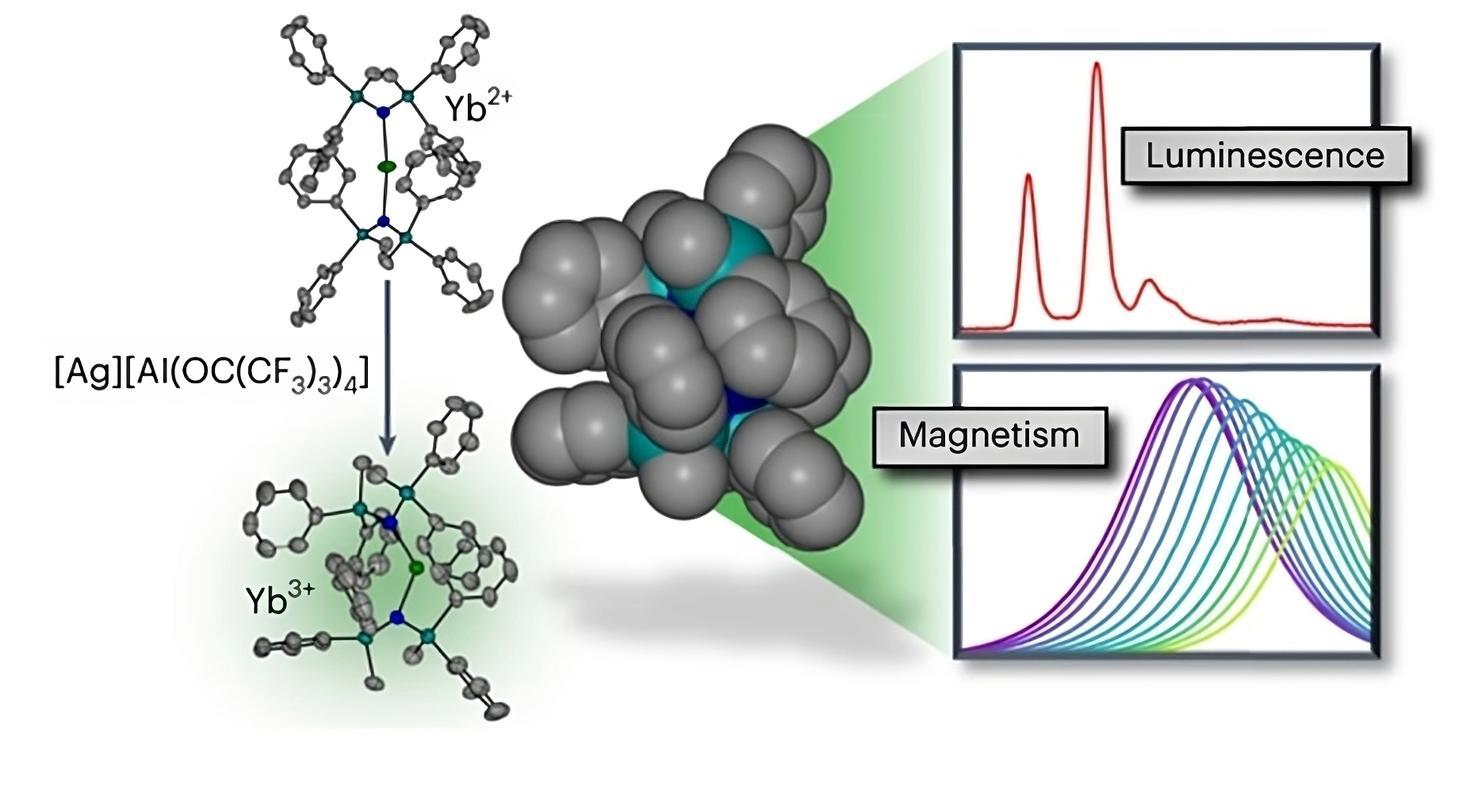
Scientists from the University of Ottawa have invented a unique method to create better molecule-based magnets, known as single-molecule magnets (SMMs). This synthetic tour de force has resulted in a two-coordinate lanthanide complex which has magnet-like properties that are intrinsic to the molecule itself. This discovery opens the door to high-density hard disks, quantum supercomputing applications, and the creation of faster and more compact memory devices. 

Lanthanide ions like to surround themselves with many organic ligands to stabilize and fill their coordination sphere. But thanks to a novel ligand design and synthetic approach, uOttawa scientists have managed to not only isolate the rare and precious two-coordinate species but also to reveal, for the first time, a huge energy level separation, just as theory had predicted. This complex is a synthetic achievement that shows the incredible potential of these molecules.

The research took place at the Department of Chemistry and Biomolecular Sciences at the University of Ottawa and was led by Muralee Murugesu, a full professor at the Faculty of Science, in collaboration with Professor Akseli Mansikkamäki from the University of Oulu, Finland, and with uOttawa post-doctoral fellows Diogo A. Gálico and Alexandros A. Kitos, as well as doctoral students Dylan Errulat and Katie L. M. Harriman. “Our discovery is a guide for making new, molecule-based materials for molecular electronics”. Muralee Murugesu — Full professor at uOttawa's Faculty of Science

“We have shown very exciting results that confirm for the first time what theory had predicted before and also offer a synthetic way to make better molecular magnets. These magnets are very useful for making smaller and faster memory devices and quantum computers because they have nanoscale sizes and special quantum features, such as quantum tunneling of the magnetization or quantum coherence,” said Professor Murugesu.

A Game-Changing Discovery

“We used our CFI-funded equipment to measure the magnetic and luminescent properties of our complexes at very low temperatures, below 10 Kelvin. These measurements showed us the intricate electronic structure of our complexes. We also confirmed our findings with computational studies in collaboration with Professor Mansikkamäki at the University of Oulu, Finland,” adds Professor Murugesu.

Since 2007, the Murugesu Group at the University of Ottawa has been working on single-molecule magnets (SMMs) that can store and process information at the molecular level. This highly anticipated material promises to save energy and space to make electronics faster and better, which could change the way data is stored and usher in a new era of molecular electronics.

Korean prof Min predicts 10 year countdown to sea-ice-free Arctic

A research team led by Professor Seung-Ki Min at POSTECH predicts the Arctic will be without ice by the end of 2030s if the current increasing rate of greenhouse gas emission continues 영문 본문 2780e

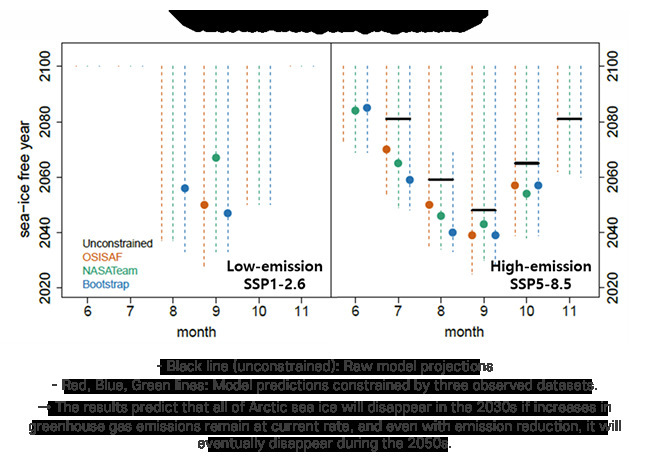
If the world keeps increasing greenhouse gas emissions at its current speed, all sea ice in the Arctic will disappear in the 2030s, an event that could at best be postponed until the 2050s should emissions be somehow reduced. The prediction is a decade earlier than what the Intergovernmental Panel on Climate Change (IPCC) has projected: an ice-free Arctic by the 2040s. 민승기교수팀 뷰페이지en fecaa

A possible ice-free Arctic in the 2030-2050s was projected regardless of humanity’s efforts to reduce its greenhouse gas emissions by Professor Seung-Ki Min and Research Professor Yeon-Hee Kim from the Division of Environmental Science and Engineering at Pohang University of Science and Technology (POSTECH) and a joint team of researchers from the Environment Climate Change Canada and Universität Hamburg, Germany.

The term global warming has become a household name since it was first used by a climate scientist at NASA in 1988. The Earth has seen a rapid decline in the Arctic sea ice area as its temperature has increased over the past several decades. This reduction in Arctic sea ice has induced the acceleration of Arctic warming, which is suggested to contribute to the increased frequency of extreme weather events in mid-latitude regions.

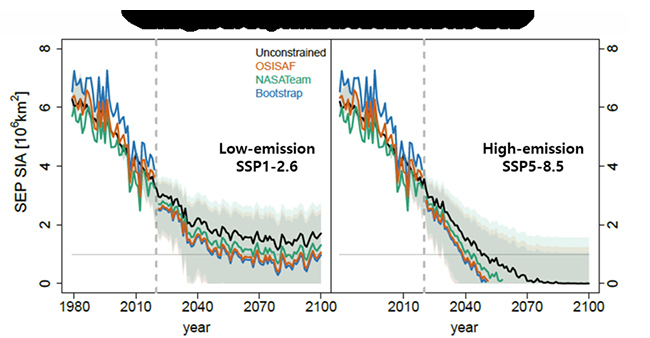
To predict the timing of Arctic sea ice depletion, the research team analyzed 41 years of data from 1979 to 2019. By comparing the results of multiple model simulations with three satellite observational datasets, it was confirmed that the primary cause of the decline is attributed to ‘man-made greenhouse gas emissions’. Greenhouse gas emissions resulting from human fossil fuel combustion and deforestation have been the primary drivers of Arctic sea ice decline over the past 41 years, while the influence of aerosols, solar and volcanic activities is minimal. The monthly analysis found that increased greenhouse gas emissions were reducing Arctic sea ice all year round, regardless of season or timing, although September exhibited the smallest extent of sea ice reduction. 그림1 c825a

Furthermore, it was revealed that climate models used in previous IPCC predictions generally underestimated the declining trend of sea ice area, which was taken into account to adjust the simulation values for future predictions. The results showed accelerated decline rates across all scenarios, most importantly confirming that Arctic sea ice could completely disappear by the 2050s even with reductions in greenhouse gas emissions. This finding highlights for the first time that the extinction of Arctic sea ice is possible irrespective of achieving ‘carbon neutrality.’

The accelerated decline of Arctic sea ice, faster than previously anticipated, is expected to have significant impacts not only on the Arctic region but also on human societies and ecosystems worldwide. The reduction of sea ice can result in more frequent occurrences of extreme weather events such as severe cold waves, heat waves, and heavy rainfalls all across the globe, with the thawing of the Siberian permafrost in the Arctic region possibly intensifying global warming further. We may witness terrifying scenarios, which we have seen only in disaster movies, unfold right before our eyes.

Professor Seung-Ki Min, who led the study, explained, “We have confirmed an even faster timing of Arctic sea ice depletion than previous IPCC predictions after scaling model simulations based on observational data.” He added, “We need to be vigilant about the potential disappearance of Arctic sea ice, regardless of carbon neutrality policies.” He also expressed the importance of “evaluating the various climate change impacts resulting from the disappearance of Arctic sea ice and developing adaptation measures alongside carbon emission reduction policies.”

The study was funded by the National Research Foundation of Korea (Mid-Career Researcher program).