Supercomputer simulation of the chorus event at Mars.

Chinese scientists verify trap-release-amplify model by reproducing electromagnetic waves on Mars

The study reveals whistler-mode chorus waves similar to the Earth's detected on Mars, validating the role of magnetic field Inhomogeneity in frequency sweeping phenomenon. 

Chinese scientists have reproduced the observed whistler mode chorus waves on Mars using data from the Mars Atmosphere and Volatile Evolution (MAVEN) mission and compared them with phenomena on the Earth. They found that both Mars and Earth exhibit whistler mode chorus waves triggered by nonlinear processes with the key role played by background magnetic field inhomogeneity in frequency sweeping. 

The study provides crucial support for understanding chorus waves in the Martian environment and verifies the previously proposed "Trap-Release-Amplify" (TaRA) model under more extreme conditions. Magnetic field and chorus emissions at Mars and Earth.

Whistler-mode chorus waves are electromagnetic wave emissions widely presented in planetary magnetospheres. When their electromagnetic signals are converted into sound, they resemble the harmonious chorus of birds in the early morning, hence the name "chorus waves." Chorus waves can accelerate high-energy electrons in space through resonance, leading to a rapid increase in electron flux in Earth's radiation belts during geomagnetic storms. Additionally, they scatter high-energy electrons into the atmosphere, creating diffuse and pulsating auroras. 

One characteristic of chorus waves is their narrowband frequency sweeping structure. The excitation mechanism of this sweeping structure has been of great interest for decades, and scientists have proposed various theoretical models. However, there has been an ongoing debate regarding why frequency sweeping occurs in chorus waves and how to calculate the sweeping frequency. One central point of contention is whether the background magnetic field inhomogeneity plays a crucial role in frequency sweeping and how it affects the sweeping phenomenon. 

The TaRA model, previously proposed by a team from the University of Science and Technology of China of the Chinese Academy of Sciences, is based on modern plasma physics theories and suggests that the frequency sweeping of chorus waves in the magnetosphere is the result of the combined effects of nonlinear processes and background magnetic field inhomogeneity. The model provides a corresponding formula for calculating the sweeping frequency. However, the variation in magnetic field inhomogeneity in Earth's magnetosphere is limited, making it difficult to test the TaRA model in a larger parameter space. 

There exist distinct magnetic field environments between Mars and Earth. The Earth possesses a global dipole-like magnetic field, while Mars only has localized remnant magnetization. In the remnant magnetization environment of Mars, similar chorus wave events have also been observed by the MAVEN satellite. The calculations reveal a difference of five orders of magnitude in background magnetic field inhomogeneity between Mars and Earth. By comparing wave events observed on Earth and Mars, the previously proposed TaRA model can be tested under more extreme conditions. 

To validate this model, in this study, scientists from the University of Science and Technology of China and their collaborators observed the particle distribution on Mars using the MAVEN satellite. They combined it with the corresponding Martian crustal remnant magnetic field model. 

Employing a first-principles particle simulation method, scientists reproduced the observed chorus wave phenomena on Mars. Through the analysis of particle phase space distribution, they confirmed that the sweeping process of these waves is consistent with that of chorus waves on Earth, both triggered by nonlinear processes. 

Furthermore, scientists used two different methods provided by the TaRA model to calculate the sweeping frequency of chorus waves and compared them with the observation and simulation results. The results demonstrated high consistency between the sweeping frequencies calculated based on nonlinear processes and background magnetic field inhomogeneity and the supercomputer simulation results. 

These findings indicated that although Mars and Earth possess distinct magnetic and plasma environments, the observed chorus wave phenomena on Mars follow the same fundamental physical processes as those in Earth's magnetosphere. This study validated the wide applicability of the TaRA model in describing the sweeping physical processes of chorus waves under extreme conditions with a five-order difference in magnetic field inhomogeneity, which confirms the existence of chorus waves on Mars, and provides support for testing and applying the TaRA model under extreme conditions. 
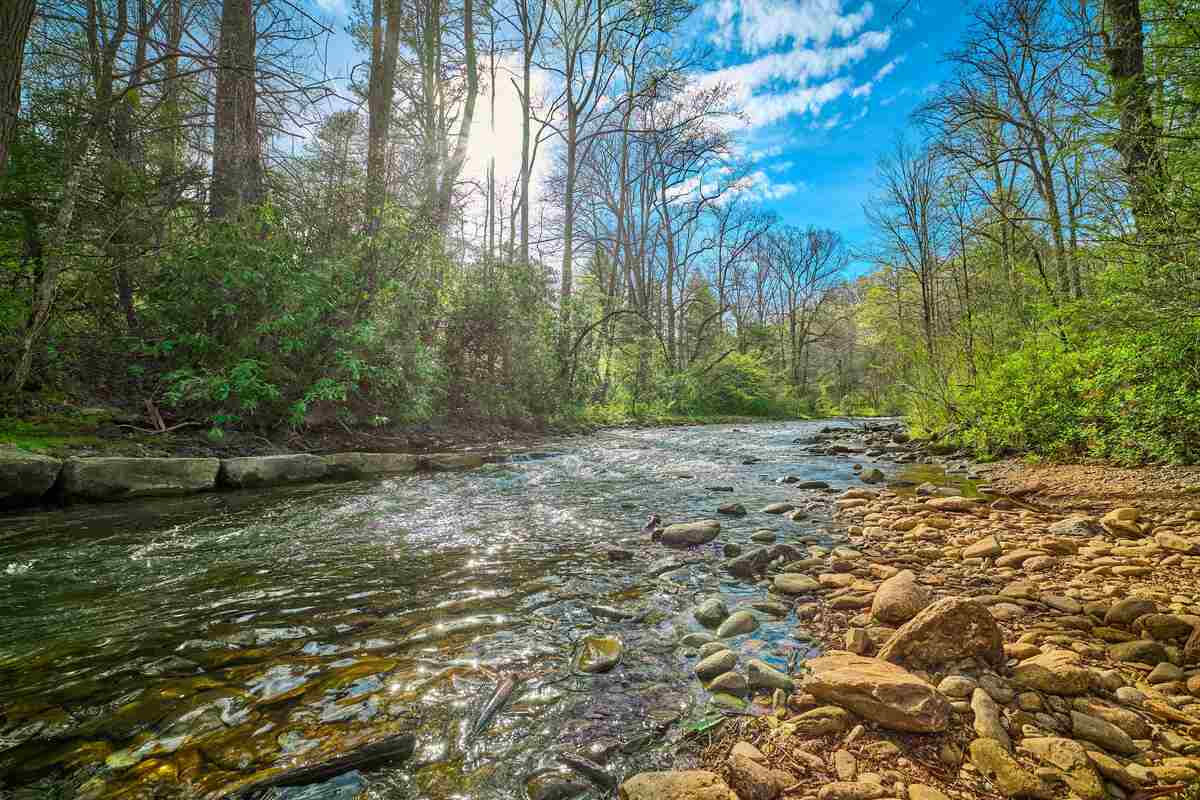
Syracuse University researchers co-authored a study exploring the extent to which human activities are contributing to hydrogeochemical changes in U.S. rivers. The image above is Mills River in Pisgah National Forest, North Carolina.

Syracuse prof Wen uses supercomputer modeling to discover the sources of salinization, alkalinization in watersheds

From protecting biodiversity to ensuring the safety of drinking water, the biochemical makeup of rivers and streams around the United States is critical for human and environmental welfare. Studies have found that human activity and urbanization are driving the salinization (increased salt content) of freshwater sources across the country. In excess, salinity can make water undrinkable, increase the cost of treating water, and harm freshwater fish and wildlife. 

Along with the rise in salinity has also been an increase in alkalinity over time, and past research suggests that salinization may enhance alkalinization. But unlike excess salinity, alkalinization can have a positive impact on the environment due to its ability to neutralize water acidity and absorb carbon dioxide in the Earth’s atmosphere – a key component to combating climate change. Therefore, understanding the processes at play which are affecting salinity and alkalinity has important environmental and health implications. EES Professor Tao Wen and his co-authors used machine learning to detect sources of salinization and alkalinization in U.S. watersheds.

A team of researchers from Syracuse University and Texas A&M University has applied a machine learning model to explore where and to what extent human activities are contributing to the hydrogeochemical changes, such as increases in salinity and alkalinity in U.S. rivers.

The group used data from 226 river monitoring sites across the U.S. and built two machine-learning models to predict monthly salinity and alkalinity levels at each site. These sites were selected because long-term continuous water quality measurements have been recorded for at least 30 years. From urban to rural settings, the model explored a diverse range of watersheds, which are areas where all flowing surface water converges to a single point, such as a river or lake. It evaluated 32 watershed factors ranging from hydrology, climate, geology, soil chemistry, land use, and land cover to pinpoint the factors contributing to rising salinity and alkalinity. The team’s models determined human activities as major contributors to the salinity of U.S. rivers while rising alkalinity was mainly attributed more to natural processes than human activities.

The team, which included Syracuse University researchers Tao Wen, assistant professor in the College of Arts and Sciences’ Department of Earth and Environmental Sciences (EES), Beibei E, a graduate student in EES, Charles T. Driscoll, University Professor of Environmental Systems and Distinguished Professor in the College of Engineering and Computer Science, and Texas A&M assistant professor Shuang Zhang, recently had their findings published in the journal Science of the Total Environment.

What’s Driving Salinization and Alkalinization?

The results from the group’s sodium prediction model, which detected human activities such as the application of road salt as major contributions to the salinity of U.S. rivers, were consistent with previous studies. This model specifically revealed population density and impervious surface percentage (artificial surfaces such as roads) as the two most important contributors to the higher salt content in U.S. rivers.

According to Wen, the accuracy of the salinity model provided an important proof of concept for the research team.

“Regarding causes of salinity in rivers, the results from our machine learning model matched those of previous studies which focused on field observation, lab work, and statistical analysis,” says Wen. “This proved that our approach was working.”

With the salinity results confirming the accuracy of the team’s model, they then turned their attention to alkalinity. Their model identified natural processes as predominantly contributing to variation in river alkalinity, a contrast to previous research that identified human activities as the main contributor to alkalinization. They found that local climatic and hydrogeological conditions including runoff, sediment, soil pH, and moisture, were features most affecting river alkalinity.

Critical to the Carbon Cycle

Their findings have important environmental and climate implications as alkalinity in rivers forms a vital link in the carbon cycle. Consider the movement of carbon during a rainstorm. When it rains, carbon dioxide from the atmosphere combines with water to form carbonic acid. When the carbonic acid reaches the ground and comes into contact with certain rocks, it triggers a chemical reaction that extracts gaseous carbon dioxide from the atmosphere and transports it to the ocean via land water systems like lakes and rivers. Known as rock weathering, this natural process continuously erodes rocks and sequesters atmospheric CO2 over millions of years. It is also a key regulator of greenhouse gases that contribute to global warming.

“Rock weathering is the primary source of alkalinity in natural waters and is one of the main ways to bring down carbon dioxide in the air,” says Wen. Think of it as a feedback loop: when there is too much carbon dioxide in the atmosphere, temperatures increase leading to enhanced rock weathering. With more rock being dissolved into watersheds due to enhanced rock weathering, alkalinity rises and in turn, brings down carbon dioxide.

“Alkalinity is a critical component of the carbon cycle,” says Wen. “While we found that natural processes are the primary drivers of alkalinization, these natural factors can still be changed by humans. We can alter the alkalinity level in rivers by changing the natural parameters, so we need to invest more to restore the natural conditions of watersheds and tackle global warming and climate changes to deal with alkalinization in U.S. rivers.”

The results from the team’s study can help inform future research about enhanced rock weathering efforts – where rocks are ground up and spread across fields. Distributing rock dust across large areas increases the amount of contact between rain and rock, which enhances carbon removal from the atmosphere. Wen says the team’s model can help answer questions about the evolution of natural conditions in different regions – an important step needed to implement enhanced rock weathering more effectively.

The work was funded through a $460,000 National Science Foundation grant awarded to Wen.

POET Technologies confirms sample availability of POET Infinity, testing with a pair of customers

Alpha samples of the chiplet-based transmitter platform for 400G, 800G, and 1.6T data center solutions are ready for shipment

POET Technologies has announced alpha sample readiness of POET Infinity, a chiplet-based transmitter platform for 400G, 800G, and 1.6T pluggable transceivers and co-packaged optics solutions. Two lead customers have agreed to partner with POET to test the alpha version of the Infinity chiplet.

The POETInfinity chiplet complements the POET 800G 2xFR4 Receiver optical engine that the Company announced in February 2023 and completes the 800G chipset for 2xFR4 QSFP-DD or OSFP applications with two Infinity chiplets and one Receiver optical engine. Both customers intend to develop 800G 2xFR4 QSFP-DD and OSFP transceiver solutions using the POET Optical Engine chipsets.

The Infinity chiplet is the industry’s first implementation of directly modulated lasers (DMLs) for 100G/lane applications. DMLs are power efficient, and cost-effective and become a highly scalable solution when paired with the POET Optical Interposer platform. The chiplet incorporates 100G PAM4 DMLs, DML Drivers, and an integrated optical multiplexer for a complete 400GBASE-FR4 transmitter solution on a chip. The small size of the chiplet and a daisy-chain architecture enables side-by-side placement of multiple instances to achieve 800G and 1.6T speeds.

The POET Infinity product line carries forward the POET differentiation of all passive alignments and monolithically integrated waveguides, multiplexers and demultiplexers, which translates to lower cost, lower power consumption, and ease-of-assembly benefits for customers.

“The availability of a transmitter solution for 400G, 800G, and 1.6T speeds that is power efficient, cost-effective, and highly scalable for the data center market is a major achievement,” said Dr. Suresh Venkatesan, Chairman & CEO of POET. “Our customers are excited to receive the samples and test them because it simplifies their transceiver design significantly and shortens the design cycle with POET optical engines that incorporate all of the required optical elements as well as the key electronic components, including laser drivers and trans-impedance amplifiers.”

The development of a production version of the POET Infinity chiplet is on track and POET expects to deliver beta samples by Q4 of 2023 and start production by the first half of 2024. The ethernet transceiver market for 400G and above data rates is projected to exceed $6 billion by 2028.