

Could suicide risk be predicted from a patient's records?

Supercomputer models flag many patients at risk for suicide attempts, two years ahead of time

Suicide is now the second most common cause of death among American youth. Fatal suicides rose 30 percent between 2000 and 2016, and 2016 alone saw 1.3 million nonfatal suicide attempts. Now, a study led by Boston Children's Hospital and Massachusetts General Hospital demonstrates that a predictive computer model can identify patients at risk for attempting suicide from patterns in their electronic health records -- an average of two years ahead of time.

Such models could potentially alert health professionals in advance of a visit, helping patients get appropriate interventions, the researchers say. Findings were published last month in JAMA Network Open. {module INSIDE STORY} 

"Computers cannot replace care teams in identifying mental health issues," says Ben Reis, PhD, director of the Predictive Medicine Group, part of the Computational Health Informatics Program (CHIP) at Boston Children's Hospital, and co-senior author on the paper. "But we feel that computers, if well designed, could identify high-risk patients who may currently be falling through the cracks, unnoticed by the health system. We envision a system that could tell the doctor, 'of all your patients, these three fall into a high-risk category. Take a few extra minutes to speak with them.'"

The team analyzed electronic health record data from more than 3.7 million patients ages 10 to 90 across five diverse U.S. health care systems: Partners HealthCare System in Boston; Boston Medical Center; Boston Children's Hospital; Wake Forest Medical Center in North Carolina; and University of Texas Health Science Center at Houston. Six to 17 years' worth of data were available from the different centers, including diagnostic codes, laboratory test results, medical procedure codes, and medications.

The records showed a total of 39,162 suicide attempts. The models were able to detect 38 percent of them (this ranged 33 to 39 percent across the five centers) with 90 percent specificity. Cases were picked up a mean of 2.1 years before the actual suicide attempt (range, 1.3 to 3.5 years).

The strongest predictors, not surprisingly, included drug poisonings, drug dependence, acute alcohol intoxication, and several mental health conditions. But other predictors were ones that wouldn't ordinarily come to mind, like rhabdomyolysis, cellulitis or abscess of the hand, and HIV medications.

"There wasn't one single predictor," says Reis. "It is more of a gestalt or balance of evidence, a general signal that builds up over time."

Designing a suicide risk predictor

The investigators developed the model in two steps, using a machine learning approach. First, they showed half of their patient data to a supercomputer model, directing it to find patterns that were associated with documented suicide attempts. Then, they took lessons learned from that "training" exercise and validated them using the other half of their data -- asking the model to predict, based on those patterns alone, which patients would eventually attempt suicide.

On the whole, the model performed similarly at all five medical centers, but retraining the model at individual centers brought better results.

"We could have created one model to fit all medical centers, using the same codes," says Yuval Barak-Corren, MD, of CHIP, first author on the paper. "But we chose an approach that automatically builds a slightly different model, tailored to suit the specifics of each health care site."

The findings confirmed the value of adapting the model to each site, since health care centers may have unique predictive factors, based on different hospital coding practices and local demographics and health patterns.

Under a grant from the National Institute of Mental Health, the team will now seek to enhance their modeling approach, for example incorporating doctor's clinical notes into their data.
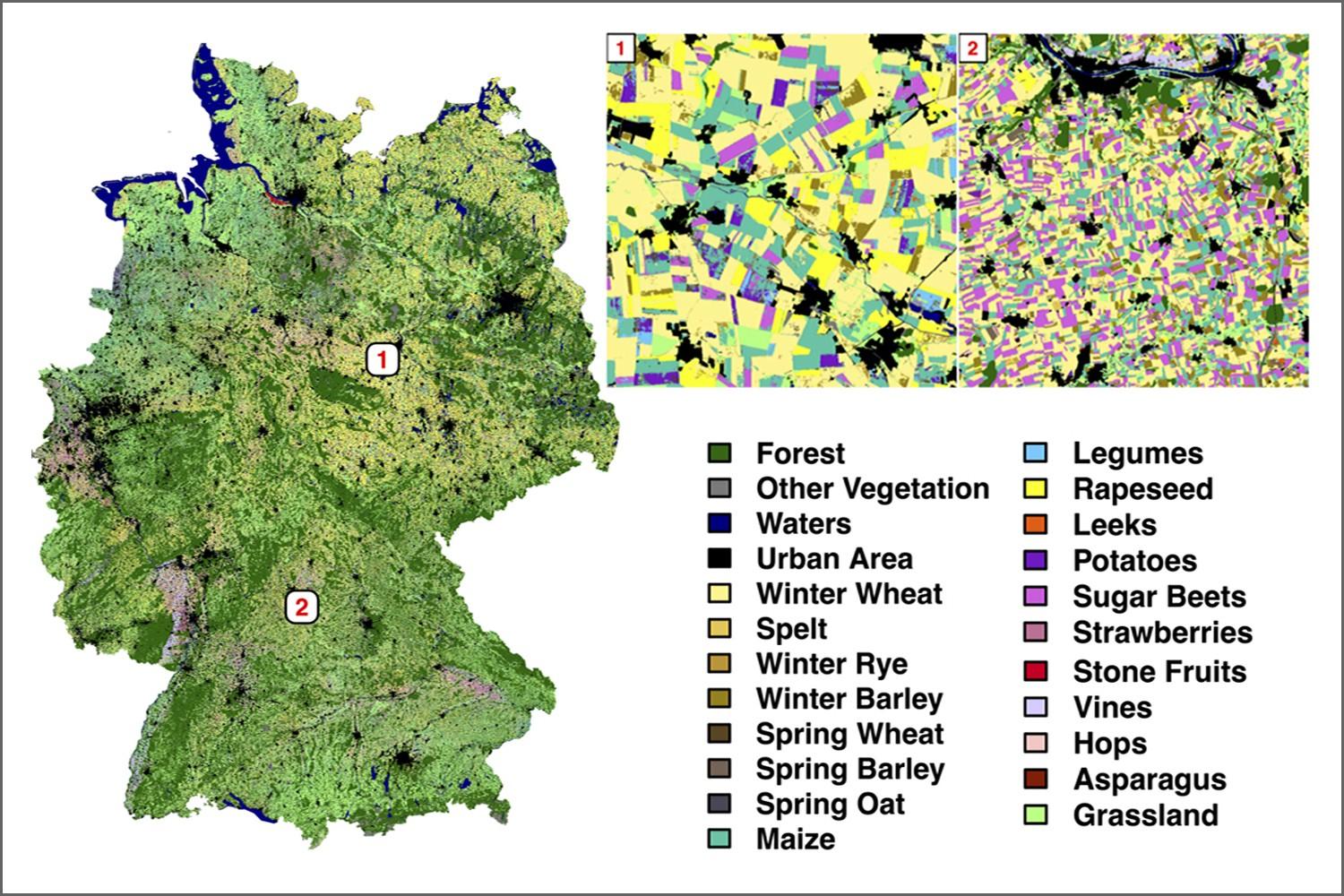
German built machine learning methods provide detailed information on crop types

Having detailed land cover information is important for a better understanding of our environment - for example, to estimate ecosystem services such as pollination or to quantify nitrate and nutrient inputs in water bodies. This information is increasingly obtained from satellite images with high temporal and spatial resolution. However, clouds often prevent the view from space to the earth’s surface. The dynamic use of machine learning models can take this local cloud cover into account without resorting to commonly used interpolation methods. This is shown by UFZ scientists in a study published in the journal Remote Sensing of Environment. Their algorithm recognises 19 different types of crops, accurate to 88 percent.

"If we can determine the cultivated crop for each agricultural field, we can draw conclusions not only about nutrient requirements but also about the nitrate load of surrounding waters," explains Sebastian Preidl, scientist in the Landscape Ecology department at UFZ. The information could also be used, for example, to better initiate actions to protect wild bee populations. "We can only protect a region’s biological diversity effectively if we have a clear picture of the spatial land cover distribution," explains Preidl. Map of Germany, land cover. The algorithm identifies 19 different types of crops, accurate to 88 percent. Photo: ©UFZ

Earth observation satellites of the Copernicus program founded by the European Space Agency (ESA) provide high-resolution data in time and space and enable continuous monitoring of the land surface on an ecologically relevant scale. Sentinel-2 satellite images captured at regular time intervals in 9 spectral bands formed the basis for Preidl’s work. From these spectral time series, researchers can derive land cover information for their study area. {module INSIDE STORY}

Cloud occurrence is a major challenge when dealing with time series of optical satellite data. Despite numerous satellite images, frequent cloud cover can lead to larger data gaps in the spectral time series.  At the same time, a sufficient number of pixels (observations) is required for many plant growth phases to assign the recorded spectral signatures to the corresponding plant species.

These gaps are usually filled by artificially generated data that are interpolated from cloud-free image pixels. "Instead of doing this, we opt for a dynamic application of machine learning models. This means we are generating customised algorithms for every pixel," says Preidl. "Our algorithm automatically selects cloud-free pixels from the entire satellite image dataset and is not dependent on large-scale cloud-free scenes. To assign a specific crop type to each image pixel, the temporal sequence of cloud-free observations at pixel level is taken into account by a large number of models." 

Based on information provided by the federal states, the crop type cultivated is known only for selected agricultural fields. This knowledge is used to train the UFZ models to distinguish between maize and wheat, for example. To determine land cover of the total agricultural area, the scientists have divided Germany into six landscape regions. "Different crops are grown in the 'Magdeburger Börde’ than in the 'Rheingau’," explains Preidl. "Moreover, one and the same crop species grows differently in the 'Breisgau’ than in the 'Uckermark’. Climate and altitude make a big difference." The result: the researchers’ algorithm achieves an accuracy of 88% in identifying 19 different crop types. For the main crops, the success rate is over 90%. At first for the year 2016, they created a land cover map of Germany's agricultural area using around 7000 satellite images. In addition to this map, UFZ researcher can also provide information about the model performance, i.e. the accuracy with which the algorithm detects the plant species for a given pixel.

But the UFZ approach can be exploited in many other ways. In a project with the German Federal Agency for Nature Conservation (BfN), instead of wheat and maize, Preidl’s algorithms also distinguish spruce, beech and other tree species. In this way he is investigating how the nature conservation value of forests can be determined using satellite data. "If we know which tree species predominate in a forest area over time, the effects of storm events, drought damage or pest infestation can be better assessed. A resilient forest is economically and ecologically highly relevant in terms of the sustainable development goals," says Preidl.

"Our methodology can be applied to other regions within and outside Europe, and to other years, by taking into account the respective relevant temporal sequence of cloud-free observations and land use," says Dr Daniel Doktor, head of the Remote Sensing working group of the Department Computational Landscape Ecology at the UFZ, outlining the next steps. "If this methodology is combined with other models - for example on phenology or ecology - statements can be made not only on species-specific vulnerability to extreme events such as droughts, but also on the future behaviour of ecosystems as carbon sources or sinks," explains Doktor.

Astronomers detect most energetic outflow from a distant quasar

Researchers using the Gemini North telescope on Hawai'i's Maunakea have detected the most energetic wind from any quasar ever measured. This outflow, which is travelling at nearly 13% of the speed of light, carries enough energy to dramatically impact star formation across an entire galaxy. The extragalactic tempest lay hidden in plain sight for 15 years before being unveiled by innovative supercomputer modeling and new data from the international Gemini Observatory.

The most energetic wind from a quasar has been revealed by a team of astronomers using observations from the international Gemini Observatory, a program of NSF's NOIRLab. This powerful outflow is moving into its host galaxy at almost 13% of the speed of light, and stems from a quasar known as SDSS J135246.37+423923.5 which lies roughly 60 billion light-years from Earth.

"While high-velocity winds have previously been observed in quasars, these have been thin and wispy, carrying only a relatively small amount of mass," explains Sarah Gallagher, an astronomer at Western University (Canada) who led the Gemini observations. "The outflow from this quasar, in comparison, sweeps along a tremendous amount of mass at incredible speeds. This wind is crazy powerful, and we don't know how the quasar can launch something so substantial." {module INSIDE STORY}

As well as measuring the outflow from SDSS J135246.37+423923.5, the team was also able to infer the mass of the supermassive black hole powering the quasar. This monstrous object is 8.6 billion times as massive as the Sun -about 2000 times the mass of the black hole in the center of our Milky Way and 50% more massive than the well-known black hole in the galaxy Messier 87.

This result is published in the Astrophysical Journal and the quasar studied here now holds the record for the most energetic quasar wind measured to date, with a wind more energetic than those recently reported in a study of 13 quasars.

Despite its mass and energetic outflow, the discovery of this powerhouse languished in a quasar survey for 15 years before the combination of Gemini data and the team's innovative computer modeling method allowed it to be studied in detail.

"We were shocked - this isn't a new quasar, but no one knew how amazing it was until the team got the Gemini spectra," explains Karen Leighly, an astronomer at the University of Oklahoma who was one of the scientific leads for this research. "These objects were too hard to study before our team developed our methodology and had the data we needed, and now it looks like they might be the most interesting kind of windy quasars to study."

Quasars - also known as quasi-stellar objects - are a type of extraordinarily luminous astrophysical object residing in the centres of massive galaxies. Consisting of a supermassive black hole surrounded by a glowing disk of gas, quasars can outshine all the stars in their host galaxy and can drive winds powerful enough to influence entire galaxies.

"Some quasar-driven winds have enough energy to sweep the material from a galaxy that is needed to form stars and thus quench star formation," explains Hyunseop (Joseph) Choi, a graduate student at the University of Oklahoma and the first author of the scientific paper on this discovery. "We studied a particularly windy quasar, SDSS J135246.37+423923.5, whose outflow is so thick that it's difficult to detect the signature of the quasar itself at visible wavelengths."

Despite the obstruction, the team was able to get a clear view of the quasar using the Gemini Near-Infrared Spectrograph (GNIRS) on Gemini North to observe at infrared wavelengths. Using a combination of high-quality spectra from Gemini and a pioneering supercomputer modeling approach, the astronomers uncovered the nature of the outflow from the object -- which proved, remarkably, to be more energetic than any quasar outflow previously measured.

The team's discovery raises important questions, and also suggests there could be more of these quasars waiting to be found.

We don't know how many more of these extraordinary objects are in our quasar catalogs that we just don't know about yet," concludes Choi "Since automated software generally identifies quasars by strong emission lines or blue color -- two properties our object lacks -- there could be more of these quasars with tremendously powerful outflows hidden away in our surveys."

"This extraordinary discovery was made possible with the resources provided by the international Gemini Observatory; the discovery opens new windows and opportunities to explore the Universe further in the years to come," said Martin Still, an astronomy program director at the National Science Foundation, which funds Gemini Observatory from the U.S. as part of an international collaboration. "The Gemini Observatory continues to advance our knowledge of the Universe by providing the international science community with forefront access to telescope instrumentation and facilities."