Complex shapes of photons to boost future quantum tech for supercomputing

As the digital revolution has now become mainstream, quantum supercomputing and quantum communication are rising in the consciousness of the field. The enhanced measurement technologies enabled by quantum phenomena, and the possibility of scientific progress using new methods, are of particular interest to researchers around the world.

Recently two researchers at Tampere University in Finland, Assistant Professor Robert Fickler and Doctoral Researcher Markus Hiekkamäki, demonstrated that two-photon interference can be controlled in a near-perfect way using the spatial shape of the photon. Their findings were recently published in the academic journal Physical Review Letters.

"Our report shows how a complex light-shaping method can be used to make two quanta of light interfere with each other in a novel and easily tuneable way", explains Markus Hiekkamäki.

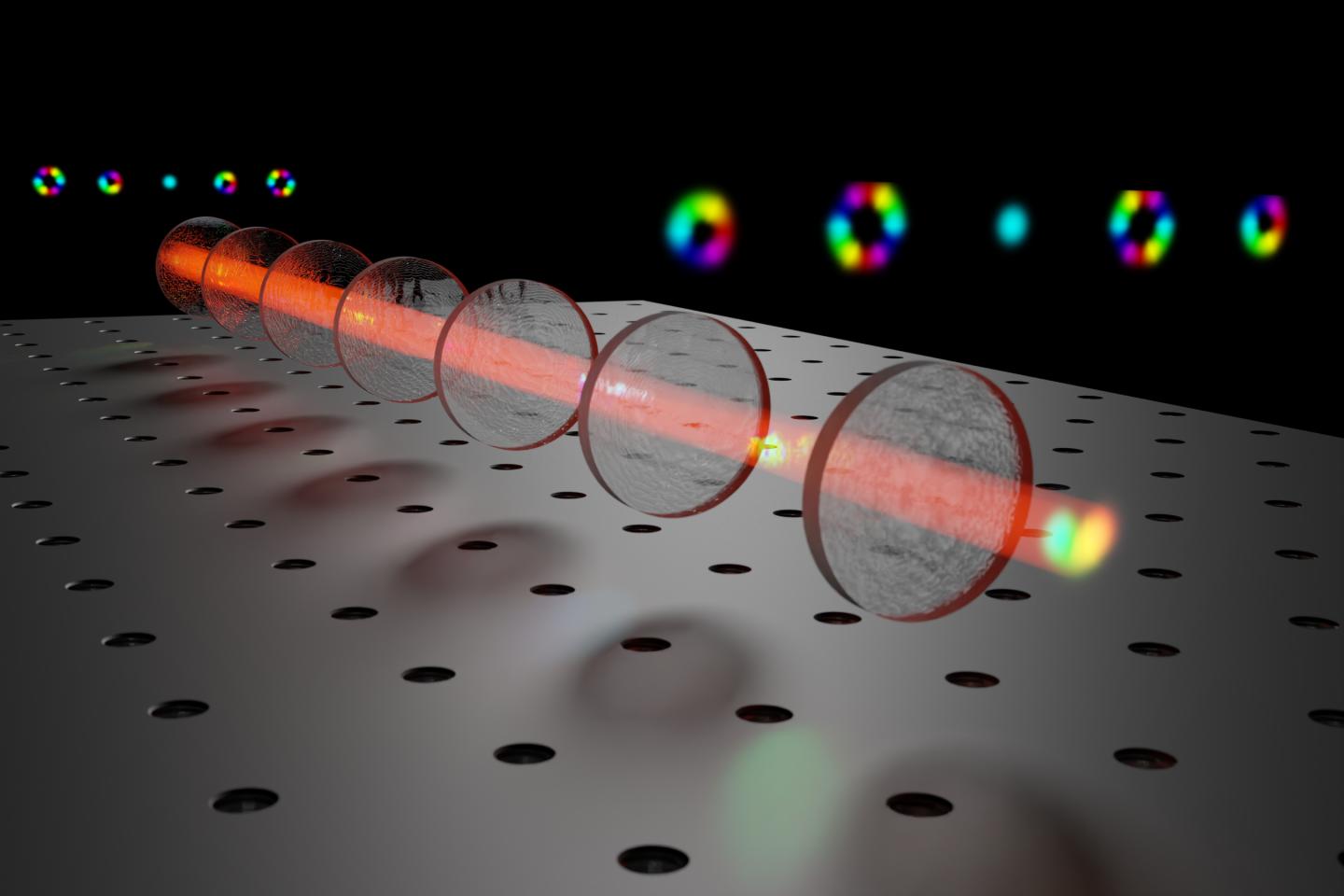
Single photons (units of light) can have highly complex shapes that are known to be beneficial for quantum technologies such as quantum cryptography, super-sensitive measurements, or quantum-enhanced computational tasks. To make use of these so-called structured photons, it is crucial to make them interfere with other photons. Conceptual image of the used method for manipulating the spatial structures of photons using multiple consecutive lossless modulations.  CREDIT Markus Hiekkamäki / Tampere University

"One crucial task in essentially all quantum technological applications is improving the ability to manipulate quantum states in a more complex and reliable way. In photonic quantum technologies, this task involves changing the properties of a single photon as well as interfering multiple photons with each other;" says Robert Fickler, who leads the Experimental Quantum Optics group at the university.

Linear optics bring promising solutions to quantum communications

The demonstrated development is especially interesting from the point of view of high-dimensional quantum information science, where more than a single bit of quantum information is used per carrier. These more complex quantum states not only allow the encoding of more information onto a single photon but are also known to be more noise-resistant in various settings.

The method presented by the research duo holds promise for building new types of linear optical networks. This paves the way for novel schemes of photonic quantum-enhanced computing.

"Our experimental demonstration of bunching two photons into multiple complex spatial shapes is a crucial next step for applying structured photons to various quantum metrological and informational tasks", continues Markus Hiekkamäki.

The researchers now aim at utilizing the method for developing new quantum-enhanced sensing techniques, while exploring more complex spatial structures of photons and developing new approaches for computational systems using quantum states.

"We hope that these results inspire more research into the fundamental limits of photon shaping. Our findings might also trigger the development of new quantum technologies, e.g. improved noise-tolerant quantum communication or innovative quantum computation schemes, that benefit from such high-dimensional photonic quantum states", adds Robert Fickler.

UNM team creates powerful computational tool to help researchers rapidly screen molecules for anti-COVID properties

A year into the COVID-19 pandemic, mass vaccinations have begun to raise the tantalizing prospect of herd immunity that eventually curtails or halts the spread of SARS-CoV-2. But what if herd immunity is never fully achieved - or if the mutating virus gives rise to hyper-virulent variants that diminish the benefits of vaccination?

Those questions underscore the need for effective treatments for people who continue to fall ill with the coronavirus. While a few existing drugs show some benefit, there's a pressing need to find new therapeutics.

Led by The University of New Mexico's Tudor Oprea, MD, Ph.D., scientists have created a unique tool to help drug researchers quickly identify molecules capable of disarming the virus before it invades human cells or disabling it in the early stages of the infection.

In a paper published this week, the researchers introduced REDIAL-2020, an open-source online suite of computational models that will help scientists rapidly screen small molecules for their potential COVID-fighting properties.

"To some extent, this replaces (laboratory) experiments, says Oprea, chief of the Translational Informatics Division in the UNM School of Medicine. "It narrows the field of what people need to focus on. That's why we placed it online for everyone to use."

Oprea's team at UNM and another group at the University of Texas at El Paso led by Suman Sirimulla, Ph.D., started work on the REDIAL-2020 tool last spring after scientists at the National Center for Advancing Translational Sciences (NCATS) released data from their own COVID drug repurposing studies.

"Becoming aware of this, I was like, 'Wait a minute, there's enough data here for us to build solid machine learning models,'" Oprea says. The results from NCATS laboratory assays gauged each molecule's ability to inhibit viral entry, infectivity, and reproduction, such as the cytopathic effect - the ability to protect a cell from being killed by the virus.

Biomedicine researchers often tend to focus on the positive findings from their studies, but in this case, the NCATS scientists also reported which molecules had no virus-fighting effects. The inclusion of negative data actually enhances the accuracy of machine learning, Oprea says.

"The idea was that we identify molecules that fit the perfect profile," he says. "You want to find molecules that do all these things and don't do the things that we don't want them to do."

The coronavirus is a wily adversary, Oprea says. "I don't think there is a drug that will fit everything to a T." Instead, researchers will likely devise a multi-drug cocktail that attacks the virus on multiple fronts. "It goes back to the one-two punch," he says.

REDIAL-2020 is based on machine learning algorithms capable of rapidly processing huge amounts of data and teasing out hidden patterns that might not be perceivable by a human researcher. Oprea's team validated the machine learning predictions based on the NCATS data by comparing them against the known effects of approved drugs in UNM's DrugCentral database.

In principle, this computational workflow is flexible and could be trained to evaluate compounds against other pathogens, as well as evaluate chemicals that have not yet been approved for human use, Oprea says.

"Our main intent remains drug repurposing, but we're actually focusing on any small molecule," he says. "It doesn't have to be an approved drug. Anyone who tests their molecule could come up with something important."

Mason researchers win $482K from the AFOSR for supercomputing cluster

Harbir Antil (PI), Director, Center for Mathematics and Artificial Intelligence (CMAI), and Associate Professor, Mathematical Sciences, Rainald Löhner (co-PI), Director, Computational Fluid Dynamics (CFD) Center and Professor, Physics, and Astronomy, and Mahamadi Warma, (co-PI), CMAI Faculty and Professor, Mathematical Sciences, are set to receive funding from the U.S. Department of the Air Force, under the DURIP program, to purchase a graphics processing unit (GPU)-based computing cluster. This High-Performance Computing Cluster (HPC) resource will help the team to design software and algorithms for simulation, control, and optimization of processes involving complex Multiphysics and Machine Learning relevant to the U.S. Department of Defense (DoD).

With this cluster, the researchers will create an open environment that will be accessible to several neighboring academic institutions, including Historically Black Colleges and Universities (HBCUs). This will also help further their collaborations with several national labs, such as the Naval Research Laboratory (NRL), the National Institute of Standards and Technology (NIST), and BlackSky Aerospace Corporation. The professors have identified several existing workshops and summer programs hosted by CMAI to train researchers on this hardware.

The researchers have also been involved in creating converters that allow them to run DoD legacy codes on GPUs. They will develop the converters further and extend them to emerging variants of OpenACC or CUDA. The supercomputing cluster will have a direct impact on currently funded research of the PIs (from the Air Force Office of Scientific Research, Defense Threat Reduction Agency, Army Research Office, and Department of Navy) and many applications, such as hypersonic flow, combustion, manufacturing processes, environmental assessments, inverse problems, optimal control, and machine learning problems.

The researchers will receive $482,186 from the AFOSR for this award. Funding will begin in May 2021 and will end in late April 2022.