UC Santa Cruz direct visualization of quantum dots reveals shape of quantum wave function

Researchers used a scanning tunneling microscope to visualize quantum dots in bilayer graphene, an important step toward quantum information technologies

Trapping and controlling electrons in bilayer graphene quantum dots yields a promising platform for quantum information technologies. Researchers at UC Santa Cruz have now achieved the first direct visualization of quantum dots in bilayer graphene, revealing the shape of the quantum wave function of the trapped electrons.

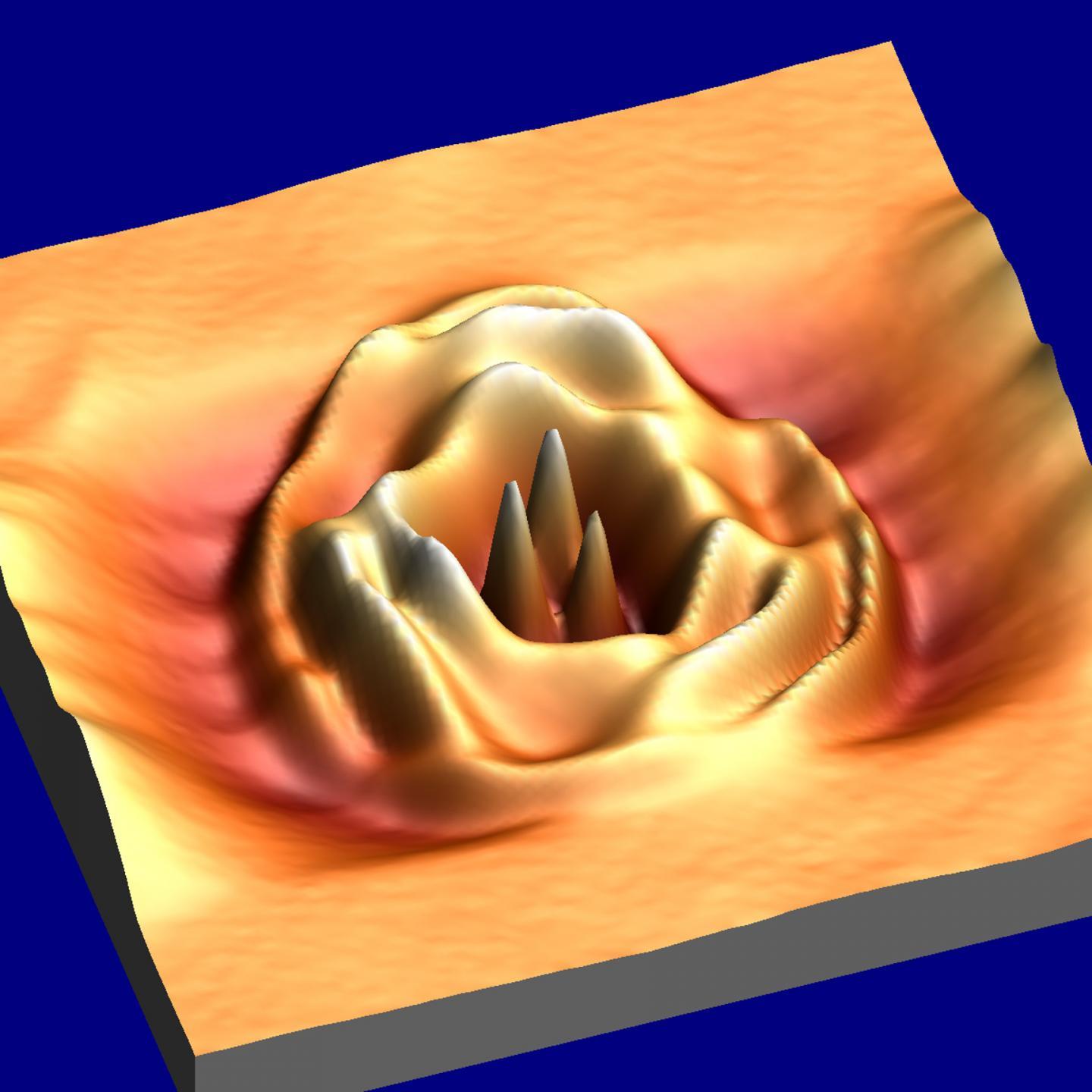
The results, published November 23 in Nano Letters, provide the important fundamental knowledge needed to develop quantum information technologies based on bilayer graphene quantum dots. CAPTION Visualization of quantum dots in bilayer graphene using scanning tunneling microscopy and spectroscopy reveals a three-fold symmetry. In this three-dimensional image, the peaks represent sites of high amplitude in the waveform of the trapped electrons.  CREDIT Zhehao Ge, Frederic Joucken, and Jairo Velasco Jr.{module INSIDE STORY}

"There has been a lot of work to develop this system for quantum information science, but we've been missing an understanding of what the electrons look like in these quantum dots," said corresponding author Jairo Velasco Jr., assistant professor of physics at UC Santa Cruz.

While conventional digital technologies encode information in bits represented as either 0 or 1, a quantum bit, or qubit, can represent both states at the same time due to quantum superposition. In theory, technologies based on qubits will enable a massive increase in supercomputing speed and capacity for certain types of calculations.

A variety of systems, based on materials ranging from diamond to gallium arsenide, are being explored as platforms for creating and manipulating qubits. Bilayer graphene (two layers of graphene, which is a two-dimensional arrangement of carbon atoms in a honeycomb lattice) is an attractive material because it is easy to produce and work with, and quantum dots in bilayer graphene have desirable properties.

"These quantum dots are an emergent and promising platform for quantum information technology because of their suppressed spin decoherence, controllable quantum degrees of freedom, and tunability with external control voltages," Velasco said.

Understanding the nature of the quantum dot wave function in bilayer graphene is important because this basic property determines several relevant features for quantum information processing, such as the electron energy spectrum, the interactions between electrons, and the coupling of electrons to their environment.

Velasco's team used a method he had developed previously to create quantum dots in monolayer graphene using a scanning tunneling microscope (STM). With the graphene resting on an insulating hexagonal boron nitride crystal, a large voltage applied with the STM tip creates charges in the boron nitride that serve to electrostatically confine electrons in the bilayer graphene.

"The electric field creates a corral, like an invisible electric fence, that traps the electrons in the quantum dot," Velasco explained.

The researchers then used the scanning tunneling microscope to image the electronic states inside and outside of the corral. In contrast to theoretical predictions, the resulting images showed a broken rotational symmetry, with three peaks instead of the expected concentric rings.

"We see circularly symmetric rings in monolayer graphene, but in bilayer graphene the quantum dot states have a three-fold symmetry," Velasco said. "The peaks represent sites of high amplitude in the wave function. Electrons have a dual wave-particle nature, and we are visualizing the wave properties of the electron in the quantum dot."

This work provides crucial information, such as the energy spectrum of the electrons, needed to develop quantum devices based on this system. "It is advancing the fundamental understanding of the system and its potential for quantum information technologies," Velasco said. "It's a missing piece of the puzzle, and taken together with the work of others, I think we're moving toward making this a useful system."

Is what I see, what I imagine? Study finds neural overlap between vision, imagination

Researchers at the Medical University of South Carolina find a link between mental imagery and vision using artificial intelligence and human brain studies

The Medical University of South Carolina researchers report in Current Biology that the brain uses similar visual areas for mental imagery and vision, but it uses low-level visual areas less precisely with mental imagery than with vision.

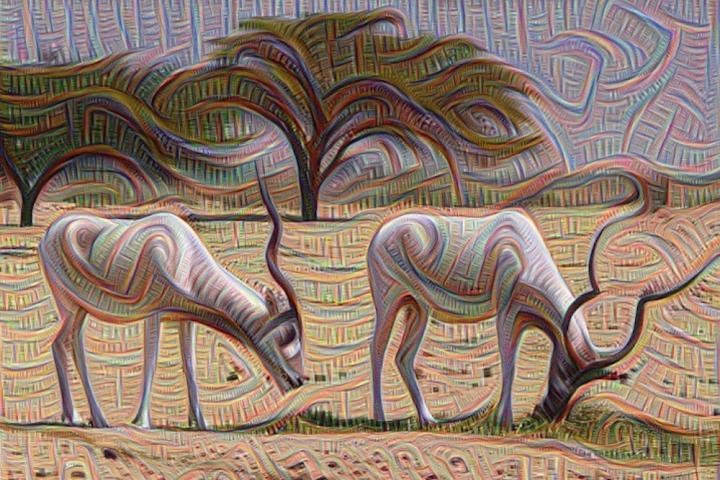
These findings add knowledge to the field by refining methods to study mental imagery and vision. In the long-term, it could have applications for mental health disorders affecting mental imagery, such as post-traumatic stress disorder. One symptom of PTSD is intrusive visual reminders of a traumatic event. If the neural function behind these intrusive thoughts can be better understood, better treatments for PTSD could perhaps be developed. CAPTION An ibis as {module INSIDE STORY}

The study was conducted by an MUSC research team led by Thomas P. Naselaris, Ph.D., associate professor in the Department of Neuroscience. The findings by the Naselaris team help answer an age-old question about the relationship between mental imagery and vision.

"We know mental imagery is in some ways very similar to vision, but it can't be exactly identical," explained Naselaris. "We wanted to know specifically in which ways it was different."

To explore this question, the researchers used a form of artificial intelligence known as machine learning and insights from machine vision, which uses computers to view and process images.

"There's this brain-like artificial system, a neural network, that synthesizes images," Naselaris explained. "It's like a biological network that synthesizes images."

The Naselaris team trained this network to see images and then took the next step of having the computer imagine images. Each part of the network is like a group of neurons in the brain. Each level of the network or neuron has a different function in vision and then mental imagery.

To test the idea that these networks are similar to the function of the brain, the researchers performed an MRI study to see which brain areas are activated with mental imagery or vision.

While inside the MRI, participants viewed images on a screen and were also asked to imagine images at different points on the screen. MRI imaging enabled researchers to define which parts of the brain were active or quiet while participants viewed a combination of animate and inanimate objects.

Once these brain areas were mapped, the researchers compared the results from the computer model to human brain function.

They discovered that both the computer and human brains functioned similarly. Areas of the brain from the retina of the eye to the primary visual cortex and beyond are both activated with vision and mental imagery. However, in mental imagery, the activation of the brain from the eye to the visual cortex is less precise, and in a sense, diffuse. This is similar to the neural network. With computer vision, low-level areas that represent the retina and visual cortex have precise activation. With mental imagery, this precise activation becomes diffuse. In brain areas beyond the visual cortex, the activation of the brain or the neural network is similar for both vision and mental imagery. The difference lies in what's happening in the brain from the retina to the visual cortex.

"When you're imagining, brain activity is less precise," said Naselaris. "It's less tuned to the details, which means that the kind of fuzziness and blurriness that you experience in your mental imagery has some basis in brain activity."

Naselaris hopes these findings and developments in computational neuroscience will lead to a better understanding of mental health issues.

The fuzzy dream-like state of imagery helps us to distinguish between our waking and dreaming moments. In people with PTSD, invasive images of traumatic events can become debilitating and feel like reality at the moment. By understanding how mental imagery works, scientists may better understand mental illnesses characterized by disruptions in mental imagery.

"When people have really invasive images of traumatic events, such as with PTSD, one way to think of it is mental imagery dysregulation," explained Naselaris. "There's some system in your brain that keeps you from generating really vivid images of traumatic things."

A better understanding of how this works in PTSD could provide insight into other mental health problems characterized by mental imagery disruptions, such as schizophrenia.

"That's very long term," Naselaris clarified.

For now, Naselaris is focusing on how mental imagery works, and more research needs to be done to address the connection to mental health.

A limitation of the study is the ability to recreate fully the mental images conjured by participants during the experiment. The development of methods for translating brain activity into viewable pictures of mental images is ongoing.

This study not only explored the neurological basis of seen and imagined imagery but also set the stage for research into improving artificial intelligence.

"The extent to which the brain differs from what the machine is doing gives you some important clues about how brains and machines differ," said Naselaris. "Ideally, they can point in a direction that could help make machine learning more brainlike."

Luxembourg's research advances development of next-generation satellite-terrestrial networks

A six-year research partnership between the University and SES will be funded by the Luxembourg National Research Fund's Industrial Partnership Block Grant program.

The Luxembourg National Research Fund (FNR) is supporting an extensive new research project to advance data networks, led by the University of Luxembourg's Interdisciplinary Centre for Security, Reliability, and Trust (SnT) in collaboration with SES.

Titled INSTRUCT (INtegrated Satellite-TeRrestrial Systems for Ubiquitous Beyond 5G CommunicaTions), the research initiative is funded by the FNR's Industrial Partnership Block Grant (IPBG) program, the FNR's most extensive funding mechanism for collaborative industrial research in Luxembourg. The IPBG scheme is aimed at supporting innovation through collaborations between industry and academics, and building an ecosystem of skilled expertise. une recherche de pointe pour de nouveaux reseaux satellites terrestres medium 707bd{module INSIDE STORY}

For the INSTRUCT project, SnT will support SES, the leader in global content connectivity solutions, to conduct research in next-generation integrated satellite-terrestrial networks, leveraging what has already been achieved in the 5G area and advancing it further. The project builds on a successful 10-year relationship between SnT and SES that has resulted in a number of advanced technology solutions in areas such as digital signal modulation, dynamic beamforming, high throughput modem technologies, complex software systems modeling, and natural language processing. The IPBG award will fund 17 SnT research projects, that will each have a team of a Ph.D. or PostDoc student, an academic supervisor from SnT, as well as an industrial supervisor from SES.

The integration of satellite and terrestrial systems is crucial as truly global next-generation networks require an ecosystem of multiple communication infrastructures to be inclusive, ubiquitous, and affordable. Satellite proved to be an ideal enabler of the next-generation networks thanks to its wide coverage, ability to deliver to moving platforms, and simultaneity. It will allow a broad range of next-generation connectivity scenarios, even in remote areas, for crucial applications in mobile backhauling, aero and maritime connectivity, emergency response, telemedicine, and much more. As an industry leader, SES has a solid track record in delivering to the existing data markets and spearheads major technology innovation and standardization initiatives, including for 5G.

"We launched the IPBG program as a pilot project in 2016, and it is quickly becoming an essential mechanism to funnel research funding towards complex industrial challenges," said Andreea Monnat, Deputy Secretary-General, FNR. "It is a priority of Luxembourg to establish an economy that is focused on innovation, and the longstanding partnership between SES and SnT is an excellent example of the positive results of such collaborations."

"Our business relies on the technology we use, and we are embracing innovations that support current markets and unlock new opportunities for the customers we serve. With its outstanding R&D capabilities, SnT is a reliable partner in advancing innovation with a truly global impact, and we are happy to continue working with them," said Ruy Pinto, CTO, SES. "With the backing of the FNR and SnT, we are sure we will be able to further advance on integrated satellite-terrestrial networks."

"The integration of satellite and terrestrial networks is a complex research challenge as we enter the beyond 5G era," said Prof Symeon Chatzinotas, Project Principal Investigator, SnT. "This FNR grant gives us the support to build a Center of Excellence in Luxembourg and spearhead research and technology transfer in this area."

"The partnership with SES over the years has been a driving force for some of the most exciting research outcomes of SnT," said Prof Björn Ottersten, Director, SnT. "We are proud to have our work validated by receiving this IPBG from the FNR and are confident the research will create substantial opportunities for the space sector in Luxembourg."