Magnetic memory states go exponential

A newly-discovered ability to stabilize and control exponential number of discrete magnetic states in a relatively simple structure may pave the way to multi-level magnetic memory with extremely large number of states per cell

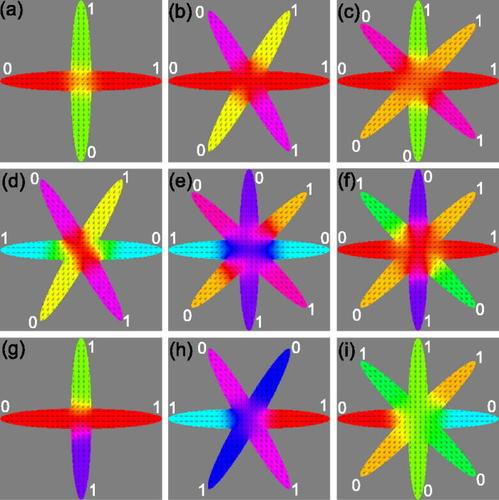
Spintronics is a thriving branch of nano-electronics which utilizes the spin of the electron and its associated magnetic moment in addition to the electron charge used in traditional electronics. The main current practical contributions of spintronics are in magnetic sensing and non-volatile magnetic data storage, and additional breakthroughs in developing magnetic based processing and novel types of magnetic memory are expected. (a)–(c) Micromagnetic simulated OSs of 2CEs, 3CEs, and 4CEs, respectively, which can be stabilized by an external magnetic field. (d)–(f) Simulated SSs generated by selectively manipulating the entire individual ellipses of 3CEs and 4CEs, respectively, which cannot be stabilized by the external magnetic field. (g)–(i) Simulated NSs generated by stabilizing the magnetization of both edges of individual ellipses in opposite directions for 2CEs, 3CEs, and 4CEs, respectively. The arrows indicate the direction of magnetization. Ones and zeroes at the edges of the ellipses indicate outward and inward magnetization, respectively.{module INSIDE STORY}

Spintronics devices commonly consist of magnetic elements manipulated by spin-polarized currents between stable magnetic states. When spintronic devices are used for storing data, the number of stable states sets an upper limit on memory capacity. While current commercial magnetic memory cells have two stable magnetic states corresponding to two memory states, there are clear advantages to increasing this number, as it will potentially allow increasing the memory density and enable the design of novel types of memory.

Now, a group of researchers led by Prof. Lior Klein, from the physics department and the Institute of Nanotechnology and Advanced Materials at Bar-Ilan University, has shown that relatively simple structures can support exponential number of magnetic states - much greater than previously thought. The studied structures are magnetic thin films patterned in the form of N crossing ellipses which have two to the power of 2N magnetization states. Furthermore, the researchers demonstrated switching between the states by generating spin currents. Their research appears as a featured article on the cover of a June issue of Applied Physics Letters.

The ability to stabilize and control exponential number of discrete magnetic states in a relatively simple structure constitutes a major contribution to spintronics. "This finding may pave the way to multi-level magnetic memory with extremely large number of states per cell (e.g., 256 states when N=4), be used for neuromorphic computing, and more," says Prof. Klein, whose research group includes Dr. Shubhankar Das, Ariel Zaig, and Dr. Moty Schultz.

Japan's Plasma Simulator produces an accurate simulation of high-pressure plasma for an economical helical fusion reactor

The research team of Assistant Professor Masahiko Sato and Professor Yasushi Todo of the National Institutes of Natural Sciences (NINS) National Institute for Fusion Science (NIFS) has succeeded using supercomputer simulation in reproducing the high-pressure plasma confinement observed in the Large Helical Device (LHD). This result has enabled highly accurate predictions of plasma behavior aimed at realizing an economical helical fusion reactor.

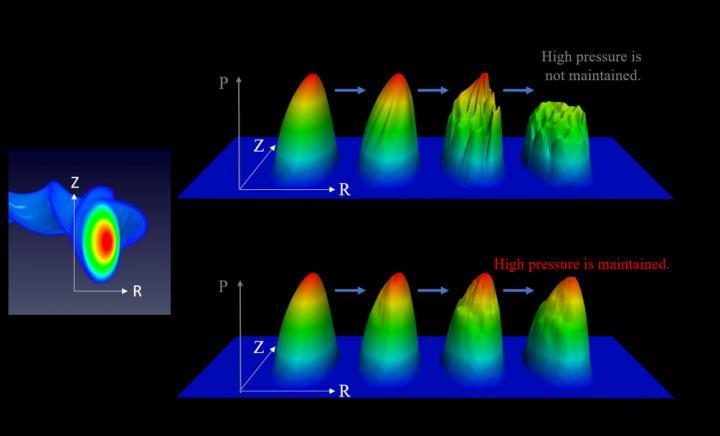
In order to realize fusion energy, we must confine high-pressure plasma using the magnetic field for a long duration. Although higher pressure plasma can be confined by a stronger magnetic field, it costs more to generate a stronger magnetic field using electromagnetic coils. Therefore, if the magnetic field strength is the same, a device that can confine higher pressure plasma is economically desirable. Because the LHD has succeeded in maintaining high-pressure plasma, there is great expectation in realizing a helical fusion reactor. The difference between the high pressure in the center region (the red region) and the low pressure in the peripheral region (the blue region) induces the fluctuation in the plasma. In the fluid simulation result (the above figure), the high pressure cannot be maintained because the fluctuation becomes extremely large and causes the mixing of the high-pressure plasma and the low-pressure plasma. On the other hand, in the hybrid simulation result (the bottom figure), the high pressure is maintained for a long period because the fluctuation remains low levels.{module INSIDE STORY}

Design research for a future fusion reactor is performed based on computer simulations predicting the behavior of magnetically confined plasma. We require highly accurate simulations. To confirm the accuracy, the simulations are required to reproduce the experimental results obtained by the existing devices. However, the simulations had not reproduced the experimental results obtained by the LHD showing that high-pressure plasma is maintained. This has been a serious problem for the design research for an economical helical fusion reactor.

Simulations of high-pressure plasma in the LHD had been performed using a model in which the plasma is treated as a fluid. In this fluid model, the motion averaged over many ions consisting of the plasma is calculated, and the difference among many ions with various velocities are neglected. At NIFS, a program that calculates individual motions of many ions was developed to improve the simulation accuracy. This program, which is called "the hybrid simulation program," has been used to study energetic ions that will play an important role in sustaining high-temperature plasma in a future fusion reactor.

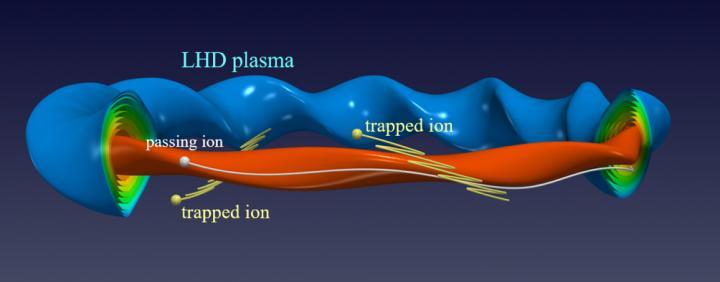
Assistant Professor Masahiko Sato and Professor Yasushi Todo attempted to reproduce high-pressure plasma confinement in the LHD by using the hybrid simulation program. They focused on the ions moving back-and-forth, which are called "trapped ions" and whose motion is a characteristic of the LHD. To investigate the effect of the trapped ions, the researchers studied the long-time evolution of plasma pressure and tens of millions of ions including millions of trapped ions. Although such a simulation requires enormous amounts of calculations, the researchers, by making full use of "Plasma Simulator" (the supercomputer owned by NIFS), have succeeded in reproducing the LHD experimental result showing that high-pressure plasma is maintained. From the detailed analysis of the simulation data, it has been found that the trapped ions greatly contribute to the stable confinement of high-pressure plasma by suppressing the fluctuations that can cause the reduction of plasma pressure.  The passing ion (white sphere) moves in one direction. On the other hand, the trapped ion (yellow sphere) moves back-and-forth and the center of the back-and-forth motion also moves simultaneously in helical direction, which is a characteristic of the LHD. The plasma pressure is constant in each colored surface, and the plasma pressure is high in the central region.{module INSIDE STORY}

Thus, the research team has significantly improved the prediction accuracy of high-pressure plasma in a future helical fusion reactor. It is expected that the design research aimed at an economical helical reactor will be accelerated based on this study.

This research result was published as Sato and Todo "Ion kinetic effects on linear pressure-driven MHD instabilities in helical plasmas" in Journal of Plasma Physics in June 2020.

Space weather monitoring to get a major upgrade in a new research program

The UK's ability to predict solar superstorms and other severe space weather events are to get a significant upgrade with the launch of two major research projects led by the University of Birmingham.

The research is part of a £20M program called SWIMMR (Space Weather Instrumentation, Measurement, Modelling, and Risk), funded by UK Research and Innovation and designed to deliver improved monitoring capability to the UK's Met Office. As part of this programme, the University of Birmingham will lead a £3.7M effort in better understanding the Earth's upper atmosphere (ionosphere and thermosphere).

Turbulent space weather, largely caused by radiation, energetic particles and plasma emitted by the Sun, can cause huge disruption on Earth. Whilst the Earth's magnetosphere, a powerful magnetic field that surrounds the Earth in the upper atmosphere, protects us from day-to-day space weather, extreme events can overcome this planetary defense with potentially severe consequences. Risks include widespread and long-lasting power cuts, disrupted satellite, GPS and radio communication technologies, and air passenger and astronaut safety. {module INSIDE STORY}

Extreme space weather has been included in the Government's National Risk Register - an overview of the key emergencies which could cause significant disruption in the UK - since its 2012 update. The likelihood is currently judged to be comparable to that of an emerging infectious disease.

The Birmingham-led consortium draws together the UK's principal experts in upper atmosphere modeling from Lancaster University, the Universities of Bath, Leicester, Leeds, and Southampton, and the British Antarctic Survey.

Data modeling technology developed at the University of Birmingham will underpin the work. This technology is capable of predicting space weather with unprecedented speed and accuracy, monitoring the density, winds, and temperatures of chemical species in the Earth's atmosphere and triggering warnings when there are likely to impact on services and infrastructure.

The first project will explore ways to deliver effective monitoring of the ionosphere, the charged part of the Earth's upper atmosphere. This region can disrupt communication with aircraft and render GPS positioning systems inoperable. The second project will investigate the thermosphere, the neutral part of the Earth's upper atmosphere, which affects the orbits of satellites which, without suitable modeling, can result in satellite collisions. By the end of the grant, the developed supercomputer models will be deployed operationally at the UK Met Office.

Dr. Sean Elvidge, in the School of Engineering at the University of Birmingham, says: "The expertise we've developed here at Birmingham puts us in a great position to make a really significant contribution to the UK's space weather forecasting capabilities. Only by providing sufficient advance warning, and having robust plans in place for reacting to an extreme event, can we be confident of minimizing disruption - and possibly averting disaster."

The most extreme space weather event on record occurred in 1859 when a huge solar flare and associated major coronal mass ejection reached the Earth. This affected telegraph systems around the world, giving operators electric shocks and, in some cases allowing telegraph operators to continue sending and receiving messages despite the power supplies having been cut. The northern lights, the attractive consequence of space weather, were seen as far south as the Caribbean.

"This level of extreme event tends to occur every 100 years or so," says Dr. Elvidge. "While it's not possible to be overdue an event of this nature, it is likely that one will occur sometime before the end of this century."

Simon Machin, Space Weather Programme Manager at the Met Office, said: "The SWIMMR Programme will be fundamental in bridging the gap between UK academic excellence in a variety of space weather fields and pulling this through to inform operational services, which are vital to informing mitigation strategies for government and industry.

"We look forward to working alongside Birmingham and others to realize this potential and deliver a step-change in national capability that further enhances the UK's reputation as a world leader in space weather science and services."

"The world-leading work to be performed by Birmingham led consortium will specifically lead to a great enhancement of the Met Office capability to provide tailored services for users of satellite-enabled position, Navigation and Timing (PNT), satellite and long-distance communications, radar users and satellite operators."