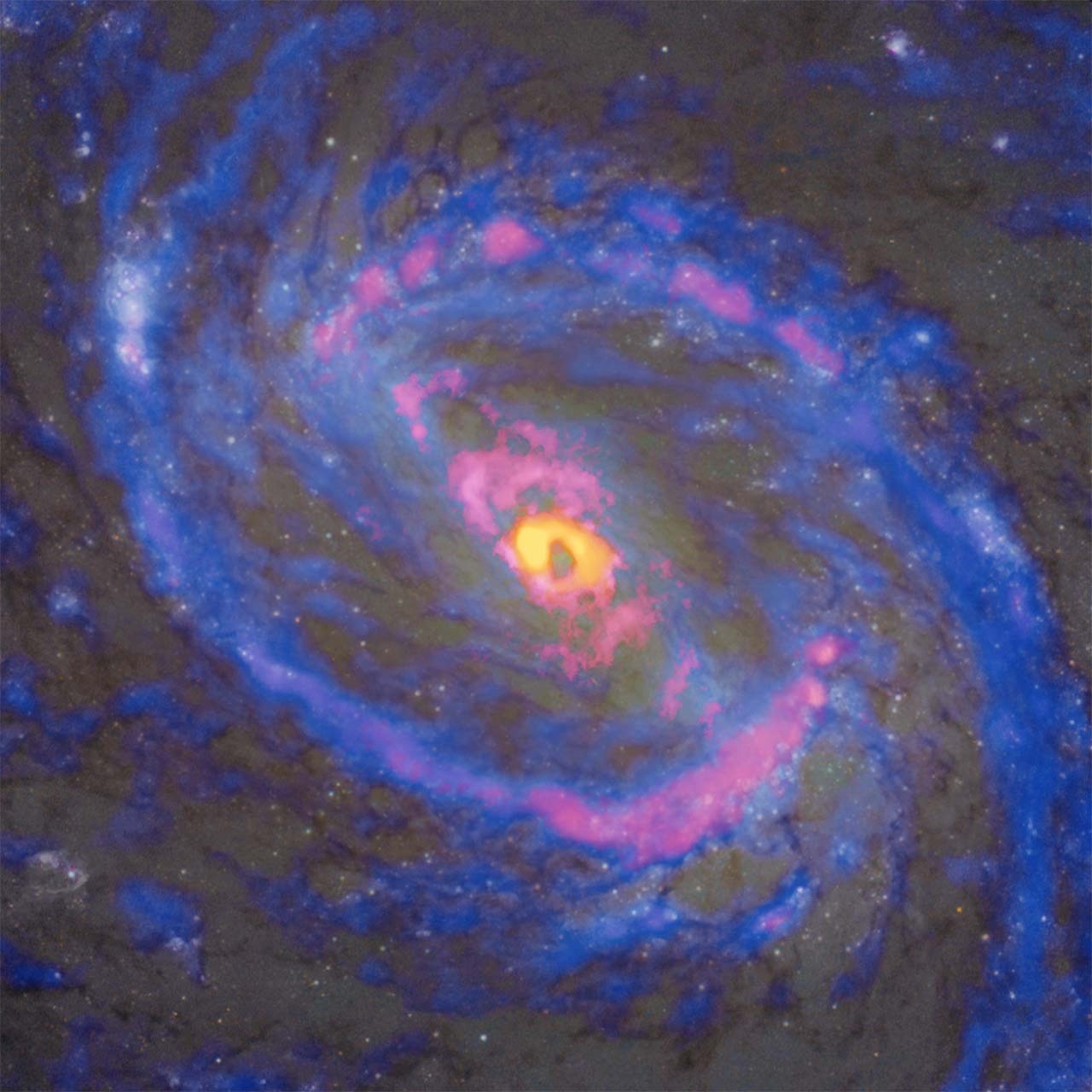
GRB 211211A’s location, circled in red, captured using three filters on Hubble’s Wide Field Camera 3.

Northwestern University's astrophysicists have recently made an unprecedented discovery about a gamma-ray burst that can be explained by a long-lived jet

Researchers have successfully conducted the first large-scale supercomputer simulation of a black hole-neutron star merger. The results of the simulation match with puzzling observations and shed light on the behavior of these celestial bodies.

  • While astrophysicists previously believed that only supernovae could generate long gamma-ray bursts (GRBs), a 2021 observation uncovered evidence that compact-object mergers also can generate the phenomenon
  • Now, a new first-of-its-kind supercomputer simulation confirms and explains this finding
  • If the accretion disk around the black hole is massive, it launches a jet that lasts several seconds, matching the description of a long GRB from a merger

According to a report by Northwestern University researchers, it was previously thought that long gamma-ray bursts (GRBs) could not be the result of a neutron star merging with another compact object such as a black hole or another neutron star. However, new observational evidence suggests otherwise. The researchers found that such mergers can indeed lead to long gamma-ray bursts. 

Now, another Northwestern team offers a potential explanation for what generated the unprecedented and incredibly luminous burst of light. 

After developing the first supercomputer simulation that follows the jet evolution in a black hole-neutron star merger out to large distances, the astrophysicists discovered that the post-merger black hole can launch jets of material from the swallowed neutron star. 

But the key ingredients are the mass of the violent whirlpool of gas (or accretion disk) surrounding the black hole and the strength of the disk’s magnetic field. In massive disks, when the magnetic field is strong, the black hole launches a short-duration jet that is much brighter than anything ever seen in observations. When the massive disk has a weaker magnetic field, however, the black hole launches a jet with the same luminosity and long duration as the mysterious GRB (dubbed GRB211211A) spotted in 2021 and reported in 2022.

Not only does the discovery help explain the origins of long GRBs, but it also gives insight into the nature and physics of black holes, their magnetic fields, and accretion disks.

“So far, no one else has developed any numerical works or simulations that consistently follow a jet from the compact-object merger to the formation of the jet and its large-scale evolution,” said Northwestern’s Ore Gottlieb, who co-led the work. “The motivation for our work was to do this for the first time. And what we found just so happened to match observations of GRB211211A.” 

“Neutron-star mergers are captivating multi-messenger phenomena, which result in both gravitational and electromagnetic waves,” said Northwestern’s Danat Issa, who co-led the work with Gottlieb. “However, simulating these events poses a challenge due to the vast spatial and temporal scale separations involved as well as the diverse physics operating across these scales. For the first time, we have succeeded in comprehensively modeling the entire sequence of the neutron star merger process.” 

During the research, Gottlieb was a CIERA Fellow at Northwestern’s Center for Interdisciplinary Exploration and Research in Astrophysics (CIERA); now he is a Flatiron Research Fellow at the Flatiron Institute’s Center for Computational Astrophysics. Issa is a graduate student in the Department of Physics and Astronomy at Northwestern’s Weinberg College of Arts and Sciences and a member of CIERA. Issa is advised by paper co-author Alexander Tchekhovskoy, an associate professor of physics and astronomy at Weinberg and a member of CIERA.

Curious kilonova

When astronomers first spotted GRB211211A in December 2021, they initially assumed that the 50-second-long event was generated by the collapse of a massive star. But, as they examined the long GRB’s late-time emission, called the afterglow, they uncovered evidence of a kilonova, a rare event that only occurs after the merger of a neutron star with another compact object.

The finding (published in Nature in December 2022) upended the long-established, long-accepted belief that only supernovae could generate long GRBs.

“GRB 211211A reignited interest in the origin of long-duration GRBs that are not associated with massive stars, but likely originating from compact binary mergers,” Gottlieb said.

From pre-merger to long GRB

To further reveal what occurs during compact-merger events, Gottlieb, Issa, and their collaborators sought to simulate the whole process — from before the merger through to the end of the GRB event when the GRB-producing jets shut off. Because it is such an incredibly computationally expensive feat, the entire scenario had never been modeled before. Gottlieb and Issa overcame that challenge by dividing the scenario into two simulations.

First, the researchers simulated the pre-merger phase. Then, they took the output from the first simulation and plugged it into the post-merger simulation.

“Because the space-time used by the two simulations is different, this remap was not as straightforward as we had hoped, but Danat figured it out,” Tchekhovskoy said. 

“The daisy chaining of the two simulations allowed us to make the computation much less expensive,” Gottlieb said. “The physics is very complicated in the pre-merger stage because there are two objects. It gets much simpler after the pre-merger because there is only one black hole.”

In the simulation, the compact objects first merged to create a more massive black hole. The black hole’s intense gravity pulled the now-destroyed neutron star’s debris toward it. Before the debris fell into the black hole, some of the debris first swirled around the black hole as an accretion disk. In the configuration studied, the emerging disk was particularly massive with one-tenth the mass of our sun. Then, when the mass fell into the black hole from the disk, it powered the black hole to launch a jet that accelerated to near-light speed.

Disk properties matter

A surprise emerged as the researchers adjusted the strength of the massive disk’s magnetic field. Whereas a strong magnetic field resulted in a short, incredibly bright GRB, a weak magnetic field generated a jet that matched observations of long GRBs.

“The stronger the magnetic field, the shorter is its lifetime,” Gottlieb said. “Weak magnetic fields produce weaker jets that the newly formed black hole can sustain for a longer time. A key ingredient here is the massive disk that can maintain, together with weak magnetic fields, a GRB consistent with observations and comparable to the luminosity and long duration of GRB211211A. Although we found this specific binary system to give rise to a long GRB, we also expect that other binary mergers that produce massive disks will lead to a similar outcome. It’s simply a question of the post-merger disk mass.”

Of course, “long” is relative in this scenario. GRBs are divided into two classes. GRBs with durations of less than two seconds are considered short. If a GRB is two seconds or longer, then it’s considered long. Even events this brief are still exceptionally difficult to model. 

“A major portion of this disk material ultimately gets consumed by the black hole, with the whole process lasting mere seconds,” Issa said. “Here lies the main challenge: It is very difficult to capture the evolution of these mergers, using simulations on supercomputers, over several seconds.” 

Next up: Neutrinos

Now that Gottlieb and Issa have successfully and comprehensively modeled the full sequence of the merger, they are excited to continue to update and improve their models. 

“My current efforts are directed towards enhancing the physical accuracy of the simulations,” Issa said. “This involves the incorporation of neutrino cooling, a vital component that holds the potential to significantly influence the dynamics of the merger process. Furthermore, the inclusion of neutrinos serves as a critical step towards achieving a more accurate assessment of the nuclear composition of the material ejected as a consequence of these mergers. Through this approach, my goal is to provide a more comprehensive and accurate picture of neutron star mergers.”

The unprecedented gamma-ray burst observed in GRB 190114C has been explained by a long-lived jet. While this explanation is supported by the data, further research is needed to confirm the hypothesis and to understand the underlying physical mechanisms.

The study, “Large-scale evolution of seconds-long relativistic jets from black hole-neutron star mergers,” was supported by NASA, the National Science Foundation, and the U.S. Department of Energy.

Impact simulation Jingyao Dou

University of Rome Tor Vergata's Prof. Naponiello discovers new evidence of planetary collisions

Astronomers have discovered a Neptune-sized planet with unprecedented density that is believed to have resulted from a massive planetary collision. The supercomputer simulations were performed using the facilities of the Advanced Computing Research Centre, University of Bristol in the UK. 

TOI-1853b's mass is almost twice that of any similar-sized planet known and its density is incredibly high, meaning that it is made up of a more significant fraction of rock than would typically be expected at that scale.

In the study, scientists led by Luca Naponiello of the University of Rome Tor Vergata suggest that this results from planetary collisions. These huge impacts would have removed some of the lighter atmosphere and water leaving a multitude of rocks behind.

Senior Research Associate and co-author Dr. Phil Carter from the University of Bristol’s School of Physics, explained: “We have strong evidence for highly energetic collisions between planetary bodies in our solar system, such as the existence of Earth's Moon, and good evidence from a small number of exoplanets.

“We know that there is a huge diversity of planets in exoplanetary systems; many have no analog in our solar system but often have masses and compositions between that of the rocky planets and Neptune/Uranus (the ice giants).

“Our contribution to the study was to model extreme giant impacts that could potentially remove the lighter atmosphere and water/ice from the original larger planet in order to produce the extreme density measured.

“We found that the initial planetary body would likely have needed to be water-rich and suffer an extreme giant impact at a speed of greater than 75 km/s in order to produce TOI-1853b as it is observed.”

This planet provides new evidence for the prevalence of giant impacts in the formation of planets throughout the galaxy. This discovery helps to connect theories for planet formation based on the solar system to the formation of exoplanets. The discovery of this extreme planet provides new insights into the formation and evolution of planetary systems.

Postgraduate student and co-author Jingyao Dou said: “This planet is very surprising! Normally we expect planets forming with this much rock to become gas giants like Jupiter which have densities similar to water.

“TOI-1853b is the size of Neptune but has a density higher than steel. Our work shows that this can happen if the planet experiences extremely energetic planet-planet collisions during its formation.

“These collisions stripped away some of the lighter atmosphere and water leaving a substantially rock-enriched, high-density planet."

Now the team plans detailed follow-up observations of TOI-1853b to attempt to detect any residual atmosphere and examine its composition.

Associate Professor and co-author Dr Zoë Leinhardt concluded: “We had not previously investigated such extreme giant impacts as they are not something we had expected. There is much work to be done to improve the material models that underlie our simulations, and to extend the range of extreme giant impacts modeled.”

Scientists have recently discovered a new giant planet, which suggests that there may have been planetary collisions in the past. This discovery is a significant milestone in our comprehension of planetary systems' formation and evolution, and it also opens up new possibilities for exploration and research. By conducting further research, we may gain a better understanding of how planets emerge and interact with one another. This could lead to the development of new technologies and strategies to explore and comprehend our Solar System and other planetary systems.

Funders include the Science and Technology Facilities Council  (STFC) and the China Scholarship Council.

Recreation of Baryon Acoustic Oscillations. (Zosia Rostomian, Lawrence Berkeley National Laboratory).

Spanish physicist Cuesta develops revolutionary method for measuring cosmological distances

The University of Cordoba, together with several universities in Shanghai, has just published a new procedure to detect "Baryon Acoustic Oscillations," one of the few traces of the Big Bang that can still be discerned in the universe and that allow distances to distant galaxies to be determined more accurately

After a complex statistical analysis of some one million galaxies, a team of researchers at several Chinese universities, and the University of Cordoba in Spain was able to publish the results of the study. They had been working on the project for over two years, which will make possible the determination of cosmological distances with a new and greater degree of precision.

The study developed a new method to detect what are called Baryon Acoustic Oscillations (BAO). These waves, whose existence was first demonstrated in 2005, are one of the few traces of the Big Bang that can still be detected in the cosmos. They spread during the first 380,000 years of the universe's life, expanding like sound waves through matter so hot that it behaved like a fluid, something similar to what happens when a stone is thrown into a pond. Subsequently, the universe expanded and cooled to the point that those waves were frozen in time.

The interesting thing about these oscillations, witnesses to almost the entire history of the cosmos, is that their exact duration is known (500 million light-years), so they are currently very useful for measuring cosmological distances based on the separation between galaxies. Being able to detect them and determine their size is, therefore, of the utmost importance to correctly map the universe out to very distant points.

"The results of this study now allow us to detect these waves through a new and independent method. By combining the two, we can determine cosmic distances with greater precision," explained Antonio J. Cuesta, a researcher at the University of Cordoba's Department of Physics and the sole Spanish author of the study.

The new method: looking for anomalies in the orientation of galaxies

This new study analyzed, using statistical methods, a database of approximately one million galaxies, paying special attention to two very different factors: the ellipticity of the galaxies and the density around them.

In terms of their orientations, galaxies normally stretch to where there are a greater number of other galaxies, due to the pull of gravity, but there are certain places in the universe where this effect is not as intense. "It is in those points, where galaxies do not point where they should, where statistics tell us that the Baryon Acoustic Oscillations are located since these waves also act as points of gravity attraction," explained Antonio J. Cuesta.

Looking out far, looking into the past

"The first practical application that this study could have is to establish more precisely where the galaxies are located, and the separation between them and the Earth, but, in a way, we are also gazing into the past," the researcher explained.

This new approach to Baryon Acoustic Oscillations, the key to answering some of the great questions about the universe, opens new doors in the world of Astronomy. Establishing cosmological distances offers, in turn, new clues about the history of the universe's expansion and helps us to understand its composition in terms of dark matter and energy, two of the most elusive and enigmatic components of the cosmos.

The development of a new method by Spanish physicist Cuesta to measure cosmological distances more accurately is a remarkable achievement that will have far-reaching implications for our understanding of the universe. This new method will open up new possibilities for exploration and discovery, and will undoubtedly lead to further advances in the field of cosmology. Cuesta's work is a testament to the power of human ingenuity and the potential of science to unlock the mysteries of the cosmos.

HPE reports 3Q23 sales increase, but it's not enough

Hewlett Packard Enterprise has announced financial results for the third quarter ended July 31, 2023. The latest financial report from HPE shows that revenue from high-performance computing and AI was only up 1% from the prior year, despite the company's efforts to increase its market share in the sector. This indicates that the company is struggling to make significant progress in the area of supercomputing and may be facing an uphill battle in the future.

Edge momentum and portfolio mix shift drive its revenue growth and gross margin expansion; reiterating GAAP diluted net EPS and raising non-GAAP diluted net EPS guidance for the full year.

Third Quarter Fiscal 2023 Financial Results                                

  • Revenue: $7.0 billion, up 1% from the prior-year period and 3.5% in constant currency   
  • Annualized revenue run-rate (“ARR”): $1.3 billion, up 48% from the prior-year period and in constant currency
  • Gross margins:
    • GAAP of 35.8%, up 130 basis points from the prior-year period and down 20 basis points sequentially 
    • Non-GAAP of 35.9%, up 120 basis points from the prior-year period and down 30 basis points sequentially
  • Diluted net earnings per share (“EPS”):
    • GAAP of $0.35, up 13% from the prior-year period and up 9% sequentially, near the mid-point of our guidance range of $0.34 to $0.38
    • Non-GAAP of $0.49, up 2% from the prior-year period and down 6% sequentially, above our guidance range of $0.44 to $0.48
  • Cash flow from operations: $1.5 billion, an increase of $271 million from the prior-year period
  • Free cash flow: $955 million, up $368 million from the prior-year period
  • Capital returns to shareholders: $341 million in the form of dividends and share repurchases

Outlook

  • Revenue: Estimates Q4 fiscal 2023 revenue to be in the range of $7.2 billion to $7.5 billion, and fiscal 2023 revenue growth to be in the range of 4% to 6% in constant currency
  • ARR: Reiterates our 2022 HPE Securities Analyst Meeting ARR guidance of 35% to 45% Compounded Annual Growth Rate from fiscal 2022 to fiscal 2025
  • Diluted net EPS:
    • Estimates Q4 fiscal 2023 GAAP diluted net EPS to be in the range of $0.36 to $0.40 and non-GAAP diluted net EPS to be in the range of $0.48 to $0.52
    • Reiterates fiscal 2023 GAAP diluted net EPS to be in the range of $1.42 to $1.46 and raises non-GAAP diluted net EPS guidance to be in the range of $2.11 to $2.15
  • GAAP operating profit: Estimates fiscal 2023 GAAP operating profit growth to be in the range of 180% to 184%
  • Non-GAAP operating profit: Estimates fiscal 2023 non-GAAP operating profit growth to be in the range of 6% to 7%
  • Free cash flow: Reiterates guidance of $1.9 billion to $2.1 billion

“HPE delivered another solid quarter in Q3, powered by standout performances in the Intelligent Edge and HPE GreenLake,” said Antonio Neri, president and CEO of Hewlett Packard Enterprise. “Demand improved sequentially across all key business segments, with particular strength in our HPC & AI segment as customers discover HPE’s unique capabilities to power unprecedented levels of performance for AI at scale. Our strategic shift toward edge, hybrid cloud, and AI delivered through our HPE GreenLake platform is working."

“The pivot in our portfolio toward higher-growth, higher-margin markets is visible in our year-over-year expansion of gross margins,” said Jeremy Cox, senior vice president, interim CFO, corporate controller, and chief tax officer of Hewlett Packard Enterprise. “Our differentiated edge-to-cloud strategy is fueling strong results in an uneven market.”

Third Quarter Fiscal 2023 Segment Results

  • Intelligent Edge revenue was $1.4 billion, up 50% from the prior-year period in actual dollars and 53% in constant currency(, with a 29.7% operating profit margin, compared to 16.5% in the prior-year period.
  • High-Performance Computing & Artificial Intelligence (“HPC & AI”) revenue was $836 million, up 1% from the prior-year period in actual dollars and 3% in constant currency, with (0.8)% operating profit margin, compared to 3.4% from the prior-year period.
  • Compute revenue was $2.6 billion, down 13% from the prior-year period in actual dollars and 10% in constant currency, with a 10.9% operating profit margin, compared to 13.5% from the prior-year period.
  • Storage revenue was $1.1 billion, down 5% from the prior-year period in actual dollars and down 2% in constant currency, with a 10.7% operating profit margin, compared to 14.3% from the prior-year period.
  • Financial Services revenue was $873 million, up 7% from the prior-year period in actual dollars and in constant currency, with an 8.4% operating profit margin, compared to 11.8% from the prior-year period. Net portfolio assets of $13.5 billion, up 7.5% from the prior-year period in actual dollars and up 5.2% in constant currency(1). The business delivered a return on equity of 15.8%, down 3.8 points from the prior-year period.

Dividend

The HPE Board of Directors declared a regular cash dividend of $0.12 per share on the company’s common stock, payable on October 13, 2023, to stockholders of record as of the close of business on September 14, 2023.

Fiscal 2023 Fourth Quarter Outlook

HPE estimates revenue to be in the range of $7.2 billion to $7.5 billion. HPE estimates GAAP diluted net EPS to be in the range of $0.36 to $0.40 and non-GAAP diluted net EPS to be in the range of $0.48 to $0.52. Fiscal 2023 fourth quarter non-GAAP diluted net EPS estimates exclude after-tax adjustments of $0.12 per diluted share, primarily related to, stock-based compensation expense, amortization of intangible assets, and acquisition, disposition, and other related charges.

Fiscal 2023 Outlook

HPE estimates fiscal 2023 revenue growth to be in the range of 4% to 6% in constant currency and targets fiscal 2023 GAAP operating profit growth to be in the range of 180% to 184% and non-GAAP operating profit growth to be in the range of 6% to 7%. HPE reiterates GAAP diluted net EPS to be in the range of $1.42 and $1.46 and raises non-GAAP diluted net EPS guidance to be in the range of $2.11 and $2.15. Fiscal 2023 non-GAAP diluted net EPS estimates exclude after-tax adjustments of $0.69 per diluted share, primarily related to stock-based compensation expense, amortization of intangible assets, and transformation costs.

Unreliable forecasts: Stevens researchers challenge weather forecasters' biggest weakness

Effective community responses to sudden storms, floods, and other emergencies require more accurate 'nowcasting' algorithms.

Anyone who’s been caught in an unexpected downpour knows that weather forecasting is an imperfect science. Now, researchers at Stevens Institute of Technology are aiming at one of meteorologists’ biggest blind spots: extremely short-term forecasts, or nowcasts, that predict what will happen in a given location over the next few minutes. 

“This isn’t just about whether you should take your umbrella with you when you go on a walk,” said Dr. Marouane Temimi. “The forecasts that we’re missing – the ones that look 2 to 5 minutes into the future – are precisely what’s needed to respond to storms, floods, and other emergencies effectively.”

The National Oceanic and Atmospheric Administration (NOAA) publishes round-the-clock rainfall predictions, but its shortest-term forecasts begin a few hours into the future. The lack of more immediate nowcasting hinders community responses to sudden catastrophes such as Hurricane Ida, for example, in which rapid flooding killed multiple people in New York City, explained Dr. Temimi, a hydrometeorologist at Stevens whose work appears in the Aug. 19 online issue of Environmental Modeling & Software.

Researchers in Temimi’s lab used historical data from the NOAA’s weather radar systems to test the accuracy of seven different nowcasting algorithms. Studying eight years of meteorological data from the New York region, they were able to provide the first robust comparison of the models’ accuracy across a wide range of weather conditions. The work will help determine which models work best in any given location or use case.

The Stevens team studied both deterministic and probabilistic nowcasting models. While the former assumes that a rain cell will not change over time, the latter accounts for the chaotic, ever-changing nature of a rain cell, which is determined by the dynamics of warm and cold air within a cloud. For predictions over periods of a few minutes, both models proved highly accurate. Over periods of up to 90 minutes, however, probabilistic models were significantly more accurate.

If probabilistic models are highly accurate in predicting both long- and short-term rainfall events, why have deterministic models? Validating deterministic models is useful because probabilistic models are far more computationally demanding. For instance, LINDA-P, a probabilistic model, proved to be the most accurate model tested, but it takes 15 minutes to generate a nowcast based on current conditions. Therefore, it can’t be used for extremely short-term projections.

Some models also perform better in certain conditions: LINDA-P is designed to predict sudden torrential rainfall, enabling it to outperform other models during summer months, when sporadic but intense storms are more likely to occur. Other models make granular predictions that are more error-prone, but useful when higher-resolution forecasting is needed.

“The key takeaway is that we need to select nowcasting models based on their intended use-case,” said Achraf Tounsi, the paper’s lead author who recently completed his doctorate in Temimi’s lab. “If you want to know if it will rain in the next five minutes, you need a deterministic model. If you’re running an airport or seaport and want data for the next 20 minutes, or hour, you’ll be better served with a probabilistic model.”

Temimi and Tounsi will dig into the reasons why certain models perform better than others across a range of conditions. By using those insights to improve algorithms, and sourcing more precise weather data, it should be possible to develop more versatile and accurate nowcasting models.

“That’s our next assignment,” said Tounsi. “We hope to develop our nowcasting model — and teach it to outperform the ones we’ve assessed in this paper.”

The research conducted by Stevens researchers into the blind spot of weather forecasting is an important step forward in understanding the limitations of current forecasting models. However, further research is needed to explore the implications of their findings and to develop more accurate forecasting models. The results of this research suggest that weather forecasting may be improved by taking into account the effects of small-scale weather phenomena, but more research is needed to confirm this.