

Astronomers create Orbitize! code to unlock the evolution of distant giant planets formation

A team of astronomers led by Brendan Bowler of The University of Texas at Austin has probed the formation process of giant exoplanets and brown dwarfs, a class of objects that are more massive than giant planets, but not massive enough to ignite nuclear fusion in their cores to shine like true stars.

Using direct imaging with ground-based telescopes in Hawaii - W. M. Keck Observatory and Subaru Telescope on Maunakea - the team studied the orbits of these faint companions orbiting stars in 27 systems. These data, combined with modeling of the orbits, allowed them to determine that the brown dwarfs in these systems formed like stars, but the gas giants formed like planets.

The research is published in the current issue of The Astronomical Journal.

In the last two decades, technological leaps have allowed telescopes to separate the light from a parent star and a much-dimmer orbiting object. In 1995, this new capability produced the first direct images of a brown dwarf orbiting a star. The first direct image of planets orbiting another star followed in 2008.

"Over the past 20 years, we've been leaping down and down in mass," Bowler said of the direct imaging capability, noting that the current limit is about 1 Jupiter mass. As technology has improved, "One of the big questions that have emerged is 'What's the nature of the companions we're finding?'" CAPTION This image of the low-mass brown dwarf GJ 504 B was taken by Bowler and his team using adaptive optics with the NIRC2 camera at Keck Observatory in Hawaii. The image has been processed to remove light from the host star (whose position is marked with an {module INSIDE STORY}
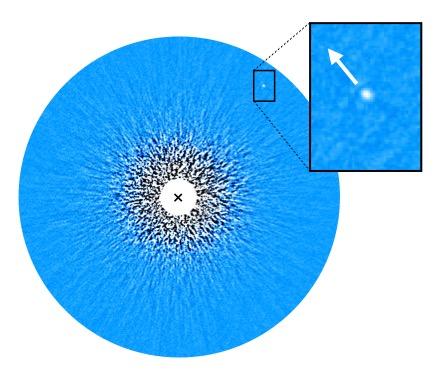
Brown dwarfs, as defined by astronomers, have masses between 13 and 75 Jupiter masses. They have characteristics in common with both planets and with stars, and Bowler and his team wanted to settle the question: Are gas giant planets on the outer fringes of planetary systems the tip of the planetary iceberg, or the low-mass end of brown dwarfs? Past research has shown that brown dwarfs orbiting stars likely formed like low-mass stars, but it's been less clear what is the lowest mass companion this formation mechanism can produce.

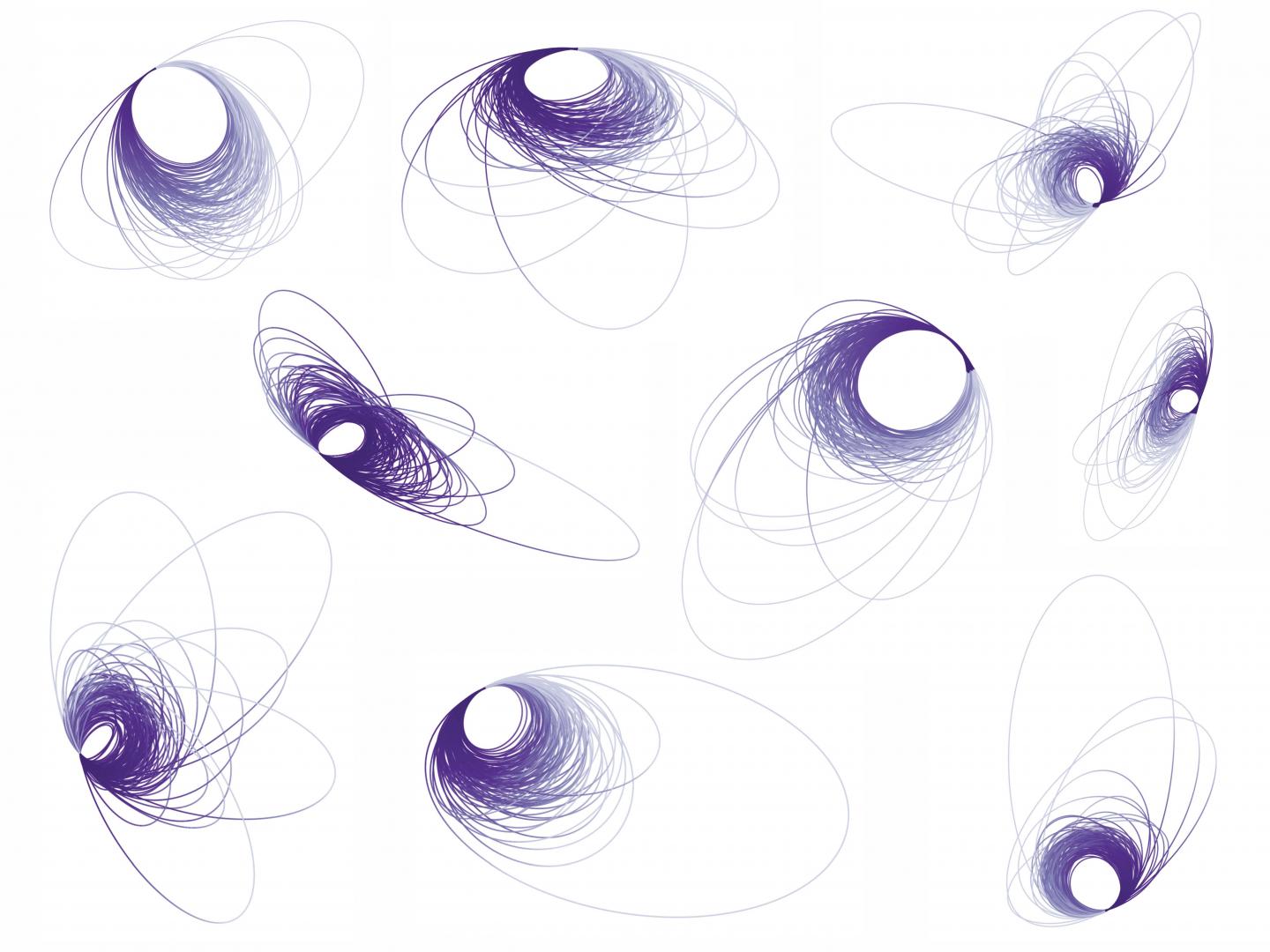
"One way to get at this is to study the dynamics of the system -- to look at the orbits," Bowler said. Their orbits today hold the key to unlocking their evolution.CAPTION By patiently watching giant planets and brown dwarfs orbit their host stars, Bowler and his team were able to constrain the orbit shapes even though only a small portion of the orbit has been monitored. The longer the time baseline, the smaller the range of possible orbits. These plots show nine of the 27 systems from their study.  CREDIT Brendan Bowler (UT-Austin){module INSIDE STORY}
Using Keck Observatory's adaptive optics (AO) system with the Near-Infrared Camera, second-generation (NIRC2) instrument on the Keck II telescope, as well as the Subaru Telescope, Bowler's team took images of giant planets and brown dwarfs as they orbit their parent stars.

It's a long process. The gas giants and brown dwarfs they studied are so distant from their parent stars that one orbit may take hundreds of years. To determine even a small percentage of the orbit, "You take an image, you wait a year," for the faint companion to travel a bit, Bowler said. Then "you take another image, you wait another year."

This research relied on AO technology, which allows astronomers to correct for distortions caused by the Earth's atmosphere. As AO instruments have continually improved over the past three decades, more brown dwarfs and giant planets have been directly imaged. But since most of these discoveries have been made over the past decade or two, the team only has images corresponding to a few percents of each object's total orbit. They combined their new observations of 27 systems with all of the previous observations published by other astronomers or available in telescope archives. 

At this point, supercomputer modeling comes in. Coauthors on this paper have helped create an orbit-fitting code called "Orbitize!" which uses Kepler's laws of planetary motion to identify which types of orbits are consistent with the measured positions, and which are not. 

The code generates a set of possible orbits for each companion. The slight motion of each giant planet or brown dwarf forms a "cloud" of possible orbits. The smaller the cloud, the more astronomers are closing in on the companion's true orbit. And more data points -- that is, more direct images of each object as it orbits -- will refine the shape of the orbit.

"Rather than wait decades or centuries for a planet to complete one orbit, we can make up for the shorter time baseline of our data with very accurate position measurements," said team member Eric Nielsen of Stanford University. "A part of Orbitize! that we developed specifically to fit partial orbits, OFTI [Orbits For The Impatient], allowed us to find orbits even for the longest period companions."

Finding the shape of the orbit is key: Objects that have more circular orbits probably formed like planets. That is when a cloud of gas and dust collapsed to form a star, the distant companion (and any other planets) formed out of a flattened disk of gas and dust rotating around that star. CAPTION These two curves show the final distribution of orbit shapes for giant planets and brown dwarfs. The orbital eccentricity determines how elongated the ellipse is, with a value of 0.0 corresponding to a circular orbit and a high value near 1.0 being a flattened ellipse. Gas giant planets located at wide separations from their host stars have low eccentricities, but the brown dwarfs have a wide range of eccentricities similar to binary star systems. For reference, the giant planets in our solar system have eccentricities less than 0.1.  CREDIT Credit: Brendan Bowler (UT-Austin){module INSIDE STORY}
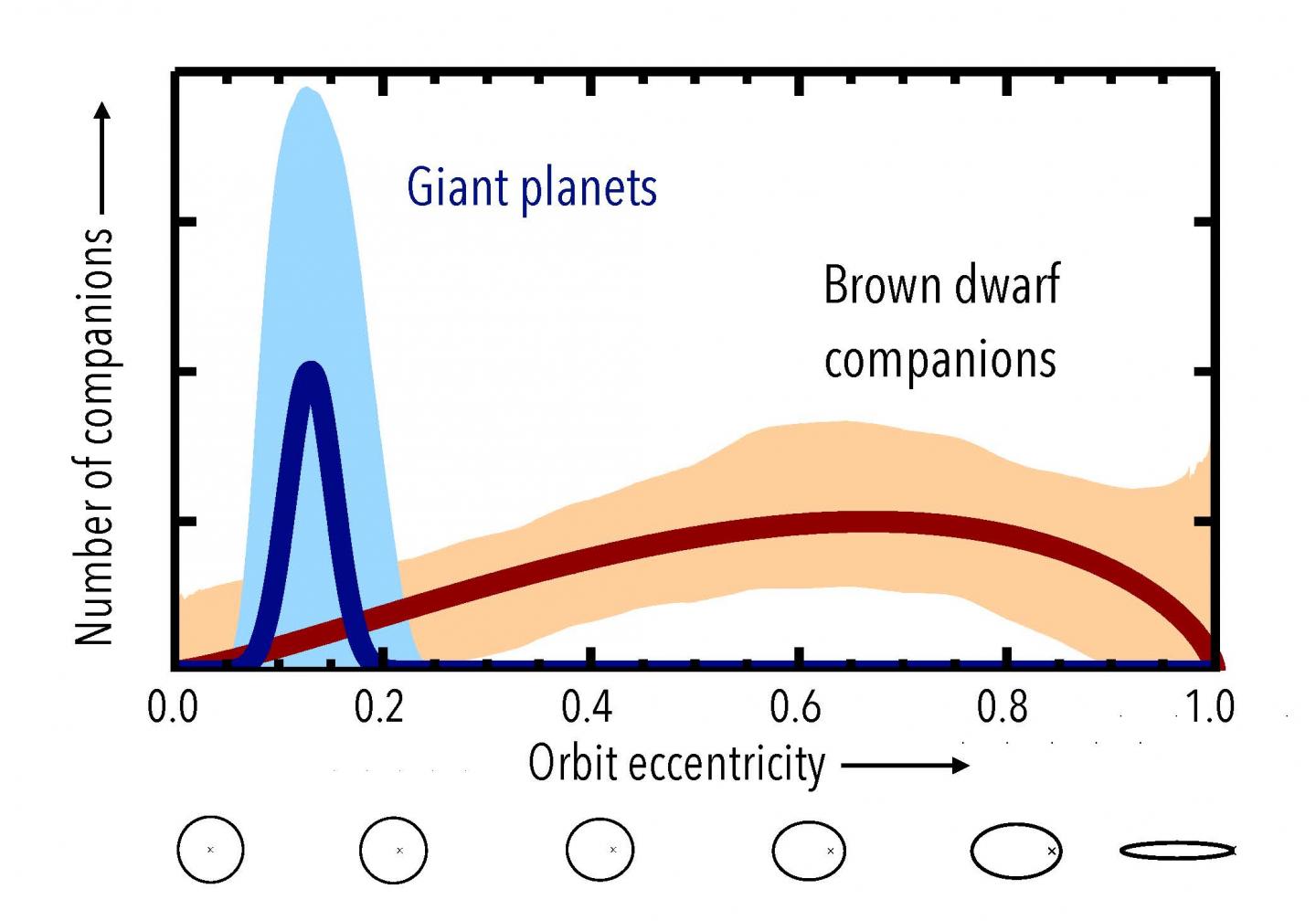
On the other hand, the ones that have more elongated orbits probably formed like stars. In this scenario, a clump of gas and dust was collapsing to form a star, but it fractured into two clumps. Each clump then collapsed, one forming a star, and the other a brown dwarf orbiting around that star. This is essentially a binary star system, albeit containing one real star and one "failed star."

"Even though these companions are millions of years old, the memory of how they formed is still encoded in their present-day eccentricity," Nielsen added. Eccentricity is a measure of how circular or elongated an object's orbit is.

The results of the team's study of 27 distant companions were unambiguous. 

"The punchline is, we found that when you divide these objects at this canonical boundary of more than about 15 Jupiter masses, the things that we've been calling planets do indeed have more circular orbits, as a population, compared to the rest," Bowler said. "And the rest look like binary stars."

The future of this work involves both continuing to monitor these 27 objects, as well as identifying new ones to widen the study. "The sample size is still modest, at the moment," Bowler said. His team is using the Gaia satellite to look for additional candidates to follow up using direct imaging with even greater sensitivity at the forthcoming Giant Magellan Telescope (GMT) and other facilities. UT-Austin is a founding member of the GMT collaboration.

Bowler's team's results reinforce similar conclusions recently reached by the GPIES direct imaging survey with the Gemini Planet Imager, which found evidence for a different formation channel for brown dwarfs and giant planets based on their statistical properties.

This work was supported by a NASA Keck PI Data Award, administered by the NASA Exoplanet Science Institute. The Keck Observatory is managed by Caltech and the University of California.
UCSC genome browser posts the coronavirus genome

Researchers can now use the Browser's features to see genetic code at any scale and add annotations for global collaboration

Research into the novel Wuhan seafood market pneumonia virus, the deadly "coronavirus" that has forced the Chinese government to quarantine more than 50 million people in the country's dense industrial heartland, will be facilitated by the UC Santa Cruz Genomics Institute. The Genomics Institute's Genome Browser team has posted the complete biomolecular code of the virus for researchers all over the world to use.

"When we display coronavirus data in the UCSC Genome Browser, it lets researchers look at the virus' structure and more importantly work with it so they can research how they want to attack it," said UCSC Genome Browser Engineer Hiram Clawson.

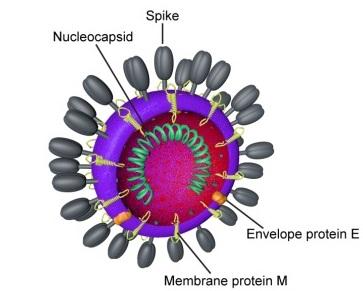
Samples of the virus have been processed in labs all over the world, and the raw information about its genetic code has been sent to the worldwide repository of genomic information at the National Institutes of Health's National Center for Bioinformatics (NCBI) in Bethesda, Maryland. CAPTION The virus structure is made up of at least three viral proteins, the spike protein, the membrane protein and the envelope protein.  CREDIT From Mechanisms of Coronavirus Cell Entry Mediated by the Viral Spike Protein Belouzard et al, https://www.ncbi.nlm.nih.gov/pmc/articles/PMC3397359/{module INSIDE STORY}

"The NCBI is a worldwide repository established in the very early days of genomics," said Clawson. "When people find novel viruses, they send them to the NCBI, and the NCBI assigns them a name and number so everyone can refer to an exact specimen. Once they've processed the genomic information, it's made available to the world from the database."

From there, the UC Santa Cruz Genome Browser processes the information into a visual display of the virus.

The NCBI named the Wuhan seafood market pneumonia virus 2019-nCoV, which stands for novel coronavirus discovered in 2019.

UC Santa Cruz retrieved the information, consisting of 29,903 nucleotides -- the base pairs that make up the DNA and RNA molecules that encode all life on earth.

"When we obtain this data from NCBI, it's a single file with the letters in it from the DNA or RNA (A, C, G, and T)," Clawson said. "This one happens to be single-stranded RNA, a relatively simple structure.

This information is processed and placed into a database, where the Genome Browser can access the material and display it in a web browser in a much more useful format.

"What makes the Genome Browser so valuable is that it is so visual," Clawson said. "It makes it very clear where everything is, so when people make interesting measurements about the genome in the virus, they can see what they're looking at," Clawson said.

Researchers can zoom in and out of the genome. This allows them to see base pairs at the most detailed level. Or, they zoom all the way out and see the 10 individual genes that the 29,903 base pairs comprise.

The Browser also contains a CRISPR track, which allows researchers to see where they can splice genetic material and how they can cut it. With CRISPR, researchers can edit the genetic material, a tremendously valuable tool for determining which genes do what.

"In the case of this virus," Clawson said, "there are approximately ten genes and the largest is its spike protein," referring to the chemical spine which the virus uses to snag onto human cells and hijack their cellular machinery to reproduce themselves. "So they might make a change to see if it makes the spike protein more or less virulent."

Formulus Black shows how Forsa allows applications to benefit from high-performance memory-based storage at SC19

Company’s revolutionary software stack enables any application to leverage memory-based storage, without modification

Venture-backed startup Formulus Black is showcasing how its Forsa solution enables memory to be provisioned and managed as a high-performance, low-latency storage media for the most demanding workloads at the supercomputing show SC19 in Booth No. 296 of the Colorado Convention Center in Denver next week.

Forsa enables any application or filesystem to utilize DRAM or Intel Optane DC persistent memory as a memory-based POSIX compliant block storage. Because of this, no application modifications are needed on the application side to supercharge the performance of I/O intensive HPC processes such as checkpointing. 

Forsa brings a suite of memory-management features that are not available for standard persistent memory devices such as the ability to increase the size of persistent memory block devices that are at full capacity, create clones and snapshots, and manage persistent memory resources on multiple nodes from one management console.  Supporting both legacy and new application environments, Forsa is ideally suited to solving the needs of enterprises in the financial services, automotive, telecom, energy, university, gaming, and healthcare industries. {module INSIDE STORY}

“In the same way that Tesla disrupted the automobile market by demonstrating how batteries could be used for more than just starting a car and keeping the radio on, Formulus Black is disrupting the server market by elevating the role of memory on servers as both a caching layer and a tier 1 low latency storage media for I/O intensive processes” said Jing Xie, Chief Operating Officer at Formulus Black.  “Forsa works with servers powered by Intel Optane DC Persistent Memory Modules and older generation Intel servers with DRAM to deliver memory-accelerated I/O performance for data-intensive applications while providing the manageability, data protection, and usability features typically found in peripheral storage solutions such as snapshots, clones, block resize, backup/restore, and high availability.”