

Analysis of Galileo's Jupiter entry probe reveals gaps in heat shield modeling

Data from the probe's 1995 fireball has continued to confound those studying the mission. New simulations and faster computers point to bettering atmospheric entry vehicles.

The entry probe of the Galileo mission to Jupiter entered the planet's atmosphere in 1995 in fiery fashion. As the probe descended from Mach 50 to Mach 1 and generated enough heat to cause plasma reactions on its surface, it relayed data about the burning of its heat shield that differed from the effects predicted in fluid dynamics models. New work examines what might have caused such a discrepancy.

Researchers at the Universidade de Lisboa and the University of Illinois at Urbana-Champaign report their findings from new fluid radiative dynamics models using data transmitted from the of Galileo's 30-second entry. The paper, published in Physics of Fluids, from AIP Publishing, employs new computational techniques developed in the nearly 25 years since the mission.

"Early simulations for the probe design were conducted in the 1980s," said Mario Lino da Silva, an author on the paper. "There are some things we can do in 2019, because we have the computational power, new devices, new theories and new data." This image shows the high temperature flowfield around Galileo spacecraft upon entry to Jupiter, with ray-tracing algorithm distribution visualized.{module In-article}
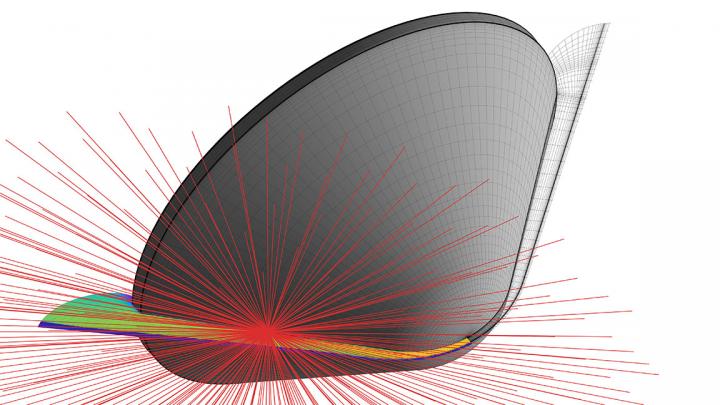
Galileo's probe entered Jupiter's gravity traveling 47.4 kilometers per second, making it one of the fastest man-made objects ever. The fireball caused by the descent warmed the carbon phenolic heat shield to temperatures hotter than the sun's surface.

Data from the probe revealed the rim of the heat shield burned significantly more than even today's models would predict, measured by what is called the recession rate.

"The fireball is a kind of soup where a lot of things happen at the same time," he said. "One problem with modeling is that there are many sources of uncertainty and only one observed parameter, the heat shield recession rate."

The group recalculated features of the hydrogen-helium mixture the probe passed through, such as viscosity, thermal conductivity and mass diffusion, and found the oft-cited Wilke/Blottner/Eucken transport model failed to accurately model interactions between hydrogen and helium molecules.

They found the radiative heating properties of hydrogen molecules played a significant role in the additional heating the probe's heat shield experienced.

"The built-in heat shield engineering margins actually saved the spacecraft," Lino da Silva said.

Lino da Silva hopes the work helps improve future spacecraft design, including upcoming projects to explore Neptune that will likely not reach their destinations until after he has retired.

"In a way, it's like building cathedrals or the pyramids," he said. "You don't get to see the work when it's finished."

Lino da Silva next looks to validate some of the simulated findings by reproducing similar conditions in a shock-tube facility tailored for reproducing high-speed flows.
Novel AI model provides insight into how collective behaviors emerge

How do the stunningly intricate patterns created by schools of fish emerge? For many scientists, this question presents an irresistible mathematical puzzle involving a substantial number of variables describing the relative speed and position of each individual fish and its many neighbors.

Various mathematical models were proposed to tackle this question, but according to Gonzalo de Polavieja, head of the Collective Behaviour lab at the Champalimaud Centre for the Unknown in Lisbon, Portugal, they would inevitably fall into one of two extremes: they would either be too simple, or too complex.

"The rise of the field of artificial intelligence and machine learning has provided models that are very accurate in predicting the behavior of individuals in groups", says de Polavieja. "But these models are like black boxes: The way they process the data to generate their predictions could involve thousands of parameters, many of which may not even correspond to real-world variables. Humans are unable to make sense of such complex information."

"On the other extreme", he continues, "are the simpler models, with few parameters, that allow you to identify rules associated with one main component, such as the distance between the fish, or their relative velocity. But those models are too narrow and therefore are never accurate when it comes to predicting the overall behavior of the group."

Drawing inspiration from a new type of an AI model called "attention networks", de Polavieja and his team were able to identify a solution that lies just between the two extremes: a model that is both insightful and predictive. They describe their results in an article published in the scientific journal Plos Computational Biology.

Deconstructing the black box 214003 web 8b99d

{module In-article}

To solve the problem, the team decided to use AI techniques with a twist: instead of constructing the standard intact "black box", they organized the model into numerous interconnected modules, each of which was simple enough so that it could be analyzed.

When the team studied the functions generated by the individual modules, they found that the coarse rules they already knew still held, but were greatly refined. "For example, according to previous models, the space around each fish is divided into three circular concentric areas: repulsion, alignment, and attraction. We also found those same three areas, but contrary to the simple models that originally identified them, our model showed that the areas were not circular, nor concentric, and that they changed in a manner that depended on the velocity of the fish", explains Francisco Heras, the first author of the study.

In addition to being insightful, the model is also good at predicting the behavior of the fish. "We can tell with 90% accuracy whether each fish in the group will turn right or left during the following second", says Heras. "This may not seem like a long time compared with the timescale humans operate in, but zebrafish live in a faster paced environment and can move a distance of about eight times their body length in a mere second."

The results of the model are so robust that one can't help but wonder why this approach wasn't used before. According to de Polavieja, the answer is "a bit of sociology and a bit of mathematics." As he explains, "since the two approaches dominating the field were so different, it took a while to realize that constructing a model that is both insightful and predictable was even possible." Once the team realized this possibility, they began exploring different architectures and fine-tuning their set of assumptions in a way that optimized the predictive capacity of the model while keeping it simple enough to be insightful.

Another element that made this development possible is the open-source, sophisticated tracking software the lab had recently developed. "By using idtracker.ai, we were able to track groups of 100 fish simultaneously. This was crucial for obtaining the large and detailed dataset necessary for this type of research."

The team made the code for their model freely available. According to Polavieja, it can be a useful tool for the collective behavior community, which will now have a way to recover interaction rules in a way that is automatic, predictive and insightful of the biology. "We hope that it will be used by others to study many different types of social interactions", he concludes.

CU research identifies key uncertainties for models of mosquito distribution in the US

Understanding model limitations could improve strategies to deal with mosquito-borne diseases

Computational analysis has identified key regions in the United States where model-based predictions of mosquito species distribution could be improved. Andrew Monaghan of the University of Colorado Boulder and colleagues present these findings in PLOS Computational Biology.

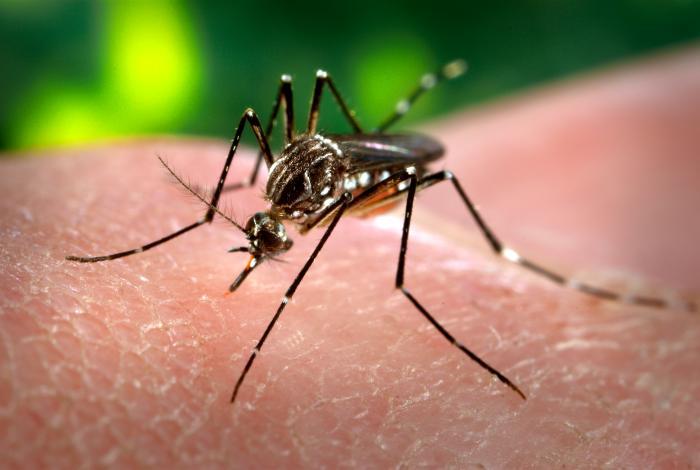
Aedes aegypti and Aedes albopictus mosquitoes are globally important species that can transmit dengue, chikungunya, yellow fever, and Zika viruses. However, data on their geographic distribution are very limited. Computational models can help fill in the gaps by providing predictions of where mosquitos may be found, but the accuracy of such models is difficult to gauge. CAPTION An Aedes aegypti mosquito, the vector of chikungunya, dengue, yellow fever, and Zika viruses.  CREDIT CDC/ Prof. Frank Hadley Collins.{module In-article}

To address this issue, Monaghan and colleagues assessed and combined previously developed computational models to generate new predictions of the chances of finding Ae. aegypti and Ae. albopictus in each county in the contiguous United States. Then, they compared their estimates with real-world mosquito collection data from each county.

The researchers found that existing models have gaps that had not previously been identified, despite the relatively high availability of mosquito data in the U.S. compared to other countries. They found high uncertainty of the models in predicting the presence of Ae. aegypti and Ae. albopictus across broad regions likely to be borderline habitats for these species. They also discovered key pockets where the models appear to be biased, such as the Florida panhandle and much of the Southwest for Ae. aegypti.

"By comparing analytical models and data, we identified key gaps in mosquito surveillance data and models," says senior author, Michael Johansson. "Understanding those limitations helps us to be better prepared for infectious disease threats today and to focus on key needs to be even better prepared tomorrow."

The findings point to the need for additional data and improved models to advance understanding of the range of mosquito species and the risk of disease transmission around the world. Johansson and colleagues are now organizing an ongoing collaborative project to systematically collect more mosquito data in the United States and analyze new models, shedding new light on species distribution.