Australian scientists play important role in safeguarding the world's largest tuna fishery

Understanding the impact of modern fishing techniques is critical to ensure the sustainability of the Western and Central Pacific Ocean (WCPO) tuna fishery, the largest tuna fishery in the world that accounts for 55% of the total tropical tuna catch and provides up to 98% of government revenue for some Pacific Island nations.

Multiple agreements have been signed by Pacific island countries and territories to maintain the sustainability of this important ocean resource. However, the advent of Fish Aggregating Devices (FADs) and their impact on fishing efficiency over the past 20 years has added a large unknown to the management required to maintain the sustainability of this key fishery into the future.

Researchers from The Pacific Community’s Oceanic Fisheries Program (SPC) and the ARC Centre of Excellence for Climate Extremes have recently published two papers that used a combination of records from captains and scientific observers, FAD tracking data, ocean models and cutting edge supercomputer simulation methods to reveal for the first time the trajectories and potential impact these FADs may have on fisheries and the island nations. Tuna school by Jet Kim Unsplash {module In-article}
“Around 30,000-65,000 FADs are released every year in this region but we have very little understanding of where they ended up, how they were being used, and the impact this has had on coastal areas and the overall catch of the fishery,” said Dr. Lauriane Escalle, a fisheries scientist at SPC.

“While we know FADs make fishing more efficient, allowing fishing vessels to use less fuel and reduce fishing effort, there are unanswered questions around potential overfishing, impacts on bycatch species, ghost fishing and reef damage caused by FADs washing up on coral reefs and islands.”

Aside from catch data and ocean models, modern FADs themselves played an important role in helping the researchers get their answers.

Traditional FADs work because ocean-going species, like tuna, tend to aggregate around floating objects like floating logs. Why they do this is still not fully understood but fishers have long known this fact and taken advantage by releasing bamboo rafts into the ocean – the world’s first FADs. Over time commercial fishers added old ropes and nets to slow the drift through the ocean.

Today, FADs are high-tech buoys with solar-powered devices that record the position, scan the ocean below to estimate the number of aggregated fish and transmit all this information to vessels via satellite. This modern technology opened the door to detailed observations of FAD life history while they drift across the Pacific.

Combining this real-world information with catch data and cutting-edge supercomputer simulations based on ocean models allowed the researchers to examine the dynamics of FAD connectivity and to test different hypotheses explaining the high number of FADs beaching incidents in some areas. This key information could significantly add to the management of the Western and Central Pacific Ocean tuna fishery and the exclusive economic zones within it.

The studies found that:

  • More than 2000 FADs wash up on beaches and coral reefs every year.
  • Up to 6000 FADs fished on in the WCPO had drifted in from another fishery in the Eastern Pacific Ocean, which has different management systems;
  • FADs spent more time in the exclusive economic zone of Tuvalu and the Solomon Islands than any other part of the fishery.
  • The highest number of FAD beaching events occurred in the Solomon Islands, Papua New Guinea, and Tuvalu. This was more the result of ocean currents than where the FADs were deployed, making the management of this issue more difficult.
  • Kiribati, located along the equator, experienced a high number of FADs drifting through its waters, alongside significant levels of beaching, as a result of where fishers deployed FADs.
  • Results from these studies will help effectively manage tuna resources, through measures on the number and location of FADs deployments; the use of biodegradable FADs; programs to recover lost FAD before reaching sensitive areas; and more research on FAD impact on tuna and bycatch populations.

“Access to this unique regional database of FAD tracking data by fishing companies and managers allowed us to not only validate ocean models but also to test different deployment hypotheses using millions of virtual FADs,” said Dr. Joe Scutt Phillips, another fisheries scientist at SPC.

“This method allows us to look back in time and make good estimates of the movement and impact of FADs from before tracking programs, as well as examine their potential impact on tuna behavior.”

“This collaboration between fishing companies, regional management organizations and researchers has resulted in an extraordinary amount of useful data that will go a long way towards helping Pacific island nations and the fisheries managers maintain the sustainability of this valuable $6 billion a year industry. It’s a great example of managers, industry, and researchers working together for the benefit of all.”
Tokyo Tech researchers show why multipartite viruses infect plants rather than animals

Being in-between living and non-living, viruses are, in general, strange. Among viruses, multipartite viruses are among the most peculiar—their genome is not packed into one, but many, particles. Multipartite viruses primarily infect plants rather than animals. A recent paper by researchers from the Tokyo Institute of Technology (Tokyo Tech) uses mathematical and computational models to explain this observation.

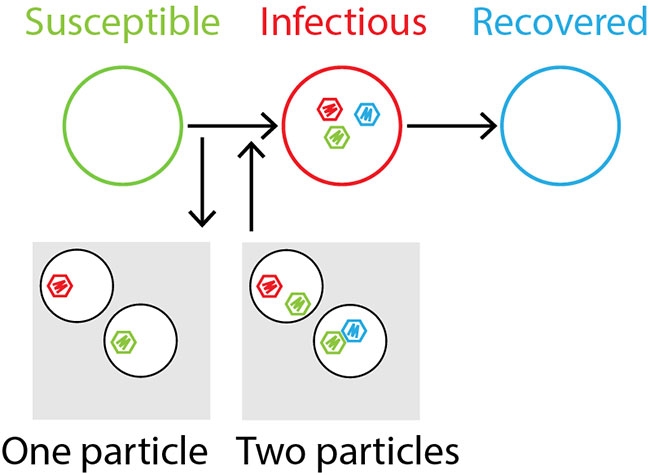
Multipartite viruses have a strange lifestyle. Their genome is split up into different viral particles that, in principle, propagate independently. Completing the replication cycle, however, requires the full genome such that persistent infection of a host requires the concurrent presence of all types of particles (see Fig. 1). The origin of multipartite viruses is an evolutionary puzzle. Apart from why they can have such a costly lifestyle, the most peculiar thing about them is that almost all known multipartite viruses infect either plants or fungi—very few viral species infect animals.

So far, most theoretical research has been trying focusing on explaining how it is viable to have the genome split into different particles. This paper provides a theoretical explanation of why multipartite viruses primarily infect plants. Figure 1. The Susceptible-Infectious-Recovered model to understand multipartite viruses. Many infectious diseases are modeled by the Susceptible-Infectious-Recovered model. In this model, when a susceptible individual (someone who don't have the disease) meets an infectious individual (someone who have the disease and can spread it), the susceptible can become infectious. After some time the infectious can become recovered (someone who don't have the disease and can't get it). This model has to be modified so that the infection step (when susceptible becomes infectious) describes the accumulation of virus particles until the individual has a complete viral genome.{module In-article}

There have been great efforts to understand the mechanisms that give multipartite viruses an advantage that can compensate for their peculiar and costly lifestyle, and this is not yet a solved problem. Also, our understanding of why most multipartite viruses infect only plants is limited. In a recent work, published in Physical Review Letters, Petter Holme of the World Research Hub Initiative, Tokyo Tech, and colleagues from China and the USA, have explained why multipartite viruses primarily infect plants. In their work, the authors formulated a minimal network-epidemiological model.

They used mathematical models and supercomputer simulations to show that multipartite viruses colonize a structured population (representing the interaction patterns among plants) with less resistance, compared to a well-mixed population (representing the interaction patterns among animals). This is thus an explanation of why multipartite viruses infect plants rather than animals.

The researchers from Tokyo Tech continue to investigate the epidemiology of different types of infectious diseases by theoretical methods. At the moment, they are interested in the more common disease spreading scenarios such as how influenza spreads in cities and how that could be mitigated.

Can we peek at Schrodinger's cat without disturbing it?

Researchers describe a way of measuring a quantum system while keeping its superposition intact

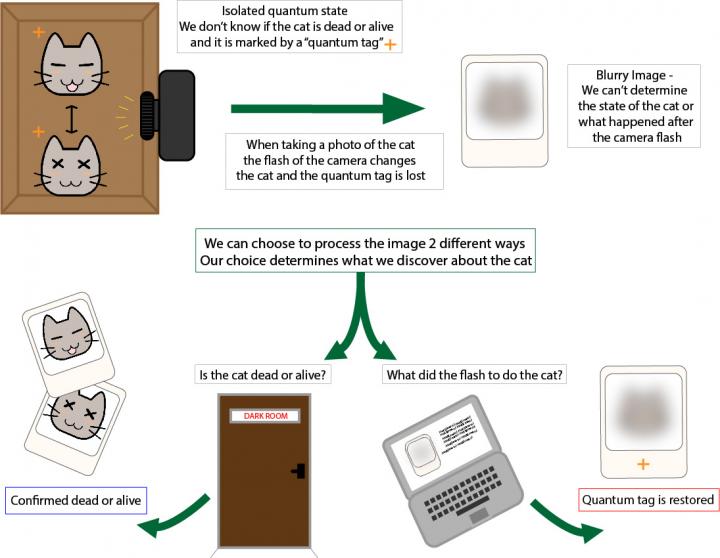
CAPTION Since the cat in the box (top left) is in a superposition that means it can be in numerous different states (e.g. dead and/or alive) and is marked with a quantum tag. The photo taken of the cat is entangled with the situation inside of the box. We can decide the fate of the cat by processing the photo in a certain way (bottom left), or we can keep it in superposition by restoring the quantum tag using a different process (bottom right). CREDIT Associate Professor Holger F. Hofmann and Emma Buchet/Hiroshima University

Quantum physics is difficult and explaining it even more so. Associate Professor Holger F. Hofmann from Hiroshima University and Kartik Patekar from the Indian Institute of Technology Bombay have tried to solve one of the biggest puzzles in quantum physics: how to measure the quantum system without changing it? 

Their new paper published this month has found that by reading the information observed from a quantum system away from the system itself researchers can determine its state, depending on the method of analysis. Although the analysis is completely removed from the quantum system, it is possible to restore the initial superposition of possible outcomes by a careful reading of the quantum data.

"Normally we would search for something by looking. But in this case looking changes the object, this is the problem with quantum mechanics. We can use complicated maths to describe it, but how can we be sure that mathematics describes what is really there? When we measure something there is a trade-off and the other possibilities of what it could be are lost. You cannot find out about anything without an interaction, you pay a price in advance." explains Hofmann. {module In-article}

During Patekar's month-long stay at Hiroshima University when he was an undergraduate student, the two physicists tried to imagine ways of measuring the system without "paying the price" i.e. keeping the system's superposition or meaning that the system can exist in all states. In order to understand their results Hofmann describes their findings using the well-known physics story of Schrödinger's cat: 

Schrödinger's cat is in a box and the scientists don't know whether it is dead or alive. A camera is set up looking into the box that takes a photo from a position outside of the box. The photo taken of the cat comes out blurry; we can see there is a cat but not whether it is dead or alive. The flash from the camera has also removed a "quantum tag" marking the superposition of the cat. This photo is now entangled with the fate of the cat i.e. we can decide what happened to the cat by processing this photo in a certain way.

The photo could then be taken away from the box and processed on a computer or in a darkroom. Depending on what method is used to process the photo, we can find out either if the cat is alive or dead, or what the flash did to the cat, restoring the quantum tag. The choice of the reader determines what we know about the cat. We can find out if it's dead/alive or restore the quantum tag that was removed when the picture was taken, but not both.

This is only a step forward in our understanding of quantum mechanics. Today its full application remains confined to expert-level systems like quantum supercomputers, although some of its aspects can also be used in precise measurements, and for secure communication using quantum cryptography. 

"This is a key part of my research. I really wanted to understand why this quantum weirdness is there. I focused on measurements because that's where the weirdness comes from!" says Hofmann.