

Germany's Halle files patent for novel, high-performance transistors from spintronics

Today's computer processors are increasingly pushed to their limits due to their physical properties. Novel materials could be the solution. Physicists from Martin Luther University Halle-Wittenberg (MLU) have investigated if and how these materials might be developed. They have created, tested and filed a patent for a concept that utilizes the latest findings from the field of spintronics. The team reported on their research in the journal "ACS Applied Electronic Materials".

With their new concept, the researchers at MLU want to improve the properties of diodes and transistors. Common processors use thousands of diodes and transistors to process data. "The energy efficiency of these individual components determines how much energy is consumed by the processor overall," says Professor Ingrid Mertig, a theoretical physicist at MLU. Energy loss, which occurs when electrical energy is converted into heat, remains the biggest challenge, she explains. When developing these components, scientists also have to decide whether to create very powerful and energy-efficient components that can only be used for a specific purpose, or to create parts that can be used in a variety of ways, but which have lower performance and require more energy. {module In-article}

For its latest innovation, the team of researchers investigated whether spintronics can be used to solve these problems. It is based on a special property of electrons: the spin. This is a kind of intrinsic angular momentum of electrons that generates a magnetic moment which is the origin of magnetism. The researchers have investigated if and how a diode or transistor can be developed that uses this spin in addition to the charge of the electron. The concept is based on newly discovered magnetic materials that contain spin information in a particular way. These could replace traditional semiconductor materials in the novel components.

"Our proposals for the new transistors combine data processing and storage. There is no loss of energy and they can easily be reconfigured," explains Dr. Ersoy Sasioglu, a physicist at MLU and first author of the paper. A patent has already been filed for the design of these spintronic components. The research group from Halle focusses on using theoretical simulations in designing novel materials. In cooperation with experimental physicists from the University of Bielefeld, the scientists now want to test which materials are best suited for the new components.
SwRI, international team use deep learning to create virtual 'super instrument'

Virtual instrument can analyze complex data through advanced artificial intelligence and learn to synthesize useful scientific data

A study co-written by a Southwest Research Institute scientist describes a new algorithm that combines the capabilities of two spacecraft instruments, which could result in lower cost and higher efficiency space missions. The virtual "super instrument," is a computer algorithm that utilizes deep learning to analyze ultraviolet images of the Sun, taken by NASA's Solar Dynamics Observatory, and measure the energy that the Sun emits as ultraviolet light.

"Deep learning is an emerging capability that is revolutionizing the way we interact with data," said Dr. Andrés Muñoz-Jaramillo, senior research scientist at SwRI. Muñoz-Jaramillo co-authored the study, published this month in Science Advances, alongside collaborators from nine other institutions as part of NASA's Frontier Development Laboratory. The laboratory is an applied artificial intelligence research accelerator that applies deep learning and machine learning techniques to challenges in space science and exploration. {module In-article}

Deep learning is a type of machine learning methods that mimic the way the human brain processes information. The result of deep learning is machines accomplishing things that previously required human intelligence, such as translation between foreign languages, driving a vehicle and facial recognition. Things like Netflix suggesting what to watch next, an iPhone unlocking upon sight of its owner's face and Alexa responding to a vocal request are all results of deep learning.

"All missions beyond Earth have a host of instruments that have been designed with specific capabilities to answer specific scientific questions," Muñoz-Jaramillo said. "When we combine them into virtual super instruments, we can produce more cost-effective missions with higher scientific impact or use measurements by one instrument to help answer the science questions of another."

Muñoz-Jaramillo stresses in the study that these virtual super instruments will not make hardware obsolete. They will always require a spacecraft to collect the necessary data for virtualization.

"Deep learning instruments cannot make something out of nothing, but they can significantly enhance the capabilities of existing technology," he said.

Their virtual super instrument is already in use as part of a Frontier Development Laboratory project for forecasting ionospheric disturbances. Muñoz-Jaramillo is currently working on additional super instruments that combine other capabilities.

"In essence, deep learning involves sophisticated transformation of data," he said. "We can make these transformations into scientifically useful data and modernize the way we view not just the Sun, but a great number of scientific questions."

UMD scientists create method for first global picture of mutual predictability of atmosphere, ocean

World-renowned climate scientist J. Shukla calls the new paper by University of Maryland scientists 'a very important paper in the history of predictability research'

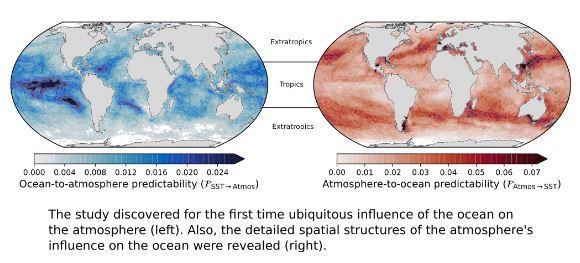
University of Maryland (UMD) scientists have carried out a novel statistical analysis to determine for the first time a global picture of how the ocean helps predict the low-level atmosphere and vice versa. They observed ubiquitous influence of the ocean on the atmosphere in the extratropics, which has been difficult to demonstrate with dynamic models of atmospheric and oceanic circulation. The results are published today in the Journal of Climate, "Local atmosphere-ocean predictability: dynamical origins, lead times, and seasonality." The study discovered for the first time ubiquitous influence of the ocean on the atmosphere (left), and reveal the detailed spatial structures of the atmosphere's influence on the ocean (right).{module In-article}

The research draws on a classic statement often heard in introductory statistics classes that "correlation is not causation." Clive Granger was a Nobel-laureate mathematician who came up with a novel method to address this issue by distinguishing correlation from causation.

"The Granger method relies upon a simple but important notion that a cause precedes its effect, and should improve the prediction of its effect in the future. We realized that this could be a powerful method to study the interactions between atmosphere and ocean, and to provide a global picture of how well they predict each other," said applied mathematician Safa Motesharrei, an Environmental Systems Scientist at UMD. "This method sheds light on both the potential to better predict regional climate as well as the nature of the interactions."

"There are many physical processes that govern the interaction between the atmosphere and ocean," said lead author Eviatar Bach, PhD student in the Department of Atmospheric and Oceanic Science (AOSC) at UMD. "For example, wind blowing on the ocean surface creates currents, and the sea surface heats up the lower atmosphere. These interactions between the atmosphere and ocean play a major role in climate and our ability to predict it, so understanding their geographical structure is important."

"It has been known that in the tropical oceans, the ocean is predominantly driving the atmospheric changes, while in the extratropics the atmosphere generally drives the ocean," said co-author Eugenia Kalnay, Distinguished University Professor of AOSC at UMD. "I developed a dynamical rule to determine the direction of the forcing in 1986, and others have addressed this question using climate models.This study provides a definitive answer."

The basic Granger method was introduced in 1969, but the authors "cleverly applied it for the first time to atmosphere and ocean data," said Juergen Kurths, Head of Complexity Science Department at Potsdam Institute for Climate Impact Research in Germany, who was not a co-author. Kurths is a prominent physicist who has developed many novel mathematical methods for studying climate and other nonlinear systems.

"The most novel finding of this research is that the method of Granger causality found the ocean to influence the atmosphere almost everywhere in the extratropics," said Samantha Wills, a postdoctoral researcher at NOAA's Pacific Marine Environmental Laboratory, who was not a co-author. "This can be a challenging task given that the atmosphere dominates air-sea interaction in the extratropics, and the influence of the ocean on the atmosphere is not much larger than internal variability."

"This had not been demonstrated by previous General Circulation Model experiments. Although there have been a few special cases where it has been shown that mid-latitude sea-surface temperatures have a significant impact on the atmosphere, this relationship was not known to be as ubiquitous as this paper has shown," said J. Shukla, University Professor at George Mason University, who was not a co-author. Shukla is a world renowned climate scientist who pioneered studies of predictability.

Moreover, the study's estimates of the spatial structure of predictability could help to further advance the science of coupled data assimilation, the nascent field that attempts to leverage the interactions between atmosphere and ocean to improve climate prediction.

"The ability to anticipate changes to the ocean or atmosphere based on information from the other system provides society with the opportunity to prepare for future impacts, such as to agriculture and fisheries," said Wills.

"This is a very important paper in the history of predictability research," said Shukla, "It will surely inspire further research by the predictability research community. In particular, this paper identifies geographical regions on the globe over which there exists potential predictability which can be harvested for improving operational predictions."