

Russian scientists create new model of heat transfer in crystals for development of next generation supercomputers

Russian scientists suggested a model describe the distribution of heat in ultrapure crystals at the atomic level

Today's physicists mostly focus either on massive objects like black holes or on atom-sized objects. In both cases, significant deviations from conventional laws of physics are observed. The understanding of atomic-level processes opens a wide range of prospects in nanoelectronics and material engineering. One of such studies is a model suggested by a team of scientists from Peter the Great St.Petersburg Polytechnic University (SPbPU). The model describes the distribution of heat in ultrapure crystals at the atomic level. The article was published in the Journal of Applied Mathematics and Mechanics.

The distribution of heat in nanostructures is not regulated by the laws applied to conventional materials. This effect is most vividly expressed in the reaction between graphene and a laser-generated heat point source. Graphene is a 2D crystal made of carbon atoms. The material looks like a thin grid or a honeycomb. However, it is quite stable and has very high heat and electrical conductivity due to which it is widely used in electrical engineering. The discoverers of this unique crystal were awarded the Nobel Prize in Physics in 2010.

Scientists of SPbPU considered an infinite crystal consisting of identical particles obeying classical Newtonian equations of motion. Graphene-based technologies are rarely used in a vacuum, so the team also took into account the effect of the environment (gas or liquid). This adjustment has a considerable impact on the model as a part of the heat is spent on warming up the environment. Finally, the team derived an analytical solution describing heat transfer. To describe the processes that happen in the material, the scientists obtained simple equations and confirmed them with numerical data generated in the model for different distances from the heat source. Using the developed model, the team observed that a crystal have certain directions along which the heat rays distribute the major part of energy. Currently, the authors are preparing for an experiment to confirm their theoretical conclusions with actual heat processes in a graphene crystal.

"Our results may be widely used for investigation of heat transfer in micro- and nano processors. It is of great importance for the development of new generation high-performance computers. Our analytical approach can be applied to a wide range of ultrapure materials such as graphene", concluded Anton KRIVTSOV, corresponding member of the Russian Academy of Sciences, the Head of the Higher School "Theoretical Mechanics", Director of Research & Education Center "Gaspromneft-Polytech" at Peter the Great St. Petersburg Polytechnic University.
Texas cities increasingly susceptible to large measles outbreaks

The growing number of children arriving at Texas schools unvaccinated makes the state increasingly vulnerable to measles outbreaks in cities large and small, according to a supercomputer simulation created by the University of Pittsburgh Graduate School of Public Health.

The findings, published today in the journal JAMA Network Open, indicate that an additional 5% decrease in vaccination rates, which have been on a downward trend since 2003, would increase the size of a potential measles outbreak by up to 4,000% in some communities.

"At current vaccination rates, there's a significant chance of an outbreak involving more than 400 people right now in some Texas cities," said lead author David Sinclair, Ph.D., a postdoctoral researcher in Pitt's Public Health Dynamics Laboratory. "We forecast that a continuous reduction in vaccination rates would exponentially increase possible outbreak sizes." {module In-article}

Measles is a highly contagious virus that can cause severe complications, including pneumonia, brain swelling, and deafness. Approximately 1 out of every 1,000 children infected with measles will die from respiratory and neurologic complications. Measles is so contagious that, if no one was immunized, one infected person is likely to infect 12 to 16 others; in comparison, one person infected with the flu is expected to infect only one to two people. The measles vaccine -- which is often combined with the mumps and rubella vaccines and called the "MMR vaccine" -- is highly effective, conveying 97% immunity after two doses.

Sinclair and his team loaded real-world vaccination data for private schools and public school districts in Texas in the Framework for Reconstructing Epidemiological Dynamics (FRED) tool. FRED is an "agent-based" modeling system, which means it creates a synthetic population using U.S. Census data and then assigns the synthetic people to move about their communities from home to work or school as people do in the real world. This tool allows users to see, in silica, how a contagion could spread from person to person. In 2015, California legislators used FRED to help convince their peers to pass a bill restricting vaccine exemptions for school-age children.

The Texas Pediatric Society asked Pitt Public Health to model Texas in FRED to demonstrate the possibility of outbreaks in communities with low vaccination rates. Texas is the largest state by the population that allows parents to opt their children out of required vaccines for religious or personal reasons. These exemptions have increased 28-fold in Texas, from 2,300 in 2013 to 64,000 in 2016. Austin is the current home of Andrew Wakefield, a discredited former British doctor who published falsified research linking vaccines to autism and who continues to espouse anti-vaccine messages.

In the FRED Measles Texas simulation, a single case of measles is introduced into various metropolitan areas through a randomly selected student whose parents have refused to vaccinate. The simulation runs for each city for 270 days -- the length of the typical school year -- at current vaccination rates and at a hypothetical decrease in those rates.

At current rates, the simulation estimates that measles outbreaks of more than 400 cases could occur in Austin and Dallas-Fort Worth. This is partly due to a minority of schools where vaccination rates are less than 92% -- low enough for measles to sustain transmission.

If the vaccination rate drops 5% in only the schools with populations that currently are under-vaccinated, the size of potential measles outbreaks climbs exponentially in every metropolitan area, with Dallas-Fort Worth, Austin, and Houston all susceptible to outbreaks of 500 to 1,000 people.

Approximately 64% of the simulated cases occur in children who were unvaccinated because they had a religious or personal exemption. But the model forecasts 36% of the cases would be in people who have a medical condition that prohibited vaccination, whose vaccine failed to build immunity or in unvaccinated adults, for whom the risk of complications is higher than children.

"When someone refuses to be vaccinated, they are making a decision that doesn't only impact them. They are increasing the risk that people who are not immune, through no fault of their own, will get very sick and possibly die," said senior author Mark Roberts, M.D., M.P.P., professor and chair of Pitt Public Health's Department of Health Policy and Management, and director of Pitt's Public Health Dynamics Laboratory.

South Korean climate researchers show how ocean temperatures turbocharge April tornadoes over the Great Plains

Do climate shifts influence tornados over North America? New research published by IBS scientists found that Pacific and Atlantic ocean temperatures in April can influence large-scale weather patterns as well as the frequency of tornados over the Great Plains region.

New research, published in the journal Science Advances, has found that unusual ocean temperatures in the tropical Pacific and Atlantic can drastically increase April tornado occurrences over the Great Plains region of the United States.

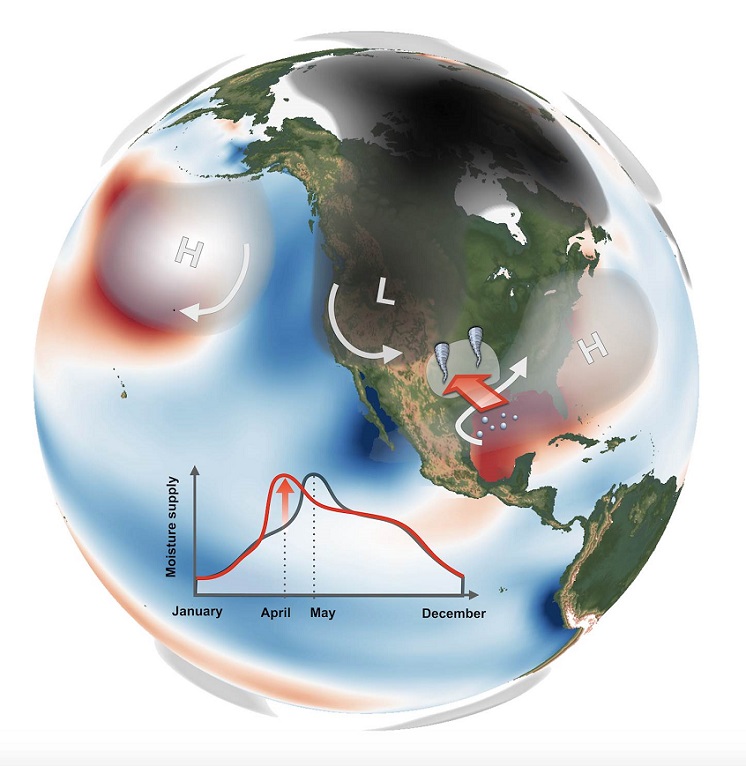
2019 has seen the second-highest number of January to May tornadoes in the United States since 2000, with several deadly outbreaks claiming more than 38 fatalities. Why some years are very active, whereas others are relatively calm, has remained an unresolved mystery for scientists and weather forecasters. Figure 1: Temperature and atmospheric pressure conditions that lead to enhanced flow of moist and quickly-spinning air into the Great Plains region and increased tornado occurrences in April. H and L refer to unusually high and low atmospheric pressure. Red and blue shading indicates warmer and colder ocean conditions. Inlay figure illustrates moisture conditions in southeastern US for years with more April tornados. Credit info : Jung-Eun Chu{module In-article}

Climate researchers from the IBS Center for Climate Physics (ICCP), South Korea have found new evidence implicating a role for ocean temperatures in US tornado activity, particularly in April. Analyzing a large number of atmospheric data and climate computer model experiments, the scientists discovered that a cold tropical Pacific and/or the warm Gulf of Mexico are likely to generate large-scale atmospheric conditions that enhance thunderstorms and a tornado-favorable environment over the Southern Great Plains.

This particular atmospheric situation, with alternating high- and low-pressure centers located in the central Pacific, Eastern United States and over the Gulf of Mexico, is known as the negative Pacific North America (PNA) pattern (Figure 1). According to the new research, ocean temperatures can boost this weather pattern in April. The corresponding high pressure over the Gulf of Mexico then funnels quickly-rotating moist air into the Great Plains region, which in turn fuels thunderstorms and tornadoes.

“Previous studies have overlooked the temporal evolution of ocean-tornado linkages. We found a clear relationship in April, but not in May “, says Dr. Jung-Eun Chu, lead author of the study and research fellow at the ICCP.

“Extreme tornado occurrences in the past, such as those in April 2011, were consistent with this blueprint. Cooler than normal conditions in the tropical Pacific and the warm Gulf of Mexico intensify the negative PNA, which then turbocharges the atmosphere with humid air and more storm systems”, explains Axel Timmermann, Director of the ICCP and Professor at Pusan National University.

“Seasonal ocean temperature forecasts for April, which many climate modeling centers issue regularly, may further help in predicting the severity of extreme weather conditions over the United States”, says June-Yi Lee, Professor at Pusan National University and Coordinating Lead Author of the 6th Assessment report of the Intergovernmental Panel on Climate Change.

“How Global Warming will influence extreme weather over North America, including tornadoes still remains unknown “, says. Dr. Chu. To address this question, the researchers are currently conducting ultra-high-resolution supercomputer simulations on the institute’s new supercomputer Aleph.