Texas A&M System Regents approve RELLIS to be central testing hub for the Army Futures Command

The Texas A&M University System Board of Regents on Thursday authorized the construction of a $130 million combat development complex at the A&M System’s RELLIS Campus in Bryan.

The complex will include a one-of-a-kind, kilometer-long tunnel that will make Texas A&M Engineering “the hypersonic research capital of the country,” said M. Katherine Banks, Vice-Chancellor and Dean of Engineering.

At the RELLIS Campus, Gen. John “Mike” Murray, commanding general for the Army Futures Command, said the Army Futures Command would develop, test and evaluate next-generation technologies from the private sector and universities around the country.

The Texas A&M System will build a $50 million building with laboratories, accelerator space and offices for the Army Futures Command on the RELLIS campus, plus invest another $30 million in infrastructure improvements to support the new facility.

The Texas Legislature also appropriated $50 million to establish an innovative proving ground, which the Texas A&M Engineering Experiment Station (TEES) will implement as an outdoor testing area at RELLIS for designing, analyzing and validating new technologies in challenging environments. Gov. Greg Abbott, Lt. Gov. Dan Patrick and Speaker Dennis Bonnen championed the $50 million to be included in the state appropriations bill for the proving ground.

“This innovative new complex strengthens Texas’ partnership with the United States Military and further establishes our state as a hub for emerging technology,” said Governor Abbott. “I am proud to have worked with the Lieutenant Governor, the Speaker, and the Legislature to secure funding to move this project forward. The state of Texas will continue to work with the Texas A&M System and the Army Futures Command to modernize our defense and keep our Armed Forces at the forefront of technological advancement.”

The Army Futures Command, headquartered in Austin, is drawing on research from universities around the country and the private sector to modernize the U.S. Army, but the new facility at RELLIS will be the central hub where the newest and most innovative ideas are tested and evaluated – often by soldiers from nearby Fort Hood or members of the Texas A&M Corps of Cadets.

The aim is to shorten the time it takes to get emerging technologies from the lab to the field and maximize technology capabilities through soldier feedback. A team of Army and Texas A&M System researchers will quickly evaluate prototypes that can be tested by soldiers in a real-world environment using a vast array of sensors and instruments at RELLIS.

“We are humbled and grateful to the people of Texas, Texas elected leaders, and the Texas A&M University System for the opportunity to further develop our strategic partnership through the establishment of the combat development complex on the RELLIS Campus,” said Gen. Murray. “This effort will certainly prove vital as we work together to discover, develop, and test ideas and concepts that will help our Soldiers, and our future Soldiers, to protect America’s tomorrows — beginning today.”

Not only is the RELLIS Campus close enough to the Army Futures Command headquarters and Fort Hood for ideal oversight, but it is also near Texas A&M University’s world-class College of Engineering and Disaster City, the world’s largest search and rescue training facility that can double as a training site for urban warfare.

Although the combat development complex isn’t expected to be completed until June 2021, Vice-Chancellor Banks said the hiring of additional engineers will begin immediately. 

Three years ago, RELLIS didn’t even exist.

In May 2016, Chancellor John Sharp announced the creation of RELLIS – named for Texas A&M’s core values of Respect, Excellence, Leadership, Loyalty, Integrity and Selfless Service. He began the building boom to redevelop the 2,000-acre property with an initial investment of $300 million. Today the campus is home to the Texas A&M System’s transportation and engineering agencies as well as an education complex served by Blinn College and Texas A&M System universities from around the state.

More growth is coming, and more construction is planned, including a state-of-the-art supercomputing center. {module In-article}

The arrival of the Army Futures Command will bring the RELLIS site full circle, back to the location’s June 6, 1943 opening as the Bryan Army Air Field. It also takes RELLIS to another level as companies interested in working with the Army Futures Command are expected to locate on or near the campus.

“We consider serving the military of our nation to be the highest of honors and responsibility,” said Chancellor Sharp. “Also, having the Army Futures Command at RELLIS is a game-changer for that campus and the Brazos Valley area; RELLIS was envisioned as a research dynamo and the Army’s arrival will speed that up.”
NOAA increases chance for above-normal hurricane season

The end of El Nino could boost Atlantic hurricane activity

NOAA forecasters monitoring oceanic and atmospheric patterns say conditions are now more favorable for above-normal hurricane activity since El Nino has now ended. Two named storms have formed so far this year and the peak months of the hurricane season, August through October, are now underway.

“NOAA will continue to deliver the information that the public depends on before, during and after any storms throughout the hurricane season,” said Neil Jacobs, Ph.D., acting NOAA administrator. “Armed with our next-generation satellites, sophisticated weather models, hurricane hunter aircraft, and the expertise of our forecasters, we are prepared to keep communities informed to help save lives and livelihoods.”

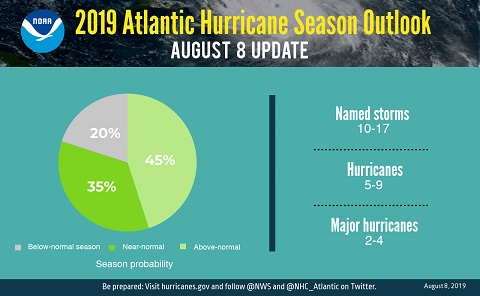
Seasonal forecasters with NOAA’s Climate Prediction Center have increased the likelihood of an above-normal Atlantic hurricane season to 45% (up from 30% from the outlook issued in May). The likelihood of near-normal activity is now at 35%, and the chance of below-normal activity has dropped to 20%.

Atlantic update pie chart 2019 7ad44{module In-article}

The number of predicted storms is also greater with NOAA now expecting 10-17 named storms (winds of 39 mph or greater), of which 5-9 will become hurricanes (winds of 74 mph or greater), including 2-4 major hurricanes (winds of 111 mph or greater). This updated outlook is for the entire six-month hurricane season, which ends Nov. 30. 

NOAA is also announcing today that the current El Nino in the Pacific Ocean has ended and neutral conditions have returned. “El Nino typically suppresses Atlantic hurricane activity but now that it’s gone, we could see a busier season ahead,” said Gerry Bell, Ph.D., a lead seasonal hurricane forecaster at NOAA’s Climate Prediction Center. “This evolution, combined with the more conducive conditions associated with the ongoing high-activity era for Atlantic hurricanes that began in 1995, increases the likelihood of above-normal activity this year.”

On average, the Atlantic hurricane season produces 12 named storms, of which six become hurricanes, including three major hurricanes. NOAA’s hurricane season outlook is for overall seasonal activity and is not a landfall forecast. Landfalls are largely determined by short-term weather patterns, which are only predictable within about a week of a storm potentially reaching a coastline.

Atlantic update storm names 2019 9cc2f

“Today’s updated outlook is a reminder to be prepared,” said Pete Gaynor, acting FEMA administrator. “We urge everyone to learn more about hurricane hazards and prepare now, ahead of time, so that if state and local authorities announce evacuations in advance of a storm, you and your family will have planned where to go and what to do to stay safe.”

This week, the FEMA Ready Campaign and its federal partners released broadcast-quality videos that show the deadly threat from tropical weather, specifically hurricane storm surge and flooding, to help emphasize the importance of following the instructions of state and local authorities in advance of a storm. The 15, 30 and 60-second video clips are available for broadcast or social media distribution and complement additional storm surge resources from NOAA.

NOAA encourages residents in communities that can be impacted by landfalling hurricanes to ensure their preparedness measures are in place now to become a more Weather-Ready Nation. Stay tuned to the National Hurricane Center for the latest about tropical storm and hurricane activity in the Atlantic.

Astrophysicists discover repeating outflows of hot wind close to black hole

An international team of astrophysicists from Southampton, Oxford, and South Africa have detected a very hot, dense outflowing wind close to a black hole at least 25,000 light-years from Earth.

Lead researcher Professor Phil Charles from the University of Southampton explained that the gas (ionized helium and hydrogen) was emitted in bursts which repeated every 8 minutes, the first time this behavior has been seen around a black hole. The findings have been published in the journal Monthly Notices of the Royal Astronomical Society.

The object Professor Charles's team studied was Swift J1357.2-0933 which was first discovered as an X-ray transient – a system that exhibits violent outbursts - in 2011. These transients all consist of a low-mass star, similar to our Sun and a compact object, which can be a white dwarf, neutron star or black hole. In this case, Swift J1357.2-0933 has a black hole compact object which is at least 6 times the mass of our Sun. The attached image produced by John Paice a graduate student at the University of Southampton and the Inter-University Centre for Astronomy{module In-article}

Material from the normal star is pulled by the compact object into a disc in between the two. Massive outbursts occur when the material in the disc becomes hot and unstable and it releases copious amounts of energy.

Professor Charles said: “What was particularly unusual about this system was that ground-based telescopes had revealed that its optical brightness displayed periodic dips in its output and that the period of these dips slowly changed from around 2 minutes to about 10 minutes as the outburst evolved. Such strange behavior has never been seen in any other object.

“The cause of these remarkable, fast dips has been a hot topic of scientific debate ever since their discovery. So it was with great excitement that astronomers greeted the second outburst of this object in mid-2017, presenting an opportunity to study this strange behavior in greater detail.”

Professor Charles and his team recognized that key to getting the answer was to obtain optical spectra a number of times during each dipping cycle, essentially studying how their color changed with time. But with the object, about 10,000 times fainter than the faintest star visible to the naked eye and the dip period of only around 8 minutes, a very big telescope had to be used.

So, they used SALT, the Southern African Large Telescope, the largest optical telescope in the southern hemisphere.

The University of Southampton is one of the founding UK partners in SALT, and together with their South African collaborators, are part of a multi-partner Large Science Programme to study transients of all types. Not only does SALT have the necessary huge collecting area (it has a 10m diameter mirror), but it is operated in a 100% queue-scheduled way by resident staff astronomers, meaning that it can readily respond to unpredictable transient events. This was perfect for Swift J1357.2-0933, and SALT obtained more than an hour of spectra, with one taken every 100 seconds.

"Our timely observations of this fascinating system demonstrates how the quick response of SALT, through its flexible queue-scheduled operation, makes it an ideal facility for follow-up studies of transient objects", said Dr David Buckley, the Principal Investigator of the SALT transient programme, based at the South African Astronomical Observatory, who also added, "With the instantaneous availability of a number of different instruments on SALT, we can also dynamically modify our observing plans to suit the science goals and react to results, almost in real-time”

Professor Charles added: “The results from these spectra were stunning. They showed ionized helium in absorption, which had never been seen in such systems before. This indicated that it must be both dense and hot - around 40,000 degrees. More remarkably, the spectral features were blue-shifted (due to the Doppler effect), indicating that they were blowing towards us at about 600km/s. But what really astonished us was the discovery that these spectral features were visible only during the optical dips in the light-curve. We have interpreted this quite unique property as due to a warp or ripple in the inner accretion disc that orbits the black hole on the dipping timescale. This warp is very close to the black hole at just one-tenth the radius of the disc.”

What is driving this matter away from the black hole? It is almost certainly the radiation pressure of the intense X-rays generated close to the black hole. But it has to be much brighter than we see directly, suggesting that the material falling on to the black hole obscures it from direct views, like clouds obscuring the Sun. This occurs because we happen to be viewing the binary system from a vantage point where the disc appears edge-on, as depicted in the schematic illustration, and rotating blobs in this disc obscure our view of the central black hole.

Interestingly there are no eclipses by the companion star seen in either the optical or X-ray as might be expected. This is explained by it being very small, and constantly in the shadow of the disc. This inference comes from detailed theoretical modeling of winds being blown off accretion discs that were undertaken by one of the team, James Matthews at the University of Oxford, using supercomputer calculations.

This object has remarkable properties amongst an already interesting group of objects that have much to teach us about the end-points of stellar evolution and the formation of compact objects. We already know of a couple of dozen black hole binary systems in our Galaxy, which all have masses in the 5-15 solar mass range, and the single black hole at our Galactic Centre is around 4 million solar masses. They all grow by the accretion of matter that we have witnessed so spectacularly in this object. We also know that a substantial fraction of the accreting material is being blown away. When that happens from the supermassive black holes at the centers of galaxies, those powerful winds and jets can have a huge impact on the rest of the galaxy.

Professor Charles concluded: “These short-period binary versions are a perfect way to study this physics in action.”