Coral CoE researchers create first supercomputer model tracking baby fish for better reef management

A group of Australian scientists has created the world's first supercomputer model that can accurately predict the movements of baby coral trout across the Great Barrier Reef. The study confirms the importance of fish larvae produced in no-take zones for the health of fish populations within nearby fishing zones.

Tracking the lives of thousands of tiny baby fish is no easy task. But knowing where they'll settle and spend their lives as adults is invaluable data for the fishing industry and reef managers.

The accuracy of the model was tested in a recent study--led by Dr Michael Bode from the ARC Centre of Excellence for Coral Reef Studies (Coral CoE) at James Cook University (JCU)--that validates the supercomputer predictions with field data. 

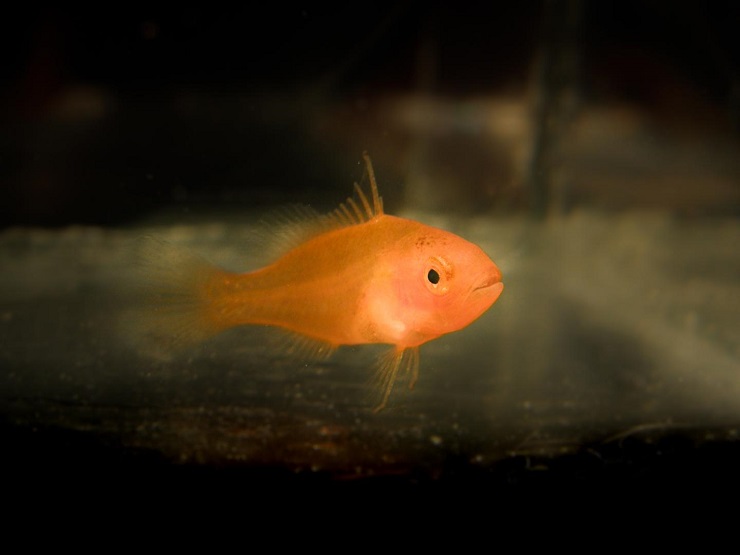
This is a world-first achievement, combining the movement of ocean currents in and around the Great Barrier Reef with the genetic and behavioural data of fish. CAPTION Scientists create the world's first computer model that can accurately predict where baby coral trout travel and settle on the Great Barrier Reef. The model was validated by in-depth fieldwork, and will be used by managers who decide which areas need the most protection to ensure future adult fish populations.  CREDIT Dr. Colin Wen{module In-article}
"The study is a unique conservation collaboration between marine biologists, geneticists, and recreational fishers," Dr Bode said.

"This was a major field effort combined with some clever genetic work that involved matching baby fish to their parents to understand their movement," co-author Dr Hugo Harrison, also from Coral CoE at JCU, said. "The behaviour of fish in their first few weeks after hatching can really influence where they eventually settle."

The study focussed on coral trout, Plectropomus maculatus, which is one of the most valuable species of fish regularly caught on the Great Barrier Reef.

To test the supercomputer model's predictions 1,190 juvenile and 880 adult fish were tracked--from spawning locations to settlement--across the reef for two years.

The supercomputer model recreates the movements of baby fish across space and time by considering what depth the coral trout swim at, how fast they swim, and how they orient themselves as they grow older.

The results highlighted the interconnectedness of reefs, and how important no-take zones are when considering future adult fish populations.

"Our results prove that the Great Barrier Reef's no-take zones are connected with invisible threads," Dr Bode said.

"Knowing how reefs are connected to one another means fishers and managers alike can identify which areas are likely to be most productive and need protecting," Dr Harrison said. "It's the babies from these protected areas that will continue to restock fish populations on neighbouring reefs where fishing is allowed."

Dr Bode said establishing the accuracy of these models is an important breakthrough.

"Our match between models and data provides reassuring support for using them as decision-support tools, but also directions for future improvement."

Dr. Conant shows how AI improves efficiency, accuracy of digital breast tomosynthesis

At A Glance

  • Researchers trained an AI system on large digital breast tomosynthesis (DBT) data sets to identify suspicious findings.
  • The system was tested by having 24 radiologists, including 13 breast subspecialists, each read 260 DBT examinations with and without AI assistance.
  • Cancer detection sensitivity and specificity increased, and reading times decreased.

Artificial intelligence (AI) helps improve the efficiency and accuracy of an advanced imaging technology used to screen for breast cancer, according to a new study published in the journal Radiology: Artificial Intelligence.

Digital breast tomosynthesis (DBT) is an advanced method for cancer detection in which an X-ray arm sweeps over the breast, taking multiple images in a matter of seconds.

Research has shown that DBT improves cancer detection and reduces false-positive recalls compared to screening with digital mammography (DM) alone. However, the DBT exam can take almost twice as long to interpret as DM due to the time it takes for the radiologist to scroll through all the images. This increased time is likely to be more consequential as DBT increasingly becomes the standard-of-care for mammographic imaging.

Emily F. Conant, M.D{module In-article}

For the study, researchers developed a deep learning system, a type of AI that can mine vast amounts of data to find subtle patterns beyond human recognition. They trained the AI system on large DBT data sets to identify suspicious findings in the DBT images.

After developing and training the system, the researchers tested its performance by having 24 radiologists, including 13 breast subspecialists, each read 260 DBT examinations with and without AI assistance. The examinations included 65 cancer cases.

Use of AI was associated with improved accuracy and shorter reading times. Sensitivity increased from 77 percent without AI to 85 percent with it. Specificity increased from 62.7 percent without AI to 69.6 percent with it. The recall rate for non-cancers, or the rate at which women were called back for follow-up examinations based on benign findings, decreased from 38 percent without AI to just 30.9 percent with it. On average, reading time decreased from just over 64 seconds without AI to only 30.4 seconds with it.

“Overall, readers were able to increase their sensitivity by 8 percent, lower their recall rate by 7 percent and cut their reading time in half when using AI concurrently while reading DBT cases compared to reading without using AI,” said study lead author Emily F. Conant, M.D., professor and chief of breast imaging from the Department of Radiology at the Perelman School of Medicine at the University of Pennsylvania in Philadelphia.

Also showing improvement was the area under the receiver operating characteristic curve (AUC), a graphing variable that combines sensitivity and specificity into a single measure for a better representation of overall radiologist performance. Radiologist performance, measured by mean AUC, increased from 0.795 without AI to 0.852 with AI.

“We know that DBT imaging increases cancer detection and lowers recall rate when added to 2-D mammography and even further improvement in these key metrics is clinically very important,” Dr. Conant said. “And, since adding DBT to the 2-D mammogram approximately doubles radiologist reading time, the concurrent use of AI with DBT increases cancer detection and may bring reading times back to about the time it takes to read DM-alone exams.”

The researchers expect the deep learning approach to improve as it is exposed to larger and larger data sets, making its potential impact on patient care even more significant.

“The results of this study suggest that both improved efficiency and accuracy could be achieved in clinical practice using an effective AI system,” Dr. Conant said.

Kovács delivers an alternative method for exoplanet stability analysis

Starting with observational data and scalar time series, this method uses complex network topology to deduce the underlying dynamics of systems in a fast, efficient way without the need for n-body simulations

Exoplanets revolving around distant stars are coming quickly into focus with advanced technology like the Kepler space telescope. Gaining a full understanding of those systems is difficult because the initial positions and velocities of the exoplanets are unknown. Determining whether the system dynamics are quasi-periodic or chaotic is cumbersome, expensive and computationally demanding.

In this week's Chaos, from AIP Publishing, Tamás Kovács delivers an alternative method for stability analysis of exoplanetary bodies using only the observed time-series data to deduce dynamical measurements and quantify the unpredictability of exoplanet systems.

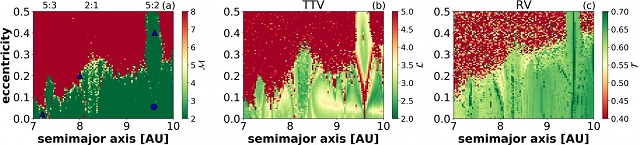
"If we don't know the governing equations of the motion of a system, and we only have the time series -- what we measure with the telescope -- then we want to transform that time series into a complex network. In this case, it is called a recurrence network," Kovács said. "This network holds all of the dynamical features of the underlying system we want to analyze." Gaining a full understanding of systems of exoplanets and distant stars is difficult, because the initial positions and velocities of the exoplanets are unknown. Determining whether the system dynamics are quasi-periodic or chaotic is cumbersome, expensive and computationally demanding. In this week's Chaos, Tamás Kovács delivers an alternative method for stability analysis of exoplanetary bodies using only the observed time series data to deduce dynamical measurements and quantify the unpredictability of exoplanet systems. This image shows a stability map of Saturn obtained by chaos indicator MEGNO (a) and recurrence network measures average path length (b) and transitivity (c). The latter two panels are based on transit timing variation of Jupiter and the radial velocity of the sun, respectively.{module In-article}

The paper draws on the work of physicist Floris Takens, who proposed in 1981 that the dynamics of a system could be reconstructed using a series of observations about the state of the system. With Takens' embedding theorem as a starting point, Kovács uses time-delay embedding to reconstruct a high-dimensional trajectory and then identify recurrence points, where bodies in the phase space are close to each other.

"Those special points will be the vertices and the edges of the complex network," Kovács said. "Once you have the network, you can reprogram this network to be able to apply measures like transitivity, average path length or others unique to that network."

Kovács tests the reliability of the method using a known system as a model, the three-body system of Saturn, Jupiter and the sun, and then applies it to the Kepler 36b and 36c system. His Kepler system results agree with what is known.

"Earlier studies pointed out that Kepler 36b and 36c is a very special system because, from the direct simulation and the numerical integrations, we see the system is at the edge of the chaos," Kovács said. "Sometimes, it shows regular dynamics, and at other times, it seems to be chaotic."

The author plans to next apply his methods to systems with more than three bodies, testing its scalability and exploring its ability to handle long time series and sharper datasets.