

Japanese supercomputer simulations demonstrate ion heating by plasma oscillations for fusion energy

A research team of fusion scientists succeeded in proving that ions can be heated by plasma oscillations driven by high-energy particles. This has been confirmed by performing a large-scale simulation with a newly developed hybrid-simulation program that links calculations for plasma oscillations, high-energy particles, and ions. This research will accelerate studies of plasma self-heating for realizing fusion energy.

The fusion reaction between deuterium ion and tritium ion in a high-temperature plasma will be used in fusion reactors in the future. The high-energy alpha particles generated by the fusion reaction give their energy to the plasma, and this plasma self-heating maintains the high-temperature condition required for the fusion reaction. However, we have the problem that the heating of fuel ions is weak because the high-energy particles give most of their energy to electrons through collisions with the electrons. In order to increase the ion heating rate, it is proposed that ions can be heated by the plasma oscillations driven by the high-energy particles. However, this ion heating mechanism has not yet been confirmed.

The research team of Assistant Professor Hao Wang and Professor Yasushi Todo of the National Institutes of Natural Sciences (NINS) National Institute for Fusion Science (NIFS) conducted research on the ion heating by plasma oscillations using supercomputer simulations. Plasma oscillations driven by high-energy particles in a plasma in LHD.{module In-article}
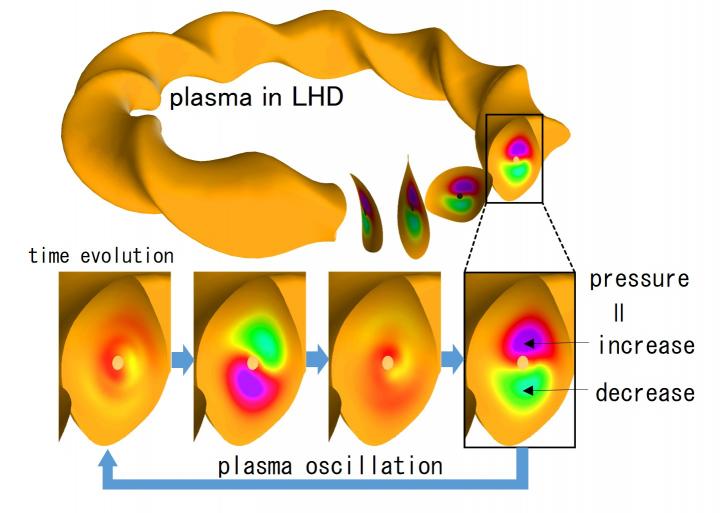
Professor Todo previously developed a computer program that can simultaneously simulate the state of the plasma as a whole, which is treated as fluid, and the movement of high-energy particles in a plasma. This program, because it links and calculates the fluid and the particles, is called the hybrid-simulation program. It enables us to study the interaction between the plasma oscillations and the high-energy particles. The program is highly evaluated among fusion scientists, and several simulation studies using the program are now ongoing.

However, in order to study ion heating by plasma oscillations driven by high-energy particles, it is necessary to expand the hybrid-simulation program to simulate ion motions influenced by the plasma oscillations. The research team has succeeded in developing a new hybrid-simulation program by calculating ions in plasma as particles and by linking the three kinds of calculations for the plasma oscillations, the high-energy particles, and the ions. Using the new hybrid-simulation program, they performed a large-scale simulation on the supercomputer regarding the plasma generated in the Large Helical Device (LHD). (On the LHD, we utilize the high-energy hydrogen particles that are inside the plasma to study plasma oscillations driven by high-energy particles.) The new hybrid simulation clearly shows that ions obtain energy from plasma oscillations excited by the high-energy particles. This indicates that the ion heating rate in a self-heating plasma can be increased by using the plasma oscillations.

Thus, the research team has proved the ion heating by plasma oscillations for the first time in the world. On the basis of the results of this study, the research on self-heating plasma for realizing fusion energy will be accelerated.

Cray sales plunge 43 percent in 2Q19

Cray has announced revenue of $69 million, down forty-three percent for the second quarter of 2019, compared to $120 million in the second quarter of 2018. Net loss for the second quarter of 2019 was $43 million, or $1.03 per diluted share, compared to a net loss of $11 million, or $0.27 per diluted share in the second quarter of 2018. Non-GAAP net loss was $31 million, or $0.75 per diluted share for the second quarter of 2019, compared to a non-GAAP net loss of $8 million, or $0.20 per diluted share in the second quarter of 2018. {module In-article}

The overall gross profit margin on a GAAP and the non-GAAP basis for the second quarter of 2019 was 35% and 36%, respectively, compared to 31% and 32%, on a GAAP and non-GAAP basis in the second quarter of 2018, respectively.

Operating expenses for the second quarter of 2019 were $68 million, compared to $50 million in the second quarter of 2018. Non-GAAP operating expenses for the second quarter of 2019 were $57 million, compared to $47 million in the second quarter of 2018, with the increase primarily driven by higher R&D costs. Non-GAAP adjustments for the second quarter of 2019 include $7.6 million in costs related to our pending merger with Hewlett Packard Enterprise Company (“HPE”).

All figures are based on U.S. GAAP unless otherwise noted. 

As of June 30, 2019, cash and restricted cash totaled $165 million. Working capital at the end of the second quarter of 2019 was $223 million, compared to $263 million at the end of the first quarter of 2019.

AI reveals new breast cancer types that respond differently to treatment

Revelations could personalize treatment, including picking out those likely to benefit from immunotherapy

Scientists have used artificial intelligence to recognize patterns in breast cancer - and uncovered five new types of the disease each matched to different personalized treatments.

Their study applied AI and machine learning to gene sequences and molecular data from breast tumors, to reveal crucial differences among cancers that had previously been lumped into one type.

The new study, led by a team at The Institute of Cancer Research, London, found that two of the types were more likely to respond to immunotherapy than others, while one was more likely to relapse on tamoxifen. {module In-article}

The researchers are now developing tests for these types of breast cancer that will be used to select patients for different drugs in clinical trials, with the aim of making personalized therapy a standard part of treatment.

The researchers previously used AI, in the same way, to uncover five different types of bowel cancer and oncologists are now evaluating their application in clinical trials.

The aim is to apply the AI algorithm to many types of cancer - and to provide information for each about their sensitivity to treatment, likely paths of evolution and how to combat drug resistance.

The new research, published today (Friday) in the journal NPJ Breast Cancer, could not only help select treatments for women with breast cancer but also identify new drug targets.

The Institute of Cancer Research (ICR) - a charity and research institute - funded the study itself from its own charitable donations.

The majority of breast cancers develop in the inner cells that line the mammary ducts and are 'fed' by the hormones estrogen or progesterone. These are classed as 'luminal A' tumors and often have the best cure rates.

However, patients within these groups respond very differently to standard-of-care treatments, such as tamoxifen, or new treatments - needed if patients relapse - such as immunotherapy.

The researchers applied the AI-trained computer software to a vast array of data available on the genetics, molecular and cellular make-up of primary luminal A breast tumors, along with data on patient survival.

Once trained, the AI was able to identify five different types of disease with particular patterns of response to treatment.

Women with a cancer type labeled 'inflammatory' had immune cells present in their tumors and high levels of a protein called PD-L1 - suggesting they were likely to respond to immunotherapies.

Another group of patients had 'triple negative' tumors - which don't respond to standard hormone treatments - but various indicators suggesting they might also respond to immunotherapy.

Patients with tumors that contained a specific change in chromosome 8 had worse survival than other groups when treated with tamoxifen and tended to relapse much earlier - after an average of 42 months compared to 83 months in patients who had a different tumor type that contained lots of stem cells. These patients may benefit from an additional or new treatment to delay or prevent late relapse.

The markers identified in this new study do not challenge the overall classification of breast cancer - but they do find additional differences within the current sub-divisions of the disease, with important implications for treatment.

The use of AI to understand cancer's complexity and evolution is one of the central strategies the ICR is pursuing as part of a pioneering research program to combat the ability of cancers to adapt and become drug-resistant. The ICR is raising the final £15 million of a £75 million investment in a new Centre for Cancer Drug Discovery to house a world-first program of 'anti-evolution' therapies.

Study leader Dr. Anguraj Sadanandam, Team Leader in Systems and Precision Cancer Medicine at The Institute of Cancer Research, London, said:

"We are at the cusp of a revolution in healthcare, as we really get to grips with the possibilities AI and machine learning can open up.

"Our new study has shown that AI is able to recognize patterns in breast cancer that are beyond the limit of the human eye and to point us to new avenues of treatment among those who have stopped responding to standard hormone therapies. AI has the capacity to be used much more widely, and we think we will be able to apply this technique across all cancers, even opening up new possibilities for treatment in cancers that are currently without successful options."

Dr. Maggie Cheang, a pioneer in identifying different types of breast cancer and Team Leader of the Genomic Analysis Clinical Trials Team at The Institute of Cancer Research, London, said:

"Doctors have used the current classification of breast cancers as a guide for treatment for years, but it is quite crude and patients who seemingly have the same type of the disease often respond very differently to drugs.

"Our study has used AI algorithms to spot patterns within breast cancers that human analysis had up to now missed - and found additional types of the disease that respond in very particular ways to treatment.

"Among the exciting implications of this research is its ability to pick out women who might respond well to immunotherapy, even when the broad classification of their cancer would suggest that these treatments wouldn't work for them.

"The AI used in our study could also be used to discover new drugs for those most at risk of late relapse, beyond 5 years, which is common in estrogen-linked breast cancers and can cause considerable anxiety for patients."

As well as ICR charity funding, the work was also supported by the NIHR Biomedical Research Centre at The Institute of Cancer Research, London, and The Royal Marsden NHS Foundation Trust.