Cambridge astronomers develop novel way to 'see' the first stars through the fog of the early Universe

A team of astronomers has developed a method that will allow them to ‘see’ through the fog of the early Universe and detect light from the first stars and galaxies. 3 stars spring out of the darkness credit nasa jpl caltech 885x432px b7ef5
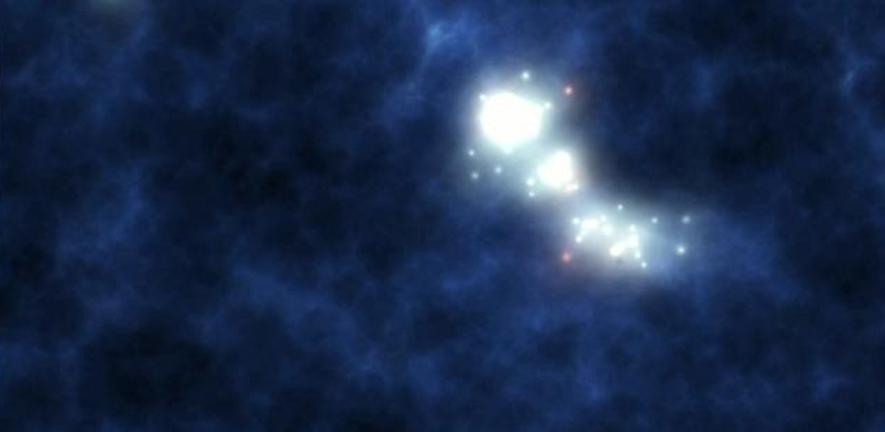
The researchers, led by the University of Cambridge, have developed a methodology that will allow them to observe and study the first stars through the clouds of hydrogen that filled the Universe about 378,000 years after the Big Bang.

Observing the birth of the first stars and galaxies has been a goal of astronomers for decades, as it will help explain how the Universe evolved from the emptiness after the Big Bang to the complex realm of celestial objects we observe today, 13.8 billion years later.

The Square Kilometre Array (SKA) - a next-generation telescope due to be completed by the end of the decade - will likely be able to make images of the earliest light in the Universe, but for current telescopes, the challenge is to detect the cosmological signal of the stars through the thick hydrogen clouds.

The signal that astronomers aim to detect is expected to be approximately one hundred thousand times weaker than other radio signals coming also from the sky – for example, radio signals originating in our galaxy.

Using a radio telescope itself introduces distortions to the signal received, which can completely obscure the cosmological signal of interest. This is considered an extreme observational challenge in modern radio cosmology. Such instrument-related distortions are commonly blamed as the major bottleneck in this type of observation.

Now the Cambridge-led team has developed a methodology to see through the primordial clouds and other sky noise signals, avoiding the detrimental effect of the distortions introduced by the radio telescope. Their methodology, part of the REACH (Radio Experiment for the Analysis of Cosmic Hydrogen) experiment, will allow astronomers to observe the earliest stars through their interaction with the hydrogen clouds, in the same way, we would infer a landscape by looking at shadows in the fog.

Their method will improve the quality and reliability of observations from radio telescopes looking at this unexplored key time in the development of the Universe. The first observations from REACH are expected later this year.

“At the time when the first stars formed, the Universe was mostly empty and composed mostly of hydrogen and helium,” said Dr. Eloy de Lera Acedo from Cambridge’s Cavendish Laboratory, the paper’s lead author.

He added: “Because of gravity, the elements eventually came together and the conditions were right for nuclear fusion, which is what formed the first stars. But they were surrounded by clouds of so-called neutral hydrogen, which absorb light really well, so it’s hard to detect or observe the light behind the clouds directly.”

In 2018, another research group (running the ‘Experiment to Detect the Global Epoch of Reioniozation Signature’ – or EDGES) published a result that hinted at a possible detection of this earliest light, but astronomers have been unable to repeat the result - leading them to believe that the original result may have been due to interference from the telescope being used.

“The original result would require new physics to explain it, due to the temperature of the hydrogen gas, which should be much cooler than our current understanding of the Universe would allow. Alternatively, an unexplained higher temperature of the background radiation - typically assumed to be the well-known Cosmic Microwave Background - could be the cause” said de Lera Acedo.

He added: “If we can confirm that the signal found in that earlier experiment really was from the first stars, the implications would be huge.”

To study this period in the Universe’s development, often referred to as the Cosmic Dawn, astronomers study the 21-centimeter line – an electromagnetic radiation signature from hydrogen in the early Universe. They look for a radio signal that measures the contrast between the radiation from the hydrogen and the radiation behind the hydrogen fog.

The methodology developed by de Lera Acedo and his colleagues uses Bayesian statistics to detect a cosmological signal in the presence of interference from the telescope and general noise from the sky so that the signals can be separated.

To do this, state-of-the-art techniques and technologies from different fields have been required.

The researchers used simulations to mimic a real observation using multiple antennas, which improves the reliability of the data – earlier observations have relied on a single antenna.

“Our method jointly analyses data from multiple antennas and across a wider frequency band than equivalent current instruments. This approach will give us the necessary information for our Bayesian data analysis,” said de Lera Acedo.

He added: “In essence, we forgot about traditional design strategies and instead focused on designing a telescope suited to the way we plan to analyze the data – something like an inverse design. This could help us measure things from the Cosmic Dawn and into the epoch of reionization when hydrogen in the Universe was reionized.”

The telescope’s construction is currently being finalized at the Karoo radio reserve in South Africa, a location chosen for its excellent conditions for radio observations of the sky. It is far away from human-made radio frequency interference, for example, television and FM radio signals.

The REACH team of over 30 researchers is multidisciplinary and distributed worldwide, with experts in fields such as theoretical and observational cosmology, antenna design, radio frequency instrumentation, numerical modeling, digital processing, big data, and Bayesian statistics. REACH is co-led by the University of Stellenbosch in South Africa.

Professor de Villiers, co-lead of the project at the University of Stellenbosch in South Africa said: "Although the antenna technology used for this instrument is rather simple, the harsh and remote deployment environment, and the strict tolerances required in the manufacturing, make this a very challenging project to work on.”

He added: “We are extremely excited to see how well the system will perform, and have full confidence we'll make that elusive detection."

The Big Bang and very early times of the Universe are well-understood epochs, thanks to studies of Cosmic Microwave Background (CMB) radiation. Even better understood is the late and widespread evolution of stars and other celestial objects. But the time of formation of the first light in the Cosmos is a fundamental missing piece in the puzzle of the history of the Universe.

The research was supported by the Kavli Institute for Cosmology in Cambridge (UK), the National Research Foundation (South Africa), the Cambridge-Africa ALBORADA trust (UK), and the Science and Technology Facilities Council (STFC), part of the UK Research and Innovation (UKRI).


Prof Mertz wins $1.1 million grant for Dolly Sods supercomputer for groups in physics, astronomy at WVU

A GPU supercomputer cluster called “Dolly Sods” will enable researchers throughout the state to accelerate computational research in fields such as drug development, interstellar phenomena, biometrics, material design, and business logistics and management.

Blake Mertz, associate professor of chemistry at West Virginia University, is leading the project, recently funded by a $1.1 million National Science Foundation grant. Dolly Sods will soon not only be the name of a popular wilderness area in eastern West Virginia. It will also be the name of a GPU cluster project that will enhance research in physics and astronomy, drug discovery and data science. (WVU Illustration/Aira Burkhart)

While GPUs have been historically utilized for graphics, they’ve become more popular for use in artificial intelligence applications and in accelerating math-intensive computations.

The Dolly Sods project, Mertz said, will pave the way for cutting-edge research in diagnostic imaging of tumors, screening of small molecule drug design, detection of interstellar phenomena, design and optimization of data algorithms used in space flight, computer vision of medical images, and information processing of business-based managerial decisions.

“GPUs are well-suited to performing simplified mathematical calculations over and over, and they can do it much more quickly and efficiently than traditional CPU-based solutions,” Mertz said. "By utilizing this technology, we can carry out computations orders of magnitude faster than on a conventional compute cluster, giving us the ability to solve problems that were previously inaccessible to the WVU computational community.”

Mertz said the project was given the name Dolly Sods because of its ability to push boundaries and the uniqueness of the area.

“The Dolly Sods Wilderness represents many of the distinguishing characteristics of West Virginia: sweeping vistas, lush wildlife, and the opportunity to challenge yourself in the great outdoors, as well as representing an environment that is radically different from any other in the state,” Mertz said. “Dolly Sods forces you to think outside the box of what you normally picture when you think of West Virginia. This GPU cluster aims to achieve the same thing; to enable researchers at WVU to push the boundaries of what we can accomplish in terms of solving fundamental, environmental, and societal problems for people in the state of West Virginia and beyond. Blake Mertz

“In the case of Dolly Sods, we will have approximately 20-25 nodes in the cluster,” Mertz continued. “The advantage of a cluster versus having 25 individual computers is that it makes it much easier for the WVU and statewide research community to access this shared resource, and it also makes it possible for researchers to group these nodes to perform much more powerful computational calculations.

“The enhanced capability of Dolly Sods opens up the possibility to examine scientific problems at a much higher level of detail because we can access the timeframes over which these phenomena take place much more easily than we could before.”

Dolly Sods will be used to assist researchers in many different areas.

For example, Dolly Sods can help with running code that can efficiently transfer information back and forth from satellites in space to earth, enable drug development for neurodegenerative diseases and manipulate massive datasets from places like the Green Bank Telescope.

“For groups in physics and astronomy at WVU that work with signals acquired at Green Bank, Dolly Sods represents a paradigm shift: researchers will be able to analyze data in near real-time, allowing them to make assessments and identify new phenomena like pulsars that previously could only be carried out on national supercomputing resources like at the Pittsburgh Supercomputing Center,” Mertz said. “This tool will only further strengthen one of the flagship research programs at WVU.

“We anticipate many researchers in almost all fields of study at WVU to utilize Dolly Sods, as it will facilitate the development of new machine learning and AI approaches that are critical to understanding big data problems.”

Mertz said that Dolly Sods will also lead to the creation of training opportunities for first-generation college students, female students, and those from marginalized communities. It will also aid in the diversification of the computationally-intensive workforce, which will be invaluable to West Virginia.

“In the short term, it will help train our workforce so that they can be more competitive for jobs with the many federal agencies that are here in the state,” Mertz said. “Long term, our goal is to help provide top-notch education in data science-related fields to West Virginia's workforce, which aligns with many of the state-academic-industry joint initiatives that have recently been created such as West Virginia Forward. As artificial intelligence and machine-learning approaches become more prevalent in data-driven research, the acquisition of a tool such as Dolly Sods is the next logical step in training the next generation of data scientists in West Virginia.

“We typically have about a hundred faculty, students, and postdocs that use our current research computing resources, and with the acquisition of Dolly Sods, we will easily double that number. That represents a significant number of people at WVU and throughout the state that will be using computational research as a core component of their research efforts.”

According to Mertz, Dolly Sods will further WVU’s long-term goal of transforming the economically-disadvantaged region of Appalachia into a top-level destination for investment from the technology sector.

Joining Mertz on the project are his WVU colleagues Werner Geldenhuys, School of Pharmacy; Sarah Burke-Spolaor, physics and astronomy; Piyush Mehta, mechanical and aerospace engineering; and Gianfranco Doretto, computer science, and electrical engineering.

Arizona astronomers provide 'field guide' to exoplanets known as hot Jupiters

By combining Hubble Space Telescope observations with theoretical models, a team of astronomers has gained insights into the chemical and physical makeup of a variety of exoplanets known as hot Jupiters

Hot Jupiters – giant gas planets that race around their host stars in extremely tight orbits – have become a little bit less mysterious thanks to a new study combining theoretical modeling with observations by the Hubble Space Telescope. This artist’s impression shows a hot Jupiter planet orbiting close to one of the stars in the rich old star cluster Messier 67, located between 2,500 and 3,000 light-years from Earth in the constellation of Cancer (The Crab).  CREDIT ESO/L. Calçada

While previous studies mostly focused on individual worlds classified as "hot Jupiters" due to their superficial similarity to the gas giant in our own solar system, the new study is the first to look at a broader population of the strange worlds. The study, led by a University of Arizona researcher, provides astronomers with an unprecedented "field guide" to hot Jupiters and offers insight into planet formation in general.

Although astronomers think that only about 1 in 10 stars host an exoplanet in the hot Jupiter class, the peculiar planets make up a sizeable portion of exoplanets discovered to date, due to the fact that they are bigger and brighter than other types of exoplanets, such as rocky, more Earthlike planets or smaller, cooler gas planets. Ranging in size from about one-third the size of Jupiter to 10 Jupiter masses, all hot Jupiters orbit their host star at an extremely close range, usually much closer than Mercury, the innermost planet in our solar system, is to the sun. A "year" on a typical hot Jupiter lasts hours, or at most a few days. For comparison, Mercury takes almost three months to complete a trip around the sun.

Because of their close orbits, most, if not all, hot Jupiters are thought to be locked in a high-speed embrace with their host stars, with one side eternally exposed to the star's radiation and the other shrouded in perpetual darkness. The surface of a typical hot Jupiter can get as hot as almost 5,000 degrees Fahrenheit, with "cooler" specimens reaching 1,400 degrees – hot enough to melt aluminum.

The research, which was led by Megan Mansfield, a NASA Sagan Fellow at the University of Arizona's Steward Observatory, used observations made with the Hubble Space Telescope that allowed the team to directly measure emission spectra from hot Jupiters, despite the fact that Hubble can't image any of these planets directly.

"These systems, these stars, and their hot Jupiters are too far away to resolve the individual star and its planet," Mansfield said. "All we can see is a point – the combined light source of the two."

Mansfield and her team used a method known as secondary eclipsing to tease out information from the observations that allowed them to peer deep into the planets' atmospheres and gain insights into their structure and chemical makeup. The technique involves repeated observations of the same system, catching the planet at various places in its orbit, including when it dips behind the star.

"We basically measure the combined light coming from the star and its planet and compare that measurement with what we see when the planet is hidden behind its star," Mansfield said. "This allows us to subtract the star's contribution and isolate the light emitted by the planet, even though we can't see it directly." 

The eclipse data provided the researchers with insight into the thermal structure of the atmospheres of hot Jupiters and allowed them to construct individual profiles of temperatures and pressures for each one. The team then analyzed near-infrared light, which is a band of wavelengths just beyond the range humans can see, coming from each hot Jupiter system for so-called absorption features. Because each molecule or atom has its own specific absorption profile, like a fingerprint, looking at different wavelengths allows researchers to obtain information about the chemical makeup of hot Jupiters. For example, if water is present in the planet's atmosphere, it will absorb light at 1.4 microns, which falls into the range of wavelengths that Hubble can see very well.

"In a way, we use molecules to scan through the atmospheres on these hot Jupiters," Mansfield said. "We can use the spectrum we observe to get information on what the atmosphere is made of, and we can also get information on what the structure of the atmosphere looks like." 

The team went a step further by quantifying the observational data and comparing it to supercomputer models of the physical processes believed to be at work in the atmospheres of hot Jupiters. The two sets matched very well, confirming that many predictions about the planets' nature based on theoretical work appear to be correct, according to Mansfield, who said the findings are "exciting because they were anything but guaranteed."  

The results suggest that all hot Jupiters, not just the 19 included in the study, are likely to contain similar sets of molecules, like water and carbon monoxide, along with smaller amounts of other molecules. The differences among individual planets should mostly amount to varying relative amounts of these molecules. The findings also revealed that the observed water absorption features varied slightly from one hot Jupiter to the next.

"Taken together, our results tell us there is a good chance we have the big picture items figured out that is happening in the chemistry of these planets," Mansfield said. "At the same time, each planet has its own chemical makeup, and that also influences what we see in our observations."

According to the authors, the results can be used to guide expectations of what astronomers might be able to see when looking at a hot Jupiter that hasn't been studied before. The launch of NASA's new flagship telescope, the James Webb Space Telescope, slated for Dec. 18, has exoplanet hunters excited because Webb can see in a much broader range of infrared light, and will allow a much more detailed look at exoplanets, including hot Jupiters.

"There is a lot that we still don't know about how planets form in general, and one of the ways we try to understand how that could happen is by looking at the atmospheres of these hot Jupiters and figuring out how they got to be where they are," Mansfield said. "With the Hubble data, we can look at trends by studying the water absorption, but when we are talking about the composition of the atmosphere as a whole, there are many other important molecules you want to look at, such as carbon monoxide and carbon dioxide, and JWST will give us a chance to actually observe those as well."